welcome
 Paradigm word 1st used by Peter Hagget and R.A. Chorley
 Prevailing pattern of thought in a discipline or part of discipline
is referred as paradigm
 Paradigm having the capacity to change
1)Thinking 2)outlook 3)ideology of the people….
 A paradigm is the entire constellation of :-
belief values techniques
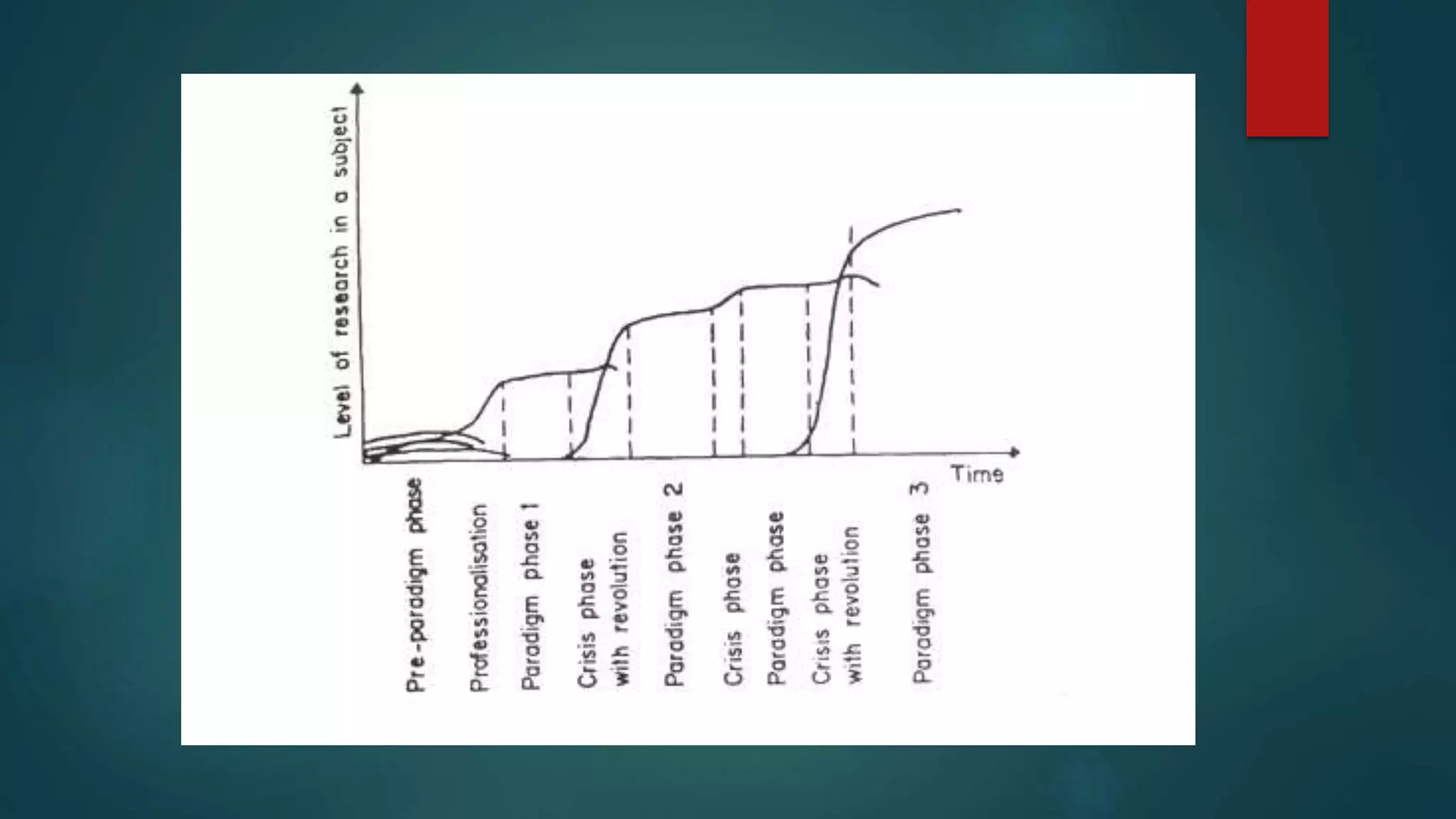
 Thomas Kuhn develop this concept to large extent
“Structure of Scientific Revolution”
 Theory is about the growth and development of science.
 According to Kuhn science is not well regulated activity where each
generation automatically builds upon the result achieved by earlier work.
 Accretion of knowledge are separated by crises which can lead to
upheaval within subject disciplines and breaks in continuity
KUHN’S PARADIGM
Development of thought/science
Pre
paradigm/science
Model drift
Model
crisis
Model
revolution
Paradigm
shift
Normal
science
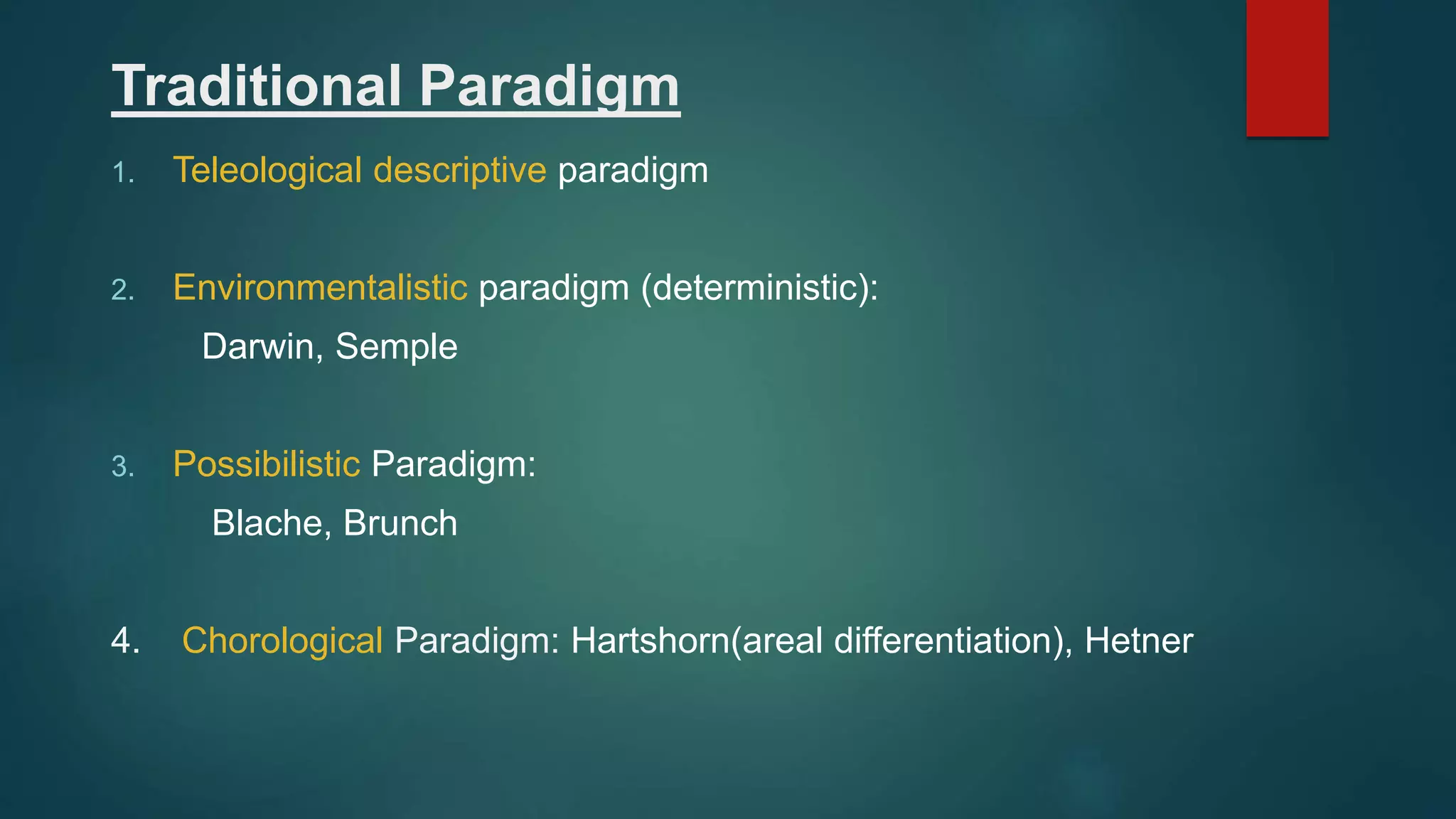
Traditional Paradigm
1. Teleological descriptive paradigm
2. Environmentalistic paradigm (deterministic):
Darwin, Semple
3. Possibilistic Paradigm:
Blache, Brunch
4. Chorological Paradigm: Hartshorn(areal differentiation), Hetner
Contemporary Paradigm
1. Positivistic Paradigm: August compte “real knowledge is always
scientific”
2. Quantitative Paradigm: Hagget, Gregory (statistical methods)
3. Behavioural Paradigm: Kirk
4. Radical Paradigm (Marxist): belief that imp. Political or social changes are
necessary
5. Welfare Paradigm: deals with the issues related to inequality and injustice
One law cant fit to all. We need new law for new world.
Because old one could not useful scientifically for new
situation.
So new law must be formulated to fit the observed
facts
Conclusion

Paradigm in geography

  • 1.
  • 2.
     Paradigm word1st used by Peter Hagget and R.A. Chorley  Prevailing pattern of thought in a discipline or part of discipline is referred as paradigm  Paradigm having the capacity to change 1)Thinking 2)outlook 3)ideology of the people….  A paradigm is the entire constellation of :- belief values techniques
  • 3.
     Thomas Kuhndevelop this concept to large extent “Structure of Scientific Revolution”  Theory is about the growth and development of science.  According to Kuhn science is not well regulated activity where each generation automatically builds upon the result achieved by earlier work.  Accretion of knowledge are separated by crises which can lead to upheaval within subject disciplines and breaks in continuity KUHN’S PARADIGM
  • 4.
    Development of thought/science Pre paradigm/science Modeldrift Model crisis Model revolution Paradigm shift Normal science
  • 6.
    Traditional Paradigm 1. Teleologicaldescriptive paradigm 2. Environmentalistic paradigm (deterministic): Darwin, Semple 3. Possibilistic Paradigm: Blache, Brunch 4. Chorological Paradigm: Hartshorn(areal differentiation), Hetner
  • 7.
    Contemporary Paradigm 1. PositivisticParadigm: August compte “real knowledge is always scientific” 2. Quantitative Paradigm: Hagget, Gregory (statistical methods) 3. Behavioural Paradigm: Kirk 4. Radical Paradigm (Marxist): belief that imp. Political or social changes are necessary 5. Welfare Paradigm: deals with the issues related to inequality and injustice
  • 8.
    One law cantfit to all. We need new law for new world. Because old one could not useful scientifically for new situation. So new law must be formulated to fit the observed facts Conclusion