Introduction to Electronics:
Section One: Resistors
James Noll - Instructor
Resistors

Resistors are defined as: “A device used in electrical
circuits to maintain a constant relation between
current flow and voltage.”

Resistors are used to step up or lower the voltage at
different points in a circuit and to transform a
current signal into a voltage signal or vice versa,
among other uses. The electrical behavior of a
resistor obeys Ohm's law for a constant resistance
Resistors
The unit of measurement of a resistor is the “ohm”

Resistors are made of several types of materials
including carbon, metal film and wire. Each material
gives each type of resistor a certain “characteristic”.

For instance, carbon is a common resistor material
used for general purpose resistors. Metal Film is a
material that is used for precision resistors and is
more delicate than carbon. Wire is used for high
power, high current applications and is considered
heavy duty.
Resistors

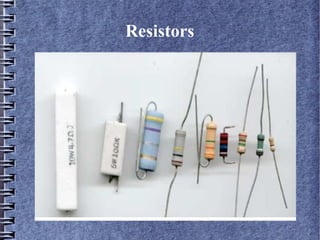
Resistors are generally a “two-lead” device

Each resistor type has a “tolerance” or percentage
accuracy – 1%, 5%, 10%, 20%, etc.

Some resistors are color coded while others have
printed information on them. The color code will be
explained later.

Resistors are considered a passive device and are a
fixed value.

Potentiometers are a variable resistor.
Resistors
Resistors

Resistors have a wide range of values:
− Resistors range in value from less than 1 ohm to
over one million ohms.
− Each resistor has a “suffix” to indicate it's value
− For resistors less than one thousand, there is no
suffix.
− For resistors greater than one thousand, the suffix
is “K”
− For resistors greater than one million, the suffix is
“M”
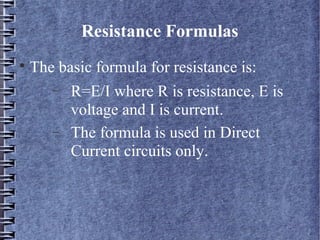
Resistance Formulas

The basic formula for resistance is:
− R=E/I where R is resistance, E is
voltage and I is current.
− The formula is used in Direct
Current circuits only.

Introduction to Electronics - Resistors

  • 1.
    Introduction to Electronics: SectionOne: Resistors James Noll - Instructor
  • 2.
    Resistors  Resistors are definedas: “A device used in electrical circuits to maintain a constant relation between current flow and voltage.”  Resistors are used to step up or lower the voltage at different points in a circuit and to transform a current signal into a voltage signal or vice versa, among other uses. The electrical behavior of a resistor obeys Ohm's law for a constant resistance
  • 3.
    Resistors The unit ofmeasurement of a resistor is the “ohm”  Resistors are made of several types of materials including carbon, metal film and wire. Each material gives each type of resistor a certain “characteristic”.  For instance, carbon is a common resistor material used for general purpose resistors. Metal Film is a material that is used for precision resistors and is more delicate than carbon. Wire is used for high power, high current applications and is considered heavy duty.
  • 4.
    Resistors  Resistors are generallya “two-lead” device  Each resistor type has a “tolerance” or percentage accuracy – 1%, 5%, 10%, 20%, etc.  Some resistors are color coded while others have printed information on them. The color code will be explained later.  Resistors are considered a passive device and are a fixed value.  Potentiometers are a variable resistor.
  • 5.
  • 6.
    Resistors  Resistors have awide range of values: − Resistors range in value from less than 1 ohm to over one million ohms. − Each resistor has a “suffix” to indicate it's value − For resistors less than one thousand, there is no suffix. − For resistors greater than one thousand, the suffix is “K” − For resistors greater than one million, the suffix is “M”
  • 7.
    Resistance Formulas  The basicformula for resistance is: − R=E/I where R is resistance, E is voltage and I is current. − The formula is used in Direct Current circuits only.