Resilience
is the capacityto adapt well when faced with adversity or
stress.
It involves more than continuing to persist despite difficulty.
Teachers/students interpret academic or social challenges in
a positive way. This may include increasing effort,
developing new strategies, or practicing conflict resolution.
3.
Why is itimportant for teachers and students?
Emotional regulation- or the ability to keep calm and
express emotions in a way that helps the situation.
Impulse control- which involves the ability to make a
conscious choice to act on a desire (or not), as well as to
delay gratification and persevere.
4.
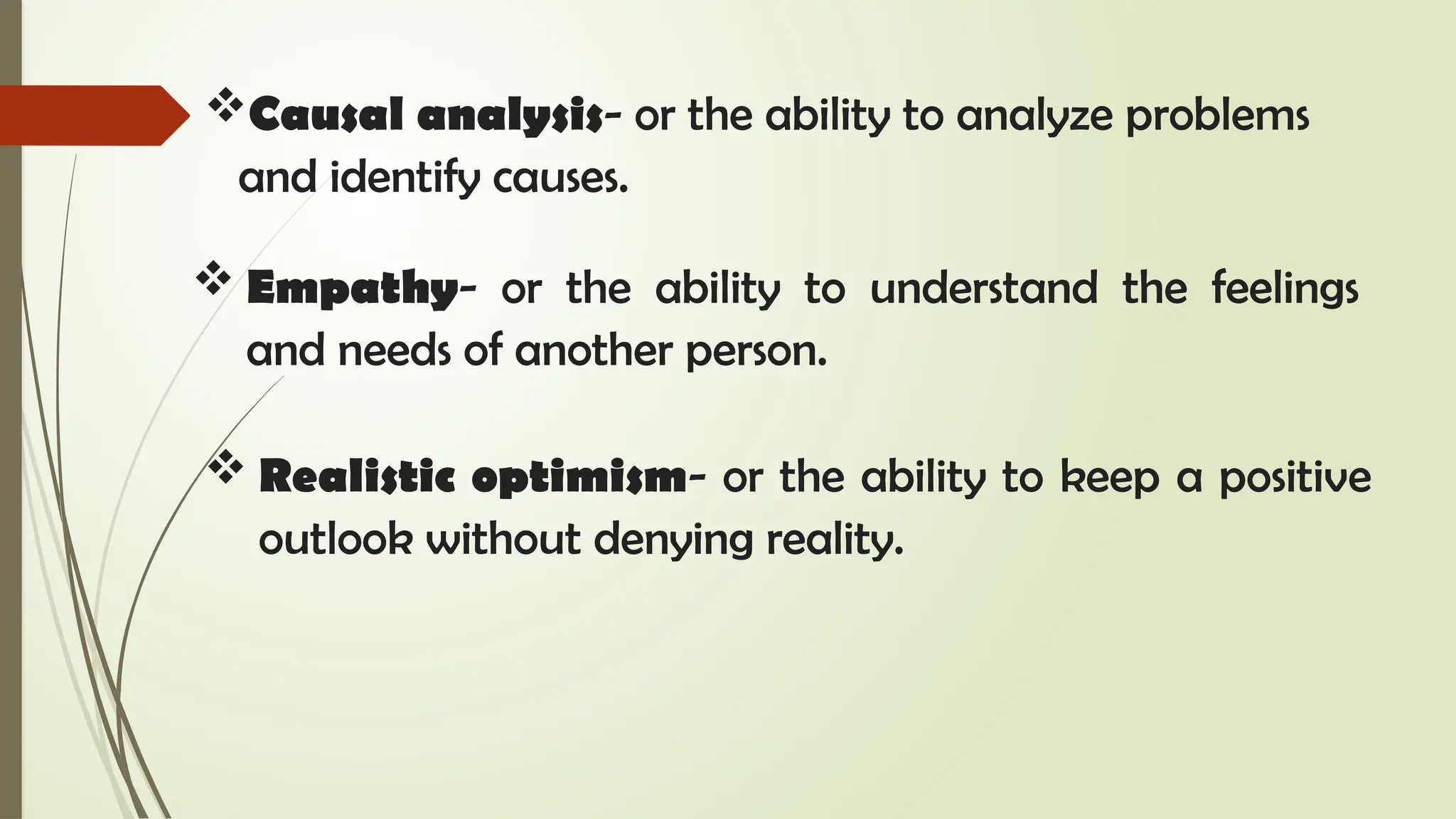
Causal analysis- orthe ability to analyze problems
and identify causes.
Empathy- or the ability to understand the feelings
and needs of another person.
Realistic optimism- or the ability to keep a positive
outlook without denying reality.
5.
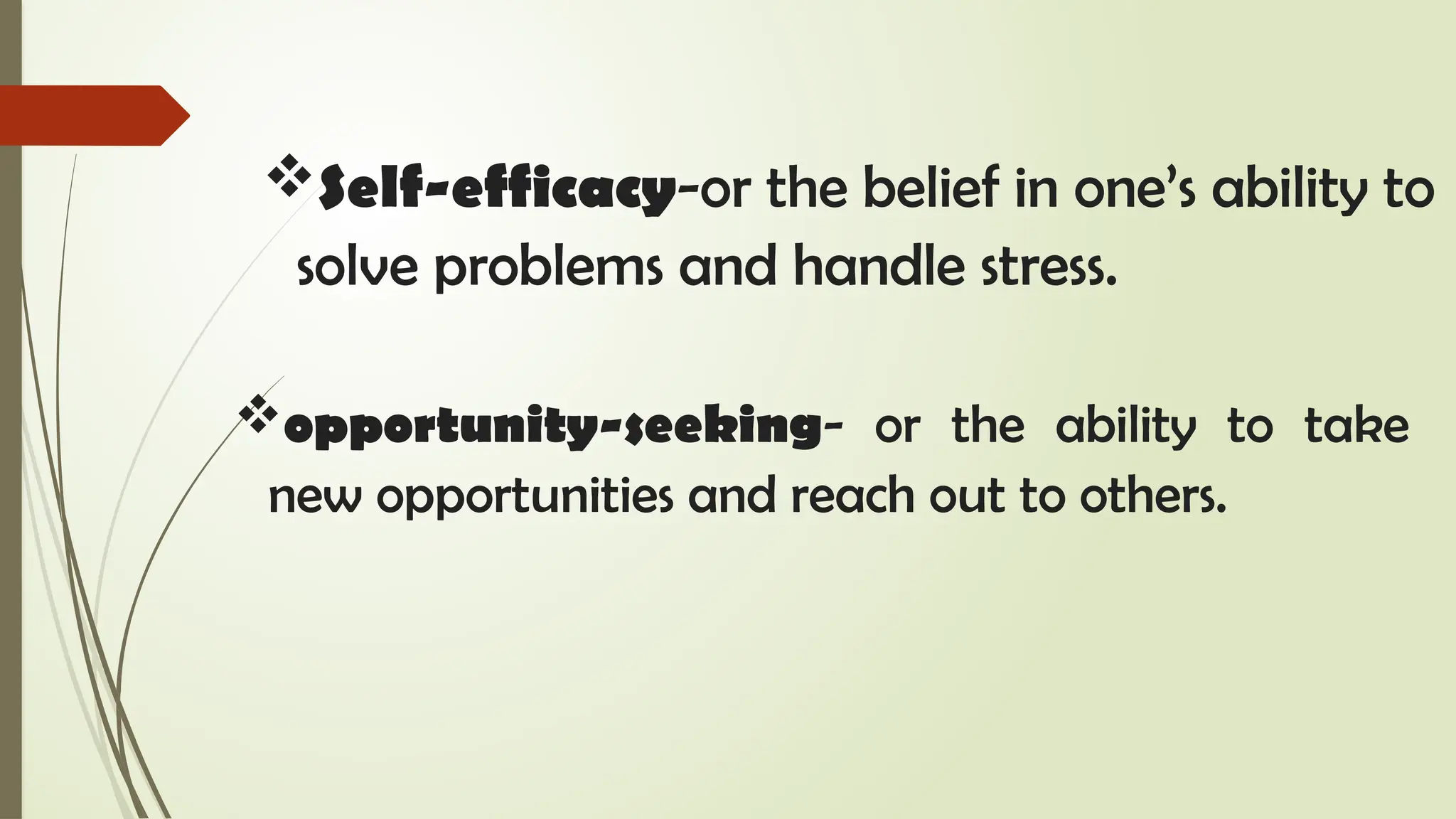
Self-efficacy-or the beliefin one’s ability to
solve problems and handle stress.
opportunity-seeking- or the ability to take
new opportunities and reach out to others.
6.
Resilient mindsets andcoping
strategies
Positive reinterpretation- reinterpreting a stressful
event in positive ways .
Humor- finding aspects to laugh at in order to
minimize stress.
7.
Active coping- initiatingdirect action to mitigate the
stress.
Planning- selecting a series/ steps to best handle the
problem.
Seeking help and social support-seeking advice,
assistance or information, moral support, empathy or
understanding.
8.
Thus, In general,students with higher resilience tend to
have more positive outcomes (including greater wellbeing)
and exhibit fewer problem behaviors.
This is because resilient people display the courage and
motivation to face problems and difficulties accurately
(rather than denying or exaggerating them) and
maintain a positive mindset and the confidence to
persevere
9.
References
1. Ager A.,Annan J., Panter-Brick C. Resilience—From conceptualization to effective
intervention. Policy Brief for Humanitarian and Development Agencies. 2013. Retrieved from
http://jackson.yale.edu/sites/default/files/documents/Resilience_Policy Brief_Ager
Annan Panter-Brick_Final.pdf. [Google Scholar]
2. American Psychological Association. Resilience and recovery after war: Refugee children and
families in the United States. 2010; Washington, DC: American Psychological Association.
[Google Scholar]
3. American Psychological Association . The road to resilience. 2014; Washington, DC: American
Psychological Association. [Google Scholar]
4. Arnold M., Mearns R., Oshima K., Prasad V. Climate and disaster resilience: The role for
community-driven development. 2014; Washington, DC: Social Development World Bank.
[Google Scholar]
5. Barber B. K. Adolescents and war: How youth deal with political violence. 2009; New York,
NY: Oxford University Press.




![References
1. Ager A., Annan J., Panter-Brick C. Resilience—From conceptualization to effective
intervention. Policy Brief for Humanitarian and Development Agencies. 2013. Retrieved from
http://jackson.yale.edu/sites/default/files/documents/Resilience_Policy Brief_Ager
Annan Panter-Brick_Final.pdf. [Google Scholar]
2. American Psychological Association. Resilience and recovery after war: Refugee children and
families in the United States. 2010; Washington, DC: American Psychological Association.
[Google Scholar]
3. American Psychological Association . The road to resilience. 2014; Washington, DC: American
Psychological Association. [Google Scholar]
4. Arnold M., Mearns R., Oshima K., Prasad V. Climate and disaster resilience: The role for
community-driven development. 2014; Washington, DC: Social Development World Bank.
[Google Scholar]
5. Barber B. K. Adolescents and war: How youth deal with political violence. 2009; New York,
NY: Oxford University Press.](https://image.slidesharecdn.com/power-point-report-resilience-theory-educ-100-250713094645-6d37ba73/75/Power-point-Report-Resilience-Theory-Educ-100-pptx-9-2048.jpg)


