PERSONAL AND COMMUNITY RESILIENCE: BUILDING IT AND SUSTAINING IT SHEILA EMERSON KELLY LICENSED PSYCHOLOGIST ASSISTANT COMMISSIONER BUREAU FOR BEHAVIORAL HEALTH AND HEALTH FACILITIES
What is resiliency? Resiliency is the process of adapting well in the face of adversity, trauma, tragedy, threats, or other significant sources of stress. Resiliency is the capacity to bounce back.
For a community to be resilient, its members must put into practice early and effective actions. If residents, agencies and organizations take meaningful and intentional actions before an event, communities can reestablish stability after an event.
Resilience implies that after an event, a person or community may not only be able to cope and to recover but also change to reflect different priorities arising from the disaster.
PERSONAL RESILIENCY DEVELOPMENT AND MAINTENANCE OF PERSONAL RESILIENCE
Personal Resilience is related to: Biological factors (temperament, emotions, intelligence, creativity, resistance to disease, genetic and physical characteristics) Attachment (capacity for bonding, for forming significant relationships with others; the capacity for empathy, compassion caring and joy) Control (capacity to manipulate one’s environment, mastery, social competence; self-esteem; personal autonomy and sense of purpose)
People who are resilient demonstrate: Sociability (form healthy relationships) Optimism (view self and future positively) Flexibility (change is part of life) Self-confidence (move toward goals, base decisions on confidence in one’s abilities) Competence (be good at something and take pride in it) Insightfulness (understand people and situations; be able to see other sides) Perseverance (don’t give up) Perspective (view crises as challenges to be faced, not insurmountable obstacles) Self control (manage strong feelings and impulses; internalization of locus of control)
RESPONSE OF CHILDREN TO DISASTER DEPENDS ON: Extent of exposure to the disaster Family distress Loss of loved ones and/or property Available support systems Disruption of school programs Community’s response to the disaster
What characterizes resilient children? Positive peer and adult interactions Low degrees of defensiveness and aggressiveness and high degrees of cooperation, participation and emotional stability Positive sense of self Sense of personal power rather than powerlessness Internal locus of control (belief that one is capable of exercising control/impact over the environment)
What are signs of vulnerability to stress? Substance abuse Poor anger management Lack of community integration/social isolation Multiple chronic illnesses or symptoms with minimal, vague or inadequate organic basis Chronic dysthymia and/or anxiety Dysfunctional relationships Inadequate school/work/community performance
PROTECTION VERSUS VULNERABILITY WHAT MAKES SOME INDIVIDUALS RESILIENT AND SOME VULNERABLE TO LIFE STRESSORS?
Risk Factors
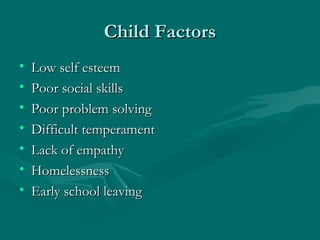
Child Factors Low self esteem Poor social skills Poor problem solving Difficult temperament Lack of empathy Homelessness Early school leaving
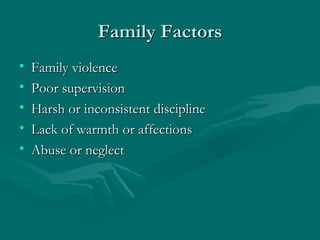
Family Factors Family violence Poor supervision Harsh or inconsistent discipline Lack of warmth or affections Abuse or neglect
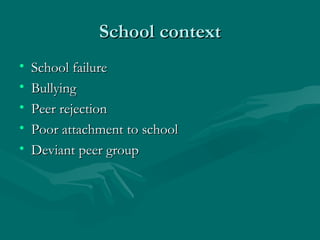
School context School failure Bullying Peer rejection Poor attachment to school Deviant peer group
Life Events Divorce and family breakup Death of a family member
Community and cultural factors Neighborhood violence and crime Lack of support services Social or cultural discrimination Community norms concerning violence
Protective Factors
Child Factors Social competence Attachment to family Empathy Problem solving  Optimism School achievement Easy temperament Good coping style
Family Factors Supportive caring parents Family harmony Secure and stable family Supportive relationship with an adult Strong family norms and morality
School Context Positive school climate Prosocial peer group Sense of belonging Opportunities for success at school and recognition of achievement School norms regarding violence
Life Events Meeting significant person Moving to new area Opportunities at critical turning points or major life transitions
Community and Cultural Factors Access to support services Community networking Attachment to the community Participation in community group Community/cultural norms against violence Strong cultural identity/ethnic pride
Problem-focused coping  increases resiliency  while emotion-focused coping impairs resiliency
When faced with a setback or challenge focus outward on the things that must be handled, not inward on emotions.  Emotions cannot become the focus of attention.
People who focus on solving their problems are the most resilient  (and are sick less often).
Problem solvers: Examine the situation to see what solutions may be possible Consider various actions Select the best Take action Observe effects of the action Modify for best results
People bounce back from disaster, tragedy, trauma, stress by having: Caring and support High expectations for success Opportunities for meaningful participation Positive bonds Clear and consistent boundaries Life skills
Just as people can be taught to be resilient, so can communities.
Community resilience A resilient community can respond to crises in ways that strengthen community bonds, resources and the community’s capacity to cope. Community resilience is the individual and collective capacity to respond to adversity and change.
In communities,  resilience is related to: Magnitude of shock a system can absorb and remain competent Degree to which a system is capable of self-organization Degree to which a system can build capacity for learning and adaptation
COMMUNITY VULNERABILITY All vulnerability and resilience is local Vulnerability is differential – different people and communities are vulnerable in different ways to different hazards Vulnerability and resilience must be assessed in the context of general social and economic circumstances Strategies developed must be specific to the locale and the issue
Building resilient communities: Is a long term project Grows through support and extension of natural caring relationships that must be nurtured Starts with strengthening natural helping institutions in neighborhoods Builds on strengths not weaknesses Arises from self-organization and self-control arising from mastery
Elements important to building resilience include: Connectedness, commitment and shared values Participation Structure, roles and responsibilities Support and nurturance Critical reflection and skill building Resources Communication
Connectedness, commitment and shared values Children and families are more likely to feel part of a community when there is shared history customs, beliefs and values. This is influenced by: How families perceive their own well-being as tied to the well-being of the overall community How families perceive respect for and sensitivity toward their ethnic and cultural identification
Strong connectedness results in:  Increased trust in community leaders Increased compliance with messages and instructions in the event of an emergency Decreased conflict among diverse groups and individuals in the community
PARTICIPATION Families are more likely to participate in their community when: Community leaders encourage active involvement They believe their contributions and ideas are valued by community leaders They can see the benefit of being involved for themselves, their children and the entire community
Structure, roles and responsibilities Communities need clear organizational structure. After a disaster, new roles may emerge. Conflict over roles can adversely impact resilience. Anticipating changes in roles and incorporating them into disaster drills can improve resilience.
Identify the responsibilities of community leaders, agencies and organizations prior to the event Provide information to the public about the structure and responsibilities of different sectors in the community Provide information to the general public about what families can do to help themselves in the event of a disaster.
Knowledge of roles and responsibilities during disasters will enhance the public’s acceptance of directives and compliance with procedures. Parents need to help children to know what is expected of them and what to do in case of disaster. The more their responsibilities are defined, the better they are prepared to cope. This will reduce anxiety and worry.,
SUPPORT AND NURTURANCE Community resilience is enhanced when families perceive support from community leaders: Opportunities to express concerns and ideas Provide feedback to leaders See their concerns addressed by actions such as community development, attracting new businesses, upgrading common areas, etc.
CRITICAL REFLECTION AND SKILL BUILDING Self-evaluation of: Successes or strengths Areas needing improvement Challenges or barriers to implementing planned responses Unanticipated problems Solutions Planning ahead (learn how to manage symptoms that arise in disasters in advance)
RESOURCES Must be made available in an equitable manner Distributed with input from families Used effectively in adverse situations Expanded through accessing additional resources and supplies (e.g., Red Cross, FEMA, etc) Available resources need to be identified in advance.
COMMUNICATION Must be understood by all ages Consistent themes but multiple messages (school, church, public health, etc) Must be two ways (families need to be able to express concerns, needs etc.,) Should convey that leaders have as priority the well-being of families and overall good of the community
Policy development and implementation  leads to public awareness  and community participation  which leads to less vulnerability and  enhanced resilience to disaster.
What can faith-based organizations do? Join faith-based organizations such as VOAD and the American Red Cross. Help disseminate important disaster information within and outside traditional cultural and faith-based settings Work with others to designate potential shelters and distribution centers within buildings owned by the organization Provide joint programs with other community and religious leaders to strengthen respect for diversity
Deliver disaster-related information to all residents through cultural and faith-based avenues (sermons, teaching programs) including referral sheets with names of mental health practitioners Develop alternative locations for worship  Review, self-evaluate, adapt
What can community leaders do? Develop a community disaster plan Ensure effective communication between leadership and families Create a centralized victim’s assistance organization that has information about available services Work with non-profits with expertise in large-scale distribution of resources during disasters
Implement guidelines for rotating, distributing and disposing of food stuffs to prevent health hazards related to food donations, working with public health Establish a system to control donations to community response and recovery to ensure equitable allocation of financial and other resources Implement a media plan to provide important updates to the community Review efforts, self-evaluate, adapt.
What can mental health providers do? Develop and activate a mental health triage system Aid community leaders and others in distinguishing appropriate and inappropriate disaster mental health services for community residents Assist in training community volunteers Provide emotional support to community responders
Supplement existing mental health resources that may need assistance in disaster (e.g., school counselors) Promote programs for mental health responders on: Disaster mental health and children Child bereavement and traumatic grief Interventions for children and families after disaster
Create informational materials on: Building resilience in children and families Preparedness Stress and coping Managing a crisis Posttraumatic stress disorder Pediatric bereavement Depression Anxiety Substance abuse
Anger management Behavior management/positive behavior supports Self-care Mental health concerns Community resources for mental health
Provide interviews to the media about resilience and emotional recovery after disaster Evaluate capacity for mental health response Help to create a fund to support long term mental health treatment for survivors when necessary Review, evaluate, adapt

Resiliency

  • 1.
    PERSONAL AND COMMUNITYRESILIENCE: BUILDING IT AND SUSTAINING IT SHEILA EMERSON KELLY LICENSED PSYCHOLOGIST ASSISTANT COMMISSIONER BUREAU FOR BEHAVIORAL HEALTH AND HEALTH FACILITIES
  • 2.
    What is resiliency?Resiliency is the process of adapting well in the face of adversity, trauma, tragedy, threats, or other significant sources of stress. Resiliency is the capacity to bounce back.
  • 3.
    For a communityto be resilient, its members must put into practice early and effective actions. If residents, agencies and organizations take meaningful and intentional actions before an event, communities can reestablish stability after an event.
  • 4.
    Resilience implies thatafter an event, a person or community may not only be able to cope and to recover but also change to reflect different priorities arising from the disaster.
  • 5.
    PERSONAL RESILIENCY DEVELOPMENTAND MAINTENANCE OF PERSONAL RESILIENCE
  • 6.
    Personal Resilience isrelated to: Biological factors (temperament, emotions, intelligence, creativity, resistance to disease, genetic and physical characteristics) Attachment (capacity for bonding, for forming significant relationships with others; the capacity for empathy, compassion caring and joy) Control (capacity to manipulate one’s environment, mastery, social competence; self-esteem; personal autonomy and sense of purpose)
  • 7.
    People who areresilient demonstrate: Sociability (form healthy relationships) Optimism (view self and future positively) Flexibility (change is part of life) Self-confidence (move toward goals, base decisions on confidence in one’s abilities) Competence (be good at something and take pride in it) Insightfulness (understand people and situations; be able to see other sides) Perseverance (don’t give up) Perspective (view crises as challenges to be faced, not insurmountable obstacles) Self control (manage strong feelings and impulses; internalization of locus of control)
  • 8.
    RESPONSE OF CHILDRENTO DISASTER DEPENDS ON: Extent of exposure to the disaster Family distress Loss of loved ones and/or property Available support systems Disruption of school programs Community’s response to the disaster
  • 9.
    What characterizes resilientchildren? Positive peer and adult interactions Low degrees of defensiveness and aggressiveness and high degrees of cooperation, participation and emotional stability Positive sense of self Sense of personal power rather than powerlessness Internal locus of control (belief that one is capable of exercising control/impact over the environment)
  • 10.
    What are signsof vulnerability to stress? Substance abuse Poor anger management Lack of community integration/social isolation Multiple chronic illnesses or symptoms with minimal, vague or inadequate organic basis Chronic dysthymia and/or anxiety Dysfunctional relationships Inadequate school/work/community performance
  • 11.
    PROTECTION VERSUS VULNERABILITYWHAT MAKES SOME INDIVIDUALS RESILIENT AND SOME VULNERABLE TO LIFE STRESSORS?
  • 12.
  • 13.
    Child Factors Lowself esteem Poor social skills Poor problem solving Difficult temperament Lack of empathy Homelessness Early school leaving
  • 14.
    Family Factors Familyviolence Poor supervision Harsh or inconsistent discipline Lack of warmth or affections Abuse or neglect
  • 15.
    School context Schoolfailure Bullying Peer rejection Poor attachment to school Deviant peer group
  • 16.
    Life Events Divorceand family breakup Death of a family member
  • 17.
    Community and culturalfactors Neighborhood violence and crime Lack of support services Social or cultural discrimination Community norms concerning violence
  • 18.
  • 19.
    Child Factors Socialcompetence Attachment to family Empathy Problem solving Optimism School achievement Easy temperament Good coping style
  • 20.
    Family Factors Supportivecaring parents Family harmony Secure and stable family Supportive relationship with an adult Strong family norms and morality
  • 21.
    School Context Positiveschool climate Prosocial peer group Sense of belonging Opportunities for success at school and recognition of achievement School norms regarding violence
  • 22.
    Life Events Meetingsignificant person Moving to new area Opportunities at critical turning points or major life transitions
  • 23.
    Community and CulturalFactors Access to support services Community networking Attachment to the community Participation in community group Community/cultural norms against violence Strong cultural identity/ethnic pride
  • 24.
    Problem-focused coping increases resiliency while emotion-focused coping impairs resiliency
  • 25.
    When faced witha setback or challenge focus outward on the things that must be handled, not inward on emotions. Emotions cannot become the focus of attention.
  • 26.
    People who focuson solving their problems are the most resilient (and are sick less often).
  • 27.
    Problem solvers: Examinethe situation to see what solutions may be possible Consider various actions Select the best Take action Observe effects of the action Modify for best results
  • 28.
    People bounce backfrom disaster, tragedy, trauma, stress by having: Caring and support High expectations for success Opportunities for meaningful participation Positive bonds Clear and consistent boundaries Life skills
  • 29.
    Just as peoplecan be taught to be resilient, so can communities.
  • 30.
    Community resilience Aresilient community can respond to crises in ways that strengthen community bonds, resources and the community’s capacity to cope. Community resilience is the individual and collective capacity to respond to adversity and change.
  • 31.
    In communities, resilience is related to: Magnitude of shock a system can absorb and remain competent Degree to which a system is capable of self-organization Degree to which a system can build capacity for learning and adaptation
  • 32.
    COMMUNITY VULNERABILITY Allvulnerability and resilience is local Vulnerability is differential – different people and communities are vulnerable in different ways to different hazards Vulnerability and resilience must be assessed in the context of general social and economic circumstances Strategies developed must be specific to the locale and the issue
  • 33.
    Building resilient communities:Is a long term project Grows through support and extension of natural caring relationships that must be nurtured Starts with strengthening natural helping institutions in neighborhoods Builds on strengths not weaknesses Arises from self-organization and self-control arising from mastery
  • 34.
    Elements important tobuilding resilience include: Connectedness, commitment and shared values Participation Structure, roles and responsibilities Support and nurturance Critical reflection and skill building Resources Communication
  • 35.
    Connectedness, commitment andshared values Children and families are more likely to feel part of a community when there is shared history customs, beliefs and values. This is influenced by: How families perceive their own well-being as tied to the well-being of the overall community How families perceive respect for and sensitivity toward their ethnic and cultural identification
  • 36.
    Strong connectedness resultsin: Increased trust in community leaders Increased compliance with messages and instructions in the event of an emergency Decreased conflict among diverse groups and individuals in the community
  • 37.
    PARTICIPATION Families aremore likely to participate in their community when: Community leaders encourage active involvement They believe their contributions and ideas are valued by community leaders They can see the benefit of being involved for themselves, their children and the entire community
  • 38.
    Structure, roles andresponsibilities Communities need clear organizational structure. After a disaster, new roles may emerge. Conflict over roles can adversely impact resilience. Anticipating changes in roles and incorporating them into disaster drills can improve resilience.
  • 39.
    Identify the responsibilitiesof community leaders, agencies and organizations prior to the event Provide information to the public about the structure and responsibilities of different sectors in the community Provide information to the general public about what families can do to help themselves in the event of a disaster.
  • 40.
    Knowledge of rolesand responsibilities during disasters will enhance the public’s acceptance of directives and compliance with procedures. Parents need to help children to know what is expected of them and what to do in case of disaster. The more their responsibilities are defined, the better they are prepared to cope. This will reduce anxiety and worry.,
  • 41.
    SUPPORT AND NURTURANCECommunity resilience is enhanced when families perceive support from community leaders: Opportunities to express concerns and ideas Provide feedback to leaders See their concerns addressed by actions such as community development, attracting new businesses, upgrading common areas, etc.
  • 42.
    CRITICAL REFLECTION ANDSKILL BUILDING Self-evaluation of: Successes or strengths Areas needing improvement Challenges or barriers to implementing planned responses Unanticipated problems Solutions Planning ahead (learn how to manage symptoms that arise in disasters in advance)
  • 43.
    RESOURCES Must bemade available in an equitable manner Distributed with input from families Used effectively in adverse situations Expanded through accessing additional resources and supplies (e.g., Red Cross, FEMA, etc) Available resources need to be identified in advance.
  • 44.
    COMMUNICATION Must beunderstood by all ages Consistent themes but multiple messages (school, church, public health, etc) Must be two ways (families need to be able to express concerns, needs etc.,) Should convey that leaders have as priority the well-being of families and overall good of the community
  • 45.
    Policy development andimplementation leads to public awareness and community participation which leads to less vulnerability and enhanced resilience to disaster.
  • 46.
    What can faith-basedorganizations do? Join faith-based organizations such as VOAD and the American Red Cross. Help disseminate important disaster information within and outside traditional cultural and faith-based settings Work with others to designate potential shelters and distribution centers within buildings owned by the organization Provide joint programs with other community and religious leaders to strengthen respect for diversity
  • 47.
    Deliver disaster-related informationto all residents through cultural and faith-based avenues (sermons, teaching programs) including referral sheets with names of mental health practitioners Develop alternative locations for worship Review, self-evaluate, adapt
  • 48.
    What can communityleaders do? Develop a community disaster plan Ensure effective communication between leadership and families Create a centralized victim’s assistance organization that has information about available services Work with non-profits with expertise in large-scale distribution of resources during disasters
  • 49.
    Implement guidelines forrotating, distributing and disposing of food stuffs to prevent health hazards related to food donations, working with public health Establish a system to control donations to community response and recovery to ensure equitable allocation of financial and other resources Implement a media plan to provide important updates to the community Review efforts, self-evaluate, adapt.
  • 50.
    What can mentalhealth providers do? Develop and activate a mental health triage system Aid community leaders and others in distinguishing appropriate and inappropriate disaster mental health services for community residents Assist in training community volunteers Provide emotional support to community responders
  • 51.
    Supplement existing mentalhealth resources that may need assistance in disaster (e.g., school counselors) Promote programs for mental health responders on: Disaster mental health and children Child bereavement and traumatic grief Interventions for children and families after disaster
  • 52.
    Create informational materialson: Building resilience in children and families Preparedness Stress and coping Managing a crisis Posttraumatic stress disorder Pediatric bereavement Depression Anxiety Substance abuse
  • 53.
    Anger management Behaviormanagement/positive behavior supports Self-care Mental health concerns Community resources for mental health
  • 54.
    Provide interviews tothe media about resilience and emotional recovery after disaster Evaluate capacity for mental health response Help to create a fund to support long term mental health treatment for survivors when necessary Review, evaluate, adapt