


WHAT IS RESILIENCE?
DR. M.J. MALINDI
• Resilience was thought to be a
characteristic of children who were
thought to be:
• Invincible;
• Invulnerable;
• Unshakable;
• Unbeatable;
• Indomitable;
• Impenetrable;
• Unconquerable;
• Indestructible;
We all know… the person whose father was an
alcoholic and whose mother was frequently
hospitalised with a psychiatric disorder, yet who
is now a happy and dedicated family man;
(What made this possible?)
We all know the person who rose from the most
severe deprivation and poverty to become a
competent, caring medical doctor;
(What made this possible?)
We all know the child who was orphaned at a
young age, grew up in children’s homes,
became a juvenile delinquent and then settled
into stable employment and is now a
respected
member of his community;
(What made this possible?)
We all know the person who experienced major
discrimination in his youth, was unfairly
imprisoned for many years and then went on to
become an icon of compassion, forgiveness
and dignity;
(What made this possible?)
Of course, we also know people whose lives
have seemed to follow a very different pattern:
individuals who seem to have had every
advantage that life could offer a loving family,
supportive friends, a good education, enough
money and so forth-yet seem unable to become
well-adjusted and productive adults”
(Killian, 2004)
(How do you explain this?
PHYSICS
• The ability of a substance to return to its
original shape after it has been pressed or
bent
BIOLOGY
• The ability to recover quickly from illness,
change, or misfortune; buoyancy.
• The property of a material that enables it
to resume its original shape or position
after being bent, stretched, or
compressed; elasticity
ECONOMICS
• Refers to the inherent and adaptive
responses to hazards that enable
individuals and communities to avoid
some potential losses.
• It can take place at the level of the firm,
household, market, or macroeconomy.
• Resilience is a context-specific term that is
not easy to define;
• The ecological perspective (Masten, 2001)
sees resilience as:
• positive outcomes despite the experience of
adversity/difficulties (being an orphan);
• continued positive or effective functioning in
adverse circumstances (sustained poverty),
• recovery after significant trauma
IN PSYCHOLOGY
The social ecology of resilience perspective
(Ungar, 2006; Ungar, 2007; Ungar 2008)
conceptualises resilience as:
•the capacity of individuals to navigate their way
to the resources that sustain well-being;
•the capacity of the individual’s physical and
social ecologies to provide resilience resources;
and lastly,
•the capacity of individuals, families and
communities to negotiate culturally meaningful
ways to share resources.
• Resilience is about someone doing well in
contexts where the circumstances
confronting this person would typically
predict poor developmental outcomes or
psychopathology (drug abuse, depression,
suicide, etc.)
• Resilience is a dynamic process, rather than
a fixed attribute or characteristic one has as
previously thought;
• Resilience in children depends on
what is built inside them AND on what is
built around them;
• Individuals are not considered resilient if they
have never been exposed to significant risk or
threat that threatened to derail their
development;
• Only when such threat or risk is present, and
overcome, does the notion of resilience come
into play.
HIDDEN RESILIENCE AND HABITUATION
• For some, life is a long, drawn out, constant,
daily struggle for survival;
• Coping is then based on unconventional
mechanisms;
• Long suffering brings about habituation
• This so for the following groups of children:
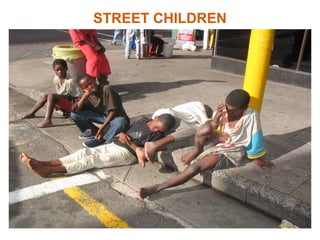
STREET CHILDREN
HOW THEY COPE
• Begging;
• Glue sniffing;
• Petty crime;
• Vandalising payphones;
• Rag-picking;
• Prostitution;
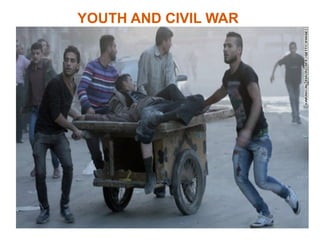
YOUTH AND CIVIL WAR
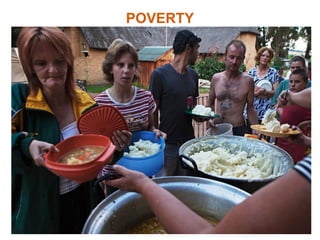
POVERTY
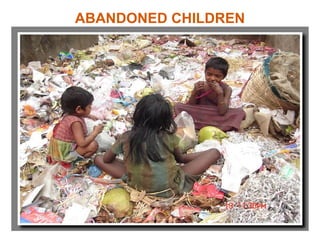
ABANDONED CHILDREN
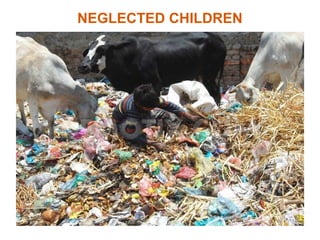
NEGLECTED CHILDREN
PROSTITUTION
WHAT ARE THE LESSONS LEARNED
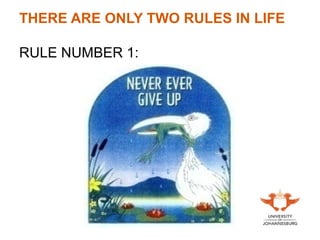
THERE ARE ONLY TWO RULES IN LIFE
RULE NUMBER 1:
RULE NUMBER 2
ALWAYS REMEMBER RULE
NUMBER 1
STAY BLESSED
Study Unit 2: Risks to resilience
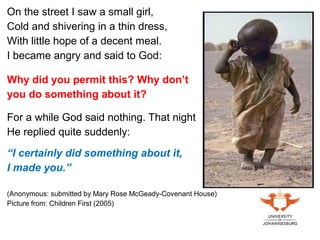
On the street I saw a small girl,
Cold and shivering in a thin dress,
With little hope of a decent meal.
I became angry and said to God:
Why did you permit this? Why don’t
you do something about it?
For a while God said nothing. That night
He replied quite suddenly:
“I certainly did something about it,
I made you.”
(Anonymous: submitted by Mary Rose McGeady-Covenant House)
Picture from: Children First (2005)
WHAT ARE RISK PROCESSES
• Generally, the term, risk refers to individual/personal
and environmental factors or processes that
combine to increase the individual’s
likelihood of negative developmental
outcomes in children;
• Risk refers to the variables that interact/work
together to bring about poor adjustment or
psychopathology;
• Risk processes do not directly cause adjustment
problems, but typically encourage poor adjustment in
the presence of other risks.
• Risks can have a cumulative effect
• Risk originates from multiple stressors rather
than from single individual or environmental
processes;
• Personal and/or environmental risks may
have a cumulative effect on an individual and
this cumulative effect is associated with non-
resilient outcomes;
• Risks should be understood as chains of
events, or processes, rather than singular
events or negative episodes;
• Some risks can be related to the biological
make-up of a child. For example, sensory-
motor deficits which affect the ability to learn
and explore the environment and unusual
sensitivities, low birth weight, age and poor
memory are implicated in the development of
poor adjustment;
• Risk processes are context-specific rather than
universal;
• Risks can be personal/individual, in
relationships, in the community and part of a
culture
PERSONAL/INDIVIDUAL LEVEL
• Difficult personality;
• Biological make-up (disability);
• Low birth-weight;
• Poor memory;
• Low intelligence;
• Low self esteem;
• Poor self image;
• Lack of assertiveness;
• Poor sense of humour;
• Low frustration tolerance
• Feeling neglected;
• Feeling unloved/unwanted
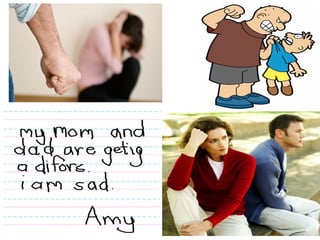
RELATIONSHIPS
• inability to maintain healthy
relationships;
• familial psychiatric
problems,
• chronic and profound social
stressors,
• low socio-economic status,
• low academic
achievements by parents,
• teenage pregnancy;
• domestic violence;
• parental illness;
• parentified youth;
• poor family functioning or
discord,
• parental harshness,
• child abuse;
• unemployment;
• parental alcoholism;
• divorce;
• parental death;
• lack of positive role models;
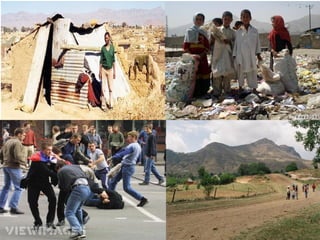
COMMUNITY
• armed conflict,
• forced migration,
• environmental degradation
and exploitation;
• lack of resources, e.g.
libraries, health-care,
social, security, housing,
electricity, water, road
infrastructure, etc,
• violence;
• bullying;
• mocking by peers;
• crime;
• gang activity;
• availability of weapons;
• availability of drugs;
• discrimination;
• overcrowding;
• noise levels;
• HIV/AIDS;
• single parent homes;
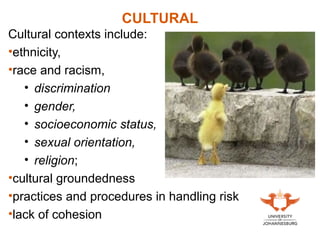
CULTURAL
Cultural contexts include:
•ethnicity,
•race and racism,
• discrimination
• gender,
• socioeconomic status,
• sexual orientation,
• religion;
•cultural groundedness
•practices and procedures in handling risk
•lack of cohesion
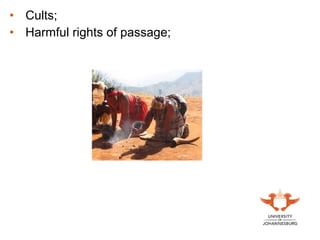
• Cults;
• Harmful rights of passage;
LESSONS LEARNED
• You cannot prevent the birds of sadness from
passing over your head, but you can prevent
their making a nest in your hair. Chinese
proverb
• Speak when you are angry, and you will make
the best speech that you will ever regret. Dr.
Laurence J. Peter
• Failure is not falling down, but refusing to get
up. Chinese proverb

RESILIENCE

  • 1.
  • 2.
    • Resilience wasthought to be a characteristic of children who were thought to be: • Invincible; • Invulnerable; • Unshakable; • Unbeatable; • Indomitable; • Impenetrable; • Unconquerable; • Indestructible;
  • 3.
    We all know…the person whose father was an alcoholic and whose mother was frequently hospitalised with a psychiatric disorder, yet who is now a happy and dedicated family man; (What made this possible?)
  • 4.
    We all knowthe person who rose from the most severe deprivation and poverty to become a competent, caring medical doctor; (What made this possible?)
  • 5.
    We all knowthe child who was orphaned at a young age, grew up in children’s homes, became a juvenile delinquent and then settled into stable employment and is now a respected member of his community; (What made this possible?)
  • 6.
    We all knowthe person who experienced major discrimination in his youth, was unfairly imprisoned for many years and then went on to become an icon of compassion, forgiveness and dignity; (What made this possible?)
  • 7.
    Of course, wealso know people whose lives have seemed to follow a very different pattern: individuals who seem to have had every advantage that life could offer a loving family, supportive friends, a good education, enough money and so forth-yet seem unable to become well-adjusted and productive adults” (Killian, 2004) (How do you explain this?
  • 8.
    PHYSICS • The abilityof a substance to return to its original shape after it has been pressed or bent
  • 9.
    BIOLOGY • The abilityto recover quickly from illness, change, or misfortune; buoyancy. • The property of a material that enables it to resume its original shape or position after being bent, stretched, or compressed; elasticity
  • 10.
    ECONOMICS • Refers tothe inherent and adaptive responses to hazards that enable individuals and communities to avoid some potential losses. • It can take place at the level of the firm, household, market, or macroeconomy.
  • 11.
    • Resilience isa context-specific term that is not easy to define; • The ecological perspective (Masten, 2001) sees resilience as: • positive outcomes despite the experience of adversity/difficulties (being an orphan); • continued positive or effective functioning in adverse circumstances (sustained poverty), • recovery after significant trauma IN PSYCHOLOGY
  • 12.
    The social ecologyof resilience perspective (Ungar, 2006; Ungar, 2007; Ungar 2008) conceptualises resilience as: •the capacity of individuals to navigate their way to the resources that sustain well-being; •the capacity of the individual’s physical and social ecologies to provide resilience resources; and lastly, •the capacity of individuals, families and communities to negotiate culturally meaningful ways to share resources.
  • 13.
    • Resilience isabout someone doing well in contexts where the circumstances confronting this person would typically predict poor developmental outcomes or psychopathology (drug abuse, depression, suicide, etc.)
  • 14.
    • Resilience isa dynamic process, rather than a fixed attribute or characteristic one has as previously thought; • Resilience in children depends on what is built inside them AND on what is built around them; • Individuals are not considered resilient if they have never been exposed to significant risk or threat that threatened to derail their development;
  • 15.
    • Only whensuch threat or risk is present, and overcome, does the notion of resilience come into play.
  • 17.
    HIDDEN RESILIENCE ANDHABITUATION • For some, life is a long, drawn out, constant, daily struggle for survival; • Coping is then based on unconventional mechanisms; • Long suffering brings about habituation • This so for the following groups of children:
  • 18.
  • 19.
    HOW THEY COPE •Begging; • Glue sniffing; • Petty crime; • Vandalising payphones; • Rag-picking; • Prostitution;
  • 20.
  • 21.
  • 22.
  • 23.
  • 24.
  • 25.
    WHAT ARE THELESSONS LEARNED
  • 30.
    THERE ARE ONLYTWO RULES IN LIFE RULE NUMBER 1:
  • 31.
    RULE NUMBER 2 ALWAYSREMEMBER RULE NUMBER 1
  • 32.
  • 33.
    Study Unit 2:Risks to resilience
  • 34.
    On the streetI saw a small girl, Cold and shivering in a thin dress, With little hope of a decent meal. I became angry and said to God: Why did you permit this? Why don’t you do something about it? For a while God said nothing. That night He replied quite suddenly: “I certainly did something about it, I made you.” (Anonymous: submitted by Mary Rose McGeady-Covenant House) Picture from: Children First (2005)
  • 35.
    WHAT ARE RISKPROCESSES • Generally, the term, risk refers to individual/personal and environmental factors or processes that combine to increase the individual’s likelihood of negative developmental outcomes in children; • Risk refers to the variables that interact/work together to bring about poor adjustment or psychopathology; • Risk processes do not directly cause adjustment problems, but typically encourage poor adjustment in the presence of other risks.
  • 36.
    • Risks canhave a cumulative effect • Risk originates from multiple stressors rather than from single individual or environmental processes; • Personal and/or environmental risks may have a cumulative effect on an individual and this cumulative effect is associated with non- resilient outcomes; • Risks should be understood as chains of events, or processes, rather than singular events or negative episodes;
  • 37.
    • Some riskscan be related to the biological make-up of a child. For example, sensory- motor deficits which affect the ability to learn and explore the environment and unusual sensitivities, low birth weight, age and poor memory are implicated in the development of poor adjustment; • Risk processes are context-specific rather than universal; • Risks can be personal/individual, in relationships, in the community and part of a culture
  • 38.
    PERSONAL/INDIVIDUAL LEVEL • Difficultpersonality; • Biological make-up (disability); • Low birth-weight; • Poor memory; • Low intelligence; • Low self esteem; • Poor self image; • Lack of assertiveness; • Poor sense of humour; • Low frustration tolerance • Feeling neglected; • Feeling unloved/unwanted
  • 39.
    RELATIONSHIPS • inability tomaintain healthy relationships; • familial psychiatric problems, • chronic and profound social stressors, • low socio-economic status, • low academic achievements by parents, • teenage pregnancy; • domestic violence; • parental illness; • parentified youth; • poor family functioning or discord, • parental harshness, • child abuse; • unemployment; • parental alcoholism; • divorce; • parental death; • lack of positive role models;
  • 41.
    COMMUNITY • armed conflict, •forced migration, • environmental degradation and exploitation; • lack of resources, e.g. libraries, health-care, social, security, housing, electricity, water, road infrastructure, etc, • violence; • bullying; • mocking by peers; • crime; • gang activity; • availability of weapons; • availability of drugs; • discrimination; • overcrowding; • noise levels; • HIV/AIDS; • single parent homes;
  • 43.
    CULTURAL Cultural contexts include: •ethnicity, •raceand racism, • discrimination • gender, • socioeconomic status, • sexual orientation, • religion; •cultural groundedness •practices and procedures in handling risk •lack of cohesion
  • 44.
    • Cults; • Harmfulrights of passage;
  • 46.
    LESSONS LEARNED • Youcannot prevent the birds of sadness from passing over your head, but you can prevent their making a nest in your hair. Chinese proverb • Speak when you are angry, and you will make the best speech that you will ever regret. Dr. Laurence J. Peter • Failure is not falling down, but refusing to get up. Chinese proverb