Andrew Soren 
09/17/2014 
TODN 
RESILIENCE
WELCOME! 
2
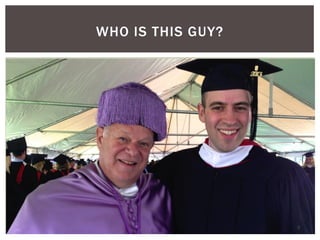
WHO IS THIS GUY? 
3
In 15 seconds or less: 
What’s your name? 
What do you do? 
What brought you here tonight? 
WHO ARE YOU? 
4
5:45 – 7pm 
Theory and research on resilience 
Application in Schools and Army 
7:15 – 8:15pm 
Some real-time resilience tools 
Practice in small groups 
Group discussion 
THE PLAN FOR TONIGHT 
5
Participate 
Ask questions 
Respect the needs of others – beware of FOMO 
Have fun 
What else? 
DESIGNED ALLIANCE 
6
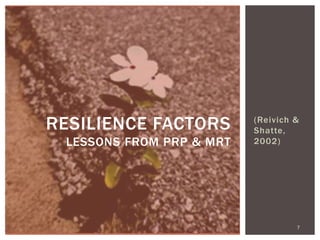
(Reivich & Shatte, 2002) 
RESILIENCE FACTORS LESSONS FROM PRP & MRT 
7
1: Take a moment and personally reflect: 
What is resilience 
Where do we have leverage? 
2: Pair and Share your thoughts 
Discuss your personal experiences 
Listen for strengths, skills, coping strategies, internal and external factors that helped, internal and external factors that inhibited. 
Come up with a common definition of Resilience 
4: At your tables refine your thinking 
Create a common definition of resilience 
Are certain factors necessary for reslience? 
All: Take-up 
8 
UNDERSTANDING RESILIENCE
From “invincible and invulnerable” to “ordinary magic” 
Patterns of positive adaptation during or following significant adversity or risk 
(Masten, Cutuli, Herbers, & Reed, 2009, p. 118) 
The ability to bounce back better 
(Seligman, 2005) 
Fundamental functions of Resilience 
helps us overcome obstacles 
steer through everyday challenges, 
bounce back from challenges in order to move forward, 
reach out to others for support 
(Reivich & Shatte, 2002) 
9 
OUR FOCUS ON RESILIENCE TONIGHT
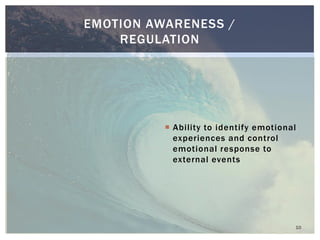
Ability to identify emotional experiences and control emotional response to external events 
EMOTION AWARENESS / REGULATION 
10
Ability to control behavior to achieve goals 
Delay gratification and tolerate ambiguity 
IMPULSE CONTROL 
11
Optimism wed to reality, focus on what is controllable 
Explanatory Style 
[not] me 
[not] always 
[not] everything 
OPTIMISM 
12
Thinking flexibly and accurately about the causes and implications of problems, perspective taking 
FLEXIBLE AND ACCURATE THINKING 
13
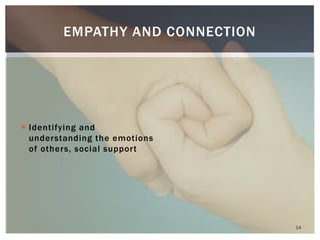
Identifying and understanding the emotions of others, social support 
EMPATHY AND CONNECTION 
14
What I believe I can do with my skills under certain conditions, sense of mastery, solution focused 
SELF-EFFICACY 
15
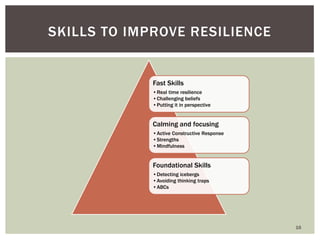
Fast Skills 
•Real time resilience 
•Challenging beliefs 
•Putting it in perspective 
Calming and focusing 
•Active Constructive Response 
•Strengths 
•Mindfulness 
Foundational Skills 
•Detecting icebergs 
•Avoiding thinking traps 
•ABCs 
16 
SKILLS TO IMPROVE RESILIENCE
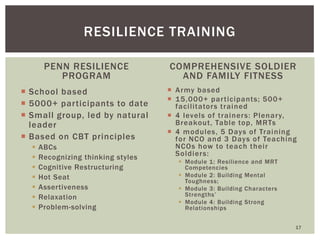
PENN RESILIENCE PROGRAM 
School based 
5000+ participants to date 
Small group, led by natural leader 
Based on CBT principles 
ABCs 
Recognizing thinking styles 
Cognitive Restructuring 
Hot Seat 
Assertiveness 
Relaxation 
Problem-solving 
COMPREHENSIVE SOLDIER AND FAMILY FITNESS 
Army based 
15,000+ participants; 500+ facilitators trained 
4 levels of trainers: Plenary, Breakout, Table top, MRTs 
4 modules, 5 Days of Training for NCO and 3 Days of Teaching NCOs how to teach their Soldiers: 
Module 1: Resilience and MRT Competencies 
Module 2: Building Mental Toughness; 
Module 3: Building Characters Strengths’ 
Module 4: Building Strong Relationships 
17 
RESILIENCE TRAINING
18 
BREAK TIME!
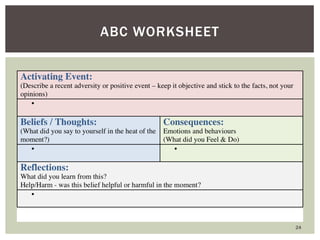
Ellis’ Cognitive Behavioral Model
A = ACTIVATING EVENT 
20 
Anything that triggers a cascade of feelings or behaviours. 
Could be good or bad.
Take a few moments to list your adversities 
Someone was on their phone and checking out at the supermarket 
Throwing recycling into the trash when there’s a recycling bin right there 
People are pre-occupied when they are talking to you 
People aren’t direct and upfront 
21 
ADVERSITIES: WHAT TICKS US OFF?
Our beliefs about the world 
That voice in your head 
Different than emotions 
Ticker-tape thoughts 
WHY thoughts: 
what caused the problem 
WHAT NEXT thoughts: 
what are the implications 
B = BELIEFS OR THOUGHTS 
22
Emotions: 
what you feel in the moment 
Behaviours: 
what you do in the moment 
C = CONSEQUENCES 
23
ABC WORKSHEET 
24
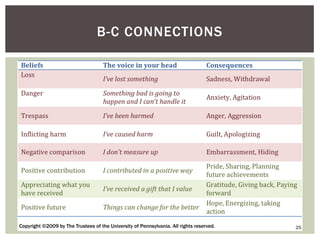
B-C CONNECTIONS 
Copyright ©2009 by The Trustees of the University of Pennsylvania. All rights reserved. 
25
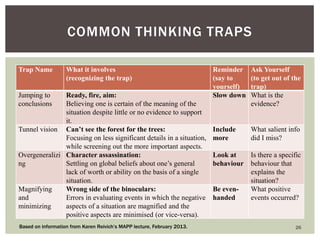
Trap Name 
What it involves (recognizing the trap) 
Reminder (say to yourself) 
Ask Yourself (to get out of the trap) 
Jumping to conclusions 
Ready, fire, aim: 
Believing one is certain of the meaning of the situation despite little or no evidence to support it. 
Slow down 
What is the evidence? 
Tunnel vision 
Can’t see the forest for the trees: 
Focusing on less significant details in a situation, while screening out the more important aspects. 
Include more 
What salient info did I miss? 
Overgeneralizing 
Character assassination: 
Settling on global beliefs about one’s general lack of worth or ability on the basis of a single situation. 
Look at behaviour 
Is there a specific behaviour that explains the situation? 
Magnifying and minimizing 
Wrong side of the binoculars: 
Errors in evaluating events in which the negative aspects of a situation are magnified and the positive aspects are minimised (or vice-versa). 
Be even- handed 
What positive events occurred? 
COMMON THINKING TRAPS 
Based on information from Karen Reivich’s MAPP lecture, February 2013. 
26
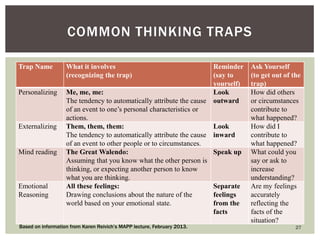
Trap Name 
What it involves (recognizing the trap) 
Reminder (say to yourself) 
Ask Yourself (to get out of the trap) 
Personalizing 
Me, me, me: 
The tendency to automatically attribute the cause of an event to one’s personal characteristics or actions. 
Look outward 
How did others or circumstances contribute to what happened? 
Externalizing 
Them, them, them: 
The tendency to automatically attribute the cause of an event to other people or to circumstances. 
Look inward 
How did I contribute to what happened? 
Mind reading 
The Great Walendo: 
Assuming that you know what the other person is thinking, or expecting another person to know what you are thinking. 
Speak up 
What could you say or ask to increase understanding? 
Emotional Reasoning 
All these feelings: 
Drawing conclusions about the nature of the world based on your emotional state. 
Separate feelings from the facts 
Are my feelings accurately reflecting the facts of the situation? 
COMMON THINKING TRAPS 
Based on information from Karen Reivich’s MAPP lecture, February 2013. 
27
28 
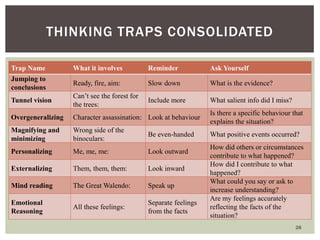
THINKING TRAPS CONSOLIDATED 
Trap Name 
What it involves 
Reminder 
Ask Yourself 
Jumping to conclusions 
Ready, fire, aim: 
Slow down 
What is the evidence? 
Tunnel vision 
Can’t see the forest for the trees: 
Include more 
What salient info did I miss? 
Overgeneralizing 
Character assassination: 
Look at behaviour 
Is there a specific behaviour that explains the situation? 
Magnifying and minimizing 
Wrong side of the binoculars: 
Be even-handed 
What positive events occurred? 
Personalizing 
Me, me, me: 
Look outward 
How did others or circumstances contribute to what happened? 
Externalizing 
Them, them, them: 
Look inward 
How did I contribute to what happened? 
Mind reading 
The Great Walendo: 
Speak up 
What could you say or ask to increase understanding? 
Emotional Reasoning 
All these feelings: 
Separate feelings from the facts 
Are my feelings accurately reflecting the facts of the situation?
What do you want to know? 
29
Masten, A. S., Cutuli, J. J., Herbers, J. E., & Reed, M. J. (2009). Resilience in development. In S. J. Lopez & C. R. Snyder (Eds.), Oxford handbook of positive psychology (pp. 117-131). New York, NY: Oxford University Press, Inc. 
Reivich, K. & Shatte, A. (2002). The resilience factor: 7 Essential skills for overcoming life’s inevitable obstacles. New York, NY: Broadway Books. 
Youssef, C. M., & Luthans, F. (2007). Positive organizational behavior in the workplace: The impact of hope, optimism, and resilience. Journal of Management, 33(5), 774-800. 
30 
REFERENCES

Organizational Resiliency

  • 1.
    Andrew Soren 09/17/2014 TODN RESILIENCE
  • 2.
  • 3.
  • 4.
    In 15 secondsor less: What’s your name? What do you do? What brought you here tonight? WHO ARE YOU? 4
  • 5.
    5:45 – 7pm Theory and research on resilience Application in Schools and Army 7:15 – 8:15pm Some real-time resilience tools Practice in small groups Group discussion THE PLAN FOR TONIGHT 5
  • 6.
    Participate Ask questions Respect the needs of others – beware of FOMO Have fun What else? DESIGNED ALLIANCE 6
  • 7.
    (Reivich & Shatte,2002) RESILIENCE FACTORS LESSONS FROM PRP & MRT 7
  • 8.
    1: Take amoment and personally reflect: What is resilience Where do we have leverage? 2: Pair and Share your thoughts Discuss your personal experiences Listen for strengths, skills, coping strategies, internal and external factors that helped, internal and external factors that inhibited. Come up with a common definition of Resilience 4: At your tables refine your thinking Create a common definition of resilience Are certain factors necessary for reslience? All: Take-up 8 UNDERSTANDING RESILIENCE
  • 9.
    From “invincible andinvulnerable” to “ordinary magic” Patterns of positive adaptation during or following significant adversity or risk (Masten, Cutuli, Herbers, & Reed, 2009, p. 118) The ability to bounce back better (Seligman, 2005) Fundamental functions of Resilience helps us overcome obstacles steer through everyday challenges, bounce back from challenges in order to move forward, reach out to others for support (Reivich & Shatte, 2002) 9 OUR FOCUS ON RESILIENCE TONIGHT
  • 10.
    Ability to identifyemotional experiences and control emotional response to external events EMOTION AWARENESS / REGULATION 10
  • 11.
    Ability to controlbehavior to achieve goals Delay gratification and tolerate ambiguity IMPULSE CONTROL 11
  • 12.
    Optimism wed toreality, focus on what is controllable Explanatory Style [not] me [not] always [not] everything OPTIMISM 12
  • 13.
    Thinking flexibly andaccurately about the causes and implications of problems, perspective taking FLEXIBLE AND ACCURATE THINKING 13
  • 14.
    Identifying and understandingthe emotions of others, social support EMPATHY AND CONNECTION 14
  • 15.
    What I believeI can do with my skills under certain conditions, sense of mastery, solution focused SELF-EFFICACY 15
  • 16.
    Fast Skills •Realtime resilience •Challenging beliefs •Putting it in perspective Calming and focusing •Active Constructive Response •Strengths •Mindfulness Foundational Skills •Detecting icebergs •Avoiding thinking traps •ABCs 16 SKILLS TO IMPROVE RESILIENCE
  • 17.
    PENN RESILIENCE PROGRAM School based 5000+ participants to date Small group, led by natural leader Based on CBT principles ABCs Recognizing thinking styles Cognitive Restructuring Hot Seat Assertiveness Relaxation Problem-solving COMPREHENSIVE SOLDIER AND FAMILY FITNESS Army based 15,000+ participants; 500+ facilitators trained 4 levels of trainers: Plenary, Breakout, Table top, MRTs 4 modules, 5 Days of Training for NCO and 3 Days of Teaching NCOs how to teach their Soldiers: Module 1: Resilience and MRT Competencies Module 2: Building Mental Toughness; Module 3: Building Characters Strengths’ Module 4: Building Strong Relationships 17 RESILIENCE TRAINING
  • 18.
  • 19.
  • 20.
    A = ACTIVATINGEVENT 20 Anything that triggers a cascade of feelings or behaviours. Could be good or bad.
  • 21.
    Take a fewmoments to list your adversities Someone was on their phone and checking out at the supermarket Throwing recycling into the trash when there’s a recycling bin right there People are pre-occupied when they are talking to you People aren’t direct and upfront 21 ADVERSITIES: WHAT TICKS US OFF?
  • 22.
    Our beliefs aboutthe world That voice in your head Different than emotions Ticker-tape thoughts WHY thoughts: what caused the problem WHAT NEXT thoughts: what are the implications B = BELIEFS OR THOUGHTS 22
  • 23.
    Emotions: what youfeel in the moment Behaviours: what you do in the moment C = CONSEQUENCES 23
  • 24.
  • 25.
    B-C CONNECTIONS Copyright©2009 by The Trustees of the University of Pennsylvania. All rights reserved. 25
  • 26.
    Trap Name Whatit involves (recognizing the trap) Reminder (say to yourself) Ask Yourself (to get out of the trap) Jumping to conclusions Ready, fire, aim: Believing one is certain of the meaning of the situation despite little or no evidence to support it. Slow down What is the evidence? Tunnel vision Can’t see the forest for the trees: Focusing on less significant details in a situation, while screening out the more important aspects. Include more What salient info did I miss? Overgeneralizing Character assassination: Settling on global beliefs about one’s general lack of worth or ability on the basis of a single situation. Look at behaviour Is there a specific behaviour that explains the situation? Magnifying and minimizing Wrong side of the binoculars: Errors in evaluating events in which the negative aspects of a situation are magnified and the positive aspects are minimised (or vice-versa). Be even- handed What positive events occurred? COMMON THINKING TRAPS Based on information from Karen Reivich’s MAPP lecture, February 2013. 26
  • 27.
    Trap Name Whatit involves (recognizing the trap) Reminder (say to yourself) Ask Yourself (to get out of the trap) Personalizing Me, me, me: The tendency to automatically attribute the cause of an event to one’s personal characteristics or actions. Look outward How did others or circumstances contribute to what happened? Externalizing Them, them, them: The tendency to automatically attribute the cause of an event to other people or to circumstances. Look inward How did I contribute to what happened? Mind reading The Great Walendo: Assuming that you know what the other person is thinking, or expecting another person to know what you are thinking. Speak up What could you say or ask to increase understanding? Emotional Reasoning All these feelings: Drawing conclusions about the nature of the world based on your emotional state. Separate feelings from the facts Are my feelings accurately reflecting the facts of the situation? COMMON THINKING TRAPS Based on information from Karen Reivich’s MAPP lecture, February 2013. 27
  • 28.
    28 THINKING TRAPSCONSOLIDATED Trap Name What it involves Reminder Ask Yourself Jumping to conclusions Ready, fire, aim: Slow down What is the evidence? Tunnel vision Can’t see the forest for the trees: Include more What salient info did I miss? Overgeneralizing Character assassination: Look at behaviour Is there a specific behaviour that explains the situation? Magnifying and minimizing Wrong side of the binoculars: Be even-handed What positive events occurred? Personalizing Me, me, me: Look outward How did others or circumstances contribute to what happened? Externalizing Them, them, them: Look inward How did I contribute to what happened? Mind reading The Great Walendo: Speak up What could you say or ask to increase understanding? Emotional Reasoning All these feelings: Separate feelings from the facts Are my feelings accurately reflecting the facts of the situation?
  • 29.
    What do youwant to know? 29
  • 30.
    Masten, A. S.,Cutuli, J. J., Herbers, J. E., & Reed, M. J. (2009). Resilience in development. In S. J. Lopez & C. R. Snyder (Eds.), Oxford handbook of positive psychology (pp. 117-131). New York, NY: Oxford University Press, Inc. Reivich, K. & Shatte, A. (2002). The resilience factor: 7 Essential skills for overcoming life’s inevitable obstacles. New York, NY: Broadway Books. Youssef, C. M., & Luthans, F. (2007). Positive organizational behavior in the workplace: The impact of hope, optimism, and resilience. Journal of Management, 33(5), 774-800. 30 REFERENCES