Residual Renal Function (RRF)
    Thomas A. Golper, MD, FACP, FASN presiding

                    Program Schedule
β€’   4:45 to 5:05--- Should volume overloaded dialysis patients
    be aggressively ultrafiltered to β€œdry weight” even if RRF
    declines?
     – Thomas Golper
β€’   5:05 to 5:25--- Residual kidney function is a vital tool to
    improve outcomes
     – Bernard Canaud
β€’   5:25 to 5:45--- How can we preserve RRF on dialysis?
     – Isaac Teitelbaum
β€’   5:45 to 6:00 ---Discussion
Should volume overloaded dialysis
 patients be aggressively ultrafiltered
to β€œdry weight” even if RRF declines?

        Thomas A. Golper, MD, FACP, FASN
        Vanderbilt University Medical Center
                   Nashville, TN
           thomas.golper@vanderbilt.edu

                    Potential Conflict of Interest Disclosure
  Consultant: Baxter Healthcare,
  Honoraria: Baxter, Fresenius North America, Genzyme
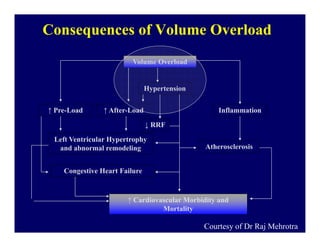
Consequences of Volume Overload
                         Volume Overload


                               Hypertension


↑ Pre-Load      ↑ After-Load                      Inflammation

                               ↓ RRF

 Left Ventricular Hypertrophy
  and abnormal remodeling                     Atherosclerosis


    Congestive Heart Failure


                       ↑ Cardiovascular Morbidity and
                                 Mortality

                                              Courtesy of Dr Raj Mehrotra
Should volume overloaded dialysis
 patients be aggressively ultrafiltered
to β€œdry weight” even if RRF declines?
                No
        Thomas A. Golper, MD, FACP, FASN
        Vanderbilt University Medical Center
                   Nashville, TN
           thomas.golper@vanderbilt.edu

                    Potential Conflict of Interest Disclosure
  Consultant: Baxter Healthcare,
  Honoraria: Baxter, Fresenius North America, Genzyme
Hold it right there.
Doesn’t excess volume kill?
Hold it right there.
Doesn’t excess volume kill?
        It sure does.
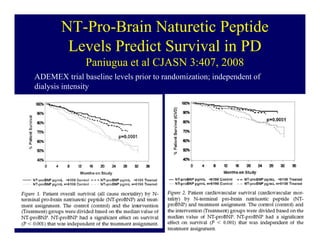
NT-Pro-Brain Naturetic Peptide
        Levels Predict Survival in PD
               Paniugua et al CJASN 3:407, 2008
ADEMEX trial baseline levels prior to randomization; independent of
dialysis intensity
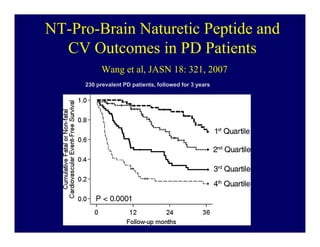
NT-Pro-Brain Naturetic Peptide and
  CV Outcomes in PD Patients
           Wang et al, JASN 18: 321, 2007
     230 prevalent PD patients, followed for 3 years
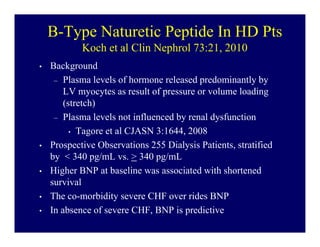
B-Type Naturetic Peptide In HD Pts
            Koch et al Clin Nephrol 73:21, 2010
β€’   Background
     – Plasma levels of hormone released predominantly by
        LV myocytes as result of pressure or volume loading
        (stretch)
     – Plasma levels not influenced by renal dysfunction
          β€’ Tagore et al CJASN 3:1644, 2008

β€’   Prospective Observations 255 Dialysis Patients, stratified
    by < 340 pg/mL vs. > 340 pg/mL
β€’   Higher BNP at baseline was associated with shortened
    survival
β€’   The co-morbidity severe CHF over rides BNP
β€’   In absence of severe CHF, BNP is predictive
Hold it right there.
Doesn’t excess volume kill?
        It sure does.
   But it doesn’t have to.
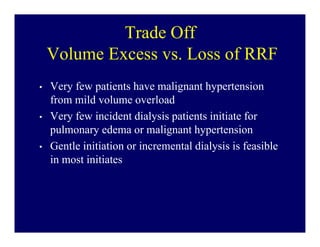
Trade Off
    Volume Excess vs. Loss of RRF
β€’   Very few patients have malignant hypertension
    from mild volume overload
β€’   Very few incident dialysis patients initiate for
    pulmonary edema or malignant hypertension
β€’   Gentle initiation or incremental dialysis is feasible
    in most initiates
What we know about RRF
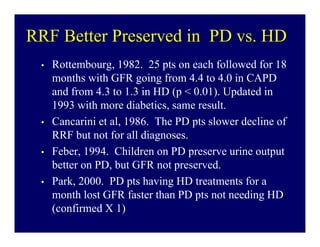
RRF Better Preserved in PD vs. HD
 β€’   Rottembourg, 1982. 25 pts on each followed for 18
     months with GFR going from 4.4 to 4.0 in CAPD
     and from 4.3 to 1.3 in HD (p < 0.01). Updated in
     1993 with more diabetics, same result.
 β€’   Cancarini et al, 1986. The PD pts slower decline of
     RRF but not for all diagnoses.
 β€’   Feber, 1994. Children on PD preserve urine output
     better on PD, but GFR not preserved.
 β€’   Park, 2000. PD pts having HD treatments for a
     month lost GFR faster than PD pts not needing HD
     (confirmed X 1)
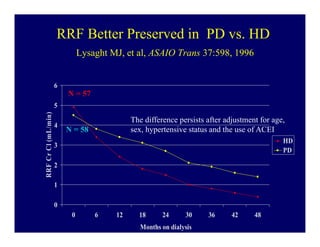
RRF Better Preserved in PD vs. HD
                              Lysaght MJ, et al, ASAIO Trans 37:598, 1996


                     6
                         N = 57
                     5
RRF Cr Cl (mL/min)


                                            The difference persists after adjustment for age,
                     4
                         N = 58             sex, hypertensive status and the use of ACEI
                                                                                            HD
                     3
                                                                                            PD

                     2

                     1

                     0
                          0       6    12     18      24      30    36      42     48
                                               Months on dialysis
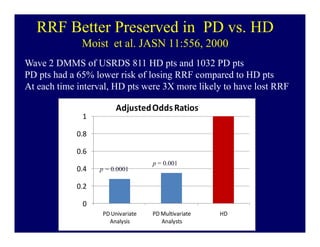
RRF Better Preserved in PD vs. HD
                Moist et al. JASN 11:556, 2000
Wave 2 DMMS of USRDS 811 HD pts and 1032 PD pts
PD pts had a 65% lower risk of losing RRF compared to HD pts
At each time interval, HD pts were 3X more likely to have lost RRF

                          Adjusted Odds Ratios
                1

               0.8
           *
               0.6
                                      p = 0.001
               0.4   p = 0.0001

               0.2

                0
                      PD Univariate   PD Multivariate   HD
.                       Analysis         Analysts
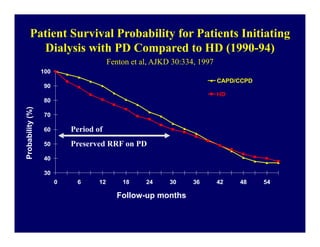
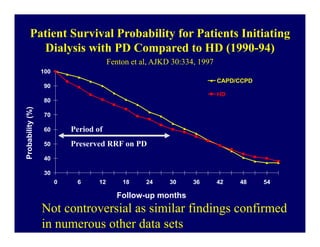
Patient Survival Probability for Patients Initiating
         Dialysis with PD Compared to HD (1990-94)
                                         Fenton et al, AJKD 30:334, 1997
                  100
                                                                           CAPD/CCPD
                  90
                                                                           HD
                  80
Probability (%)


                  70

                  60        Period of
                  50        Preserved RRF on PD
                  40

                  30
                        0    6      12       18     24     30     36       42   48     54

                                           Follow-up months
Patient Survival Probability for Patients Initiating
         Dialysis with PD Compared to HD (1990-94)
                                         Fenton et al, AJKD 30:334, 1997
                  100
                                                                           CAPD/CCPD
                  90
                                                                           HD
                  80
Probability (%)


                  70

                  60        Period of
                  50        Preserved RRF on PD
                  40

                  30
                        0    6      12       18     24     30     36       42   48     54

                                           Follow-up months
                  Not controversial as similar findings confirmed
                  in numerous other data sets
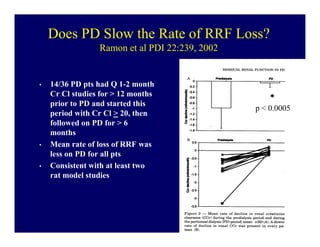
Does PD Slow the Rate of RRF Loss?
                 Ramon et al PDI 22:239, 2002


β€’   14/36 PD pts had Q 1-2 month
    Cr Cl studies for > 12 months
    prior to PD and started this
                                                p < 0.0005
    period with Cr Cl > 20, then
    followed on PD for > 6
    months
β€’   Mean rate of loss of RRF was
    less on PD for all pts
β€’   Consistent with at least two
    rat model studies
Why Would This Be?

β€’   Volume overload at initiation portends a poor outcome
β€’   Is this a condemnation of predialysis care?
     – The damage is already done so the patient’s goose is
        cooked no matter what happens next
β€’   Is this a condemnation of post dialysis care?
     – The patient was left volume overloaded
β€’   Is it merely identifying multi-organ failure?
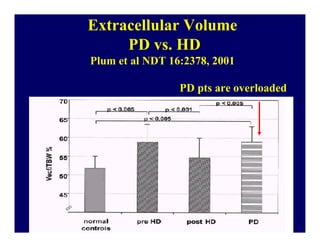
Extracellular Volume
     PD vs. HD
Plum et al NDT 16:2378, 2001

                 PD pts are overloaded
Compared To HD Patients
          PD Patients……
β€’   Are more frequently in volume excess
β€’   Have better early survival
β€’   Have better preservation of RRF
Benefits of RRF In Dialysis Patients
               Dr. Canaud’s talk is next
 β€’   Better BP control
      – Menon et al NDT 16:2207, 2001
      – Ates et al KI 60:767, 2001
 β€’   Higher liklihood of euvolemia
      – Konings et al NDT 18:797
 β€’   Normalization of LVMI
      – Wang et al KI 62:639, 2002
 β€’   Survival
      – Diaz Buxo et al AJKD 33:523, 1999
      – Rocco et al KI 58:446, 2000
      – Bargman et al JASN 12:2158, 2001
The conundrum continues
because volume excess is bad for
          our patients
PD
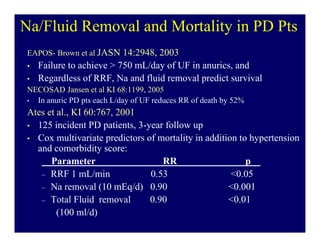
Na/Fluid Removal and Mortality in PD Pts
 EAPOS- Brown et al JASN   14:2948, 2003
 β€’   Failure to achieve > 750 mL/day of UF in anurics, and
 β€’   Regardless of RRF, Na and fluid removal predict survival
 NECOSAD Jansen et al KI 68:1199, 2005
 β€’ In anuric PD pts each L/day of UF reduces RR of death by 52%

 Ates et al., KI 60:767, 2001
 β€’ 125 incident PD patients, 3-year follow up
 β€’ Cox multivariate predictors of mortality in addition to hypertension
   and comorbidity score:
       Parameter                   RR                     p
    – RRF 1 mL/min              0.53                  <0.05
    – Na removal (10 mEq/d) 0.90                     <0.001
    – Total Fluid removal       0.90                 <0.01
         (100 ml/d)
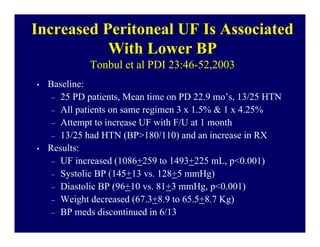
Increased Peritoneal UF Is Associated
           With Lower BP
             Tonbul et al PDI 23:46-52,2003
β€’   Baseline:
     – 25 PD patients, Mean time on PD 22.9 mo’s, 13/25 HTN
     – All patients on same regimen 3 x 1.5% & 1 x 4.25%
     – Attempt to increase UF with F/U at 1 month
     – 13/25 had HTN (BP>180/110) and an increase in RX
β€’   Results:
     – UF increased (1086+259 to 1493+225 mL, p<0.001)
     – Systolic BP (145+13 vs. 128+5 mmHg)
     – Diastolic BP (96+10 vs. 81+3 mmHg, p<0.001)
     – Weight decreased (67.3+8.9 to 65.5+8.7 Kg)
     – BP meds discontinued in 6/13
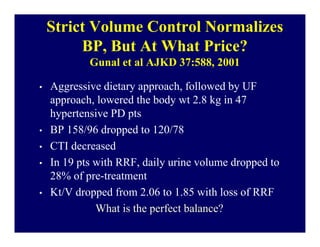
Strict Volume Control Normalizes
         BP, But At What Price?
            Gunal et al AJKD 37:588, 2001

β€’   Aggressive dietary approach, followed by UF
    approach, lowered the body wt 2.8 kg in 47
    hypertensive PD pts
β€’   BP 158/96 dropped to 120/78
β€’   CTI decreased
β€’   In 19 pts with RRF, daily urine volume dropped to
    28% of pre-treatment
β€’   Kt/V dropped from 2.06 to 1.85 with loss of RRF
              What is the perfect balance?
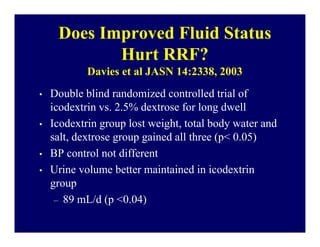
Does Improved Fluid Status
            Hurt RRF?
            Davies et al JASN 14:2338, 2003
β€’   Double blind randomized controlled trial of
    icodextrin vs. 2.5% dextrose for long dwell
β€’   Icodextrin group lost weight, total body water and
    salt, dextrose group gained all three (p< 0.05)
β€’   BP control not different
β€’   Urine volume better maintained in icodextrin
    group
     – 89 mL/d (p <0.04)
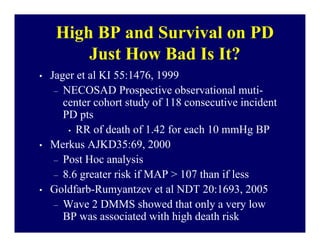
High BP and Survival on PD
         Just How Bad Is It?
β€’   Jager et al KI 55:1476, 1999
     – NECOSAD Prospective observational muti-
       center cohort study of 118 consecutive incident
       PD pts
        β€’ RR of death of 1.42 for each 10 mmHg BP

β€’   Merkus AJKD35:69, 2000
     – Post Hoc analysis
     – 8.6 greater risk if MAP > 107 than if less
β€’   Goldfarb-Rumyantzev et al NDT 20:1693, 2005
     – Wave 2 DMMS showed that only a very low
       BP was associated with high death risk
HD

Hypertension and volume excess in
hemodialysis:
how aggressive should we be and at
what price?
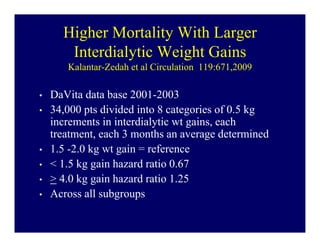
Higher Mortality With Larger
       Interdialytic Weight Gains
       Kalantar-Zedah et al Circulation 119:671,2009

β€’   DaVita data base 2001-2003
β€’   34,000 pts divided into 8 categories of 0.5 kg
    increments in interdialytic wt gains, each
    treatment, each 3 months an average determined
β€’   1.5 -2.0 kg wt gain = reference
β€’   < 1.5 kg gain hazard ratio 0.67
β€’   > 4.0 kg gain hazard ratio 1.25
β€’   Across all subgroups
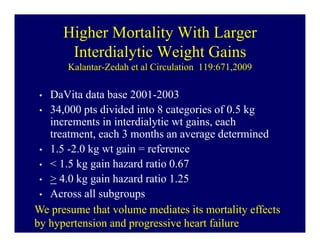
Higher Mortality With Larger
       Interdialytic Weight Gains
       Kalantar-Zedah et al Circulation 119:671,2009

 β€’ DaVita data base 2001-2003
 β€’ 34,000 pts divided into 8 categories of 0.5 kg
   increments in interdialytic wt gains, each
   treatment, each 3 months an average determined
 β€’ 1.5 -2.0 kg wt gain = reference
 β€’ < 1.5 kg gain hazard ratio 0.67
 β€’ > 4.0 kg gain hazard ratio 1.25
 β€’ Across all subgroups
We presume that volume mediates its mortality effects
by hypertension and progressive heart failure
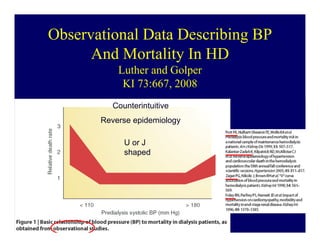
Observational Data Describing BP
      And Mortality In HD
           Luther and Golper
            KI 73:667, 2008
         Counterintuitive
       Reverse epidemiology

            U or J
            shaped
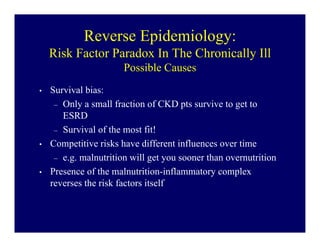
Reverse Epidemiology:
    Risk Factor Paradox In The Chronically Ill
                       Possible Causes
β€’   Survival bias:
     – Only a small fraction of CKD pts survive to get to
       ESRD
     – Survival of the most fit!
β€’   Competitive risks have different influences over time
     – e.g. malnutrition will get you sooner than overnutrition
β€’   Presence of the malnutrition-inflammatory complex
    reverses the risk factors itself
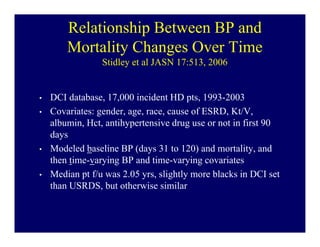
Relationship Between BP and
        Mortality Changes Over Time
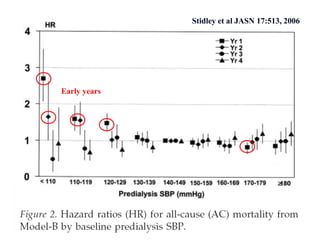
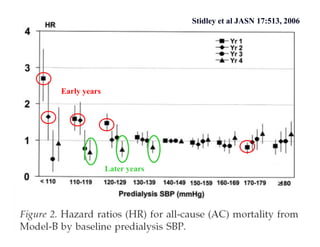
                 Stidley et al JASN 17:513, 2006


β€’   DCI database, 17,000 incident HD pts, 1993-2003
β€’   Covariates: gender, age, race, cause of ESRD, Kt/V,
    albumin, Hct, antihypertensive drug use or not in first 90
    days
β€’   Modeled baseline BP (days 31 to 120) and mortality, and
    then time-varying BP and time-varying covariates
β€’   Median pt f/u was 2.05 yrs, slightly more blacks in DCI set
    than USRDS, but otherwise similar
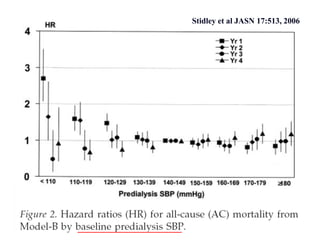
Stidley et al JASN 17:513, 2006


Early years
Stidley et al JASN 17:513, 2006


Early years


              Later years
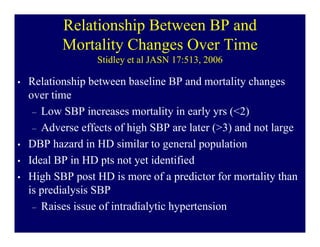
Relationship Between BP and
           Mortality Changes Over Time
                   Stidley et al JASN 17:513, 2006

β€’   Relationship between baseline BP and mortality changes
    over time
     – Low SBP increases mortality in early yrs (<2)
     – Adverse effects of high SBP are later (>3) and not large
β€’   DBP hazard in HD similar to general population
β€’   Ideal BP in HD pts not yet identified
β€’   High SBP post HD is more of a predictor for mortality than
    is predialysis SBP
     – Raises issue of intradialytic hypertension
So now maybe we should treat
hypertension more aggressively in
           HD patients
Achieving BP Targets in HD
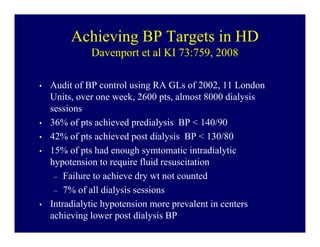
             Davenport et al KI 73:759, 2008

β€’   Audit of BP control using RA GLs of 2002, 11 London
    Units, over one week, 2600 pts, almost 8000 dialysis
    sessions
β€’   36% of pts achieved predialysis BP < 140/90
β€’   42% of pts achieved post dialysis BP < 130/80
β€’   15% of pts had enough symtomatic intradialytic
    hypotension to require fluid resuscitation
     – Failure to achieve dry wt not counted
     – 7% of all dialysis sessions
β€’   Intradialytic hypotension more prevalent in centers
    achieving lower post dialysis BP
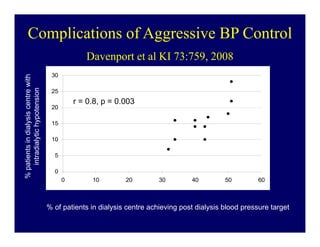
Complications of Aggressive BP Control
                                                  Davenport et al KI 73:759, 2008
                                      30
% patients in dialysis centre with
   intradialytic hypotension


                                      25
                                               r = 0.8, p = 0.003
                                      20

                                      15

                                      10

                                       5

                                       0
                                           0        10        20         30        40         50         60


                                     % of patients in dialysis centre achieving post dialysis blood pressure target
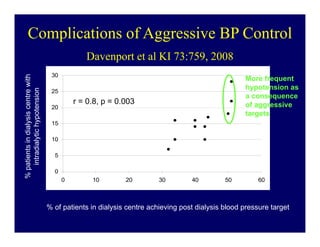
Complications of Aggressive BP Control
                                                  Davenport et al KI 73:759, 2008
                                      30
% patients in dialysis centre with


                                                                                                    More frequent
                                                                                                    hypotension as
   intradialytic hypotension


                                      25
                                                                                                    a consequence
                                               r = 0.8, p = 0.003                                   of aggressive
                                      20
                                                                                                    targets
                                      15

                                      10

                                       5

                                       0
                                           0        10        20         30        40         50         60


                                     % of patients in dialysis centre achieving post dialysis blood pressure target
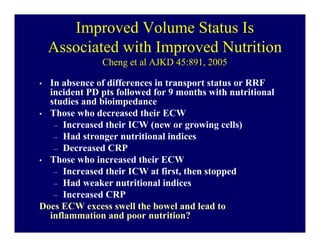
Improved Volume Status Is
    Associated with Improved Nutrition
               Cheng et al AJKD 45:891, 2005

β€’ In absence of differences in transport status or RRF
  incident PD pts followed for 9 months with nutritional
  studies and bioimpedance
β€’ Those who decreased their ECW
   – Increased their ICW (new or growing cells)
   – Had stronger nutritional indices
   – Decreased CRP
β€’ Those who increased their ECW
   – Increased their ICW at first, then stopped
   – Had weaker nutritional indices
   – Increased CRP
Does ECW excess swell the bowel and lead to
  inflammation and poor nutrition?
What are we to do then?
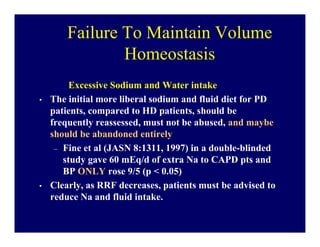
Failure To Maintain Volume
                Homeostasis
         Excessive Sodium and Water intake
β€’   The initial more liberal sodium and fluid diet for PD
    patients, compared to HD patients, should be
    frequently reassessed, must not be abused, and maybe
    should be abandoned entirely
     – Fine et al (JASN 8:1311, 1997) in a double-blinded
       study gave 60 mEq/d of extra Na to CAPD pts and
       BP ONLY rose 9/5 (p < 0.05)
β€’   Clearly, as RRF decreases, patients must be advised to
    reduce Na and fluid intake.
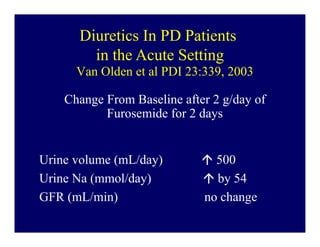
Diuretics In PD Patients
        in the Acute Setting
      Van Olden et al PDI 23:339, 2003

    Change From Baseline after 2 g/day of
           Furosemide for 2 days


Urine volume (mL/day)         500
Urine Na (mmol/day)           by 54
GFR (mL/min)                 no change
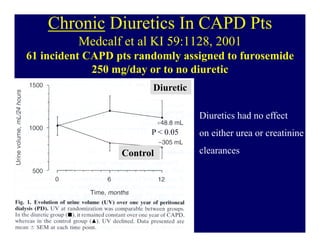
Chronic Diuretics In CAPD Pts
          Medcalf et al KI 59:1128, 2001
61 incident CAPD pts randomly assigned to furosemide
             250 mg/day or to no diuretic
                        Diuretic

                                   Diuretics had no effect
                        P < 0.05   on either urea or creatinine

                  Control          clearances
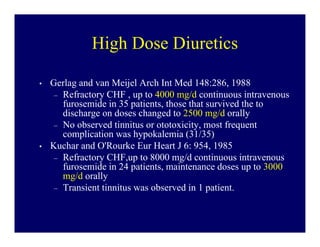
High Dose Diuretics

β€’   Gerlag and van Meijel Arch Int Med 148:286, 1988
     – Refractory CHF , up to 4000 mg/d continuous intravenous
       furosemide in 35 patients, those that survived the to
       discharge on doses changed to 2500 mg/d orally
     – No observed tinnitus or ototoxicity, most frequent
       complication was hypokalemia (31/35)
β€’   Kuchar and O'Rourke Eur Heart J 6: 954, 1985
     – Refractory CHF,up to 8000 mg/d continuous intravenous
       furosemide in 24 patients, maintenance doses up to 3000
       mg/d orally
     – Transient tinnitus was observed in 1 patient.
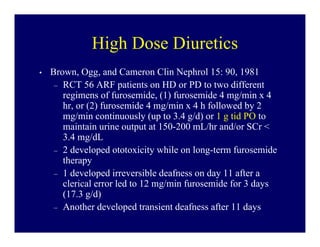
High Dose Diuretics
β€’   Brown, Ogg, and Cameron Clin Nephrol 15: 90, 1981
     – RCT 56 ARF patients on HD or PD to two different
       regimens of furosemide, (1) furosemide 4 mg/min x 4
       hr, or (2) furosemide 4 mg/min x 4 h followed by 2
       mg/min continuously (up to 3.4 g/d) or 1 g tid PO to
       maintain urine output at 150-200 mL/hr and/or SCr <
       3.4 mg/dL
     – 2 developed ototoxicity while on long-term furosemide
       therapy
     – 1 developed irreversible deafness on day 11 after a
       clerical error led to 12 mg/min furosemide for 3 days
       (17.3 g/d)
     – Another developed transient deafness after 11 days
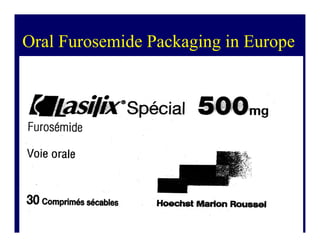
Oral Furosemide Packaging in Europe
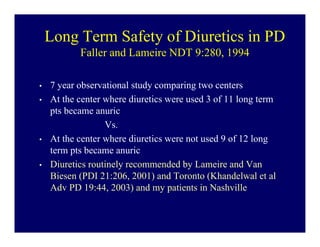
Long Term Safety of Diuretics in PD
           Faller and Lameire NDT 9:280, 1994

β€’   7 year observational study comparing two centers
β€’   At the center where diuretics were used 3 of 11 long term
    pts became anuric
                  Vs.
β€’   At the center where diuretics were not used 9 of 12 long
    term pts became anuric
β€’   Diuretics routinely recommended by Lameire and Van
    Biesen (PDI 21:206, 2001) and Toronto (Khandelwal et al
    Adv PD 19:44, 2003) and my patients in Nashville
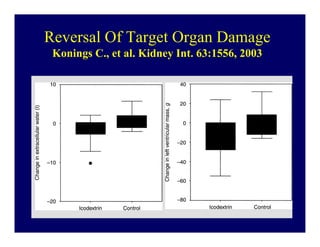
Reversal Of Target Organ Damage
 Konings C., et al. Kidney Int. 63:1556, 2003
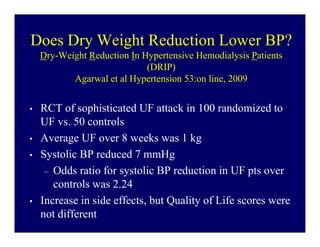
Does Dry Weight Reduction Lower BP?
    Dry-Weight Reduction In Hypertensive Hemodialysis Patients
                             (DRIP)
           Agarwal et al Hypertension 53:on line, 2009


β€’   RCT of sophisticated UF attack in 100 randomized to
    UF vs. 50 controls
β€’   Average UF over 8 weeks was 1 kg
β€’   Systolic BP reduced 7 mmHg
     – Odds ratio for systolic BP reduction in UF pts over
       controls was 2.24
β€’   Increase in side effects, but Quality of Life scores were
    not different
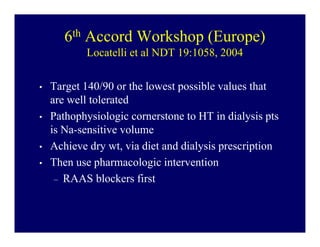
6th Accord Workshop (Europe)
           Locatelli et al NDT 19:1058, 2004

β€’   Target 140/90 or the lowest possible values that
    are well tolerated
β€’   Pathophysiologic cornerstone to HT in dialysis pts
    is Na-sensitive volume
β€’   Achieve dry wt, via diet and dialysis prescription
β€’   Then use pharmacologic intervention
     – RAAS blockers first
6th Accord Workshop (Europe)
           Locatelli et al NDT 19:1058, 2004

β€’   Target 140/90 or the lowest possible values that
    are well tolerated
β€’   Pathophysiologic cornerstone to HT in dialysis pts
    is Na-sensitive volume
β€’   Achieve dry wt, via diet and dialysis prescription
β€’   Then use pharmacologic intervention
     – RAAS blockers first

Residual renal function.dr.Golper

  • 1.
    Residual Renal Function(RRF) Thomas A. Golper, MD, FACP, FASN presiding Program Schedule β€’ 4:45 to 5:05--- Should volume overloaded dialysis patients be aggressively ultrafiltered to β€œdry weight” even if RRF declines? – Thomas Golper β€’ 5:05 to 5:25--- Residual kidney function is a vital tool to improve outcomes – Bernard Canaud β€’ 5:25 to 5:45--- How can we preserve RRF on dialysis? – Isaac Teitelbaum β€’ 5:45 to 6:00 ---Discussion
  • 2.
    Should volume overloadeddialysis patients be aggressively ultrafiltered to β€œdry weight” even if RRF declines? Thomas A. Golper, MD, FACP, FASN Vanderbilt University Medical Center Nashville, TN thomas.golper@vanderbilt.edu Potential Conflict of Interest Disclosure Consultant: Baxter Healthcare, Honoraria: Baxter, Fresenius North America, Genzyme
  • 3.
    Consequences of VolumeOverload Volume Overload Hypertension ↑ Pre-Load ↑ After-Load Inflammation ↓ RRF Left Ventricular Hypertrophy and abnormal remodeling Atherosclerosis Congestive Heart Failure ↑ Cardiovascular Morbidity and Mortality Courtesy of Dr Raj Mehrotra
  • 4.
    Should volume overloadeddialysis patients be aggressively ultrafiltered to β€œdry weight” even if RRF declines? No Thomas A. Golper, MD, FACP, FASN Vanderbilt University Medical Center Nashville, TN thomas.golper@vanderbilt.edu Potential Conflict of Interest Disclosure Consultant: Baxter Healthcare, Honoraria: Baxter, Fresenius North America, Genzyme
  • 5.
    Hold it rightthere. Doesn’t excess volume kill?
  • 6.
    Hold it rightthere. Doesn’t excess volume kill? It sure does.
  • 7.
    NT-Pro-Brain Naturetic Peptide Levels Predict Survival in PD Paniugua et al CJASN 3:407, 2008 ADEMEX trial baseline levels prior to randomization; independent of dialysis intensity
  • 8.
    NT-Pro-Brain Naturetic Peptideand CV Outcomes in PD Patients Wang et al, JASN 18: 321, 2007 230 prevalent PD patients, followed for 3 years
  • 9.
    B-Type Naturetic PeptideIn HD Pts Koch et al Clin Nephrol 73:21, 2010 β€’ Background – Plasma levels of hormone released predominantly by LV myocytes as result of pressure or volume loading (stretch) – Plasma levels not influenced by renal dysfunction β€’ Tagore et al CJASN 3:1644, 2008 β€’ Prospective Observations 255 Dialysis Patients, stratified by < 340 pg/mL vs. > 340 pg/mL β€’ Higher BNP at baseline was associated with shortened survival β€’ The co-morbidity severe CHF over rides BNP β€’ In absence of severe CHF, BNP is predictive
  • 10.
    Hold it rightthere. Doesn’t excess volume kill? It sure does. But it doesn’t have to.
  • 11.
    Trade Off Volume Excess vs. Loss of RRF β€’ Very few patients have malignant hypertension from mild volume overload β€’ Very few incident dialysis patients initiate for pulmonary edema or malignant hypertension β€’ Gentle initiation or incremental dialysis is feasible in most initiates
  • 12.
    What we knowabout RRF
  • 13.
    RRF Better Preservedin PD vs. HD β€’ Rottembourg, 1982. 25 pts on each followed for 18 months with GFR going from 4.4 to 4.0 in CAPD and from 4.3 to 1.3 in HD (p < 0.01). Updated in 1993 with more diabetics, same result. β€’ Cancarini et al, 1986. The PD pts slower decline of RRF but not for all diagnoses. β€’ Feber, 1994. Children on PD preserve urine output better on PD, but GFR not preserved. β€’ Park, 2000. PD pts having HD treatments for a month lost GFR faster than PD pts not needing HD (confirmed X 1)
  • 14.
    RRF Better Preservedin PD vs. HD Lysaght MJ, et al, ASAIO Trans 37:598, 1996 6 N = 57 5 RRF Cr Cl (mL/min) The difference persists after adjustment for age, 4 N = 58 sex, hypertensive status and the use of ACEI HD 3 PD 2 1 0 0 6 12 18 24 30 36 42 48 Months on dialysis
  • 15.
    RRF Better Preservedin PD vs. HD Moist et al. JASN 11:556, 2000 Wave 2 DMMS of USRDS 811 HD pts and 1032 PD pts PD pts had a 65% lower risk of losing RRF compared to HD pts At each time interval, HD pts were 3X more likely to have lost RRF Adjusted Odds Ratios 1 0.8 * 0.6 p = 0.001 0.4 p = 0.0001 0.2 0 PD Univariate PD Multivariate HD . Analysis Analysts
  • 16.
    Patient Survival Probabilityfor Patients Initiating Dialysis with PD Compared to HD (1990-94) Fenton et al, AJKD 30:334, 1997 100 CAPD/CCPD 90 HD 80 Probability (%) 70 60 Period of 50 Preserved RRF on PD 40 30 0 6 12 18 24 30 36 42 48 54 Follow-up months
  • 17.
    Patient Survival Probabilityfor Patients Initiating Dialysis with PD Compared to HD (1990-94) Fenton et al, AJKD 30:334, 1997 100 CAPD/CCPD 90 HD 80 Probability (%) 70 60 Period of 50 Preserved RRF on PD 40 30 0 6 12 18 24 30 36 42 48 54 Follow-up months Not controversial as similar findings confirmed in numerous other data sets
  • 18.
    Does PD Slowthe Rate of RRF Loss? Ramon et al PDI 22:239, 2002 β€’ 14/36 PD pts had Q 1-2 month Cr Cl studies for > 12 months prior to PD and started this p < 0.0005 period with Cr Cl > 20, then followed on PD for > 6 months β€’ Mean rate of loss of RRF was less on PD for all pts β€’ Consistent with at least two rat model studies
  • 19.
    Why Would ThisBe? β€’ Volume overload at initiation portends a poor outcome β€’ Is this a condemnation of predialysis care? – The damage is already done so the patient’s goose is cooked no matter what happens next β€’ Is this a condemnation of post dialysis care? – The patient was left volume overloaded β€’ Is it merely identifying multi-organ failure?
  • 20.
    Extracellular Volume PD vs. HD Plum et al NDT 16:2378, 2001 PD pts are overloaded
  • 21.
    Compared To HDPatients PD Patients…… β€’ Are more frequently in volume excess β€’ Have better early survival β€’ Have better preservation of RRF
  • 22.
    Benefits of RRFIn Dialysis Patients Dr. Canaud’s talk is next β€’ Better BP control – Menon et al NDT 16:2207, 2001 – Ates et al KI 60:767, 2001 β€’ Higher liklihood of euvolemia – Konings et al NDT 18:797 β€’ Normalization of LVMI – Wang et al KI 62:639, 2002 β€’ Survival – Diaz Buxo et al AJKD 33:523, 1999 – Rocco et al KI 58:446, 2000 – Bargman et al JASN 12:2158, 2001
  • 23.
    The conundrum continues becausevolume excess is bad for our patients
  • 24.
  • 25.
    Na/Fluid Removal andMortality in PD Pts EAPOS- Brown et al JASN 14:2948, 2003 β€’ Failure to achieve > 750 mL/day of UF in anurics, and β€’ Regardless of RRF, Na and fluid removal predict survival NECOSAD Jansen et al KI 68:1199, 2005 β€’ In anuric PD pts each L/day of UF reduces RR of death by 52% Ates et al., KI 60:767, 2001 β€’ 125 incident PD patients, 3-year follow up β€’ Cox multivariate predictors of mortality in addition to hypertension and comorbidity score: Parameter RR p – RRF 1 mL/min 0.53 <0.05 – Na removal (10 mEq/d) 0.90 <0.001 – Total Fluid removal 0.90 <0.01 (100 ml/d)
  • 26.
    Increased Peritoneal UFIs Associated With Lower BP Tonbul et al PDI 23:46-52,2003 β€’ Baseline: – 25 PD patients, Mean time on PD 22.9 mo’s, 13/25 HTN – All patients on same regimen 3 x 1.5% & 1 x 4.25% – Attempt to increase UF with F/U at 1 month – 13/25 had HTN (BP>180/110) and an increase in RX β€’ Results: – UF increased (1086+259 to 1493+225 mL, p<0.001) – Systolic BP (145+13 vs. 128+5 mmHg) – Diastolic BP (96+10 vs. 81+3 mmHg, p<0.001) – Weight decreased (67.3+8.9 to 65.5+8.7 Kg) – BP meds discontinued in 6/13
  • 27.
    Strict Volume ControlNormalizes BP, But At What Price? Gunal et al AJKD 37:588, 2001 β€’ Aggressive dietary approach, followed by UF approach, lowered the body wt 2.8 kg in 47 hypertensive PD pts β€’ BP 158/96 dropped to 120/78 β€’ CTI decreased β€’ In 19 pts with RRF, daily urine volume dropped to 28% of pre-treatment β€’ Kt/V dropped from 2.06 to 1.85 with loss of RRF What is the perfect balance?
  • 28.
    Does Improved FluidStatus Hurt RRF? Davies et al JASN 14:2338, 2003 β€’ Double blind randomized controlled trial of icodextrin vs. 2.5% dextrose for long dwell β€’ Icodextrin group lost weight, total body water and salt, dextrose group gained all three (p< 0.05) β€’ BP control not different β€’ Urine volume better maintained in icodextrin group – 89 mL/d (p <0.04)
  • 29.
    High BP andSurvival on PD Just How Bad Is It? β€’ Jager et al KI 55:1476, 1999 – NECOSAD Prospective observational muti- center cohort study of 118 consecutive incident PD pts β€’ RR of death of 1.42 for each 10 mmHg BP β€’ Merkus AJKD35:69, 2000 – Post Hoc analysis – 8.6 greater risk if MAP > 107 than if less β€’ Goldfarb-Rumyantzev et al NDT 20:1693, 2005 – Wave 2 DMMS showed that only a very low BP was associated with high death risk
  • 30.
    HD Hypertension and volumeexcess in hemodialysis: how aggressive should we be and at what price?
  • 31.
    Higher Mortality WithLarger Interdialytic Weight Gains Kalantar-Zedah et al Circulation 119:671,2009 β€’ DaVita data base 2001-2003 β€’ 34,000 pts divided into 8 categories of 0.5 kg increments in interdialytic wt gains, each treatment, each 3 months an average determined β€’ 1.5 -2.0 kg wt gain = reference β€’ < 1.5 kg gain hazard ratio 0.67 β€’ > 4.0 kg gain hazard ratio 1.25 β€’ Across all subgroups
  • 32.
    Higher Mortality WithLarger Interdialytic Weight Gains Kalantar-Zedah et al Circulation 119:671,2009 β€’ DaVita data base 2001-2003 β€’ 34,000 pts divided into 8 categories of 0.5 kg increments in interdialytic wt gains, each treatment, each 3 months an average determined β€’ 1.5 -2.0 kg wt gain = reference β€’ < 1.5 kg gain hazard ratio 0.67 β€’ > 4.0 kg gain hazard ratio 1.25 β€’ Across all subgroups We presume that volume mediates its mortality effects by hypertension and progressive heart failure
  • 33.
    Observational Data DescribingBP And Mortality In HD Luther and Golper KI 73:667, 2008 Counterintuitive Reverse epidemiology U or J shaped
  • 34.
    Reverse Epidemiology: Risk Factor Paradox In The Chronically Ill Possible Causes β€’ Survival bias: – Only a small fraction of CKD pts survive to get to ESRD – Survival of the most fit! β€’ Competitive risks have different influences over time – e.g. malnutrition will get you sooner than overnutrition β€’ Presence of the malnutrition-inflammatory complex reverses the risk factors itself
  • 35.
    Relationship Between BPand Mortality Changes Over Time Stidley et al JASN 17:513, 2006 β€’ DCI database, 17,000 incident HD pts, 1993-2003 β€’ Covariates: gender, age, race, cause of ESRD, Kt/V, albumin, Hct, antihypertensive drug use or not in first 90 days β€’ Modeled baseline BP (days 31 to 120) and mortality, and then time-varying BP and time-varying covariates β€’ Median pt f/u was 2.05 yrs, slightly more blacks in DCI set than USRDS, but otherwise similar
  • 36.
    Stidley et alJASN 17:513, 2006
  • 37.
    Stidley et alJASN 17:513, 2006 Early years
  • 38.
    Stidley et alJASN 17:513, 2006 Early years Later years
  • 39.
    Relationship Between BPand Mortality Changes Over Time Stidley et al JASN 17:513, 2006 β€’ Relationship between baseline BP and mortality changes over time – Low SBP increases mortality in early yrs (<2) – Adverse effects of high SBP are later (>3) and not large β€’ DBP hazard in HD similar to general population β€’ Ideal BP in HD pts not yet identified β€’ High SBP post HD is more of a predictor for mortality than is predialysis SBP – Raises issue of intradialytic hypertension
  • 40.
    So now maybewe should treat hypertension more aggressively in HD patients
  • 41.
    Achieving BP Targetsin HD Davenport et al KI 73:759, 2008 β€’ Audit of BP control using RA GLs of 2002, 11 London Units, over one week, 2600 pts, almost 8000 dialysis sessions β€’ 36% of pts achieved predialysis BP < 140/90 β€’ 42% of pts achieved post dialysis BP < 130/80 β€’ 15% of pts had enough symtomatic intradialytic hypotension to require fluid resuscitation – Failure to achieve dry wt not counted – 7% of all dialysis sessions β€’ Intradialytic hypotension more prevalent in centers achieving lower post dialysis BP
  • 42.
    Complications of AggressiveBP Control Davenport et al KI 73:759, 2008 30 % patients in dialysis centre with intradialytic hypotension 25 r = 0.8, p = 0.003 20 15 10 5 0 0 10 20 30 40 50 60 % of patients in dialysis centre achieving post dialysis blood pressure target
  • 43.
    Complications of AggressiveBP Control Davenport et al KI 73:759, 2008 30 % patients in dialysis centre with More frequent hypotension as intradialytic hypotension 25 a consequence r = 0.8, p = 0.003 of aggressive 20 targets 15 10 5 0 0 10 20 30 40 50 60 % of patients in dialysis centre achieving post dialysis blood pressure target
  • 44.
    Improved Volume StatusIs Associated with Improved Nutrition Cheng et al AJKD 45:891, 2005 β€’ In absence of differences in transport status or RRF incident PD pts followed for 9 months with nutritional studies and bioimpedance β€’ Those who decreased their ECW – Increased their ICW (new or growing cells) – Had stronger nutritional indices – Decreased CRP β€’ Those who increased their ECW – Increased their ICW at first, then stopped – Had weaker nutritional indices – Increased CRP Does ECW excess swell the bowel and lead to inflammation and poor nutrition?
  • 45.
    What are weto do then?
  • 46.
    Failure To MaintainVolume Homeostasis Excessive Sodium and Water intake β€’ The initial more liberal sodium and fluid diet for PD patients, compared to HD patients, should be frequently reassessed, must not be abused, and maybe should be abandoned entirely – Fine et al (JASN 8:1311, 1997) in a double-blinded study gave 60 mEq/d of extra Na to CAPD pts and BP ONLY rose 9/5 (p < 0.05) β€’ Clearly, as RRF decreases, patients must be advised to reduce Na and fluid intake.
  • 47.
    Diuretics In PDPatients in the Acute Setting Van Olden et al PDI 23:339, 2003 Change From Baseline after 2 g/day of Furosemide for 2 days Urine volume (mL/day)  500 Urine Na (mmol/day)  by 54 GFR (mL/min) no change
  • 48.
    Chronic Diuretics InCAPD Pts Medcalf et al KI 59:1128, 2001 61 incident CAPD pts randomly assigned to furosemide 250 mg/day or to no diuretic Diuretic Diuretics had no effect P < 0.05 on either urea or creatinine Control clearances
  • 49.
    High Dose Diuretics β€’ Gerlag and van Meijel Arch Int Med 148:286, 1988 – Refractory CHF , up to 4000 mg/d continuous intravenous furosemide in 35 patients, those that survived the to discharge on doses changed to 2500 mg/d orally – No observed tinnitus or ototoxicity, most frequent complication was hypokalemia (31/35) β€’ Kuchar and O'Rourke Eur Heart J 6: 954, 1985 – Refractory CHF,up to 8000 mg/d continuous intravenous furosemide in 24 patients, maintenance doses up to 3000 mg/d orally – Transient tinnitus was observed in 1 patient.
  • 50.
    High Dose Diuretics β€’ Brown, Ogg, and Cameron Clin Nephrol 15: 90, 1981 – RCT 56 ARF patients on HD or PD to two different regimens of furosemide, (1) furosemide 4 mg/min x 4 hr, or (2) furosemide 4 mg/min x 4 h followed by 2 mg/min continuously (up to 3.4 g/d) or 1 g tid PO to maintain urine output at 150-200 mL/hr and/or SCr < 3.4 mg/dL – 2 developed ototoxicity while on long-term furosemide therapy – 1 developed irreversible deafness on day 11 after a clerical error led to 12 mg/min furosemide for 3 days (17.3 g/d) – Another developed transient deafness after 11 days
  • 51.
  • 52.
    Long Term Safetyof Diuretics in PD Faller and Lameire NDT 9:280, 1994 β€’ 7 year observational study comparing two centers β€’ At the center where diuretics were used 3 of 11 long term pts became anuric Vs. β€’ At the center where diuretics were not used 9 of 12 long term pts became anuric β€’ Diuretics routinely recommended by Lameire and Van Biesen (PDI 21:206, 2001) and Toronto (Khandelwal et al Adv PD 19:44, 2003) and my patients in Nashville
  • 53.
    Reversal Of TargetOrgan Damage Konings C., et al. Kidney Int. 63:1556, 2003
  • 54.
    Does Dry WeightReduction Lower BP? Dry-Weight Reduction In Hypertensive Hemodialysis Patients (DRIP) Agarwal et al Hypertension 53:on line, 2009 β€’ RCT of sophisticated UF attack in 100 randomized to UF vs. 50 controls β€’ Average UF over 8 weeks was 1 kg β€’ Systolic BP reduced 7 mmHg – Odds ratio for systolic BP reduction in UF pts over controls was 2.24 β€’ Increase in side effects, but Quality of Life scores were not different
  • 55.
    6th Accord Workshop(Europe) Locatelli et al NDT 19:1058, 2004 β€’ Target 140/90 or the lowest possible values that are well tolerated β€’ Pathophysiologic cornerstone to HT in dialysis pts is Na-sensitive volume β€’ Achieve dry wt, via diet and dialysis prescription β€’ Then use pharmacologic intervention – RAAS blockers first
  • 56.
    6th Accord Workshop(Europe) Locatelli et al NDT 19:1058, 2004 β€’ Target 140/90 or the lowest possible values that are well tolerated β€’ Pathophysiologic cornerstone to HT in dialysis pts is Na-sensitive volume β€’ Achieve dry wt, via diet and dialysis prescription β€’ Then use pharmacologic intervention – RAAS blockers first