Social innovation and social
entreprenurship
– new role(s) for Universities?
Fredrik Björk
Universities, social innovation & social
entreprenurship
• Universities quick to pick
up social innovation
• R&D projects
• Courses & programs
• Incubators & knowledge
centers
• Cross-sector collaborations
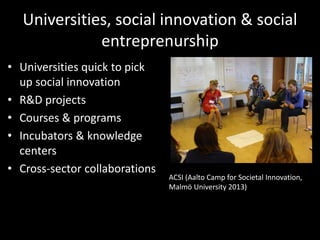
ACSI (Aalto Camp for Societal Innovation,
Malmö University 2013)
• Discourse around the need for academia to be
'relevant' and act on current societal challenges
• Discourse about the need for cross-sector
collaboration and multi-/cross-/transdisciplinary
approaches
• “governance”-approach opens up/gives legitimacy
for “new” actors and collaborations
• An increasing proportion of research funding is
directed towards applied approaches (like
Horizon2020)
Background
• Engaged scholarship US
1960s
• Critical perspectives -
civic, social &
environmental
• Early 1970s: action
research - participatory
research
• Project based education
”The competitive University”
• Higher education as a
market
• Focus on rankings etc.
• Business oriented approach
• ”Education factories”
• ”Employability”
• Higher proportion of
research funding from
external sources/industry
Universities and sustainability
• Big impact in Universities
since 1990s
• Cross-disciplinary /cross-
sector perspectives
• Project-based approach
to learning
• Different directions –
differ in the view on the
view on growth & role of
business/CSR
• When social innovation and social
entreprenurship became household concepts –
many universities, especially in the US, were
quick to pick it up and institutionalize (ex as
courses for MBAs) – mid-1990s – (Harvard
Business School Social Enterprise Initiative)
• Student focus – ”outreach”
• Later in the EU (c. 2005) primarily business
schools as well
• More focus on research (SKOLL Center for Social
Entreprenuership at Oxford)
Courses & programs:
• From modules to masters (ex. social
entrepreneurship and management masters at
RUC)
• campus to moocs; (ex. zukunftsmacher-plattform
,
Kiel U.; U-Lab (edX/MIT))
• Applied; design-thinking; skills for social
entreprenurs; case studies/live cases
Research
• Horizon2020 and other transnational
programs (EU-funding)
• Independent foundations (Ex. Robert Bosch
foundation)
• National funding – (ex FORMAS in Sweden)
• Often emphasize cross-disciplinary and cross
sector approaches
Institutional arrangements:
• Center for Socialt Entreprenørskap, RUC
• Institute for community engaged scholarship,
Uni of Guelph, Canada
• Forum for social innovation Sweden, Mah
• Research – education –
collaboration/knowledge hubs
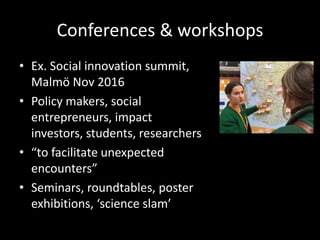
Conferences & workshops
• Ex. Social innovation summit,
Malmö Nov 2016
• Policy makers, social
entrepreneurs, impact
investors, students, researchers
• “to facilitate unexpected
encounters”
• Seminars, roundtables, poster
exhibitions, ‘science slam’
New role(s) for the academy?
• ”The challenge driven university – to solve
global problems”?
• Geoff Mulgan, NESTA
• Student focus
• Collaborative problem solving
• Sustainable development goals

Si new role for universities

  • 1.
    Social innovation andsocial entreprenurship – new role(s) for Universities? Fredrik Björk
  • 2.
    Universities, social innovation& social entreprenurship • Universities quick to pick up social innovation • R&D projects • Courses & programs • Incubators & knowledge centers • Cross-sector collaborations ACSI (Aalto Camp for Societal Innovation, Malmö University 2013)
  • 3.
    • Discourse aroundthe need for academia to be 'relevant' and act on current societal challenges • Discourse about the need for cross-sector collaboration and multi-/cross-/transdisciplinary approaches • “governance”-approach opens up/gives legitimacy for “new” actors and collaborations • An increasing proportion of research funding is directed towards applied approaches (like Horizon2020)
  • 4.
    Background • Engaged scholarshipUS 1960s • Critical perspectives - civic, social & environmental • Early 1970s: action research - participatory research • Project based education
  • 5.
    ”The competitive University” •Higher education as a market • Focus on rankings etc. • Business oriented approach • ”Education factories” • ”Employability” • Higher proportion of research funding from external sources/industry
  • 6.
    Universities and sustainability •Big impact in Universities since 1990s • Cross-disciplinary /cross- sector perspectives • Project-based approach to learning • Different directions – differ in the view on the view on growth & role of business/CSR
  • 7.
    • When socialinnovation and social entreprenurship became household concepts – many universities, especially in the US, were quick to pick it up and institutionalize (ex as courses for MBAs) – mid-1990s – (Harvard Business School Social Enterprise Initiative) • Student focus – ”outreach” • Later in the EU (c. 2005) primarily business schools as well • More focus on research (SKOLL Center for Social Entreprenuership at Oxford)
  • 8.
    Courses & programs: •From modules to masters (ex. social entrepreneurship and management masters at RUC) • campus to moocs; (ex. zukunftsmacher-plattform , Kiel U.; U-Lab (edX/MIT)) • Applied; design-thinking; skills for social entreprenurs; case studies/live cases
  • 9.
    Research • Horizon2020 andother transnational programs (EU-funding) • Independent foundations (Ex. Robert Bosch foundation) • National funding – (ex FORMAS in Sweden) • Often emphasize cross-disciplinary and cross sector approaches
  • 10.
    Institutional arrangements: • Centerfor Socialt Entreprenørskap, RUC • Institute for community engaged scholarship, Uni of Guelph, Canada • Forum for social innovation Sweden, Mah • Research – education – collaboration/knowledge hubs
  • 11.
    Conferences & workshops •Ex. Social innovation summit, Malmö Nov 2016 • Policy makers, social entrepreneurs, impact investors, students, researchers • “to facilitate unexpected encounters” • Seminars, roundtables, poster exhibitions, ‘science slam’
  • 12.
    New role(s) forthe academy? • ”The challenge driven university – to solve global problems”? • Geoff Mulgan, NESTA • Student focus • Collaborative problem solving • Sustainable development goals

Editor's Notes

  • #3 During the last 15 years, the interest in social entrepreneurship and social innovation as strategies to meet challenges in society has grown continuously all over the world. The drivers of this process has largely been social entrepreneurs themselves, but Universities were quick to pick up on this. Today, there is an abundance of research and development projects, courses and programs on different levels as well as different institutional arrangements, such as incubators and knowledge centers. It can be argued that this can be seen as an example of Universities pushing beyond traditional roles of teaching and research towards taking a more active role in society, especially building on cross-sector collaborations.
  • #4 history - in Malmö, researchers from Lund universit engaged in 'kroksbäcksprojektet' from the early 1970s. Social mobilization etc. project was stopped my the city of malmö in 197x because they did not agree with the results