Now We’re Talking! Tool Kit PowerPoint Presentation /C.1
©Alberta Education, Alberta, Canada 2006
The
Conclusion
Chapter
Now We’re Talking! Tool Kit PowerPoint Presentation /C.2
©Alberta Education, Alberta, Canada 2006
Writing conclusions to your dissertation
 Often people feel that conclusions are hard to write;
 However, this usually emerges for a number of non-academic reasons:
 Psychologically you have “finished” your dissertation, so it is hard to write
another chapter;
 You are tired after many time of work;
 You are a little bored with the topic because interesting discoveries have
been made;
 But:
 It is an important chapter, and its significance con not be underestimated;
 Its main purpose is to make a strong impression on the audience and
give a sensation of completeness to the whole paper;
Now We’re Talking! Tool Kit PowerPoint Presentation /C.3
©Alberta Education, Alberta, Canada 2006
 It is connected to the introduction;
 It provides a summary of your research;
 It completes the contents and provides a sense
to the totality to the work;
 It is elaborative and covers all the answers
about the questions raised before in the previous
sections;
 It focuses on the answers and not on questions;
Now We’re Talking! Tool Kit PowerPoint Presentation /C.4
©Alberta Education, Alberta, Canada 2006
Concluding your dissertation
 The conclusion section is where students both summarize and ‘wrap up’
their work;
 Conclusions always have the following features of conclusions (Evans &
Gruba, 2002):
 Conclusions are what the Middle sections/ or Discussion chapter has been
arguing for;
 Conclusion should be a separate chapter from the “Discussion” chapter;
 The Conclusions reached in this chapter should be drawn from the Middle/
or “Discussion" chapter;
 There should be no further discussion in the conclusion’s chapter;
 You are not going to analyze particular issues, you are to give a constructive
and precise evaluation of the work you have conducted;
 Conclusions should respond to the aims that were stated in the first chapter;
Now We’re Talking! Tool Kit PowerPoint Presentation /C.5
©Alberta Education, Alberta, Canada 2006
 According to Morley (2006): conclusions serve the
following purposes:
 Identify common distinctive features of the object of
your study;
 Demonstrate the results of your research;
 Prove the audience that the process of your research:
You succeeded to develop a critical understanding of
range of problems set in the dissertation;
 Do not include any new information and materials not
mentioned before;
Now We’re Talking! Tool Kit PowerPoint Presentation /C.6
©Alberta Education, Alberta, Canada 2006
The importance of conclusions
 For the examination process:
 It is often the last piece of text in the dissertation that
examiners read;
 Examiners may have read the dissertation over a series of
weeks with interruptions and come back to recap via a quick
read of the introduction and conclusion;
 For your longer term research career:
 A good conclusion will provide you with the energy to publish
your work when you come back to recap your findings;
Now We’re Talking! Tool Kit PowerPoint Presentation /C.7
©Alberta Education, Alberta, Canada 2006
The purpose of conclusions
 Tie together, integrate, and synthesize the various
issues raised in the body sections, whilst reflecting the
introductory chapter;
 Provide answers to the dissertation’s research
questions;
 Identify the theoretical and policy implications of the
research with respect to the overall study area;
 Highlight the study’s limitations;
 Provide direction and areas for future research;
Now We’re Talking! Tool Kit PowerPoint Presentation /C.8
©Alberta Education, Alberta, Canada 2006
Basic functions of conclusions
 To summarize:
 What did you research ?
 What is the nature of your main arguments ?
 How did you research ?
 What did you discover ?
 To provide an overview of:
 The new knowledge or information discovered;
 The significance of your research;
 The limitations of your research;
 Speculation on the implications of these limitations;
 Areas for further development and research;
Now We’re Talking! Tool Kit PowerPoint Presentation /C.9
©Alberta Education, Alberta, Canada 2006
Conclusions are statements of the significance of
what they found out;
Often a conclusion chapter is only a few pages
long, as opposed to the Discussion chapter which
should be much longer and much more extensive
in its elaboration and reference to prior research;
Thompson (2005: 317–318) lists the following
conventional sections of conclusion chapters;
Now We’re Talking! Tool Kit PowerPoint Presentation /C.10
©Alberta Education, Alberta, Canada 2006
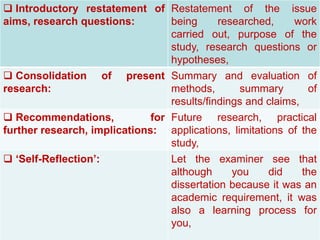
 Introductory restatement of
aims, research questions:
Restatement of the issue
being researched, work
carried out, purpose of the
study, research questions or
hypotheses,
 Consolidation of present
research:
Summary and evaluation of
methods, summary of
results/findings and claims,
 Recommendations, for
further research, implications:
Future research, practical
applications, limitations of the
study,
 ‘Self-Reflection’: Let the examiner see that
although you did the
dissertation because it was an
academic requirement, it was
also a learning process for
you,
Now We’re Talking! Tool Kit PowerPoint Presentation /C.11
©Alberta Education, Alberta, Canada 2006
 Bunton (2005) carried out an examination of the structure of conclusions
chapters;
 There are two main types of conclusions:
 Thesis-oriented conclusion Vs. Field-oriented conclusion;
 Thesis-oriented conclusion: ‘focuses mainly on the thesis itself, beginning
with a restatement of purpose and summary of findings and claims’ (Bunton
2005: 214–5);
 Field-oriented conclusion: ‘focuses mainly on the field and only mentions
the thesis and its findings or contributions in the context of the whole field’
(Bunton 2005: 215);
 Accordingly, conclusions also vary across areas of study;
 For example, conclusions written in the humanities and social sciences tend
to be longer than science and technology conclusions;
Now We’re Talking! Tool Kit PowerPoint Presentation /C.12
©Alberta Education, Alberta, Canada 2006
The language of Conclusions
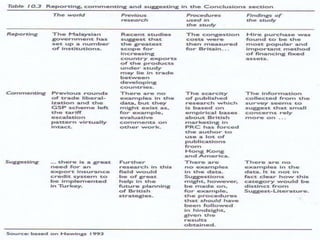
 Hewings (1993) discusses typical language
features of Conclusions;
 He describes how writers report, comment, and
speculate on their findings;
 He found, in his research, that writers typically
refer to one of three things when they do this: the
world, other research, and either the
methodology or findings of the thesis/ or
dissertation itself;
Now We’re Talking! Tool Kit PowerPoint Presentation /C.13
©Alberta Education, Alberta, Canada 2006
Now We’re Talking! Tool Kit PowerPoint Presentation /C.14
©Alberta Education, Alberta, Canada 2006
The content of good conclusions
 Be logical ending and synthesizing what has been previously
discussed and never contain any new information;
 It must pull together all of the parts of your argument and refer
the reader back to the focus you have outlined in your
introduction and to the central topic and thereby create a sense
of unity;
 Be very systematic, brief, and never contain any new
information;
 It should be preferably less than or equal to about 5 pages;
 Add to the overall quality and impact of the research;
Now We’re Talking! Tool Kit PowerPoint Presentation /C.15
©Alberta Education, Alberta, Canada 2006
The “4 Avoids”
 Avoid claiming findings that you have not proven throughout
your research;
 Avoid introducing new data;
 Avoid hiding weaknesses or limitations in your research
(make a virtue of showing strong analytical skills and self-
critique by discussing the limitations);
 Avoid being too long (repetitive) or too short (saying nothing
of importance);
Now We’re Talking! Tool Kit PowerPoint Presentation /C.16
©Alberta Education, Alberta, Canada 2006
Sample conclusion structure
 One paragraph to focus on what you researched and how
you did it;
 One paragraph to focus on what are the main findings
were;
 One paragraph to focus on possible areas for future
research;
 One paragraph reminding readers of the original
contribution and significance of your research to your field;
Now We’re Talking! Tool Kit PowerPoint Presentation /C.17
©Alberta Education, Alberta, Canada 2006
Conclusion
 The conclusion is where you can make the strongest case
for yourself as an academic;
 It is therefore important to know that the conclusion is
often what the examiner or reader remembers best and
should project the best of your work;
 This is your final statement about the research work, thus
it must have a great impact on the examiner;
Now We’re Talking! Tool Kit PowerPoint Presentation /C.18
©Alberta Education, Alberta, Canada 2006
Now We’re Talking! Tool Kit PowerPoint Presentation /C.19
©Alberta Education, Alberta, Canada 2006

Concluding your research

  • 1.
    Now We’re Talking!Tool Kit PowerPoint Presentation /C.1 ©Alberta Education, Alberta, Canada 2006 The Conclusion Chapter
  • 2.
    Now We’re Talking!Tool Kit PowerPoint Presentation /C.2 ©Alberta Education, Alberta, Canada 2006 Writing conclusions to your dissertation  Often people feel that conclusions are hard to write;  However, this usually emerges for a number of non-academic reasons:  Psychologically you have “finished” your dissertation, so it is hard to write another chapter;  You are tired after many time of work;  You are a little bored with the topic because interesting discoveries have been made;  But:  It is an important chapter, and its significance con not be underestimated;  Its main purpose is to make a strong impression on the audience and give a sensation of completeness to the whole paper;
  • 3.
    Now We’re Talking!Tool Kit PowerPoint Presentation /C.3 ©Alberta Education, Alberta, Canada 2006  It is connected to the introduction;  It provides a summary of your research;  It completes the contents and provides a sense to the totality to the work;  It is elaborative and covers all the answers about the questions raised before in the previous sections;  It focuses on the answers and not on questions;
  • 4.
    Now We’re Talking!Tool Kit PowerPoint Presentation /C.4 ©Alberta Education, Alberta, Canada 2006 Concluding your dissertation  The conclusion section is where students both summarize and ‘wrap up’ their work;  Conclusions always have the following features of conclusions (Evans & Gruba, 2002):  Conclusions are what the Middle sections/ or Discussion chapter has been arguing for;  Conclusion should be a separate chapter from the “Discussion” chapter;  The Conclusions reached in this chapter should be drawn from the Middle/ or “Discussion" chapter;  There should be no further discussion in the conclusion’s chapter;  You are not going to analyze particular issues, you are to give a constructive and precise evaluation of the work you have conducted;  Conclusions should respond to the aims that were stated in the first chapter;
  • 5.
    Now We’re Talking!Tool Kit PowerPoint Presentation /C.5 ©Alberta Education, Alberta, Canada 2006  According to Morley (2006): conclusions serve the following purposes:  Identify common distinctive features of the object of your study;  Demonstrate the results of your research;  Prove the audience that the process of your research: You succeeded to develop a critical understanding of range of problems set in the dissertation;  Do not include any new information and materials not mentioned before;
  • 6.
    Now We’re Talking!Tool Kit PowerPoint Presentation /C.6 ©Alberta Education, Alberta, Canada 2006 The importance of conclusions  For the examination process:  It is often the last piece of text in the dissertation that examiners read;  Examiners may have read the dissertation over a series of weeks with interruptions and come back to recap via a quick read of the introduction and conclusion;  For your longer term research career:  A good conclusion will provide you with the energy to publish your work when you come back to recap your findings;
  • 7.
    Now We’re Talking!Tool Kit PowerPoint Presentation /C.7 ©Alberta Education, Alberta, Canada 2006 The purpose of conclusions  Tie together, integrate, and synthesize the various issues raised in the body sections, whilst reflecting the introductory chapter;  Provide answers to the dissertation’s research questions;  Identify the theoretical and policy implications of the research with respect to the overall study area;  Highlight the study’s limitations;  Provide direction and areas for future research;
  • 8.
    Now We’re Talking!Tool Kit PowerPoint Presentation /C.8 ©Alberta Education, Alberta, Canada 2006 Basic functions of conclusions  To summarize:  What did you research ?  What is the nature of your main arguments ?  How did you research ?  What did you discover ?  To provide an overview of:  The new knowledge or information discovered;  The significance of your research;  The limitations of your research;  Speculation on the implications of these limitations;  Areas for further development and research;
  • 9.
    Now We’re Talking!Tool Kit PowerPoint Presentation /C.9 ©Alberta Education, Alberta, Canada 2006 Conclusions are statements of the significance of what they found out; Often a conclusion chapter is only a few pages long, as opposed to the Discussion chapter which should be much longer and much more extensive in its elaboration and reference to prior research; Thompson (2005: 317–318) lists the following conventional sections of conclusion chapters;
  • 10.
    Now We’re Talking!Tool Kit PowerPoint Presentation /C.10 ©Alberta Education, Alberta, Canada 2006  Introductory restatement of aims, research questions: Restatement of the issue being researched, work carried out, purpose of the study, research questions or hypotheses,  Consolidation of present research: Summary and evaluation of methods, summary of results/findings and claims,  Recommendations, for further research, implications: Future research, practical applications, limitations of the study,  ‘Self-Reflection’: Let the examiner see that although you did the dissertation because it was an academic requirement, it was also a learning process for you,
  • 11.
    Now We’re Talking!Tool Kit PowerPoint Presentation /C.11 ©Alberta Education, Alberta, Canada 2006  Bunton (2005) carried out an examination of the structure of conclusions chapters;  There are two main types of conclusions:  Thesis-oriented conclusion Vs. Field-oriented conclusion;  Thesis-oriented conclusion: ‘focuses mainly on the thesis itself, beginning with a restatement of purpose and summary of findings and claims’ (Bunton 2005: 214–5);  Field-oriented conclusion: ‘focuses mainly on the field and only mentions the thesis and its findings or contributions in the context of the whole field’ (Bunton 2005: 215);  Accordingly, conclusions also vary across areas of study;  For example, conclusions written in the humanities and social sciences tend to be longer than science and technology conclusions;
  • 12.
    Now We’re Talking!Tool Kit PowerPoint Presentation /C.12 ©Alberta Education, Alberta, Canada 2006 The language of Conclusions  Hewings (1993) discusses typical language features of Conclusions;  He describes how writers report, comment, and speculate on their findings;  He found, in his research, that writers typically refer to one of three things when they do this: the world, other research, and either the methodology or findings of the thesis/ or dissertation itself;
  • 13.
    Now We’re Talking!Tool Kit PowerPoint Presentation /C.13 ©Alberta Education, Alberta, Canada 2006
  • 14.
    Now We’re Talking!Tool Kit PowerPoint Presentation /C.14 ©Alberta Education, Alberta, Canada 2006 The content of good conclusions  Be logical ending and synthesizing what has been previously discussed and never contain any new information;  It must pull together all of the parts of your argument and refer the reader back to the focus you have outlined in your introduction and to the central topic and thereby create a sense of unity;  Be very systematic, brief, and never contain any new information;  It should be preferably less than or equal to about 5 pages;  Add to the overall quality and impact of the research;
  • 15.
    Now We’re Talking!Tool Kit PowerPoint Presentation /C.15 ©Alberta Education, Alberta, Canada 2006 The “4 Avoids”  Avoid claiming findings that you have not proven throughout your research;  Avoid introducing new data;  Avoid hiding weaknesses or limitations in your research (make a virtue of showing strong analytical skills and self- critique by discussing the limitations);  Avoid being too long (repetitive) or too short (saying nothing of importance);
  • 16.
    Now We’re Talking!Tool Kit PowerPoint Presentation /C.16 ©Alberta Education, Alberta, Canada 2006 Sample conclusion structure  One paragraph to focus on what you researched and how you did it;  One paragraph to focus on what are the main findings were;  One paragraph to focus on possible areas for future research;  One paragraph reminding readers of the original contribution and significance of your research to your field;
  • 17.
    Now We’re Talking!Tool Kit PowerPoint Presentation /C.17 ©Alberta Education, Alberta, Canada 2006 Conclusion  The conclusion is where you can make the strongest case for yourself as an academic;  It is therefore important to know that the conclusion is often what the examiner or reader remembers best and should project the best of your work;  This is your final statement about the research work, thus it must have a great impact on the examiner;
  • 18.
    Now We’re Talking!Tool Kit PowerPoint Presentation /C.18 ©Alberta Education, Alberta, Canada 2006
  • 19.
    Now We’re Talking!Tool Kit PowerPoint Presentation /C.19 ©Alberta Education, Alberta, Canada 2006