Citation Indexing : An Overview

          Vasantha Raju N.
                Librarian
        Govt. First Grade College
               Periyapatna
Outline of the Presentation
•   Concept of Citations
•   Citation Indexing
•   Web of Science databases
•   Limitations of WoS Databases
•   Indian Citation Index (ICI)
•   Why We Need ICI?
•   Benefits of ICI

• The Impact Factor
• Tools for measuring Impact Analysis
     • JCR (Journal Citation Report)
     • Other tools for Measuring the Impact analysis
• Example of Google Scholar and Scholarometer
Concept of Citations

citations symbolize the conceptual association of scientific ideas as
recognized by publishing research authors .

By the references they cite in their papers, authors make explicit
linkages between their current research and prior work in the
archive of scientific literature.
distinction between "citation" and
                          "reference"
     • If Paper R contains a bibliographic footnote using
       and describing Paper C, then
           – R contains a reference to C,
           – C has a citation from R.
     • The number of references a paper has is measured
       by the number of items in its bibliography as
       endnotes, footnotes, etc.,
     • The number of citations a paper has is found by
       looking it up [in a] citation index and seeing how
       many others papers mention it."
Source: Price D. J. D. Little science, big science. and beyond. New York: Columbia University Press, 1986.
Paper R

                …..To start, it is important to clarify the
                terminological distinction between
                "citation“[6] and "reference". In his classic
                book Little Science, Big Science, Derek
                Price gave a clear definition of both terms.
                He said: "It seems to me a great pity to
                waste a good technical term by using the
                words citation and reference
                interchangeably. I therefore propose and
                adopt the convention that if Paper R
                contains a bibliographic footnote using and
                describing Paper C, then R contains…                 R contains a reference to C,

              [6] The concept of citation indexing: A unique and
              innovative tool for navigating the research
              literature. Current Contents, January 3, 1994.


Paper C

              Little science, big science...and beyond.


              This is my first Current Contents® (CC®) essay
              under the rubric of Citation Comments. As
              discussed in last week's CC, this new monthly
              feature will focus on the applications of the
              Institute for Scientific Information's (ISI's)
              databases. 1 An appropriate topic to launch this
                                                                         C has a citation from R.
              new series is perhaps the most rudimentary -- the
              basic concept of citation indexing.
              To start, it is important to clarify the
              terminological distinction between "citation" and
              "reference". In his classic book Little Science, Big
              Science, Derek Price gave a clear definition of both
              terms. He said: "It seems to me a great pity to
              waste a good technical term by using the words
              citation and reference interchangeably. I therefore
              propose and adopt the convention that if Paper R
              contains a bibliographic footnote using and
              describing Paper C, then R contains a.


adopted from : Mathew, N. (n.d.). Citation indexing. Retrieved from http://ist.psu.edu/faculty_pages/giles/IST497/presentations/Mathew.ppt
Citation Indexing
• Introduced by Dr. Eugene Garfield of Institute of Scientific
  Information (Web of Science) in 1950s.

• Citation indexing makes links between books and articles that
  were written in the past and articles that make reference to
  ("cite") these older publications. In other words, it is a technique
  that allows us to trace the use of an idea (an earlier document)
  forward to others who have used ("cited") it.

• The citation indexes were originally designed primarily for
  information retrieval. Helps for identifying the relevant research
  papers independent of language, title words, or author keywords
ISI Web of Science Databases
• Science Citation Index Expanded(SCI)
• Social Science Citation Index (SSCI)
• Arts and Humanities Citation Index (A&HCI)
WoS Search Interface
Advantages of Citation Indexing
• SCI, SSCI and A&HCI are multidisciplinary in nature..
• The citation-based associations and connections within
  the literature are made by authors themselves.
• Helps for identifying the core periodicals in a subject.
• Helps for quantifying or measuring the research
  productivity of an institution or individual or country
  or region.
Limitations of WoS Databases

• Majority of the journals are from US.
• Less presence of journals published from third world
  countries.
• Only index journals not monographs
• Non-English language journals are not as
  comprehensively indexed (Mathew, n.d.)
Indian Citation Index
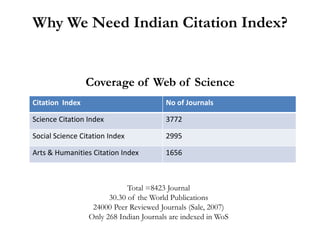
Why We Need Indian Citation Index?


                 Coverage of Web of Science
Citation Index                          No of Journals

Science Citation Index                  3772

Social Science Citation Index           2995

Arts & Humanities Citation Index        1656


                             Total =8423 Journal
                       30.30 of the World Publications
                  24000 Peer Reviewed Journals (Sale, 2007)
                 Only 268 Indian Journals are indexed in WoS
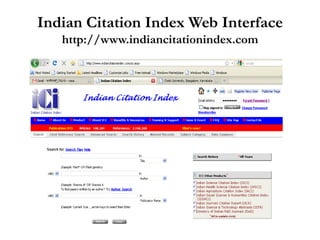
Indian Citation Index Web Interface
   http://www.indiancitationindex.com
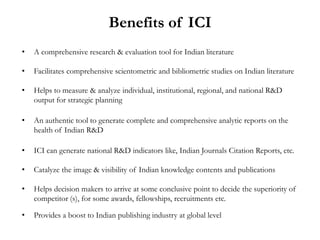
Benefits of ICI
•   A comprehensive research & evaluation tool for Indian literature

•   Facilitates comprehensive scientometric and bibliometric studies on Indian literature

•   Helps to measure & analyze individual, institutional, regional, and national R&D
    output for strategic planning

•   An authentic tool to generate complete and comprehensive analytic reports on the
    health of Indian R&D

•   ICI can generate national R&D indicators like, Indian Journals Citation Reports, etc.

•   Catalyze the image & visibility of Indian knowledge contents and publications

•   Helps decision makers to arrive at some conclusive point to decide the superiority of
    competitor (s), for some awards, fellowships, recruitments etc.

•   Provides a boost to Indian publishing industry at global level
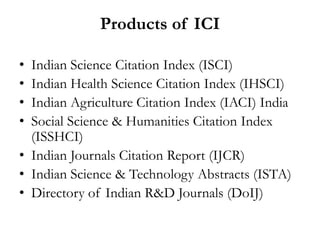
Products of ICI

• Indian Science Citation Index (ISCI)
• Indian Health Science Citation Index (IHSCI)
• Indian Agriculture Citation Index (IACI) India
• Social Science & Humanities Citation Index
  (ISSHCI)
• Indian Journals Citation Report (IJCR)
• Indian Science & Technology Abstracts (ISTA)
• Directory of Indian R&D Journals (DoIJ)
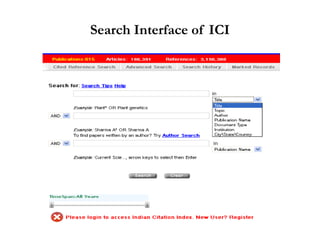
Search Interface of ICI
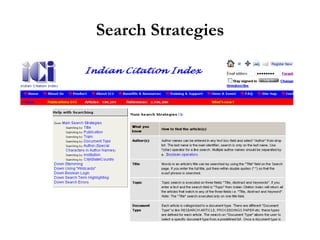
Search Strategies
• What are the criteria for adding new journals
                     to ICI?

    ICI works with its basic intent to cover all scholarly
   journals from India irrespective of their discipline (s)
             subject to content selection criteria
Indexing Research Materials


• Research articles
• Review articles
• Short or brief communications
• Editorial and letter to editor
• Research notes
• Case studies
• Case reports
• Opinion papers
• Observations
The Impact Factor
• The impact factor is a measure of the frequency with
  which the average article in a journal has been cited in a
  particular year or period.

• JCR (Journal Citation Report) of WoS has been major
  tool for measuring the Impact factor of journals.
JCR Impact Factor
• The JCR provides quantitative tools for ranking, evaluating,
  categorizing, and comparing journals (Thomson Reuters, 2011).

• JCR impact factor is a ratio between citations and recent citable
  items published.
• Thus, the impact factor of a journal is calculated by dividing the
  number of current year citations to the source items published in
  that journal during the previous two years
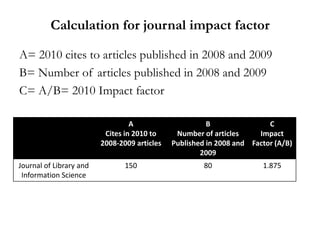
Calculation for journal impact factor

A= 2010 cites to articles published in 2008 and 2009
B= Number of articles published in 2008 and 2009
C= A/B= 2010 Impact factor

                                  A                     B                C
                          Cites in 2010 to     Number of articles     Impact
                         2008-2009 articles   Published in 2008 and Factor (A/B)
                                                      2009
Journal of Library and          150                    80              1.875
 Information Science
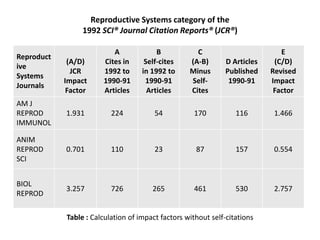
Reproductive Systems category of the
                 1992 SCI® Journal Citation Reports® (JCR®)

                          A              B           C                         E
Reproduct
             (A/D)     Cites in      Self-cites    (A-B)       D Articles    (C/D)
ive
              JCR      1992 to      in 1992 to     Minus       Published    Revised
Systems
            Impact     1990-91       1990-91       Self-        1990-91     Impact
Journals
             Factor    Articles       Articles     Cites                     Factor
AM J
REPROD      1.931         224           54          170           116        1.466
IMMUNOL

ANIM
REPROD      0.701         110           23           87           157        0.554
SCI


BIOL
            3.257         726          265          461           530        2.757
REPROD

            Table : Calculation of impact factors without self-citations
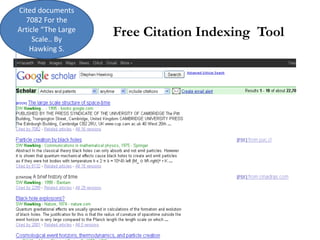
Free Citation Indexing Tool
Cited documents
  7082 For the
Article “The Large
     Scale.. By
                     Free Citation Indexing Tool
    Hawking S.
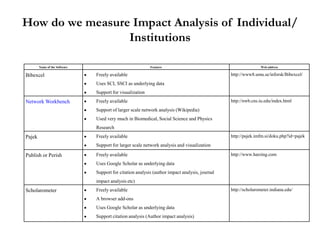
How do we measure Impact Analysis of Individual/
                 Institutions

        Name of the Software                               Features                                             Web address

Bibexcel                       Freely available                                                 http://www8.umu.se/inforsk/Bibexcel/
                               Uses SCI, SSCI as underlying data
                               Support for visualization
Network Workbench              Freely available                                                 http://nwb.cns.iu.edu/index.html
                               Support of larger scale network analysis (Wikipedia)
                               Used very much in Biomedical, Social Science and Physics
                               Research
Pajek                          Freely available                                                 http://pajek.imfm.si/doku.php?id=pajek
                               Support for larger scale network analysis and visualization

Publish or Perish              Freely available                                                 http://www.harzing.com
                               Uses Google Scholar as underlying data
                               Support for citation analysis (author impact analysis, journal
                               impact analysis etc)
Scholarometer                  Freely available                                                 http://scholarometer.indiana.edu/
                               A browser add-ons
                               Uses Google Scholar as underlying data
                               Support citation analysis (Author impact analysis)
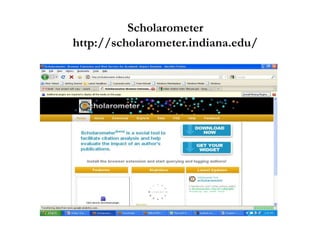
Scholarometer
http://scholarometer.indiana.edu/
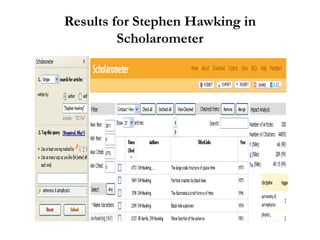
Results for Stephen Hawking in
         Scholarometer
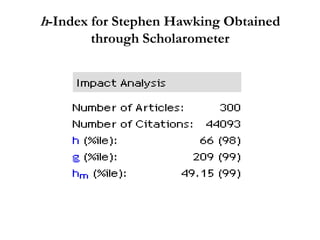
h-Index for Stephen Hawking Obtained
       through Scholarometer
Thank You

Citation indexing

  • 1.
    Citation Indexing :An Overview Vasantha Raju N. Librarian Govt. First Grade College Periyapatna
  • 2.
    Outline of thePresentation • Concept of Citations • Citation Indexing • Web of Science databases • Limitations of WoS Databases • Indian Citation Index (ICI) • Why We Need ICI? • Benefits of ICI • The Impact Factor • Tools for measuring Impact Analysis • JCR (Journal Citation Report) • Other tools for Measuring the Impact analysis • Example of Google Scholar and Scholarometer
  • 3.
    Concept of Citations citationssymbolize the conceptual association of scientific ideas as recognized by publishing research authors . By the references they cite in their papers, authors make explicit linkages between their current research and prior work in the archive of scientific literature.
  • 4.
    distinction between "citation"and "reference" • If Paper R contains a bibliographic footnote using and describing Paper C, then – R contains a reference to C, – C has a citation from R. • The number of references a paper has is measured by the number of items in its bibliography as endnotes, footnotes, etc., • The number of citations a paper has is found by looking it up [in a] citation index and seeing how many others papers mention it." Source: Price D. J. D. Little science, big science. and beyond. New York: Columbia University Press, 1986.
  • 5.
    Paper R …..To start, it is important to clarify the terminological distinction between "citation“[6] and "reference". In his classic book Little Science, Big Science, Derek Price gave a clear definition of both terms. He said: "It seems to me a great pity to waste a good technical term by using the words citation and reference interchangeably. I therefore propose and adopt the convention that if Paper R contains a bibliographic footnote using and describing Paper C, then R contains… R contains a reference to C, [6] The concept of citation indexing: A unique and innovative tool for navigating the research literature. Current Contents, January 3, 1994. Paper C Little science, big science...and beyond. This is my first Current Contents® (CC®) essay under the rubric of Citation Comments. As discussed in last week's CC, this new monthly feature will focus on the applications of the Institute for Scientific Information's (ISI's) databases. 1 An appropriate topic to launch this C has a citation from R. new series is perhaps the most rudimentary -- the basic concept of citation indexing. To start, it is important to clarify the terminological distinction between "citation" and "reference". In his classic book Little Science, Big Science, Derek Price gave a clear definition of both terms. He said: "It seems to me a great pity to waste a good technical term by using the words citation and reference interchangeably. I therefore propose and adopt the convention that if Paper R contains a bibliographic footnote using and describing Paper C, then R contains a. adopted from : Mathew, N. (n.d.). Citation indexing. Retrieved from http://ist.psu.edu/faculty_pages/giles/IST497/presentations/Mathew.ppt
  • 6.
    Citation Indexing • Introducedby Dr. Eugene Garfield of Institute of Scientific Information (Web of Science) in 1950s. • Citation indexing makes links between books and articles that were written in the past and articles that make reference to ("cite") these older publications. In other words, it is a technique that allows us to trace the use of an idea (an earlier document) forward to others who have used ("cited") it. • The citation indexes were originally designed primarily for information retrieval. Helps for identifying the relevant research papers independent of language, title words, or author keywords
  • 7.
    ISI Web ofScience Databases • Science Citation Index Expanded(SCI) • Social Science Citation Index (SSCI) • Arts and Humanities Citation Index (A&HCI)
  • 8.
  • 9.
    Advantages of CitationIndexing • SCI, SSCI and A&HCI are multidisciplinary in nature.. • The citation-based associations and connections within the literature are made by authors themselves. • Helps for identifying the core periodicals in a subject. • Helps for quantifying or measuring the research productivity of an institution or individual or country or region.
  • 10.
    Limitations of WoSDatabases • Majority of the journals are from US. • Less presence of journals published from third world countries. • Only index journals not monographs • Non-English language journals are not as comprehensively indexed (Mathew, n.d.)
  • 11.
  • 12.
    Why We NeedIndian Citation Index? Coverage of Web of Science Citation Index No of Journals Science Citation Index 3772 Social Science Citation Index 2995 Arts & Humanities Citation Index 1656 Total =8423 Journal 30.30 of the World Publications 24000 Peer Reviewed Journals (Sale, 2007) Only 268 Indian Journals are indexed in WoS
  • 13.
    Indian Citation IndexWeb Interface http://www.indiancitationindex.com
  • 14.
    Benefits of ICI • A comprehensive research & evaluation tool for Indian literature • Facilitates comprehensive scientometric and bibliometric studies on Indian literature • Helps to measure & analyze individual, institutional, regional, and national R&D output for strategic planning • An authentic tool to generate complete and comprehensive analytic reports on the health of Indian R&D • ICI can generate national R&D indicators like, Indian Journals Citation Reports, etc. • Catalyze the image & visibility of Indian knowledge contents and publications • Helps decision makers to arrive at some conclusive point to decide the superiority of competitor (s), for some awards, fellowships, recruitments etc. • Provides a boost to Indian publishing industry at global level
  • 15.
    Products of ICI •Indian Science Citation Index (ISCI) • Indian Health Science Citation Index (IHSCI) • Indian Agriculture Citation Index (IACI) India • Social Science & Humanities Citation Index (ISSHCI) • Indian Journals Citation Report (IJCR) • Indian Science & Technology Abstracts (ISTA) • Directory of Indian R&D Journals (DoIJ)
  • 16.
  • 17.
  • 18.
    • What arethe criteria for adding new journals to ICI? ICI works with its basic intent to cover all scholarly journals from India irrespective of their discipline (s) subject to content selection criteria
  • 19.
    Indexing Research Materials •Research articles • Review articles • Short or brief communications • Editorial and letter to editor • Research notes • Case studies • Case reports • Opinion papers • Observations
  • 20.
    The Impact Factor •The impact factor is a measure of the frequency with which the average article in a journal has been cited in a particular year or period. • JCR (Journal Citation Report) of WoS has been major tool for measuring the Impact factor of journals.
  • 21.
    JCR Impact Factor •The JCR provides quantitative tools for ranking, evaluating, categorizing, and comparing journals (Thomson Reuters, 2011). • JCR impact factor is a ratio between citations and recent citable items published. • Thus, the impact factor of a journal is calculated by dividing the number of current year citations to the source items published in that journal during the previous two years
  • 22.
    Calculation for journalimpact factor A= 2010 cites to articles published in 2008 and 2009 B= Number of articles published in 2008 and 2009 C= A/B= 2010 Impact factor A B C Cites in 2010 to Number of articles Impact 2008-2009 articles Published in 2008 and Factor (A/B) 2009 Journal of Library and 150 80 1.875 Information Science
  • 23.
    Reproductive Systems categoryof the 1992 SCI® Journal Citation Reports® (JCR®) A B C E Reproduct (A/D) Cites in Self-cites (A-B) D Articles (C/D) ive JCR 1992 to in 1992 to Minus Published Revised Systems Impact 1990-91 1990-91 Self- 1990-91 Impact Journals Factor Articles Articles Cites Factor AM J REPROD 1.931 224 54 170 116 1.466 IMMUNOL ANIM REPROD 0.701 110 23 87 157 0.554 SCI BIOL 3.257 726 265 461 530 2.757 REPROD Table : Calculation of impact factors without self-citations
  • 24.
  • 25.
    Cited documents 7082 For the Article “The Large Scale.. By Free Citation Indexing Tool Hawking S.
  • 26.
    How do wemeasure Impact Analysis of Individual/ Institutions Name of the Software Features Web address Bibexcel Freely available http://www8.umu.se/inforsk/Bibexcel/ Uses SCI, SSCI as underlying data Support for visualization Network Workbench Freely available http://nwb.cns.iu.edu/index.html Support of larger scale network analysis (Wikipedia) Used very much in Biomedical, Social Science and Physics Research Pajek Freely available http://pajek.imfm.si/doku.php?id=pajek Support for larger scale network analysis and visualization Publish or Perish Freely available http://www.harzing.com Uses Google Scholar as underlying data Support for citation analysis (author impact analysis, journal impact analysis etc) Scholarometer Freely available http://scholarometer.indiana.edu/ A browser add-ons Uses Google Scholar as underlying data Support citation analysis (Author impact analysis)
  • 27.
  • 28.
    Results for StephenHawking in Scholarometer
  • 29.
    h-Index for StephenHawking Obtained through Scholarometer
  • 30.