Research Proposal
A - Z
By-
Md Ramim Tanver Rahman
Sir Tanver ( wechat : T18800591830 )
Facebook : Md Ramim Tanver Rahman
Research Proposal
lWhat is a research proposal
lThe importance of the research proposal
lBasic principles
lThe length of a research proposal
lFormalities
lSelf Assessment of theProposal
1. What is a researchproposal
1.1 definition
l "a document that presents a case for an idea and
the action one proposeswith respect to it."
lpurpose:
"to justify whatyou plan todo in order togain
approval for it."
content: a plan &outline
l central issues or research questions
l research methods
l the significance of the research
function No. 1: informative
l (1) the background and context of your research
l(2) present understandings and knowledge on the topic.
l(3) how your research adds to, develops (or challenges)
existing literature
function No. 2: persuasive --- “Will it work??”
lthe research question is significant enough
l the method you plan to use is suitable and feasible
lthe results are likely to prove fruitful.
2. Importance of the researchproposal
(1) direction and map for yourresearch
Ø what you willdo,
Ø why it should bedone,
Ø how you will do itand
Ø what result you willexpect
(2) sell yourresearch idea toyoursupervisor.
Ø think through the wholeproject
Ø condsider problems that mayoccur
Ø estimate thesize of a project
(3) theopportunity foryouryoursupervisorto
evaluate theproject
Ø whether the resultsare likely to be significant?
Ø an appropriatemethodology?
Ø conclusionsareconsistentwith youraims?
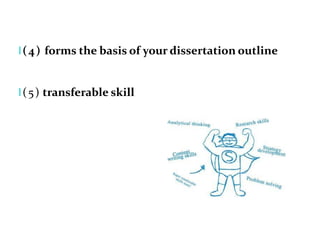
l(4) forms the basis of your dissertation outline
l(5) transferable skill
3. Basic principles
l(1). A good proposal explains clearly three elements
Ø what research is intended,
Ø why it is being researched and
Ø how the researcher proposes to carry out the
research.
l(2). A good proposal is straightforward.
l(3). A good proposal uses clear and precise language.
l(4). A good proposal should be clearly organised.
l(5). The nature -- not fully binding
Ø Yourproposal does NOT permanently setwhatyou will
do.
Ø Good proposals evolve as the workprogresses.
Ø yourproposal as an initial outline ora starting point
rather than a summaryof the ‘final product’.
4. The length of a researchproposal
lprinciple
Ø noset length fora proposal,
Ø to provide enoughinformation
Ø toavoid becoming unnecessarilywordyorrepetitive
lrecommended length
Ø 2,000 words long, plus references andbibliography
Ø maximum 5000 words
5. Elements of researchproposal
l Cover page / Title page
l Abstract
l Introduction
l Issues / Research Question
lSignificance of theResearch
lLiterature Review
lMethodology
lTable of Contents /Outline
lTimetable
l Bibliography
5.1 Cover page / Titlepage
lnecessary elements:
Ø your name, student ID,department
Ø supervisor/s,
Ø title of yourdissertation.
ltitle:
Ø The title should beshort.
Ø This is just a tentative /working title
Ø The title should beindicative.
Ø Itshould beconsistentwith theoutline.
ABSTRACT
Ø on a separate page, immediately following the title page
Ø at the topof the page in all-capital letters
Ø less than 200words
Ø brief summary / acondensed outline / quick overview
Ø including a short introduction,your research
questions, research methods and possibleimplications
Ø Be especiallyalert
5.3 Introduction / Rationale /Statement of Topic
l the broad background of your research
Ø a brief overview of area and current state of knowledge
Ø recent debates on thetopic
Ø recent events
Ø the major issue, problem, or gap in knowledge.
Ø a legal framework
l Howdid the problem or issuearise?
l Why is thisan importantarea tostudy? (the practical
and/or theoretical value of theresearch)
l Are there any underlying assumptions?
l Definitions of key terms or concepts ?
5.4 Issues / research question:
l questions that you seek to answer through your research
l the most important aspect; the focal point
l the clarity of the research question
l to reflect & refine: manageable project
lWhat legal orgovernancequestion(s) doyou intend to
investigate?
lWhat problem areyou trying to resolve?
lWhat will be the purposeof your findings?
lWhat new understanding areyou trying to provide?
5.5 Importance/Significance of Research
Think about howyourresearch may be used:
Ø may resolve theoretical questions in yourarea
Ø maydevelop bettertheoretical models inyourarea
Ø may correct a misunderstanding of thelaw
Ø may providesolutions toa legal problem
Ø may lead to lawreform
Ø may influence publicpolicy
Ø maychange theway people behave
5.6 Research Methodology
ltwo questions:
Ø what approach you will adoptand
Ø why this particularapproach is suitatble
l doctrinal
library-based, relying on information that alreadyexists
l comparative study
l fieldwork or empirical study
gathering information through direct interactionwith
people andprocesses
l historical approach
5.7 literature review
(1) definition
l a critical summary and assessment of the range of
existing materials dealing with knowledge and
understanding in a givenfield….
lIts purpose is to locate the research project, to form its
context or background, and to provide insights into
previous work.
(2)content
–what is already known on the topic;
–how to integrate yourstudy intoa broader framework
of relevant theory andresearch:
relate to, build on & develop, or differsfrom
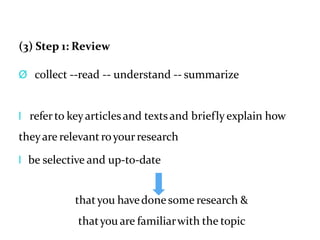
(3) Step 1: Review
Ø collect --read -- understand -- summarize
l referto keyarticlesand textsand briefly explain how
theyare relevantroyourresearch
l be selective and up-to-date
thatyou havedonesome research &
thatyou are familiarwith the topic
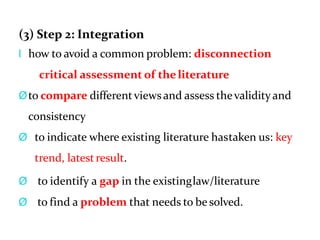
(3) Step 2: Integration
l how to avoid a common problem: disconnection
critical assessment of theliterature
Øto compare differentviewsand assess thevalidityand
consistency
Ø to indicate where existing literature hastaken us: key
trend, latestresult.
Ø to identify a gap in the existinglaw/literature
Ø to find a problem that needs to be solved.
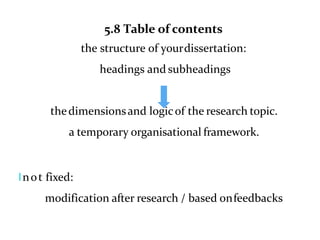
5.8 Table of contents
the structure of yourdissertation:
headings and subheadings
thedimensionsand logicof the research topic.
a temporary organisational framework.
lnot fixed:
modification after research / based onfeedbacks
5.9 Timetable:
l a schedule and plan
tasks and chapters -- stages and timeperiod
l It is possible torevise the timetable.
l D o not underestimate theamountof time you need.
5.10 References and Bibliography
l(1) it should be fully referenced
l(2) include a short bibliography
Ø not need to becomplete
Ø indicative: the most relevantworks
Ø does not count towards theword limit
Ø goes beyond citedwork
lFollow a standard referencingsystem: OSCOLA
6. Formalities
Ø typewritten in TimesNew Roman,
Ø 12 point fontsized,
Ø 1.5 - spaced.
7. Self Assessment of the Proposal
a check list: 10questions
Ø (1) Is the titleclearand concise?
Ø (2) Is the research questionmanageable?
Ø (3) Does the literaturereview draw on authors from
wide range of materials?
Ø (4) Is the proposed research methods suitableto
answer the researchquestion?
Ø (5 ) Is the time planfeasible?
Ø (6) Doeseach footnoteand each item in the
bibliography follow theOSCOLA?
Ø (7) Is itdescriptiveordoes it reflectyourcritical
thinking?
Ø (8 )Is it up todate?
Ø (9) Is it written in a fluent, easy to read style?
Ø (10) Are there spelling, grammarand punctuation
mistakes?

Research proposal

  • 1.
    Research Proposal A -Z By- Md Ramim Tanver Rahman Sir Tanver ( wechat : T18800591830 ) Facebook : Md Ramim Tanver Rahman
  • 2.
    Research Proposal lWhat isa research proposal lThe importance of the research proposal lBasic principles lThe length of a research proposal lFormalities lSelf Assessment of theProposal
  • 3.
    1. What isa researchproposal 1.1 definition l "a document that presents a case for an idea and the action one proposeswith respect to it." lpurpose: "to justify whatyou plan todo in order togain approval for it."
  • 4.
    content: a plan&outline l central issues or research questions l research methods l the significance of the research
  • 5.
    function No. 1:informative l (1) the background and context of your research l(2) present understandings and knowledge on the topic. l(3) how your research adds to, develops (or challenges) existing literature
  • 6.
    function No. 2:persuasive --- “Will it work??” lthe research question is significant enough l the method you plan to use is suitable and feasible lthe results are likely to prove fruitful.
  • 7.
    2. Importance ofthe researchproposal (1) direction and map for yourresearch Ø what you willdo, Ø why it should bedone, Ø how you will do itand Ø what result you willexpect
  • 8.
    (2) sell yourresearchidea toyoursupervisor. Ø think through the wholeproject Ø condsider problems that mayoccur Ø estimate thesize of a project
  • 9.
    (3) theopportunity foryouryoursupervisorto evaluatetheproject Ø whether the resultsare likely to be significant? Ø an appropriatemethodology? Ø conclusionsareconsistentwith youraims?
  • 10.
    l(4) forms thebasis of your dissertation outline l(5) transferable skill
  • 11.
    3. Basic principles l(1).A good proposal explains clearly three elements Ø what research is intended, Ø why it is being researched and Ø how the researcher proposes to carry out the research. l(2). A good proposal is straightforward. l(3). A good proposal uses clear and precise language. l(4). A good proposal should be clearly organised.
  • 12.
    l(5). The nature-- not fully binding Ø Yourproposal does NOT permanently setwhatyou will do. Ø Good proposals evolve as the workprogresses. Ø yourproposal as an initial outline ora starting point rather than a summaryof the ‘final product’.
  • 13.
    4. The lengthof a researchproposal lprinciple Ø noset length fora proposal, Ø to provide enoughinformation Ø toavoid becoming unnecessarilywordyorrepetitive lrecommended length Ø 2,000 words long, plus references andbibliography Ø maximum 5000 words
  • 14.
    5. Elements ofresearchproposal l Cover page / Title page l Abstract l Introduction l Issues / Research Question lSignificance of theResearch lLiterature Review lMethodology lTable of Contents /Outline lTimetable l Bibliography
  • 15.
    5.1 Cover page/ Titlepage lnecessary elements: Ø your name, student ID,department Ø supervisor/s, Ø title of yourdissertation. ltitle: Ø The title should beshort. Ø This is just a tentative /working title Ø The title should beindicative. Ø Itshould beconsistentwith theoutline.
  • 16.
    ABSTRACT Ø on aseparate page, immediately following the title page Ø at the topof the page in all-capital letters Ø less than 200words Ø brief summary / acondensed outline / quick overview Ø including a short introduction,your research questions, research methods and possibleimplications Ø Be especiallyalert
  • 17.
    5.3 Introduction /Rationale /Statement of Topic l the broad background of your research Ø a brief overview of area and current state of knowledge Ø recent debates on thetopic Ø recent events Ø the major issue, problem, or gap in knowledge. Ø a legal framework
  • 18.
    l Howdid theproblem or issuearise? l Why is thisan importantarea tostudy? (the practical and/or theoretical value of theresearch) l Are there any underlying assumptions? l Definitions of key terms or concepts ?
  • 19.
    5.4 Issues /research question: l questions that you seek to answer through your research l the most important aspect; the focal point l the clarity of the research question l to reflect & refine: manageable project
  • 20.
    lWhat legal orgovernancequestion(s)doyou intend to investigate? lWhat problem areyou trying to resolve? lWhat will be the purposeof your findings? lWhat new understanding areyou trying to provide?
  • 21.
    5.5 Importance/Significance ofResearch Think about howyourresearch may be used: Ø may resolve theoretical questions in yourarea Ø maydevelop bettertheoretical models inyourarea Ø may correct a misunderstanding of thelaw Ø may providesolutions toa legal problem Ø may lead to lawreform Ø may influence publicpolicy Ø maychange theway people behave
  • 22.
    5.6 Research Methodology ltwoquestions: Ø what approach you will adoptand Ø why this particularapproach is suitatble l doctrinal library-based, relying on information that alreadyexists l comparative study l fieldwork or empirical study gathering information through direct interactionwith people andprocesses l historical approach
  • 23.
    5.7 literature review (1)definition l a critical summary and assessment of the range of existing materials dealing with knowledge and understanding in a givenfield…. lIts purpose is to locate the research project, to form its context or background, and to provide insights into previous work.
  • 24.
    (2)content –what is alreadyknown on the topic; –how to integrate yourstudy intoa broader framework of relevant theory andresearch: relate to, build on & develop, or differsfrom
  • 25.
    (3) Step 1:Review Ø collect --read -- understand -- summarize l referto keyarticlesand textsand briefly explain how theyare relevantroyourresearch l be selective and up-to-date thatyou havedonesome research & thatyou are familiarwith the topic
  • 26.
    (3) Step 2:Integration l how to avoid a common problem: disconnection critical assessment of theliterature Øto compare differentviewsand assess thevalidityand consistency Ø to indicate where existing literature hastaken us: key trend, latestresult. Ø to identify a gap in the existinglaw/literature Ø to find a problem that needs to be solved.
  • 27.
    5.8 Table ofcontents the structure of yourdissertation: headings and subheadings thedimensionsand logicof the research topic. a temporary organisational framework. lnot fixed: modification after research / based onfeedbacks
  • 28.
    5.9 Timetable: l aschedule and plan tasks and chapters -- stages and timeperiod l It is possible torevise the timetable. l D o not underestimate theamountof time you need.
  • 29.
    5.10 References andBibliography l(1) it should be fully referenced l(2) include a short bibliography Ø not need to becomplete Ø indicative: the most relevantworks Ø does not count towards theword limit Ø goes beyond citedwork lFollow a standard referencingsystem: OSCOLA
  • 30.
    6. Formalities Ø typewrittenin TimesNew Roman, Ø 12 point fontsized, Ø 1.5 - spaced.
  • 31.
    7. Self Assessmentof the Proposal a check list: 10questions Ø (1) Is the titleclearand concise? Ø (2) Is the research questionmanageable? Ø (3) Does the literaturereview draw on authors from wide range of materials? Ø (4) Is the proposed research methods suitableto answer the researchquestion? Ø (5 ) Is the time planfeasible?
  • 32.
    Ø (6) Doeseachfootnoteand each item in the bibliography follow theOSCOLA? Ø (7) Is itdescriptiveordoes it reflectyourcritical thinking? Ø (8 )Is it up todate? Ø (9) Is it written in a fluent, easy to read style? Ø (10) Are there spelling, grammarand punctuation mistakes?