DRAFTING AND COMPELLING
RESEARCH PROPOSAL
How to Write a Research Proposal?
A research proposal describes what you will
investigate, why it’s important, and how you will conduct your
research.
The format of a research proposal varies between
fields, but most proposals will contain at least these elements:
 Title page
 Introduction
 Literature Review
 Methodology
 Reference list
While the sections may vary, the overall objective is
always the same. A research proposal serves as a blueprint
and guide for your research plan, helping you get organized
and feel confident in the path forward you choose to take.
Research Proposal Purpose
Academics often have to write research proposals to
get funding for their projects. As a student, you might have to
write a research proposal as part of a grad school application,
or prior to starting your thesis or dissertation.
In addition to helping you figure out what your
research can look like, a proposal can also serve to
demonstrate why your project is worth pursuing to a funder,
educational institution, or supervisor.
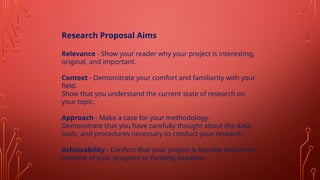
Research Proposal Aims
Relevance - Show your reader why your project is interesting,
original, and important.
Context - Demonstrate your comfort and familiarity with your
field.
Show that you understand the current state of research on
your topic.
Approach - Make a case for your methodology.
Demonstrate that you have carefully thought about the data,
tools, and procedures necessary to conduct your research.
Achievability - Confirm that your project is feasible within the
timeline of your program or funding deadline.
Research Proposal Length
The length of a research proposal can vary quite a bit.
A bachelor’s or master’s thesis proposal can be just a few
pages, while proposals for PhD dissertations or research
funding are usually much longer and more detailed. Your
supervisor can help you determine the best length for your
work.
One trick to get started is to think of your proposal’s
structure as a shorter version of your thesis or dissertation,
only without the results, conclusion and discussion sections.
Title Page
Like your dissertation or thesis, the proposal will
usually have a title page that includes:
 The proposed title of your project
 Your name
 Your supervisor’s name
 Your institution and department
Introduction
The first part of your proposal is the initial pitch for
your project. Make sure it succinctly explains what you want to
do and why.
Your introduction should:
 Introduce your topic
 Give necessary background and context
 Outline your problem statement and research questions
To guide your introduction, include information about:
 Who could have an interest in the topic (e.g., scientists,
policymakers)
 How much is already known about the topic
 What is missing from this current knowledge
 What new insights your research will contribute
 Why you believe this research is worth doing
Literature Review
In this section, share exactly how your project will
contribute to ongoing conversations in the field by:
 Comparing and contrasting the main theories, methods,
and debates.
 Examining the strengths and weaknesses of different
approaches.
 Explaining how will you build on, challenge, or synthesize
prior scholarship.
As you get started, it’s important to demonstrate that
you’re familiar with the most important research on your topic.
A strong literature review shows your reader that your project
has a solid foundation in existing knowledge or theory. It also
shows that you’re not simply repeating what other people
have already done or said, but rather using existing research
as a jumping-off point for your own.
Research Design and Methods
Following the literature review, restate your main
objectives. This brings the focus back to your own project.
Next, your research design or methodology section will
describe your overall approach, and the practical steps you will
take to answer your research questions.
Building a research proposal methodology
Research Type
 Qualitative or quantitative?
 Original data collection or primary and secondary source
analysis?
 Descriptive, correlational, or experimental research design?
Population and Sample
 Who or what will you study (e.g., high school students in
Albay; local newspaper archives 2000-10)?
 How will you select your subjects (e.g., probability sampling,
non-probability sampling)?
 When and where will you collect your data?
Research Methods
 What data collection tools and procedures will you use (e.g.,
surveys, interviews, observational studies, experiments)?
 Why?
Practicalities
 How much time will you need?
 How will you gain access to your population?
 How will you address any obstacles you face?
Reference List
Last but not least, your research proposal must include
correct citations for every source you have used, compiled in a
reference list. Research Schedule
Some institutions or funders require a detailed
timeline of the project, asking you to forecast what you will do
at each stage and how long it may take. While not always
required, be sure to check the requirements of your project.
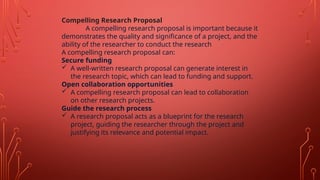
Compelling Research Proposal
A compelling research proposal is important because it
demonstrates the quality and significance of a project, and the
ability of the researcher to conduct the research

A compelling research proposal can:
Secure funding
 A well-written research proposal can generate interest in
the research topic, which can lead to funding and support.
Open collaboration opportunities
 A compelling research proposal can lead to collaboration
on other research projects.
Guide the research process
 A research proposal acts as a blueprint for the research
project, guiding the researcher through the project and
justifying its relevance and potential impact.
5 – steps Process to
Develop a Compelling
Research Proposal
ps
velop
a Compelling
esearch Proposal
1
2
3
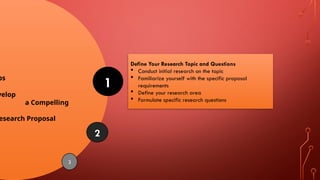
Define Your Research Topic and Questions
 Conduct initial research on the topic
 Familiarize yourself with the specific proposal
requirements
 Define your research area
 Formulate specific research questions
ps
velop
a Compelling
esearch Proposal
2
3
4
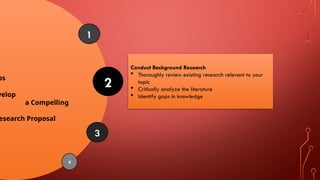
Conduct Background Research
 Thoroughly review existing research relevant to your
topic
 Critically analyze the literature
 Identify gaps in knowledge
1
ps
velop
a Compelling
esearch Proposal
3
4
5
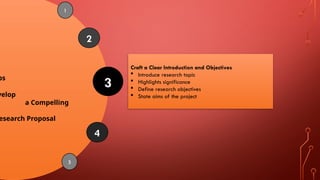
Craft a Clear Introduction and Objectives
 Introduce research topic
 Highlights significance
 Define research objectives
 State aims of the project
2
1
ps
velop
a Compelling
esearch Proposal
4
5
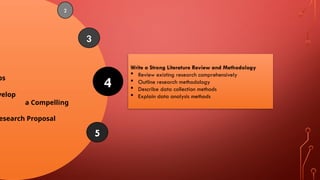
Write a Strong Literature Review and Methodology
 Review existing research comprehensively
 Outline research methodology
 Describe data collection methods
 Explain data analysis methods
3
2
ps
velop
a Compelling
esearch Proposal
5
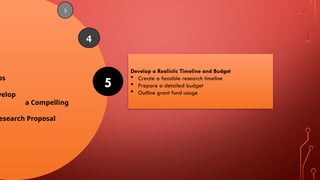
Develop a Realistic Timeline and Budget
 Create a feasible research timeline
 Prepare a detailed budget
 Outline grant fund usage
4
3
Conclusion:
The purpose of the research proposal: The research
proposal is your chance to explain the significance of your
project to organizations who might wish to fund or otherwise
support it. Ideally, it will demonstrate the quality and
importance of your project as well as your ability to conduct
the proposed research.
A research proposal is important for several reasons: It
helps identify the research focus. A research proposal defines
the topic, outlines methods, and clarifies your research
objectives. It assists in research planning.
A compelling research proposal is important because it
demonstrates the quality and significance of a project, and the
ability of the researcher to conduct the research

Thank You

DRAFTING-AND-COMPELLING-RESEARCH-PROPOSAL.pptx

  • 1.
  • 2.
    How to Writea Research Proposal? A research proposal describes what you will investigate, why it’s important, and how you will conduct your research. The format of a research proposal varies between fields, but most proposals will contain at least these elements:  Title page  Introduction  Literature Review  Methodology  Reference list While the sections may vary, the overall objective is always the same. A research proposal serves as a blueprint and guide for your research plan, helping you get organized and feel confident in the path forward you choose to take.
  • 3.
    Research Proposal Purpose Academicsoften have to write research proposals to get funding for their projects. As a student, you might have to write a research proposal as part of a grad school application, or prior to starting your thesis or dissertation. In addition to helping you figure out what your research can look like, a proposal can also serve to demonstrate why your project is worth pursuing to a funder, educational institution, or supervisor.
  • 4.
    Research Proposal Aims Relevance- Show your reader why your project is interesting, original, and important. Context - Demonstrate your comfort and familiarity with your field. Show that you understand the current state of research on your topic. Approach - Make a case for your methodology. Demonstrate that you have carefully thought about the data, tools, and procedures necessary to conduct your research. Achievability - Confirm that your project is feasible within the timeline of your program or funding deadline.
  • 5.
    Research Proposal Length Thelength of a research proposal can vary quite a bit. A bachelor’s or master’s thesis proposal can be just a few pages, while proposals for PhD dissertations or research funding are usually much longer and more detailed. Your supervisor can help you determine the best length for your work. One trick to get started is to think of your proposal’s structure as a shorter version of your thesis or dissertation, only without the results, conclusion and discussion sections.
  • 6.
    Title Page Like yourdissertation or thesis, the proposal will usually have a title page that includes:  The proposed title of your project  Your name  Your supervisor’s name  Your institution and department
  • 7.
    Introduction The first partof your proposal is the initial pitch for your project. Make sure it succinctly explains what you want to do and why. Your introduction should:  Introduce your topic  Give necessary background and context  Outline your problem statement and research questions To guide your introduction, include information about:  Who could have an interest in the topic (e.g., scientists, policymakers)  How much is already known about the topic  What is missing from this current knowledge  What new insights your research will contribute  Why you believe this research is worth doing
  • 8.
    Literature Review In thissection, share exactly how your project will contribute to ongoing conversations in the field by:  Comparing and contrasting the main theories, methods, and debates.  Examining the strengths and weaknesses of different approaches.  Explaining how will you build on, challenge, or synthesize prior scholarship. As you get started, it’s important to demonstrate that you’re familiar with the most important research on your topic. A strong literature review shows your reader that your project has a solid foundation in existing knowledge or theory. It also shows that you’re not simply repeating what other people have already done or said, but rather using existing research as a jumping-off point for your own.
  • 9.
    Research Design andMethods Following the literature review, restate your main objectives. This brings the focus back to your own project. Next, your research design or methodology section will describe your overall approach, and the practical steps you will take to answer your research questions. Building a research proposal methodology Research Type  Qualitative or quantitative?  Original data collection or primary and secondary source analysis?  Descriptive, correlational, or experimental research design? Population and Sample  Who or what will you study (e.g., high school students in Albay; local newspaper archives 2000-10)?  How will you select your subjects (e.g., probability sampling, non-probability sampling)?  When and where will you collect your data?
  • 10.
    Research Methods  Whatdata collection tools and procedures will you use (e.g., surveys, interviews, observational studies, experiments)?  Why? Practicalities  How much time will you need?  How will you gain access to your population?  How will you address any obstacles you face?
  • 11.
    Reference List Last butnot least, your research proposal must include correct citations for every source you have used, compiled in a reference list. Research Schedule Some institutions or funders require a detailed timeline of the project, asking you to forecast what you will do at each stage and how long it may take. While not always required, be sure to check the requirements of your project.
  • 12.
    Compelling Research Proposal Acompelling research proposal is important because it demonstrates the quality and significance of a project, and the ability of the researcher to conduct the research A compelling research proposal can: Secure funding  A well-written research proposal can generate interest in the research topic, which can lead to funding and support. Open collaboration opportunities  A compelling research proposal can lead to collaboration on other research projects. Guide the research process  A research proposal acts as a blueprint for the research project, guiding the researcher through the project and justifying its relevance and potential impact.

  • 13.
    5 – stepsProcess to Develop a Compelling Research Proposal
  • 14.
    ps velop a Compelling esearch Proposal 1 2 3 DefineYour Research Topic and Questions  Conduct initial research on the topic  Familiarize yourself with the specific proposal requirements  Define your research area  Formulate specific research questions
  • 15.
    ps velop a Compelling esearch Proposal 2 3 4 ConductBackground Research  Thoroughly review existing research relevant to your topic  Critically analyze the literature  Identify gaps in knowledge 1
  • 16.
    ps velop a Compelling esearch Proposal 3 4 5 Crafta Clear Introduction and Objectives  Introduce research topic  Highlights significance  Define research objectives  State aims of the project 2 1
  • 17.
    ps velop a Compelling esearch Proposal 4 5 Writea Strong Literature Review and Methodology  Review existing research comprehensively  Outline research methodology  Describe data collection methods  Explain data analysis methods 3 2
  • 18.
    ps velop a Compelling esearch Proposal 5 Developa Realistic Timeline and Budget  Create a feasible research timeline  Prepare a detailed budget  Outline grant fund usage 4 3
  • 19.
    Conclusion: The purpose ofthe research proposal: The research proposal is your chance to explain the significance of your project to organizations who might wish to fund or otherwise support it. Ideally, it will demonstrate the quality and importance of your project as well as your ability to conduct the proposed research. A research proposal is important for several reasons: It helps identify the research focus. A research proposal defines the topic, outlines methods, and clarifies your research objectives. It assists in research planning. A compelling research proposal is important because it demonstrates the quality and significance of a project, and the ability of the researcher to conduct the research
  • 20.