Submitted to-
Prof. Rattan Singh
Dr. Gulshan
Dr. Anupam Bahri Submitted by-
Gagandeep Kaur
Roll no.-1728
L.L.M Sem-1
UILS, PU
P.V. Young defines research as, “we may define
social research as the systematic method of
discovering new facts or verifying old facts,
their sequence, inter-relationships, casual
explanations and the natural law which govern
them.”
According to Webster’s international dictionary
as, “a careful critical inquiry or examination in
seeking facts or principles diligent investigation
in order to ascertain something”
Legal research report
 The legal research report is the statement that contains
in brief the procedure adopted and the findings
arrived at by the researcher of a legal problem. A legal
report is not a complete description of work done by the
researcher. It is only a brief statement of most significant
facts that are necessary for understanding the
generalizations drawn by the investigator.
 After the collected data has been analysed and interpreted,
the report has to be prepared. It is the last phase of the
research.
 There are different types of research reports like
dissertation, thesis, research papers etc.
Research proposal
A research proposal is a concise and coherent summary of your proposed
research. It sets out the central issues or questions that you intend to address. It
outlines the general area of study within which your research falls, referring to
the current state of knowledge and any recent debates on the topic. It also
demonstrates the originality of your proposed research.
It is a document that you will submit to your adviser detailing your
plan.
*The purpose of a proposal is to explain and justify your proposed study.
* It is intended to convince others that you have a worthwhile research project
and that you have the competence and the work-plan to complete it.
* The proposal should be about your proposed study, not the literature, your
research topic, or research methods in general.
The main challenges
you will be faced with
in writing your
proposal are:
 To move from a research idea to
a research problem;
 To gain clarity on the unit of
analysis;
 To select an appropriate research
design;
 To conform to the style and
format of a proposal.

A good research
proposal will help you:
 define and formulate your
research question;
 narrow down the study to a
manageable form within the
prescribed time limits:
 structure the development of
your writing;
 Avoid wasting time in the
literature search and data
collection stages of the project.
(a) Abstract- It is the summary of the whole research. It should briefly re-
establish the topic of the research, give the main objective of the research,
indicate the methodology used and present the main findings and conclusion.
(b) Topic of the research- the title should reflect the well- defined aims of the
research. It should be short, clear, precise and depict the threshold of the
project. The topic should not be more than 21 –23 words.
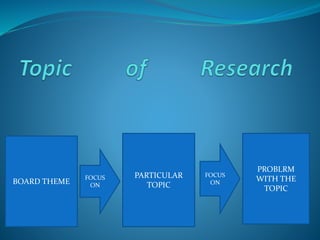
BOARD THEME
PARTICULAR
TOPIC
PROBLRM
WITH THE
TOPIC
FOCUS
ON
FOCUS
ON
c) Background and Introduction to the study/Literature review- The introductory aspect
will highlight what encouraged and motivated the writing of the proposal which may include the
historical background, the antecedence and the current state of operations of the law with regard to
the particular research topic which has made the research necessary. The introduction to your
proposal “sets the stage for your research, explaining what you want to do and
why”(peters,1992,p.202)
(d) The statement of the problem-The purpose of the research should be stated here. The
problem statement is a clear description of the issues, it includes a vision, issue statement, and
method used to solve the problem.
 5WSWHO
Is committing
the crimes
(age, etc.)
WHEN
At what time
WHERE
The place at
which it is
committed
WHAT
What kinds of
crimes are
committed
WHY
REASON FOR THE CRIME
(e) Objectives of the study- The objectives of a research project summaries what is
to be achieved by the study. Objectives should be closely related to the statement of
the problem.
(f) Justification of the study- This section should:
(i) Demonstrate how your research ‘fills a gap’ in existing research.
(ii) Explain why your research is important.
(g) Definition of major concepts/terms- This implies the idea of assigning
meanings to the key concepts of the research. Every major concept or legal maxim to
be used in the study must be explained in the correct language of the field of study in
order to avoid several interpretations by different readers of the work.
(h) Conceptual/ theoretical framework- First, It needs to show how your
proposed research fits into what is already known(its relationship to existing theory
and research) and how it makes a contribution to the understanding of the topic(its
intellectual goals). Second its needs to explain the theoretical framework that informs
your study. This provides the foundation upon which the research structure is laid and
acts as a guide to the researcher in knowing the hypothesis to be generated and the type
of information or data.
(i) Major assumptions/hypotheses-Hypothesis is a tentative proposition. The
hypothesis translates the problem statement into a precise, unambiguous
prediction of expected outcomes. Hypotheses are not meant to be
haphazard guesses, but should reflect the depth of knowledge, imagination
and experience of the investigator.
(j) Research design/ research Methodology: It gives a clear indication of the
means by which you hope to achieve your research aims, to outline a procedure which, if
necessary, can be repeated by others, and to indicate the sources of data that will be used.
It includes details about the methods and procedures to be used. It says how you are
going to investigate. It includes:
(i.) Sources of data collection- Where you will get your information and data from
for your research?
(ii.) Collection techniques- For example; libraries, journals, newspapers gazettes or
through the use of questionnaires, interviews and participants observations.
(iii.) Data analysis techniques- It could be in form of statistical tables, measures
of central tendency, graphical representation as it may be relevant to the study.
Ethics statement relating to issues of ethics like confidentiality, consent, debriefing etc
can be dealt with as part of the methods section, but if there are significant ethical
questions that could be raised about your study, it may be better to have a separate ethics
section
(k) Scope of the study- The scope of the study refers to the boundaries or limits
within which the study needs to be kept. The reasons for such limits may be
geographical, historical, ideological, person or any other. This helps the researcher to
focus and exhaustive.
(l) Limitation to the study- Limitations are potential weaknesses in your study and
are out of your control. You must explain how you intend to deal with the limitations
you are aware of so as not to affect the outcome of the study.
(m) Chapters Sequences/Chapters Organization-It is the outline of what one
intends to discuss under each chapter. This may be a summary of what each chapter will
contain.
(n) conclusion- this is where one pull together what one have said in the previous
sections, remind the readers of the goals of the study and what it will contribute and
discuss its potential relevance and implications in broader field(s) that it is situated in.
(o) Time-line - Here you need to outline a work schedule which couples the various
research activities you will be involved in with a time-frame. It is important that you
present a realistic time-frame.
(p) Pilot or feasibility study - Pilot study is conducted to check the
shortcomings of the research process. If one takes this study it should be mentioned in
the research proposal.
(q) Preliminary bibliography - List all the texts that you have referred to in your
proposal, as well as others that you have consulted thus far. The bibliography need not be
extensive at this stage, but it should provide an indication of the texts that are
important and relevant for your project.
A thesis includes the findings in the form of a report (internationally accepted
length being 50,000- 60,000 words) arising out of a test of a specific issue or a
problem. A dissertation, on the contrary , demands as much rigour as a thesis
would, but will be comparatively shorter in overall length than a thesis (not
more than 20,000 words). A dissertation normally refers to a formal report,
which does not address the testing of a specific issue or a problem.
In thesis, you have to conduct your own research, which has to be
original; while for a dissertation, you have to synthesize any information
that is collected. Thesis analysis is added to the already existing literature, while
dissertation is an analysis of the existing literature.
BRAINSTORMING YOUR CONCEPT
THE PROPOSAL
OUTLINING YOUR AURGUMENT
COLLECTING NOTES AND SOURCES
WRITING
Brainstorming Your Concept- The fundamental part of writing a dissertation
or thesis is the ideas that form the foundation of the whole exercise. Write
down all your ideas, concepts, and thoughts related to your project on paper.
Consider arranging this in a mind map to allow for linkages to be explored.
The Proposal- The next step in writing a dissertation or thesis is the proposal:
a document that you will submit to your adviser detailing your plan.
Outlining Your Argument-Drafting a table of contents and outline early on
can help guide one through the writing process by reminding one to explore
certain topics and explain linkages that may otherwise be overlooked.
Collecting Notes and Sources-It is important to search as many research
databases as you can, to find all the facts that you can use to support or refute
your arguments.
Writing- Once your sources are all ready, it’s time to move on to writing. In
general, it may be best to start writing with the sections that you are best
prepared for.
A. Preliminaries-
1. Title page of thesis- The title page is the first page after the front cover and should
include the final research title, Name of candidate, the year of submission.
2. Acknowledgement- It is in practice to acknowledge them who supported researcher
during his study. This support could be financial, moral, administrative, or technical.
3. Abstract-Essentially, the Abstract is a succinct summary of the research. It should
be able to represent why and how you did what you did, and what the results and
implications are. It is often only one page long.
4. Table of contents-The Table of Contents lists the chapters, topics and sub-topics
together with their page numbers
5.List of tables- This list contains the titles of tables, together with their page
numbers, which are listed in the text. The numbering system is according to chapter, for
e.g.: tables in Chapter 1 are numbered sequentially: Table 1.1, Table 1.2 and so on.
6. List of figures- This list contains the titles of figures, together with their page
numbers, which are found throughout the text.
B .Chapters-
(i) Introduction- It includes:
. A brief background to establish context, relevance, or
nature of the problem, question, or purpose (what is
known)
The importance of the problem and unclear issues.(what is
un-known)
. The rationale, hypothesis, main objective, or purpose must
be stated.(why the study was done)
. Two more sections may be added to this chapter that is
definitions and notations.
(ii) Brief review of earlier works/ literature
review- A literature review is a description of the
literature relevant to a particular field or topic of study.
* It consists of a critically written and comprehensive
account of the published works on a topic by accredited
scholars and researchers.
* It provides information on theories, models, materials
and techniques used in the research.
*It should also indicate the areas of agreement and
disagreement in his findings and consequent gaps in
existing knowledge should also be clearly identified.
(iii)Presentation of own experimental and /or
analytical work- The text should consist of report of facts,
statistically analysed data, interpretation and generalization.
*The collected data is analysed and various inferences are drawn from
it. The report should contain not only the generalization of inference
but also the basis upon which the inference has been drawn.
*All sorts of proofs, numerical and logical must be given in support of
the conclusions.
(iv)Materials and methods/ methodology- This chapter
describes and explains the materials as well as the research
methodology used in the study. It includes the key research
questions, the research design, and the research procedures
adopted.
* It may also, where appropriate, indicate sampling methods, research
instruments and statistical methods employed.
*The purpose of this is to inform the reader on the methods used to
collect the data and generate the findings reported.
(v)Results or findings - The results are actual statements of
observations, including statistics, tables and graphs. Positive as
well as negative results should be mentioned. At this point, you'll
restate the research questions and discuss the results you found,
explaining the direction they led you to.
(vi)Discussion- The discussion may include from other related
studies that support or reject our hypothesis. In this section we can
include limitation of the present study and proposed hypothesis for
future research. A new hypothesis may be proposed.
(vii)Summary, conclusion and suggestion- Summarize
results briefly. Discuss results in non-statistical terms. Answer the
research question and hypothesis.
Explicitly discuss the implications of the results. Integrate
your results with the theoretical background and very relevant
literature findings.
The recommendations are oriented to improvement, progress
and development, modification in existing course of action and
strategy. The suggestions or recommendations are for the future
scope of conducting researches in the concerned field.
C. Reference material-
 Bibliography or list of references or both- All
works or studies referred to in the dissertation/thesis
in the form of quotations or citations must be included
in the references. This section needs to be highly
structured, and needs to include all of your references
in the required referencing style.
 Appendices-The appendix section supports the
written text of the research report/dissertation/thesis
by including materials that can provide additional
information. These materials include tables, charts,
computer programmes and questionnaires.

Research Methodology

  • 1.
    Submitted to- Prof. RattanSingh Dr. Gulshan Dr. Anupam Bahri Submitted by- Gagandeep Kaur Roll no.-1728 L.L.M Sem-1 UILS, PU
  • 2.
    P.V. Young definesresearch as, “we may define social research as the systematic method of discovering new facts or verifying old facts, their sequence, inter-relationships, casual explanations and the natural law which govern them.” According to Webster’s international dictionary as, “a careful critical inquiry or examination in seeking facts or principles diligent investigation in order to ascertain something”
  • 4.
    Legal research report The legal research report is the statement that contains in brief the procedure adopted and the findings arrived at by the researcher of a legal problem. A legal report is not a complete description of work done by the researcher. It is only a brief statement of most significant facts that are necessary for understanding the generalizations drawn by the investigator.  After the collected data has been analysed and interpreted, the report has to be prepared. It is the last phase of the research.  There are different types of research reports like dissertation, thesis, research papers etc.
  • 5.
  • 6.
    A research proposalis a concise and coherent summary of your proposed research. It sets out the central issues or questions that you intend to address. It outlines the general area of study within which your research falls, referring to the current state of knowledge and any recent debates on the topic. It also demonstrates the originality of your proposed research. It is a document that you will submit to your adviser detailing your plan.
  • 7.
    *The purpose ofa proposal is to explain and justify your proposed study. * It is intended to convince others that you have a worthwhile research project and that you have the competence and the work-plan to complete it. * The proposal should be about your proposed study, not the literature, your research topic, or research methods in general.
  • 8.
    The main challenges youwill be faced with in writing your proposal are:  To move from a research idea to a research problem;  To gain clarity on the unit of analysis;  To select an appropriate research design;  To conform to the style and format of a proposal.  A good research proposal will help you:  define and formulate your research question;  narrow down the study to a manageable form within the prescribed time limits:  structure the development of your writing;  Avoid wasting time in the literature search and data collection stages of the project.
  • 9.
    (a) Abstract- Itis the summary of the whole research. It should briefly re- establish the topic of the research, give the main objective of the research, indicate the methodology used and present the main findings and conclusion. (b) Topic of the research- the title should reflect the well- defined aims of the research. It should be short, clear, precise and depict the threshold of the project. The topic should not be more than 21 –23 words.
  • 10.
  • 11.
    c) Background andIntroduction to the study/Literature review- The introductory aspect will highlight what encouraged and motivated the writing of the proposal which may include the historical background, the antecedence and the current state of operations of the law with regard to the particular research topic which has made the research necessary. The introduction to your proposal “sets the stage for your research, explaining what you want to do and why”(peters,1992,p.202) (d) The statement of the problem-The purpose of the research should be stated here. The problem statement is a clear description of the issues, it includes a vision, issue statement, and method used to solve the problem.  5WSWHO Is committing the crimes (age, etc.) WHEN At what time WHERE The place at which it is committed WHAT What kinds of crimes are committed WHY REASON FOR THE CRIME
  • 12.
    (e) Objectives ofthe study- The objectives of a research project summaries what is to be achieved by the study. Objectives should be closely related to the statement of the problem. (f) Justification of the study- This section should: (i) Demonstrate how your research ‘fills a gap’ in existing research. (ii) Explain why your research is important. (g) Definition of major concepts/terms- This implies the idea of assigning meanings to the key concepts of the research. Every major concept or legal maxim to be used in the study must be explained in the correct language of the field of study in order to avoid several interpretations by different readers of the work. (h) Conceptual/ theoretical framework- First, It needs to show how your proposed research fits into what is already known(its relationship to existing theory and research) and how it makes a contribution to the understanding of the topic(its intellectual goals). Second its needs to explain the theoretical framework that informs your study. This provides the foundation upon which the research structure is laid and acts as a guide to the researcher in knowing the hypothesis to be generated and the type of information or data.
  • 13.
    (i) Major assumptions/hypotheses-Hypothesisis a tentative proposition. The hypothesis translates the problem statement into a precise, unambiguous prediction of expected outcomes. Hypotheses are not meant to be haphazard guesses, but should reflect the depth of knowledge, imagination and experience of the investigator. (j) Research design/ research Methodology: It gives a clear indication of the means by which you hope to achieve your research aims, to outline a procedure which, if necessary, can be repeated by others, and to indicate the sources of data that will be used. It includes details about the methods and procedures to be used. It says how you are going to investigate. It includes: (i.) Sources of data collection- Where you will get your information and data from for your research? (ii.) Collection techniques- For example; libraries, journals, newspapers gazettes or through the use of questionnaires, interviews and participants observations. (iii.) Data analysis techniques- It could be in form of statistical tables, measures of central tendency, graphical representation as it may be relevant to the study. Ethics statement relating to issues of ethics like confidentiality, consent, debriefing etc can be dealt with as part of the methods section, but if there are significant ethical questions that could be raised about your study, it may be better to have a separate ethics section
  • 14.
    (k) Scope ofthe study- The scope of the study refers to the boundaries or limits within which the study needs to be kept. The reasons for such limits may be geographical, historical, ideological, person or any other. This helps the researcher to focus and exhaustive. (l) Limitation to the study- Limitations are potential weaknesses in your study and are out of your control. You must explain how you intend to deal with the limitations you are aware of so as not to affect the outcome of the study. (m) Chapters Sequences/Chapters Organization-It is the outline of what one intends to discuss under each chapter. This may be a summary of what each chapter will contain. (n) conclusion- this is where one pull together what one have said in the previous sections, remind the readers of the goals of the study and what it will contribute and discuss its potential relevance and implications in broader field(s) that it is situated in. (o) Time-line - Here you need to outline a work schedule which couples the various research activities you will be involved in with a time-frame. It is important that you present a realistic time-frame. (p) Pilot or feasibility study - Pilot study is conducted to check the shortcomings of the research process. If one takes this study it should be mentioned in the research proposal. (q) Preliminary bibliography - List all the texts that you have referred to in your proposal, as well as others that you have consulted thus far. The bibliography need not be extensive at this stage, but it should provide an indication of the texts that are important and relevant for your project.
  • 15.
    A thesis includesthe findings in the form of a report (internationally accepted length being 50,000- 60,000 words) arising out of a test of a specific issue or a problem. A dissertation, on the contrary , demands as much rigour as a thesis would, but will be comparatively shorter in overall length than a thesis (not more than 20,000 words). A dissertation normally refers to a formal report, which does not address the testing of a specific issue or a problem. In thesis, you have to conduct your own research, which has to be original; while for a dissertation, you have to synthesize any information that is collected. Thesis analysis is added to the already existing literature, while dissertation is an analysis of the existing literature.
  • 16.
    BRAINSTORMING YOUR CONCEPT THEPROPOSAL OUTLINING YOUR AURGUMENT COLLECTING NOTES AND SOURCES WRITING
  • 17.
    Brainstorming Your Concept-The fundamental part of writing a dissertation or thesis is the ideas that form the foundation of the whole exercise. Write down all your ideas, concepts, and thoughts related to your project on paper. Consider arranging this in a mind map to allow for linkages to be explored. The Proposal- The next step in writing a dissertation or thesis is the proposal: a document that you will submit to your adviser detailing your plan. Outlining Your Argument-Drafting a table of contents and outline early on can help guide one through the writing process by reminding one to explore certain topics and explain linkages that may otherwise be overlooked. Collecting Notes and Sources-It is important to search as many research databases as you can, to find all the facts that you can use to support or refute your arguments. Writing- Once your sources are all ready, it’s time to move on to writing. In general, it may be best to start writing with the sections that you are best prepared for.
  • 18.
    A. Preliminaries- 1. Titlepage of thesis- The title page is the first page after the front cover and should include the final research title, Name of candidate, the year of submission. 2. Acknowledgement- It is in practice to acknowledge them who supported researcher during his study. This support could be financial, moral, administrative, or technical. 3. Abstract-Essentially, the Abstract is a succinct summary of the research. It should be able to represent why and how you did what you did, and what the results and implications are. It is often only one page long. 4. Table of contents-The Table of Contents lists the chapters, topics and sub-topics together with their page numbers 5.List of tables- This list contains the titles of tables, together with their page numbers, which are listed in the text. The numbering system is according to chapter, for e.g.: tables in Chapter 1 are numbered sequentially: Table 1.1, Table 1.2 and so on. 6. List of figures- This list contains the titles of figures, together with their page numbers, which are found throughout the text.
  • 19.
    B .Chapters- (i) Introduction-It includes: . A brief background to establish context, relevance, or nature of the problem, question, or purpose (what is known) The importance of the problem and unclear issues.(what is un-known) . The rationale, hypothesis, main objective, or purpose must be stated.(why the study was done) . Two more sections may be added to this chapter that is definitions and notations.
  • 20.
    (ii) Brief reviewof earlier works/ literature review- A literature review is a description of the literature relevant to a particular field or topic of study. * It consists of a critically written and comprehensive account of the published works on a topic by accredited scholars and researchers. * It provides information on theories, models, materials and techniques used in the research. *It should also indicate the areas of agreement and disagreement in his findings and consequent gaps in existing knowledge should also be clearly identified.
  • 21.
    (iii)Presentation of ownexperimental and /or analytical work- The text should consist of report of facts, statistically analysed data, interpretation and generalization. *The collected data is analysed and various inferences are drawn from it. The report should contain not only the generalization of inference but also the basis upon which the inference has been drawn. *All sorts of proofs, numerical and logical must be given in support of the conclusions. (iv)Materials and methods/ methodology- This chapter describes and explains the materials as well as the research methodology used in the study. It includes the key research questions, the research design, and the research procedures adopted. * It may also, where appropriate, indicate sampling methods, research instruments and statistical methods employed. *The purpose of this is to inform the reader on the methods used to collect the data and generate the findings reported.
  • 22.
    (v)Results or findings- The results are actual statements of observations, including statistics, tables and graphs. Positive as well as negative results should be mentioned. At this point, you'll restate the research questions and discuss the results you found, explaining the direction they led you to. (vi)Discussion- The discussion may include from other related studies that support or reject our hypothesis. In this section we can include limitation of the present study and proposed hypothesis for future research. A new hypothesis may be proposed. (vii)Summary, conclusion and suggestion- Summarize results briefly. Discuss results in non-statistical terms. Answer the research question and hypothesis. Explicitly discuss the implications of the results. Integrate your results with the theoretical background and very relevant literature findings. The recommendations are oriented to improvement, progress and development, modification in existing course of action and strategy. The suggestions or recommendations are for the future scope of conducting researches in the concerned field.
  • 23.
    C. Reference material- Bibliography or list of references or both- All works or studies referred to in the dissertation/thesis in the form of quotations or citations must be included in the references. This section needs to be highly structured, and needs to include all of your references in the required referencing style.  Appendices-The appendix section supports the written text of the research report/dissertation/thesis by including materials that can provide additional information. These materials include tables, charts, computer programmes and questionnaires.