RESEARCH ETHICS
SPH 534
NUREMBERG CODE
PADDINGTON MUNDAGOWA
160097
PRESENTATION OUTLINE
• Introduction
• Nazi experiments
• Nuremberg trials
• Nuremberg code
• Conclusion
• References
INTRODUCTION
• Experts at the Doctor’s Trial submitted points which were
incorporated into the Nuremberg Code.
• Before the formation of Nuremberg Code there were 3 drafted
codes
1. First Prussian directive on informed consent (1891)
2. Berlin Code (1900)- directed its attention to beneficence and
autonomy.
3. Guidelines to Human experimentation (1931)- added legal
consent
• these were not legally binding
NAZI EXPERIMENTS
• In Nazi Germany, German physicians planned & enacted the
"Euthanasia" Program ignoring the drafted codes
• the systematic killing of those they deemed "unworthy of life“
• The victims included the mentally retarded, the institutionalized
mentally ill & the physically impaired
• during World War II, German physicians conducted
pseudoscientific medical experiments utilizing thousands of
concentration camp prisoners without their consent.
• Most victims died or were permanently crippled
NUREMBERG TRIALS (1946-7)
• Held from 9 Dec 1946 to 19 Aug 1947
• Twenty two men & one woman tried for participation in
experiments
• The defendants in this case were charged with murders,
tortures & other atrocities committed in the name of
medical science
NUREMBERG CODE
VOLUNTARY CONSENT
1. Voluntary well informed, understanding consent of human
participants in a full legal capacity (free power of choice)
SCIENTIFIC STUDIES
2. Experiment should aim at positive results for the society
PRIOR KNOWLEDGE
3. Experiments should be based on previous knowledge of
natural history of the disease to justify the performance of the
experiment
NUREMBERG CODE (CONT.)
INJURY &SUFFERING
4. It should not be conducted to avoid unnecessary physical &
mental suffering or disabling injury
5. No experiment should be conducted where there is any prior
reason to believe that death or disabling injury will occur
PROTECTION AGAINST RISKS
6. Risk of experiment should never exceed human benefit
7. Preparations and facilities must be able to adequately protect
the participants against experimental risks
NUREMBERG CODE (CONT)
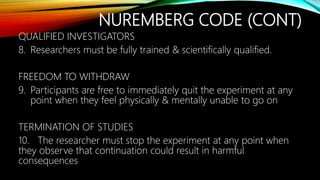
QUALIFIED INVESTIGATORS
8. Researchers must be fully trained & scientifically qualified.
FREEDOM TO WITHDRAW
9. Participants are free to immediately quit the experiment at any
point when they feel physically & mentally unable to go on
TERMINATION OF STUDIES
10. The researcher must stop the experiment at any point when
they observe that continuation could result in harmful
consequences
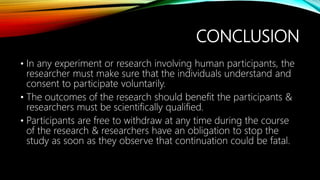
CONCLUSION
• In any experiment or research involving human participants, the
researcher must make sure that the individuals understand and
consent to participate voluntarily.
• The outcomes of the research should benefit the participants &
researchers must be scientifically qualified.
• Participants are free to withdraw at any time during the course
of the research & researchers have an obligation to stop the
study as soon as they observe that continuation could be fatal.
REFERENCES
• British Medical Journal (1996)No. 7070 Volume 313 page 1448
available at http://www.cirp.org/library/ethics/nuremberg/
• Nuremberg Code retrieved from website:
https://www.slideshare.net/Pradeepben84/nuremberg-
code?from_action=save
THANK YOU
KEAOLEBOGA

Nuremberg code presantation

  • 1.
    RESEARCH ETHICS SPH 534 NUREMBERGCODE PADDINGTON MUNDAGOWA 160097
  • 2.
    PRESENTATION OUTLINE • Introduction •Nazi experiments • Nuremberg trials • Nuremberg code • Conclusion • References
  • 3.
    INTRODUCTION • Experts atthe Doctor’s Trial submitted points which were incorporated into the Nuremberg Code. • Before the formation of Nuremberg Code there were 3 drafted codes 1. First Prussian directive on informed consent (1891) 2. Berlin Code (1900)- directed its attention to beneficence and autonomy. 3. Guidelines to Human experimentation (1931)- added legal consent • these were not legally binding
  • 4.
    NAZI EXPERIMENTS • InNazi Germany, German physicians planned & enacted the "Euthanasia" Program ignoring the drafted codes • the systematic killing of those they deemed "unworthy of life“ • The victims included the mentally retarded, the institutionalized mentally ill & the physically impaired • during World War II, German physicians conducted pseudoscientific medical experiments utilizing thousands of concentration camp prisoners without their consent. • Most victims died or were permanently crippled
  • 5.
    NUREMBERG TRIALS (1946-7) •Held from 9 Dec 1946 to 19 Aug 1947 • Twenty two men & one woman tried for participation in experiments • The defendants in this case were charged with murders, tortures & other atrocities committed in the name of medical science
  • 7.
    NUREMBERG CODE VOLUNTARY CONSENT 1.Voluntary well informed, understanding consent of human participants in a full legal capacity (free power of choice) SCIENTIFIC STUDIES 2. Experiment should aim at positive results for the society PRIOR KNOWLEDGE 3. Experiments should be based on previous knowledge of natural history of the disease to justify the performance of the experiment
  • 8.
    NUREMBERG CODE (CONT.) INJURY&SUFFERING 4. It should not be conducted to avoid unnecessary physical & mental suffering or disabling injury 5. No experiment should be conducted where there is any prior reason to believe that death or disabling injury will occur PROTECTION AGAINST RISKS 6. Risk of experiment should never exceed human benefit 7. Preparations and facilities must be able to adequately protect the participants against experimental risks
  • 9.
    NUREMBERG CODE (CONT) QUALIFIEDINVESTIGATORS 8. Researchers must be fully trained & scientifically qualified. FREEDOM TO WITHDRAW 9. Participants are free to immediately quit the experiment at any point when they feel physically & mentally unable to go on TERMINATION OF STUDIES 10. The researcher must stop the experiment at any point when they observe that continuation could result in harmful consequences
  • 10.
    CONCLUSION • In anyexperiment or research involving human participants, the researcher must make sure that the individuals understand and consent to participate voluntarily. • The outcomes of the research should benefit the participants & researchers must be scientifically qualified. • Participants are free to withdraw at any time during the course of the research & researchers have an obligation to stop the study as soon as they observe that continuation could be fatal.
  • 12.
    REFERENCES • British MedicalJournal (1996)No. 7070 Volume 313 page 1448 available at http://www.cirp.org/library/ethics/nuremberg/ • Nuremberg Code retrieved from website: https://www.slideshare.net/Pradeepben84/nuremberg- code?from_action=save
  • 13.

Editor's Notes

  • #4 (Leo Alexander, Werner Liebrand and Andrew Ivy) Intro of scientific experiments into clinical medicine in bacteriology, immunology & physiology )- research to be performed under medical authorization & circumstances cases were to be documented in the medical history
  • #5 Experiments were horrific Inc. typhus, sea water, high-altitude, bone transplantation, extreme cold, sterilization, poison bullets, and skeleton collection Most of the victims were Jews, Poles, Russians, and also Roma (Gypsies) There was wholesale man slaughter & victims treated worse than animals
  • #6  judgment was pronounced on August 19, 1947 Of the 23 defendants, 7 were sentenced the death by hanging (carried out at Landsberg Prison), 9 were given prison terms, and 7 were found not guilty.
  • #7 Nuremberg trial defendants (1947)
  • #8 3.Designed based on results of animal experimentation
  • #9 5. except, perhaps, in those experiments where the experimental physicians also serve as subjects
  • #10 8. The highest degree of skill and care should be required through all stages of the experiment of those who conduct or engage in the experiment.
  • #12 Young Adolf Hitler probably in the early 1890s. WHO WOULD EVER THOUGHT THAT THIS CUTE BABY WOULD CAUSE DEATH & SUFFERING TO HUNDREDS OF THOUSANDS OF PEOPLE FOUR DECADES LATER?