Gestalt psychology
• Gestalt is a German word that means “shape”,
“form”, or “whole”.
• Gestalt is a psychology term which means
"unified whole".
• It was developed about 1910by Max Wertheimer
and carry on by Wolfgang Kohler and Kurt Koffka
at Frankfurt University.
• Max Wertheimer – developed Gestalt principles
• Kurt Koffka – developed laws of perception
• Wolfgang Kohler – worked with apes on insight
Gestalt psychology
Gestalt focuses on the belief that human
consciousness cannot be broken down
into its elements.
Gestaltists pointed out that perception
has meaning only when it is seen as a
whole
Perceptions are shaped by our thoughts
Perceptual process
learners do not just collect information as
is but they actively process and
restructure data in order to understand it.
This is the Perceptual Process
Certain factors impact on this
perceptual process.
Factors like past experiences, needs,
attitudes and one’s present situation can
affect his perception
Gestalt Principles
• They believed learning is the result from
good perception, which enable an
individual to form correct concept in their
mind. Later on they proposed the
principles or law for perceptual
organization
1. Law of Proximity
2. Law of Similarity
3. Law of Closure
4. Law of Good Continuation
5. Law of Good form or Pragnanz
6. Law of Figure/Ground
Law of Proximity
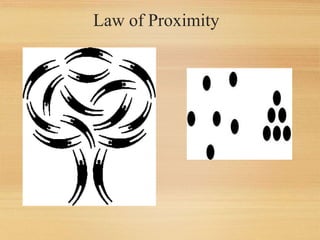
Law of Proximity
Proximity means nearness in space,
time, or relationship
The law of proximity states that when
objects appear close to one another they
tend to be perceived as a group .Things,
which are close together in space or
time, tend to be perceived as grouped
together
Thus, if you want to perceive two ideas
as associated, present them in close
proximity.
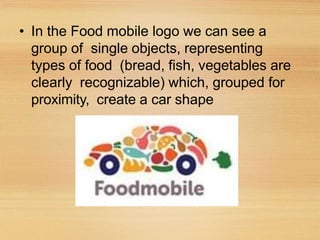
• In the Food mobile logo we can see a
group of single objects, representing
types of food (bread, fish, vegetables are
clearly recognizable) which, grouped for
proximity, create a car shape
Law of Similarity
Law of Similarity
Law of Similarity
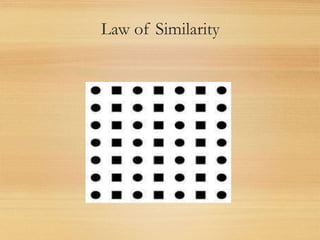
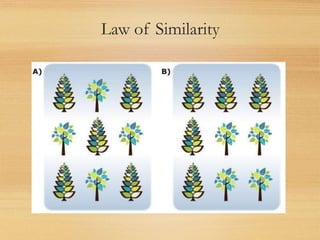
• The law of similarity captures the idea that
when we look at objects that are similar to
each other, we tend to group them together.
Our brains quickly identify patterns faster
than the separate parts of the pattern.
1. The way we group things together based on
similar aspects (look, sound, texture, taste,
etc.)
2. We group things that are alike.
3. We tend to group similar shapes together
and often times, we try to attach some
type of meaning to them
Law of Closure
Words and
shape
Law of Closure
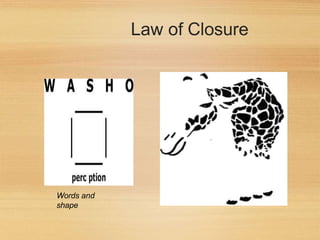
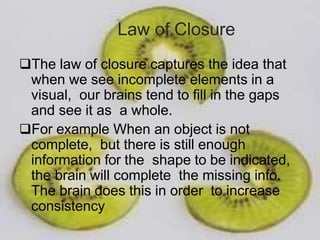
The law of closure captures the idea that
when we see incomplete elements in a
visual, our brains tend to fill in the gaps
and see it as a whole.
For example When an object is not
complete, but there is still enough
information for the shape to be indicated,
the brain will complete the missing info.
The brain does this in order to increase
consistency
Law of Good Continuation
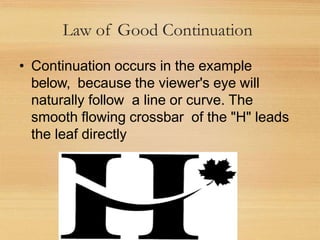
• Continuation occurs in the example
below, because the viewer's eye will
naturally follow a line or curve. The
smooth flowing crossbar of the "H" leads
the leaf directly
Law of Good Continuation
• Continuity: To
maintain order, the
brain will carry on
any visual patterns .
Also, continuation
happens when the
viewer’s eye moves
(whether smoothly or
disjointedly) through
an object into
another
Law of Good Continuation
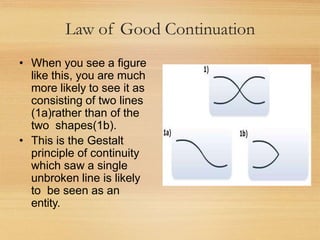
• When you see a figure
like this, you are much
more likely to see it as
consisting of two lines
(1a)rather than of the
two shapes(1b).
• This is the Gestalt
principle of continuity
which saw a single
unbroken line is likely
to be seen as an
entity.
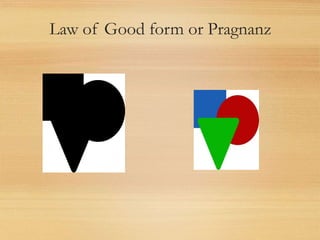
Law of Good form or Pragnanz
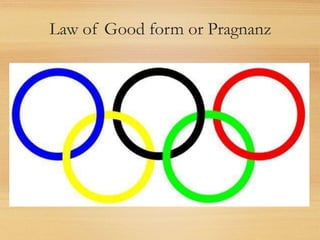
• The word pragnanz is a German term meaning
"good figure." The law of Pragnanz is sometimes
referred to as the law of good figure or the law of
simplicity, which says that we tend to order our
experience in a manner that, is regular, orderly,
symmetric, and simple our perceptions are
influenced by our past experiences. This principle
is also called Pragnanz Law. (Tan Oon Seng et
al., 2003).
• This law holds that objects in the environment are
seen in a way that makes them appear as simple
as possible
Law of Good form or Pragnanz
Law of Figure/Ground
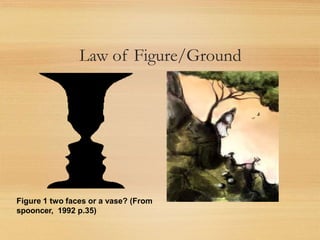
Figure 1 two faces or a vase? (From
spooncer, 1992 p.35)
Law of Figure/Ground
• Figure–ground organization is a type of
perceptual grouping which is a vital
necessity for recognizing objects through
vision.
• This law explains that the source of a
message determines one’s perception.
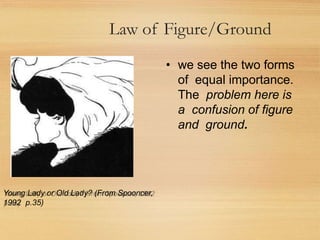
• The concept of figure-ground perception
is often illustrated with the classic "faces
or vases" illusion, also known as the
Rubin vase.
Law of Figure/Ground
• we see the two forms
of equal importance.
The problem here is
a confusion of figure
and ground.
Young Lady or Old Lady? (From Spooncer,
1992 p.35)
Insight Learning
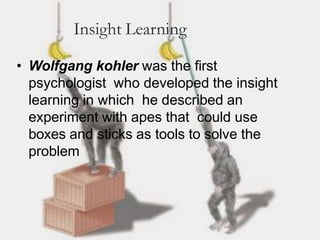
• Wolfgang kohler was the first
psychologist who developed the insight
learning in which he described an
experiment with apes that could use
boxes and sticks as tools to solve the
problem
Insight Learning
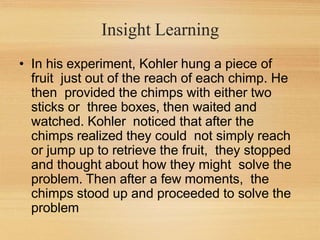
• In his experiment, Kohler hung a piece of
fruit just out of the reach of each chimp. He
then provided the chimps with either two
sticks or three boxes, then waited and
watched. Kohler noticed that after the
chimps realized they could not simply reach
or jump up to retrieve the fruit, they stopped
and thought about how they might solve the
problem. Then after a few moments, the
chimps stood up and proceeded to solve the
problem
Insight Learning
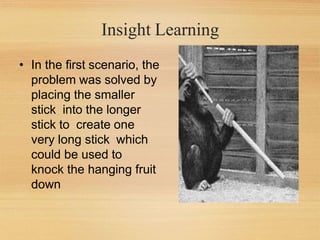
• In the first scenario, the
problem was solved by
placing the smaller
stick into the longer
stick to create one
very long stick which
could be used to
knock the hanging fruit
down
Insight Learning
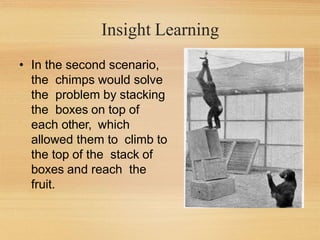
• In the second scenario,
the chimps would solve
the problem by stacking
the boxes on top of
each other, which
allowed them to climb to
the top of the stack of
boxes and reach the
fruit.
Insight Learning
• Insight learning is the abrupt realization
of a problem's solution. Insight learning is
not the result of trial and error It is a
completely cognitive experience, which
requires the ability to visualize the problem
and the solution internally, in the mind,
before giving a behavioral response.
• The important aspect of learning was
not reinforcement, but the coordination
of thinking to create new organizations.
Kohler referred to this behavior as
insight or discovery learning.
Implications of the Gestalt principles
in the teaching and learning process
1. Law of Proximity
Related concepts or lessons
should be taught aligned or closely
to each other.
This is the reason why subtraction is
taught after addition, multiplication after
subtraction then division after
multiplication
2. Law of Similarity
• Similar lessons or contents should be grouped
together to make learners develop Understanding
more efficiently and effectively.
• This is the reason why lessons are Grouped into
units: Unit I is for human body, Unit II is for
energy and motion, So on and so forth.
3. Law of Closure
When a concept or topic is incomplete thus
isn't "closed", incomplete information May
make
learners want to discover what’s missing,
rather
than concentrating onThe given instruction.
If students find a math algorithm confusing
because a certain Question is left
unanswered or a step isn't clear, they will
tend to concentrate on That confused part of
the process rather than the total process as
a whole. This is why students get
"lost". Thus, make the lesson complete.
Present it clearly, Simply and always be
ready for students' clarifications.
4. Law of Good
Continuation
Lessons should be presented in such a
way that learners will see these as
connected
an
d continuous.
Now you know why we have the "review"
part
of the lesson plan. This way, students will
realize that their new lesson actually has
continuity and isrelated to what they
5. Law of
Pragnanz
Pragnanz states that when things are
grasped as wholes, the minimal amount
of energy is exerted in thinking. In short,
make your lesson holistic, complete and
most of all simple.
6. Law of
Figure/Ground
• For a figure to be perceived, it must stand out from
the background.
•Emphasis should be done on important aspects of
the lesson. For example, teachers should vary the
tone of their voice or write boldly or underline the
important key words of the lesson.
Gestalt psychology.pptx

Gestalt psychology.pptx

  • 2.
    Gestalt psychology • Gestaltis a German word that means “shape”, “form”, or “whole”. • Gestalt is a psychology term which means "unified whole". • It was developed about 1910by Max Wertheimer and carry on by Wolfgang Kohler and Kurt Koffka at Frankfurt University. • Max Wertheimer – developed Gestalt principles • Kurt Koffka – developed laws of perception • Wolfgang Kohler – worked with apes on insight
  • 3.
    Gestalt psychology Gestalt focuseson the belief that human consciousness cannot be broken down into its elements. Gestaltists pointed out that perception has meaning only when it is seen as a whole Perceptions are shaped by our thoughts
  • 4.
    Perceptual process learners donot just collect information as is but they actively process and restructure data in order to understand it. This is the Perceptual Process Certain factors impact on this perceptual process. Factors like past experiences, needs, attitudes and one’s present situation can affect his perception
  • 5.
    Gestalt Principles • Theybelieved learning is the result from good perception, which enable an individual to form correct concept in their mind. Later on they proposed the principles or law for perceptual organization 1. Law of Proximity 2. Law of Similarity 3. Law of Closure 4. Law of Good Continuation 5. Law of Good form or Pragnanz 6. Law of Figure/Ground
  • 6.
  • 7.
    Law of Proximity Proximitymeans nearness in space, time, or relationship The law of proximity states that when objects appear close to one another they tend to be perceived as a group .Things, which are close together in space or time, tend to be perceived as grouped together Thus, if you want to perceive two ideas as associated, present them in close proximity.
  • 8.
    • In theFood mobile logo we can see a group of single objects, representing types of food (bread, fish, vegetables are clearly recognizable) which, grouped for proximity, create a car shape
  • 9.
  • 10.
  • 11.
    Law of Similarity •The law of similarity captures the idea that when we look at objects that are similar to each other, we tend to group them together. Our brains quickly identify patterns faster than the separate parts of the pattern. 1. The way we group things together based on similar aspects (look, sound, texture, taste, etc.) 2. We group things that are alike. 3. We tend to group similar shapes together and often times, we try to attach some type of meaning to them
  • 12.
  • 13.
    Law of Closure Thelaw of closure captures the idea that when we see incomplete elements in a visual, our brains tend to fill in the gaps and see it as a whole. For example When an object is not complete, but there is still enough information for the shape to be indicated, the brain will complete the missing info. The brain does this in order to increase consistency
  • 14.
    Law of GoodContinuation • Continuation occurs in the example below, because the viewer's eye will naturally follow a line or curve. The smooth flowing crossbar of the "H" leads the leaf directly
  • 15.
    Law of GoodContinuation • Continuity: To maintain order, the brain will carry on any visual patterns . Also, continuation happens when the viewer’s eye moves (whether smoothly or disjointedly) through an object into another
  • 16.
    Law of GoodContinuation • When you see a figure like this, you are much more likely to see it as consisting of two lines (1a)rather than of the two shapes(1b). • This is the Gestalt principle of continuity which saw a single unbroken line is likely to be seen as an entity.
  • 17.
    Law of Goodform or Pragnanz
  • 18.
    Law of Goodform or Pragnanz • The word pragnanz is a German term meaning "good figure." The law of Pragnanz is sometimes referred to as the law of good figure or the law of simplicity, which says that we tend to order our experience in a manner that, is regular, orderly, symmetric, and simple our perceptions are influenced by our past experiences. This principle is also called Pragnanz Law. (Tan Oon Seng et al., 2003). • This law holds that objects in the environment are seen in a way that makes them appear as simple as possible
  • 19.
    Law of Goodform or Pragnanz
  • 20.
    Law of Figure/Ground Figure1 two faces or a vase? (From spooncer, 1992 p.35)
  • 21.
    Law of Figure/Ground •Figure–ground organization is a type of perceptual grouping which is a vital necessity for recognizing objects through vision. • This law explains that the source of a message determines one’s perception. • The concept of figure-ground perception is often illustrated with the classic "faces or vases" illusion, also known as the Rubin vase.
  • 22.
    Law of Figure/Ground •we see the two forms of equal importance. The problem here is a confusion of figure and ground. Young Lady or Old Lady? (From Spooncer, 1992 p.35)
  • 23.
    Insight Learning • Wolfgangkohler was the first psychologist who developed the insight learning in which he described an experiment with apes that could use boxes and sticks as tools to solve the problem
  • 24.
    Insight Learning • Inhis experiment, Kohler hung a piece of fruit just out of the reach of each chimp. He then provided the chimps with either two sticks or three boxes, then waited and watched. Kohler noticed that after the chimps realized they could not simply reach or jump up to retrieve the fruit, they stopped and thought about how they might solve the problem. Then after a few moments, the chimps stood up and proceeded to solve the problem
  • 25.
    Insight Learning • Inthe first scenario, the problem was solved by placing the smaller stick into the longer stick to create one very long stick which could be used to knock the hanging fruit down
  • 26.
    Insight Learning • Inthe second scenario, the chimps would solve the problem by stacking the boxes on top of each other, which allowed them to climb to the top of the stack of boxes and reach the fruit.
  • 27.
    Insight Learning • Insightlearning is the abrupt realization of a problem's solution. Insight learning is not the result of trial and error It is a completely cognitive experience, which requires the ability to visualize the problem and the solution internally, in the mind, before giving a behavioral response. • The important aspect of learning was not reinforcement, but the coordination of thinking to create new organizations. Kohler referred to this behavior as insight or discovery learning.
  • 28.
    Implications of theGestalt principles in the teaching and learning process 1. Law of Proximity Related concepts or lessons should be taught aligned or closely to each other. This is the reason why subtraction is taught after addition, multiplication after subtraction then division after multiplication
  • 29.
    2. Law ofSimilarity • Similar lessons or contents should be grouped together to make learners develop Understanding more efficiently and effectively. • This is the reason why lessons are Grouped into units: Unit I is for human body, Unit II is for energy and motion, So on and so forth.
  • 30.
    3. Law ofClosure When a concept or topic is incomplete thus isn't "closed", incomplete information May make learners want to discover what’s missing, rather than concentrating onThe given instruction. If students find a math algorithm confusing because a certain Question is left unanswered or a step isn't clear, they will tend to concentrate on That confused part of the process rather than the total process as a whole. This is why students get "lost". Thus, make the lesson complete. Present it clearly, Simply and always be ready for students' clarifications.
  • 31.
    4. Law ofGood Continuation Lessons should be presented in such a way that learners will see these as connected an d continuous. Now you know why we have the "review" part of the lesson plan. This way, students will realize that their new lesson actually has continuity and isrelated to what they
  • 32.
    5. Law of Pragnanz Pragnanzstates that when things are grasped as wholes, the minimal amount of energy is exerted in thinking. In short, make your lesson holistic, complete and most of all simple.
  • 33.
    6. Law of Figure/Ground •For a figure to be perceived, it must stand out from the background. •Emphasis should be done on important aspects of the lesson. For example, teachers should vary the tone of their voice or write boldly or underline the important key words of the lesson.