Research in Action Series Cross Age Peer Mentoring
Overview of Research in Action Series MENTOR has developed an innovative series - Research in Action  Translates the latest research on mentoring into tangible strategies for mentoring practitioners.  Makes the best available research accessible and relevant to the mentoring field.   Using the Research in Action series, programs can ensure their practices are based on current research, resulting in improved services and better impacts for young people.
10 issues  Each issue provides:   Research Action  Resources Overview of Research in Action Series
Research in Action Issues: Mentoring: A Key Resource for Promoting Positive Youth Development Effectiveness of Mentoring Program Practices Program Staff in Youth Mentoring Programs: Qualifications, Training, and Retention Fostering Close and Effective Relationships in Youth Mentoring Programs Why Youth Mentoring Relationships End School-Based Mentoring Cross-Age Peer Mentoring Mentoring Across Generations: Engaging 50+ Adults as Mentors Youth Mentoring: Do Race and Ethnicity Really Matter? Mentoring: A Promising Intervention for Children of Prisoners
Mentor Michigan Webinar Series www.mentormichigan.org Click on “Training & Technical Assistance”
Issue 7:  Cross Age Peer Mentoring   Michael Karcher, Ed.D., Ph.D., University of Texas at San Antonio Issue available for free download at MENTOR’s website www.mentoring.org “ Access Research” Tab    Research in Action
Issue 7 - Overview Introduction Defining Cross-Age Peer Mentoring Outcomes Characteristics of Effective CAMPs Discussion
Introduction What is the model of your cross-age peer mentoring program? How old are mentors/mentees? Where do they meet? How often and for how long are they matched? One-to-one or group?
Cross-Age Peer Mentoring The mentor is usually an older youth, typically high school-aged Paired with middle school or elementary-aged child Almost always take place at schools Meet weekly, for duration of school year Primarily one-to-one relationships, but often meetings occur in larger group, with some group-based activities
CAMPs are here to stay BBBS   High School Bigs comprise nearly ¼ of all matches annually CAMPs have elements that are appealing to mentees, mentors, school staff and parents Practice has outpaced research leading to under-structured CAMPs
Defining Cross-Age  Peer Mentoring Distinctions   Structure - tutoring or mentoring? Duration Focus/Approach Cross-age
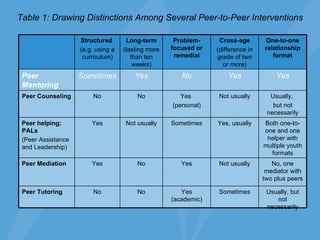
Table 1: Drawing Distinctions Among Several Peer-to-Peer Interventions Structured  (e.g. using a curriculum) Long-term (lasting more than ten weeks) Problem-focused or remedial Cross-age (difference in grade of two or more) One-to-one relationship format Peer Mentoring Sometimes Yes No Yes Yes Peer Counseling No No Yes  (personal) Not usually Usually,  but not necessarily Peer helping; PALs  (Peer Assistance and Leadership) Yes Not usually Sometimes Yes, usually Both one-to-one and one helper with multiple youth formats Peer Mediation Yes No Yes Not usually No, one mediator with two plus peers Peer Tutoring No No Yes (academic) Sometimes Usually, but not necessarily
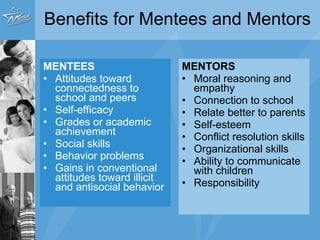
Benefits for Mentees and Mentors MENTEES Attitudes toward connectedness to school and peers Self-efficacy Grades or academic achievement Social skills Behavior problems Gains in conventional attitudes toward illicit and antisocial behavior MENTORS Moral reasoning and empathy Connection to school Relate better to parents Self-esteem Conflict resolution skills Organizational skills Ability to communicate with children Responsibility
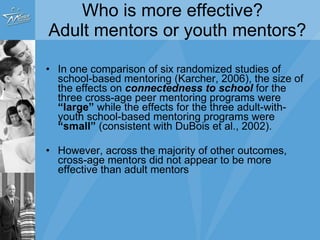
Who is more effective?  Adult mentors or youth mentors? The size of the effects on  connectedness to school  for the three cross-age peer mentoring programs were   “large”  while the effects for the three adult-with-youth school-based mentoring programs were   “small” However, across the majority of other outcomes, cross-age mentors did not appear to be more effective than adult mentors
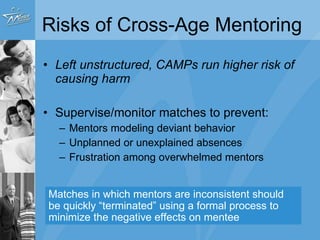
Risks of Cross-Age Mentoring  Left unstructured, CAMPs run higher risk of causing harm Matches should be monitored closely for: Mentors modeling deviant behavior Unplanned and unexplained absences Frustration among overwhelmed mentors Matches in which mentors are inconsistent should be quickly “terminated” using a formal process to minimize the negative effects on mentee
Developmental Approach Descriptive evaluations of BBBS H.S. Bigs Program found that most matches engage in physical activities, general talking, and crafts or board games. In fact, while playing one-on-one games was related to better outcomes, the more the match worked on academics (e.g., tutoring), the  less  likely they were to be rematched for a second year.
Characteristics of Effective  Cross-Age Peer Mentoring Programs Mentee orientation – how to best utilize their mentors by seeking out the mentors’ support Recruit socially interested youth Support to overwhelmed mentors Older mentors
Recommendations Mentors trained in a developmental approach Strategically recruit mentors with greater social interest and less self-interested motivations Mentors and mentees differ in age by at least two years, mentors in high school Programs provide structure but focus clearly on strengthening relationships Matches monitored for signs of “deviancy training” Mentees are taught how best to utilize their mentors for support Mentors are required to participate in formal termination processes
Conclusion Although there is promise, there remains a great deal to be learned about the most efficient and effective ways to utilize older peers in mentoring relationships.
Other Key Considerations: Age Gap Parent Involvement  Collaboration and/or Partnerships  Cross-age peer mentoring is not “mentoring-lite”  Potential to do harm
ACTION Part I: Designing a Cross-Age Peer Mentoring Program Part II: Implications of Cross-Age Peer Mentoring on Program Practices
Part I: Designing a Cross-Age Peer Mentoring Program
MENTOR The leader in expanding the power of mentoring to millions of young Americans who want and need adult mentors. Mentor/Mentee Termination Ritual How to Build a Successful Mentoring Program Using the Elements of Effective Practice www.mentoring.org
National organization that provides training and technical assistance to youth mentoring programs http://educationnorthwest.org/nmc Resources    Peer Mentoring Resources Building Effective Peer Mentoring Programs In Schools: An Introductory Guide Peer Mentoring: Recruiting, Training, and Ensuring Longevity (webinar) Peer Mentoring: New Research and Innovative Practice (webinar) Education Northwest:  National Mentoring Center
National Association of Peer Programs Sponsors conferences and provides consultation for peer mentoring programs http://www.peerprograms.org/  Peer Resources  Canadian organization that supports peer mentoring http://www.peer.ca/peer.html  Other Resources:
This presentation provides an  overview of Research in Action  Issue 7: Cross-Age Peer Mentoring This tool was produced by MENTOR/The National Mentoring Partnership and can be accessed on their website: www.mentoring.org

Research in Action #7

  • 1.
    Research in ActionSeries Cross Age Peer Mentoring
  • 2.
    Overview of Researchin Action Series MENTOR has developed an innovative series - Research in Action Translates the latest research on mentoring into tangible strategies for mentoring practitioners. Makes the best available research accessible and relevant to the mentoring field.   Using the Research in Action series, programs can ensure their practices are based on current research, resulting in improved services and better impacts for young people.
  • 3.
    10 issues Each issue provides:   Research Action Resources Overview of Research in Action Series
  • 4.
    Research in ActionIssues: Mentoring: A Key Resource for Promoting Positive Youth Development Effectiveness of Mentoring Program Practices Program Staff in Youth Mentoring Programs: Qualifications, Training, and Retention Fostering Close and Effective Relationships in Youth Mentoring Programs Why Youth Mentoring Relationships End School-Based Mentoring Cross-Age Peer Mentoring Mentoring Across Generations: Engaging 50+ Adults as Mentors Youth Mentoring: Do Race and Ethnicity Really Matter? Mentoring: A Promising Intervention for Children of Prisoners
  • 5.
    Mentor Michigan WebinarSeries www.mentormichigan.org Click on “Training & Technical Assistance”
  • 6.
    Issue 7: Cross Age Peer Mentoring Michael Karcher, Ed.D., Ph.D., University of Texas at San Antonio Issue available for free download at MENTOR’s website www.mentoring.org “ Access Research” Tab  Research in Action
  • 7.
    Issue 7 -Overview Introduction Defining Cross-Age Peer Mentoring Outcomes Characteristics of Effective CAMPs Discussion
  • 8.
    Introduction What isthe model of your cross-age peer mentoring program? How old are mentors/mentees? Where do they meet? How often and for how long are they matched? One-to-one or group?
  • 9.
    Cross-Age Peer MentoringThe mentor is usually an older youth, typically high school-aged Paired with middle school or elementary-aged child Almost always take place at schools Meet weekly, for duration of school year Primarily one-to-one relationships, but often meetings occur in larger group, with some group-based activities
  • 10.
    CAMPs are hereto stay BBBS High School Bigs comprise nearly ¼ of all matches annually CAMPs have elements that are appealing to mentees, mentors, school staff and parents Practice has outpaced research leading to under-structured CAMPs
  • 11.
    Defining Cross-Age Peer Mentoring Distinctions Structure - tutoring or mentoring? Duration Focus/Approach Cross-age
  • 12.
    Table 1: DrawingDistinctions Among Several Peer-to-Peer Interventions Structured (e.g. using a curriculum) Long-term (lasting more than ten weeks) Problem-focused or remedial Cross-age (difference in grade of two or more) One-to-one relationship format Peer Mentoring Sometimes Yes No Yes Yes Peer Counseling No No Yes (personal) Not usually Usually, but not necessarily Peer helping; PALs (Peer Assistance and Leadership) Yes Not usually Sometimes Yes, usually Both one-to-one and one helper with multiple youth formats Peer Mediation Yes No Yes Not usually No, one mediator with two plus peers Peer Tutoring No No Yes (academic) Sometimes Usually, but not necessarily
  • 13.
    Benefits for Menteesand Mentors MENTEES Attitudes toward connectedness to school and peers Self-efficacy Grades or academic achievement Social skills Behavior problems Gains in conventional attitudes toward illicit and antisocial behavior MENTORS Moral reasoning and empathy Connection to school Relate better to parents Self-esteem Conflict resolution skills Organizational skills Ability to communicate with children Responsibility
  • 14.
    Who is moreeffective? Adult mentors or youth mentors? The size of the effects on connectedness to school for the three cross-age peer mentoring programs were “large” while the effects for the three adult-with-youth school-based mentoring programs were “small” However, across the majority of other outcomes, cross-age mentors did not appear to be more effective than adult mentors
  • 15.
    Risks of Cross-AgeMentoring Left unstructured, CAMPs run higher risk of causing harm Matches should be monitored closely for: Mentors modeling deviant behavior Unplanned and unexplained absences Frustration among overwhelmed mentors Matches in which mentors are inconsistent should be quickly “terminated” using a formal process to minimize the negative effects on mentee
  • 16.
    Developmental Approach Descriptiveevaluations of BBBS H.S. Bigs Program found that most matches engage in physical activities, general talking, and crafts or board games. In fact, while playing one-on-one games was related to better outcomes, the more the match worked on academics (e.g., tutoring), the less likely they were to be rematched for a second year.
  • 17.
    Characteristics of Effective Cross-Age Peer Mentoring Programs Mentee orientation – how to best utilize their mentors by seeking out the mentors’ support Recruit socially interested youth Support to overwhelmed mentors Older mentors
  • 18.
    Recommendations Mentors trainedin a developmental approach Strategically recruit mentors with greater social interest and less self-interested motivations Mentors and mentees differ in age by at least two years, mentors in high school Programs provide structure but focus clearly on strengthening relationships Matches monitored for signs of “deviancy training” Mentees are taught how best to utilize their mentors for support Mentors are required to participate in formal termination processes
  • 19.
    Conclusion Although thereis promise, there remains a great deal to be learned about the most efficient and effective ways to utilize older peers in mentoring relationships.
  • 20.
    Other Key Considerations:Age Gap Parent Involvement Collaboration and/or Partnerships Cross-age peer mentoring is not “mentoring-lite” Potential to do harm
  • 21.
    ACTION Part I:Designing a Cross-Age Peer Mentoring Program Part II: Implications of Cross-Age Peer Mentoring on Program Practices
  • 22.
    Part I: Designinga Cross-Age Peer Mentoring Program
  • 23.
    Part I: Designinga Cross-Age Peer Mentoring Program
  • 24.
    MENTOR The leaderin expanding the power of mentoring to millions of young Americans who want and need adult mentors. Mentor/Mentee Termination Ritual How to Build a Successful Mentoring Program Using the Elements of Effective Practice www.mentoring.org
  • 25.
    National organization thatprovides training and technical assistance to youth mentoring programs http://educationnorthwest.org/nmc Resources  Peer Mentoring Resources Building Effective Peer Mentoring Programs In Schools: An Introductory Guide Peer Mentoring: Recruiting, Training, and Ensuring Longevity (webinar) Peer Mentoring: New Research and Innovative Practice (webinar) Education Northwest: National Mentoring Center
  • 26.
    National Association ofPeer Programs Sponsors conferences and provides consultation for peer mentoring programs http://www.peerprograms.org/ Peer Resources Canadian organization that supports peer mentoring http://www.peer.ca/peer.html Other Resources:
  • 27.
    This presentation providesan overview of Research in Action Issue 7: Cross-Age Peer Mentoring This tool was produced by MENTOR/The National Mentoring Partnership and can be accessed on their website: www.mentoring.org