Innovative Matching
           Strategies

 Collaboration of Education Northwest/National
Mentoring Center, Friends for Youth, Mentoring
Partnership of Minnesota, and Oregon Mentors

                   March 2012
Good to Know…
All attendees will receive an email after the webinar
that will include:
 Link to presentation slides
 Link to an online recording of webinar
 Resources
 Contact information

Please help us by taking the time to complete a
short 5-question survey as you exit the webinar.


                                                        1
2012 Collaborative Mentoring
              Webinar Series

          o Research                   Celeste Janssen
                                       Program Director
           o Practice                  Oregon Mentors

          o Innovation
                                       Sarah Kremer
Date: Third Thursday of every month.   Program Director
                                       Friends for Youth’s Mentoring
                                       Institute
Time: 10-11:15am Pacific/11am-
12:15pm Mountain/12-1:15 pm
                                       April Riordan
Central/1-2:15pm Easter                Director of Training & Partnerships
                                       Mentoring Partnership of
                                       Minnesota
Cost: Free


                                                                             2
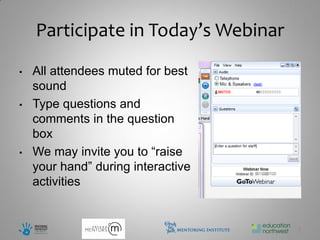
Participate in Today’s Webinar
•   All attendees muted for best
    sound
•   Type questions and
    comments in the question
    box
•   We may invite you to “raise
    your hand” during interactive
    activities


                                     3
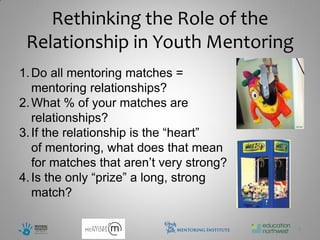
Rethinking the Role of the
 Relationship in Youth Mentoring
1. Do all mentoring matches =
   mentoring relationships?
2. What % of your matches are
   relationships?
3. If the relationship is the “heart”
   of mentoring, what does that mean
   for matches that aren’t very strong?
4. Is the only “prize” a long, strong
   match?

                                          4
Podcast: Interview with Dr. Tim Cavell


                                         5
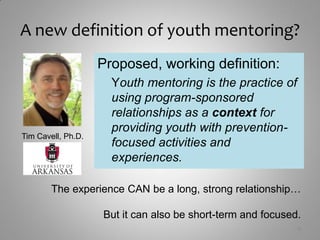
A new definition of youth mentoring?
                    Proposed, working definition:
                      Youth mentoring is the practice of
                      using program-sponsored
                      relationships as a context for
                      providing youth with prevention-
Tim Cavell, Ph.D.
                      focused activities and
                      experiences.

        The experience CAN be a long, strong relationship…

                    But it can also be short-term and focused.
                                                             6
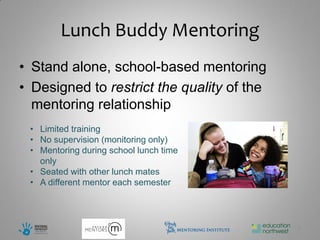
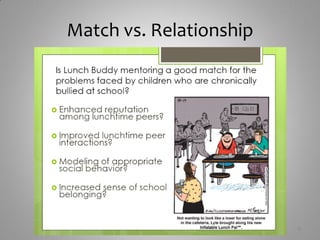
Lunch Buddy Mentoring
• Stand alone, school-based mentoring
• Designed to restrict the quality of the
  mentoring relationship
 • Limited training
 • No supervision (monitoring only)
 • Mentoring during school lunch time
   only
 • Seated with other lunch mates
 • A different mentor each semester


                                            7
Match vs. Relationship


                         8
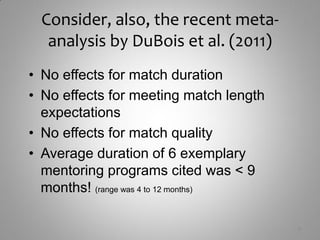
Consider, also, the recent meta-
  analysis by DuBois et al. (2011)
• No effects for match duration
• No effects for meeting match length
  expectations
• No effects for match quality
• Average duration of 6 exemplary
  mentoring programs cited was < 9
  months! (range was 4 to 12 months)

                                        9
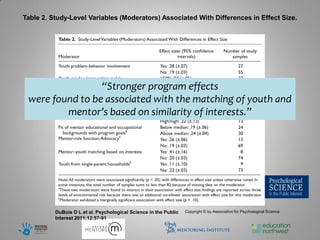
Table 2. Study-Level Variables (Moderators) Associated With Differences in Effect Size.


                 “Stronger program effects
 were found to be associated with the matching of youth and
         mentor’s based on similarity of interests.”


          DuBois D L et al. Psychological Science in the Public   Copyright © by Association for Psychological Science
          Interest 2011;12:57-91
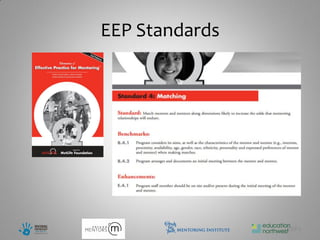
EEP Standards


11                   EEP3
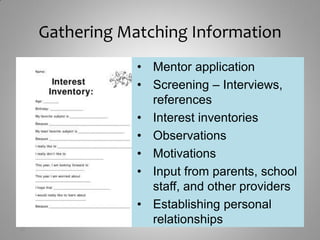
Gathering Matching Information
                 • Mentor application
                 • Screening – Interviews,
                   references
                 • Interest inventories
                 • Observations
                 • Motivations
                 • Input from parents, school
                   staff, and other providers
                 • Establishing personal
                   relationships
12
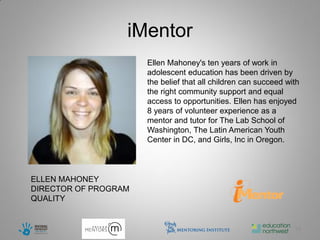
iMentor
                      Ellen Mahoney's ten years of work in
                      adolescent education has been driven by
                      the belief that all children can succeed with
                      the right community support and equal
                      access to opportunities. Ellen has enjoyed
                      8 years of volunteer experience as a
                      mentor and tutor for The Lab School of
                      Washington, The Latin American Youth
                      Center in DC, and Girls, Inc in Oregon.


ELLEN MAHONEY
DIRECTOR OF PROGRAM
QUALITY


                                                                 13
14
15
Improving mentoring success through a
  research-based matching strategy
          Currently agency-level staff workers match mentors
          to youth through a process that varies from agency
          to agency and is largely unknown to the researcher.

          Potentially, we could use mentor and mentee
          characteristics known at the time of match to
          optimize the process.

          This could allow agencies to be scientific about
          what makes for best matching practices and impose
          these practices uniformly across offices.

          Rhodes (UMass) and Featherstone (Harvard
          Business School) are working with programs to
          develop more effective matching strategies


                                                                16
17
Friends of the Children
                   Joe started out at Friends of the
                   Children 10 years ago as a paid,
                   professional mentor (Friend) to 8
                   boys. He believes deeply that
                   mentoring relationships have the
                   power to transform a young
                   person’s life, especially those who
                   have many socio-economic
                   obstacles to overcome.


Joe Bergen
Program Director
                                                         18
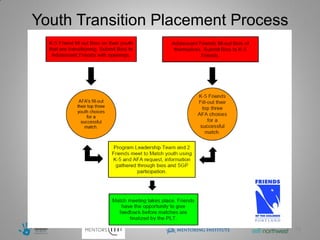
Youth Transition Placement Process


                                     19
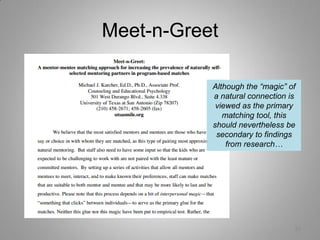
Meet-n-Greet

           Although the “magic” of
           a natural connection is
            viewed as the primary
              matching tool, this
           should nevertheless be
            secondary to findings
               from research…


                                 20
Friends for Youth
     Matching supported by
In-depth application process
• Mentors interviewed extensively,
  including experiences
• Mentees interviewed alone
• Parents/caregivers interviewed
  about “preferences”
• Referral agent gives input on
  strengths, needs, challenges at
  beginning

                                     21
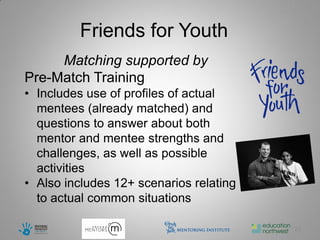
Friends for Youth
     Matching supported by
Pre-Match Training
• Includes use of profiles of actual
  mentees (already matched) and
  questions to answer about both
  mentor and mentee strengths and
  challenges, as well as possible
  activities
• Also includes 12+ scenarios relating
  to actual common situations

                                         22
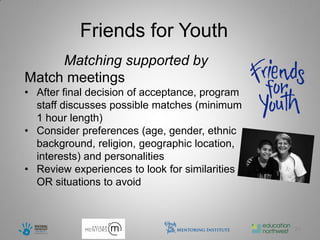
Friends for Youth
     Matching supported by
Match meetings
• After final decision of acceptance, program
  staff discusses possible matches (minimum
  1 hour length)
• Consider preferences (age, gender, ethnic
  background, religion, geographic location,
  interests) and personalities
• Review experiences to look for similarities
  OR situations to avoid


                                                23
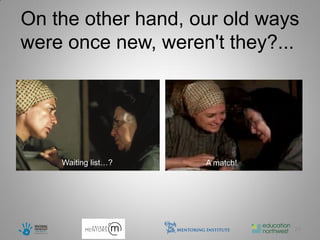
On the other hand, our old ways
were once new, weren't they?...


    Waiting list…?   A match!


                                24
Before we go…
All attendees will receive an email after the webinar
that will include:
 Link to presentation slides
 Link to an online recording of webinar
 Resources
 Contact information

Please help us by taking the time to complete a
short 5-question survey as you exit the webinar.


                                                        25
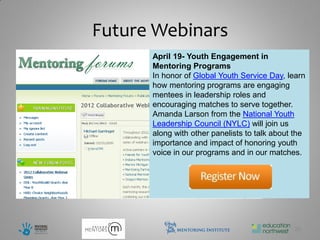
Future Webinars
      April 19- Youth Engagement in
      Mentoring Programs
      In honor of Global Youth Service Day, learn
      how mentoring programs are engaging
      mentees in leadership roles and
      encouraging matches to serve together.
      Amanda Larson from the National Youth
      Leadership Council (NYLC) will join us
      along with other panelists to talk about the
      importance and impact of honoring youth
      voice in our programs and in our matches.


                                              26
Thank you!
 Collaboration of Education Northwest/National
Mentoring Center, Friends for Youth, Mentoring
Partnership of Minnesota, and Oregon Mentors
   Michael Garringer, michael.garringer@educationnorthwest.org
           Celeste Janssen, celeste@oregonmentors.org
            Sarah Kremer, sarah@friendsforyouth.org
                  April Riordan, april@mpmn.org

Innovative Matching Strategies

  • 1.
    Innovative Matching Strategies Collaboration of Education Northwest/National Mentoring Center, Friends for Youth, Mentoring Partnership of Minnesota, and Oregon Mentors March 2012
  • 2.
    Good to Know… Allattendees will receive an email after the webinar that will include:  Link to presentation slides  Link to an online recording of webinar  Resources  Contact information Please help us by taking the time to complete a short 5-question survey as you exit the webinar. 1
  • 3.
    2012 Collaborative Mentoring Webinar Series o Research Celeste Janssen Program Director o Practice Oregon Mentors o Innovation Sarah Kremer Date: Third Thursday of every month. Program Director Friends for Youth’s Mentoring Institute Time: 10-11:15am Pacific/11am- 12:15pm Mountain/12-1:15 pm April Riordan Central/1-2:15pm Easter Director of Training & Partnerships Mentoring Partnership of Minnesota Cost: Free 2
  • 4.
    Participate in Today’sWebinar • All attendees muted for best sound • Type questions and comments in the question box • We may invite you to “raise your hand” during interactive activities 3
  • 5.
    Rethinking the Roleof the Relationship in Youth Mentoring 1. Do all mentoring matches = mentoring relationships? 2. What % of your matches are relationships? 3. If the relationship is the “heart” of mentoring, what does that mean for matches that aren’t very strong? 4. Is the only “prize” a long, strong match? 4
  • 6.
    Podcast: Interview withDr. Tim Cavell 5
  • 7.
    A new definitionof youth mentoring? Proposed, working definition: Youth mentoring is the practice of using program-sponsored relationships as a context for providing youth with prevention- Tim Cavell, Ph.D. focused activities and experiences. The experience CAN be a long, strong relationship… But it can also be short-term and focused. 6
  • 8.
    Lunch Buddy Mentoring •Stand alone, school-based mentoring • Designed to restrict the quality of the mentoring relationship • Limited training • No supervision (monitoring only) • Mentoring during school lunch time only • Seated with other lunch mates • A different mentor each semester 7
  • 9.
  • 10.
    Consider, also, therecent meta- analysis by DuBois et al. (2011) • No effects for match duration • No effects for meeting match length expectations • No effects for match quality • Average duration of 6 exemplary mentoring programs cited was < 9 months! (range was 4 to 12 months) 9
  • 11.
    Table 2. Study-LevelVariables (Moderators) Associated With Differences in Effect Size. “Stronger program effects were found to be associated with the matching of youth and mentor’s based on similarity of interests.” DuBois D L et al. Psychological Science in the Public Copyright © by Association for Psychological Science Interest 2011;12:57-91
  • 12.
  • 13.
    Gathering Matching Information • Mentor application • Screening – Interviews, references • Interest inventories • Observations • Motivations • Input from parents, school staff, and other providers • Establishing personal relationships 12
  • 14.
    iMentor Ellen Mahoney's ten years of work in adolescent education has been driven by the belief that all children can succeed with the right community support and equal access to opportunities. Ellen has enjoyed 8 years of volunteer experience as a mentor and tutor for The Lab School of Washington, The Latin American Youth Center in DC, and Girls, Inc in Oregon. ELLEN MAHONEY DIRECTOR OF PROGRAM QUALITY 13
  • 15.
  • 16.
  • 17.
    Improving mentoring successthrough a research-based matching strategy Currently agency-level staff workers match mentors to youth through a process that varies from agency to agency and is largely unknown to the researcher. Potentially, we could use mentor and mentee characteristics known at the time of match to optimize the process. This could allow agencies to be scientific about what makes for best matching practices and impose these practices uniformly across offices. Rhodes (UMass) and Featherstone (Harvard Business School) are working with programs to develop more effective matching strategies 16
  • 18.
  • 19.
    Friends of theChildren Joe started out at Friends of the Children 10 years ago as a paid, professional mentor (Friend) to 8 boys. He believes deeply that mentoring relationships have the power to transform a young person’s life, especially those who have many socio-economic obstacles to overcome. Joe Bergen Program Director 18
  • 20.
  • 21.
    Meet-n-Greet Although the “magic” of a natural connection is viewed as the primary matching tool, this should nevertheless be secondary to findings from research… 20
  • 22.
    Friends for Youth Matching supported by In-depth application process • Mentors interviewed extensively, including experiences • Mentees interviewed alone • Parents/caregivers interviewed about “preferences” • Referral agent gives input on strengths, needs, challenges at beginning 21
  • 23.
    Friends for Youth Matching supported by Pre-Match Training • Includes use of profiles of actual mentees (already matched) and questions to answer about both mentor and mentee strengths and challenges, as well as possible activities • Also includes 12+ scenarios relating to actual common situations 22
  • 24.
    Friends for Youth Matching supported by Match meetings • After final decision of acceptance, program staff discusses possible matches (minimum 1 hour length) • Consider preferences (age, gender, ethnic background, religion, geographic location, interests) and personalities • Review experiences to look for similarities OR situations to avoid 23
  • 25.
    On the otherhand, our old ways were once new, weren't they?... Waiting list…? A match! 24
  • 26.
    Before we go… Allattendees will receive an email after the webinar that will include:  Link to presentation slides  Link to an online recording of webinar  Resources  Contact information Please help us by taking the time to complete a short 5-question survey as you exit the webinar. 25
  • 27.
    Future Webinars April 19- Youth Engagement in Mentoring Programs In honor of Global Youth Service Day, learn how mentoring programs are engaging mentees in leadership roles and encouraging matches to serve together. Amanda Larson from the National Youth Leadership Council (NYLC) will join us along with other panelists to talk about the importance and impact of honoring youth voice in our programs and in our matches. 26
  • 28.
    Thank you! Collaborationof Education Northwest/National Mentoring Center, Friends for Youth, Mentoring Partnership of Minnesota, and Oregon Mentors Michael Garringer, michael.garringer@educationnorthwest.org Celeste Janssen, celeste@oregonmentors.org Sarah Kremer, sarah@friendsforyouth.org April Riordan, april@mpmn.org