

Research in Action Series School-Based Mentoring
Overview of Research in Action Series MENTOR has developed an innovative series - Research in Action  Translates the latest research on mentoring into tangible strategies for mentoring practitioners.  Makes the best available research accessible and relevant to the mentoring field.   Using the Research in Action series, programs can ensure their practices are based on current research, resulting in improved services and better impacts for young people.
10 issues  Each issue provides:   Research Action  Resources Overview of Research in Action Series
Research in Action Issues: Mentoring: A Key Resource for Promoting Positive Youth Development Effectiveness of Mentoring Program Practices Program Staff in Youth Mentoring Programs: Qualifications, Training, and Retention Fostering Close and Effective Relationships in Youth Mentoring Programs Why Youth Mentoring Relationships End School-Based Mentoring Cross-Age Peer Mentoring Mentoring Across Generations: Engaging 50+ Adults as Mentors Youth Mentoring: Do Race and Ethnicity Really Matter? Mentoring: A Promising Intervention for Children of Prisoners
Mentor Michigan Webinar Series www.mentormichigan.org Click on “Training & Technical Assistance”
Issue 6:  School-based Mentoring  Michael Karcher, Ed.D., Ph.D., University of Texas at San Antonio Carla Herrera, Ph.D., Public/Private Ventures   Issue available for free download at MENTOR’s website www.mentoring.org “ Access Research” Tab    Research in Action
Issue 6 - Overview Introduction SB & CB Approaches to Mentoring SBM Outcomes Characteristics of Effective Programs Questions/Discussion
Introduction School-based mentoring is now the most common form of formal mentoring in the U.S. Close to 870,000 adults are mentoring children in schools School-based mentoring: Is a very different intervention than the community based model Does benefit the youth, primarily in the areas of peer relationships and school-related areas Necessitates several practices to maximize benefits for youth
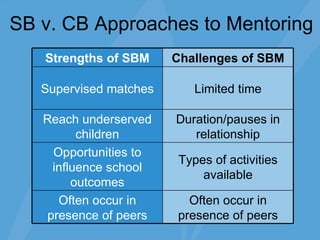
SB v. CB Approaches to Mentoring Often occur in presence of peers Often occur in presence of peers Types of activities available Opportunities to influence school outcomes Duration/pauses in relationship Reach underserved children Limited time Supervised matches Challenges of SBM Strengths of SBM
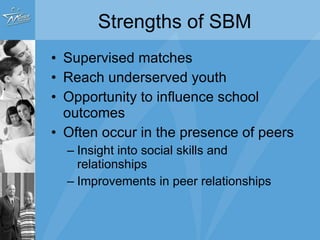
Strengths of SBM Supervised matches Reach underserved youth Opportunity to influence school outcomes Often occur in the presence of peers Insight into social skills and relationships Improvements in peer relationships
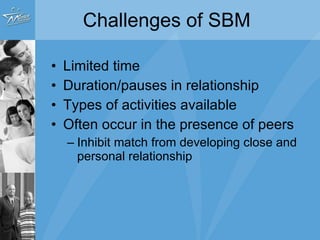
Challenges of SBM Limited time Duration/pauses in relationship Types of activities available Often occur in the presence of peers Inhibit match from developing close and personal relationship
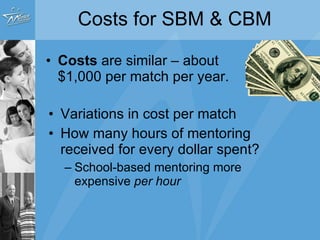
Costs for SBM & CBM Costs  are similar – about $1,000 per match per year. Variations in cost per match How many hours of mentoring received for every dollar spent? School-based mentoring more expensive  per hour
Outcomes-Based Analysis When determining program’s potential  value , costs must be weighed with type of services being provided and population being served. Considering  outcomes  yielded for a given price is likely a better strategy. Dollar for dollar, school-based mentoring yields comparable benefits to community-based mentoring
SBM – Who Benefits the Most?  Age of mentees Nature of relationship and enthusiasm for program changes as the mentee gets older Gender of mentees and perception of what being mentored means Girls benefiting slightly more than boys Girls are more receptive to the idea of mentoring as a “helping relationship” versus a “social opportunity”
SBM – Who Benefits the Most?  Characteristics of mentee Academic performance Grade level Not all youth benefit in same way – does not imply that SBM should stop serving youth with smallest benefits
Characteristics of Effective SBM Programs Mentor Support Types of Activities Increasing Longevity Terminating Effectively Summer Contact
Mentor Support  Pre-match & ongoing training Regular staff support  Contact with case managers at the school Actively seek out mentors School support Tailor the type and amount of support to the needs of the mentors
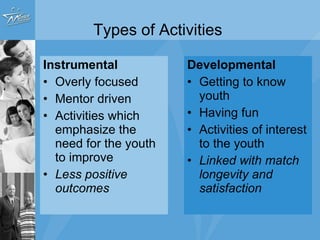
Types of Activities  Instrumental Overly focused Mentor driven Activities which emphasize the need for the youth to improve Less positive outcomes Developmental Getting to know youth Having fun Activities of interest to the youth Linked with match longevity and satisfaction
Increasing Longevity Meet early in the school year Start new mentors with younger students Establish programs or connections with other programs in feeder schools
Terminating Effectively Establish closure procedures  Train mentors on ending the relationship Help the youth feel positive at the end of the relationship Consistently implement closure procedures at the end of the school year
Summer Contact Increase match longevity and quality BBBS Study Matches that communicated over the summer were more likely to carry over into the following school year and lasted longer in that year More improvements in relationship quality Responsibility of program to facilitate and establishing guidelines for summer contact
Facilitating Summer Contact Hold agency-sponsored summer activities Hold a spring party to encourage matches to stay in touch by phone, letters or email over the summer Provide matches with ideas for games and activities they could engage in by phone, email or letters Send out summer newsletters
Conclusions SBM programs must adjust to the structure of the school New mentor training, staff support and match maintenance efforts, such as summer contacts, will be necessary for SBM to reach its potential Important to adapt SBM to better suit specific needs of boys and girls of specific ages
Action Part I: Is a School-Based Mentoring Program Right for You? Part II: Is Your School-based Mentoring Program Effective? Download this issue by visiting: www.mentoring.org “Access Research” Tab    Research in Action
National leader in creating and strengthening programs that improve lives in low-income communities.  School-based mentoring resources Recent mentoring publications Major mentoring initiatives  Go to: www.ppv.org Program Area    Mentoring Major Initiatives    School-based mentoring Public/Private Ventures (P/PV)
The Mentor Consulting Group Consulting firm led by Dr. Susan Weinberger, founder of the nation’s first school-based mentoring program www.mentorconsultinggroup.com  Resources    Free MCG Publications “ Two Decades of Learned Lessons from School-Based Mentoring” –Dr. Weinberger
The leader in expanding the power of mentoring to millions of young Americans who want and need adult mentors. High School Mentor Activity Report How to Build a Successful Mentoring Program Using the Elements of Effective Practice www.mentoring.org MENTOR
National organization that provides training and technical assistance to youth mentoring programs http://educationnorthwest.org/nmc Resources    School-Based Mentoring  The ABCs of School-Based Mentoring Keeping Matches in Touch Over the Summer Months (Fact sheet) Education Northwest:  National Mentoring Center
Questions or Comments?
This presentation provides an overview of Research in Action Issue 6:  School-Based Mentoring This tool was produced by MENTOR/The National Mentoring Partnership and can be accessed on their website: www.mentoring.org

Research In Action #6

  • 1.
    Research in ActionSeries School-Based Mentoring
  • 2.
    Overview of Researchin Action Series MENTOR has developed an innovative series - Research in Action Translates the latest research on mentoring into tangible strategies for mentoring practitioners. Makes the best available research accessible and relevant to the mentoring field.   Using the Research in Action series, programs can ensure their practices are based on current research, resulting in improved services and better impacts for young people.
  • 3.
    10 issues Each issue provides:   Research Action Resources Overview of Research in Action Series
  • 4.
    Research in ActionIssues: Mentoring: A Key Resource for Promoting Positive Youth Development Effectiveness of Mentoring Program Practices Program Staff in Youth Mentoring Programs: Qualifications, Training, and Retention Fostering Close and Effective Relationships in Youth Mentoring Programs Why Youth Mentoring Relationships End School-Based Mentoring Cross-Age Peer Mentoring Mentoring Across Generations: Engaging 50+ Adults as Mentors Youth Mentoring: Do Race and Ethnicity Really Matter? Mentoring: A Promising Intervention for Children of Prisoners
  • 5.
    Mentor Michigan WebinarSeries www.mentormichigan.org Click on “Training & Technical Assistance”
  • 6.
    Issue 6: School-based Mentoring Michael Karcher, Ed.D., Ph.D., University of Texas at San Antonio Carla Herrera, Ph.D., Public/Private Ventures Issue available for free download at MENTOR’s website www.mentoring.org “ Access Research” Tab  Research in Action
  • 7.
    Issue 6 -Overview Introduction SB & CB Approaches to Mentoring SBM Outcomes Characteristics of Effective Programs Questions/Discussion
  • 8.
    Introduction School-based mentoringis now the most common form of formal mentoring in the U.S. Close to 870,000 adults are mentoring children in schools School-based mentoring: Is a very different intervention than the community based model Does benefit the youth, primarily in the areas of peer relationships and school-related areas Necessitates several practices to maximize benefits for youth
  • 9.
    SB v. CBApproaches to Mentoring Often occur in presence of peers Often occur in presence of peers Types of activities available Opportunities to influence school outcomes Duration/pauses in relationship Reach underserved children Limited time Supervised matches Challenges of SBM Strengths of SBM
  • 10.
    Strengths of SBMSupervised matches Reach underserved youth Opportunity to influence school outcomes Often occur in the presence of peers Insight into social skills and relationships Improvements in peer relationships
  • 11.
    Challenges of SBMLimited time Duration/pauses in relationship Types of activities available Often occur in the presence of peers Inhibit match from developing close and personal relationship
  • 12.
    Costs for SBM& CBM Costs are similar – about $1,000 per match per year. Variations in cost per match How many hours of mentoring received for every dollar spent? School-based mentoring more expensive per hour
  • 13.
    Outcomes-Based Analysis Whendetermining program’s potential value , costs must be weighed with type of services being provided and population being served. Considering outcomes yielded for a given price is likely a better strategy. Dollar for dollar, school-based mentoring yields comparable benefits to community-based mentoring
  • 14.
    SBM – WhoBenefits the Most? Age of mentees Nature of relationship and enthusiasm for program changes as the mentee gets older Gender of mentees and perception of what being mentored means Girls benefiting slightly more than boys Girls are more receptive to the idea of mentoring as a “helping relationship” versus a “social opportunity”
  • 15.
    SBM – WhoBenefits the Most? Characteristics of mentee Academic performance Grade level Not all youth benefit in same way – does not imply that SBM should stop serving youth with smallest benefits
  • 16.
    Characteristics of EffectiveSBM Programs Mentor Support Types of Activities Increasing Longevity Terminating Effectively Summer Contact
  • 17.
    Mentor Support Pre-match & ongoing training Regular staff support Contact with case managers at the school Actively seek out mentors School support Tailor the type and amount of support to the needs of the mentors
  • 18.
    Types of Activities Instrumental Overly focused Mentor driven Activities which emphasize the need for the youth to improve Less positive outcomes Developmental Getting to know youth Having fun Activities of interest to the youth Linked with match longevity and satisfaction
  • 19.
    Increasing Longevity Meetearly in the school year Start new mentors with younger students Establish programs or connections with other programs in feeder schools
  • 20.
    Terminating Effectively Establishclosure procedures Train mentors on ending the relationship Help the youth feel positive at the end of the relationship Consistently implement closure procedures at the end of the school year
  • 21.
    Summer Contact Increasematch longevity and quality BBBS Study Matches that communicated over the summer were more likely to carry over into the following school year and lasted longer in that year More improvements in relationship quality Responsibility of program to facilitate and establishing guidelines for summer contact
  • 22.
    Facilitating Summer ContactHold agency-sponsored summer activities Hold a spring party to encourage matches to stay in touch by phone, letters or email over the summer Provide matches with ideas for games and activities they could engage in by phone, email or letters Send out summer newsletters
  • 23.
    Conclusions SBM programsmust adjust to the structure of the school New mentor training, staff support and match maintenance efforts, such as summer contacts, will be necessary for SBM to reach its potential Important to adapt SBM to better suit specific needs of boys and girls of specific ages
  • 24.
    Action Part I:Is a School-Based Mentoring Program Right for You? Part II: Is Your School-based Mentoring Program Effective? Download this issue by visiting: www.mentoring.org “Access Research” Tab  Research in Action
  • 25.
    National leader increating and strengthening programs that improve lives in low-income communities. School-based mentoring resources Recent mentoring publications Major mentoring initiatives Go to: www.ppv.org Program Area  Mentoring Major Initiatives  School-based mentoring Public/Private Ventures (P/PV)
  • 26.
    The Mentor ConsultingGroup Consulting firm led by Dr. Susan Weinberger, founder of the nation’s first school-based mentoring program www.mentorconsultinggroup.com Resources  Free MCG Publications “ Two Decades of Learned Lessons from School-Based Mentoring” –Dr. Weinberger
  • 27.
    The leader inexpanding the power of mentoring to millions of young Americans who want and need adult mentors. High School Mentor Activity Report How to Build a Successful Mentoring Program Using the Elements of Effective Practice www.mentoring.org MENTOR
  • 28.
    National organization thatprovides training and technical assistance to youth mentoring programs http://educationnorthwest.org/nmc Resources  School-Based Mentoring The ABCs of School-Based Mentoring Keeping Matches in Touch Over the Summer Months (Fact sheet) Education Northwest: National Mentoring Center
  • 29.
  • 30.
    This presentation providesan overview of Research in Action Issue 6: School-Based Mentoring This tool was produced by MENTOR/The National Mentoring Partnership and can be accessed on their website: www.mentoring.org