The Requirements Process


  PMI Tools & Techniques Forum
       Ivars K. Lenss, PMP
Agenda

        Introductions
        Definition of Requirements
        Requirements Planning
        Requirements Elicitation
        Process Modeling
        Q&A
                       Tools & Techniques Forum
                            January 14, 2009      Ivars@Lenss.us
Ivars K. Lenss, PMP
What Is a Requirement?

       (1) A condition or capability needed by a stakeholder
          to solve a problem or achieve an objective.

       (2) A condition or capability that must be met or
          possessed by a system or system component to
          satisfy a contract, standard, specification, or other
          formally imposed documents.

       (3) A documented representation of a condition or
          capability as in (1) or (2)
        Source: IEEE Std 610.12-1990


                                       Tools & Techniques Forum
                                            January 14, 2009      Ivars@Lenss.us
Ivars K. Lenss, PMP
How Requirements Work
 Requirements are not solutions
 Design translates requirements into solutions
 Many stakeholders mix requirements with their
        proposed solutions

 Requirements gathering is discovering the
        essence of the system

 Essence is the business reason of the work -
        what the work would be if there was no project

                              Tools & Techniques Forum
                                   January 14, 2009      Ivars@Lenss.us
Ivars K. Lenss, PMP
Benefits of Good Requirements

             Common understanding
             Collaborative relationships
             Commitment of team members
             Products support stakeholder needs


                            Tools & Techniques Forum
                                 January 14, 2009      Ivars@Lenss.us
Ivars K. Lenss, PMP
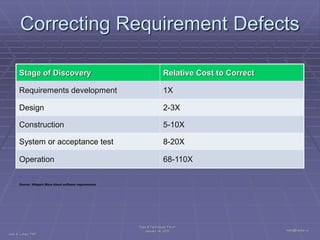
Correcting Requirement Defects

       Stage of Discovery                                                Relative Cost to Correct

       Requirements development                                          1X

       Design                                                            2-3X

       Construction                                                      5-10X

       System or acceptance test                                         8-20X

       Operation                                                         68-110X

       Source: Wiegers More About software requirements


                                                          Tools & Techniques Forum
                                                               January 14, 2009                     Ivars@Lenss.us
Ivars K. Lenss, PMP
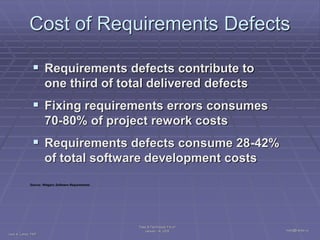
Cost of Requirements Defects

                 Requirements defects contribute to
                       one third of total delivered defects
                 Fixing requirements errors consumes
                       70-80% of project rework costs
                 Requirements defects consume 28-42%
                       of total software development costs
              Source: Wiegers Software Requirements


                                                      Tools & Techniques Forum
                                                           January 14, 2009      Ivars@Lenss.us
Ivars K. Lenss, PMP
Requirement Sources
                  Business                      Implementation
                  Stakeholder                   Maintainability
                  User                          Regulatory
                  Quality of Service  Legal
                  Performance                   Safety
                  Security                      Request for Proposal
                  External Systems              Derived
                                 Tools & Techniques Forum
                                      January 14, 2009              Ivars@Lenss.us
Ivars K. Lenss, PMP
Raw Requirements
       A raw requirement is an environmental or customer requirement that
       has not been analyzed and formulated as a well-formed requirement.
       (IEEE Std 1233, 1998 Edition)


 Higher-level statements of the business
        goals, objectives, and success factors
 Often expressed in initiating documents
 Often vague and subjectively interpreted
 Can be intermingled with ideas and
        suggestions for potential designs
                                            Tools & Techniques Forum
                                                 January 14, 2009       Ivars@Lenss.us
Ivars K. Lenss, PMP
Example
        Requirement: “The traffic monitor running in the
               background shall provide status messages at
               regular intervals not less than every minute.”

              What are the status messages?
              How are they provided to the user?
              If displayed, how long are they displayed?
              What is the acceptable timing interval?


                                  Tools & Techniques Forum
                                       January 14, 2009         Ivars@Lenss.us
Ivars K. Lenss, PMP
Business Events

        A system responds to things that happen
               externally – these are business events
        Each event has a preplanned response –
               This response is a business use case
        A requirement associates a business event
               with a business use case


                                Tools & Techniques Forum
                                     January 14, 2009      Ivars@Lenss.us
Ivars K. Lenss, PMP
Well-Formed Requirements
     A well-formed requirement is a statement of system functionality (a capability)
     that can be validated, and that must be possessed by a system to solve a
     customer objective, and is qualified by measurable conditions and bounded by
     constraints. (IEEE Std 1233, 1998 Edition)


    Abstract: Independent of its implementation
    Unambiguous: Interpreted in only one way
    Traceable: Associated with source
    Validateable: Fit criteria


                                       Tools & Techniques Forum
                                            January 14, 2009                     Ivars@Lenss.us
Ivars K. Lenss, PMP
Example
                      Raw Requirement: “The traffic monitor running in the
                      background shall provide status messages at
                      regular intervals not less than every minute.”


         The traffic monitor shall display status
                 messages in a designated area of the user
                 interface
         The messages shall be updated every 60
                 seconds, plus or minus five seconds
         Messages shall remain visible continuously


                                              Tools & Techniques Forum
                                                   January 14, 2009          Ivars@Lenss.us
Ivars K. Lenss, PMP
Requirements Classification
         Functional Requirements
                      - Things the product must do
                      - Action verbs – calculate, produce, inspect, publish

         Nonfunctional Requirements
                      - Qualities the product must have
                      - Look and feel, performance, security, regulatory

         Constraints
                      - Boundaries and limits on the solution.
                      - Glossary and naming conventions
                      - Training, knowledge transfer

                                           Tools & Techniques Forum
                                                January 14, 2009              Ivars@Lenss.us
Ivars K. Lenss, PMP
Examples

        Functional
        The rail system shall move people from San
               Francisco to Los Angeles
        Nonfunctional
        The rail system shall operate at an optimal
               cruise speed of 100 miles per hour
        Constraint
        The rail system shall operate at a maximum
               speed of 130 miles per hour
                                  Tools & Techniques Forum
                                       January 14, 2009      Ivars@Lenss.us
Ivars K. Lenss, PMP
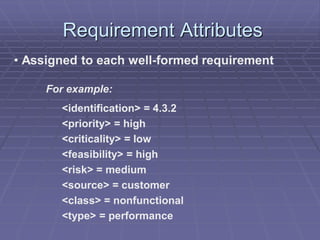
Requirement Attributes
• Assigned to each well-formed requirement

     For example:
       <identification> = 4.3.2
       <priority> = high
       <criticality> = low
       <feasibility> = high
       <risk> = medium
       <source> = customer
       <class> = nonfunctional
       <type> = performance
Requirements Planning

    PMI Tools & Techniques Forum
          January 14, 2009
Requirements Planning
        Identify stakeholders and key project team members
        Identify and communicate key roles/responsibilities
               to people involved in requirements gathering
                  [R]esponsible (does the work)
                  [A]ccountable (the decision maker-only one person)
                  [C]onsulted (consulted prior to the work, provides
                   input)
                  [I]nformed (on a need to know basis)
        Identify project assumptions
        Determine tools and techniques to gather and
               communicate requirements

                                      Tools & Techniques Forum
                                           January 14, 2009         Ivars@Lenss.us
Ivars K. Lenss, PMP
Planning Considerations

                       Number of stakeholders
                       Locations of stakeholders
                       Sources of domain knowledge
                       Organizational culture
                       Documentation requirements

                                    Tools & Techniques Forum
                                         January 14, 2009      Ivars@Lenss.us
Ivars K. Lenss, PMP
Obstacles

         Multiple, conflicting needs from stakeholders
         Stakeholder availability
         Stakeholder knowledge
         Lack of involvement of the right people
         Delivery dates mandated without prioritized
          requirements
         Scope creep
         Analysis paralysis

                           Tools & Techniques Forum
                                January 14, 2009      Ivars@Lenss.us
Ivars K. Lenss, PMP
Requirements Life Cycle
                                 Target                                               Stakeholder
                               Environment                                           Goals, Needs,


                                                                                                                                 PR
                                                                                                                                     O
                                                                                     and Objectives


                                                                                                                                      D
                                                                                                                                         U
                                                                                                                                          C
                                                                                                                                             T
                                REQUIREMENTS
                                                                                                   RELEASE
     Process                      MODELS                 Requirements                             FEEDBACK                       Product
     Modeling                                              Definition                                                            Release
                                                      TI TS
                                                     A N
                                                         N
                                                   IC E
                                                        O
                                                 IF EM


                                                                                    FE
                                                                                    B DB
                      MO


                                                                                     U A
                                               EC UIR


                                                                                      E
                                                                                       IL C
                        DE


                                                                                         D K
                                             SP EQ
                          LS


                                               R


                                        B N
                                             K
                                           G
                                           C
                                      ED SI
                                         A


                                                                                                                                 T
                                    FE E


                                                                                                                              C
                                       D


                                                                                                                             U
                                                                                                                         D
                                                                                                                        O
                                                                                                                     PR
                                                                                         Product
                               Product                                                    Build
                               Design                   DESIGN
                                                     SPECIFICATION
                                                         Tools & Techniques Forum
                                                              January 14, 2009                                                              Ivars@Lenss.us
Ivars K. Lenss, PMP                                                                        Source: Robertson & Robertson, Mastering the Requirements Process
Requirements Elicitation

     PMI Tools & Techniques Forum
           January 14, 2009
Requirements Elicitation

        Used to build analytical models
        Exposes missing, incomplete, or incorrect
               requirements

        Determines if additional iterations required


                               Tools & Techniques Forum
                                    January 14, 2009      Ivars@Lenss.us
Ivars K. Lenss, PMP
REQUIREMENTS
                                             WORKSHOPS

                 INTERVIEWS                                                          BRAINSTORMING/
                                                                                     FOCUS GROUPS


    SURVEY/
 QUESTIONNAIRE                              REQUIREMENTS                                 PROTOTYPING


         OBSERVATION/
          SHADOWING                                                                      DOCUMENT
                                                                                         ANALYSIS


                                REVERSE                                  INTERFACE
                              ENGINEERING                                 ANALYSIS


                                              Tools & Techniques Forum
                                                   January 14, 2009                               Ivars@Lenss.us
Ivars K. Lenss, PMP
Interviews
      Solicit stakeholder involvement, authority, impact
      Most common elicitation technique
      Structured interview, pre-defined questions
      Unstructured interview, no pre-defined questions
      Encourages participation and establishes rapport
       with the stakeholder
      Results subject to interviewer’s interpretation
      Not a means of reaching consensus


                           Tools & Techniques Forum
                                January 14, 2009      Ivars@Lenss.us
Ivars K. Lenss, PMP
Requirements Workshops
      Structured way to capture requirements (scope,
             define, discover, prioritize, and reach closure)
            Also referred to as JAD, Joint Application Design
            Effective way to elicit requirements quickly
            Feedback is immediate
            Stakeholders availability affects scheduling
            Too many participants can slow down the process
            Too few participants can overlook requirements


                                  Tools & Techniques Forum
                                       January 14, 2009         Ivars@Lenss.us
Ivars K. Lenss, PMP
Brainstorming/Focus Group
        Focuses on a topic or problem area
        Share new ideas without criticism or evaluation
        Create a condensed list of ideas

        Homogeneous—individuals with similar characteristics
                  Differing perspectives might not be shared


        Heterogeneous—individuals with diverse backgrounds
                  Individuals may self-censor if not comfortable with others’
                   background


                                           Tools & Techniques Forum
                                                January 14, 2009                 Ivars@Lenss.us
Ivars K. Lenss, PMP
Survey / Questionnaire

              Quick and relatively inexpensive
              Does not usually require significant time
              Efficient when stakeholders are not co-located
              Closed-ended questions:
                  Used when issues are known, responses are not
                  Effective in obtaining quantitative data
        Open-ended questions:
                  Effective in obtaining insights and opinions
                  Difficult to quantify and summarize

                                       Tools & Techniques Forum
                                            January 14, 2009       Ivars@Lenss.us
Ivars K. Lenss, PMP
Prototyping
        Creates “mock ups” of screen or report layouts
        Lets stakeholders “see” the system’s interface
        Horizontal prototype
                  Models a shallow and wide view of the system (breadth)
        Vertical prototype
                  Models a deep and narrow view of the system (depth)
        Can take considerable time
        Can get bogged down by the “hows” rather than “whats”
        May lead to unrealistic expectations of performance,
               reliability, usability


                                          Tools & Techniques Forum
                                               January 14, 2009             Ivars@Lenss.us
Ivars K. Lenss, PMP
Document Analysis
      Used to gather details of the “As Is” environment
      Leverage existing materials to discover and/or confirm
       requirements
      Applied in situations where
                 the subject matter experts for the existing systems are no longer
                  with the organization
                 or are not going to be available throughout the duration of the
                  requirements elicitation process

      Documentation may not be up-to-date
      Can be tedious and time-consuming


                                           Tools & Techniques Forum
                                                January 14, 2009                Ivars@Lenss.us
Ivars K. Lenss, PMP
Interface Analysis
         Used to identify shared interface requirements
         Interfaces types include:
                       User interfaces
                       System-to-system interfaces
                       Interfaces to and from external hardware devices
                Reveals inputs, outputs, functionality
                Important to look across all interfaces
                Promotes successful interoperability
                Does not reveal business processes


                                              Tools & Techniques Forum
                                                   January 14, 2009        Ivars@Lenss.us
Ivars K. Lenss, PMP
Observation / Shadowing
    Study people performing their jobs
    Assess an SME’s work environment
    Sometimes called "job shadowing” or “following
           people around”
    Documents details about a current process
    Could be time-consuming
    May be disruptive

                               Tools & Techniques Forum
                                    January 14, 2009      Ivars@Lenss.us
Ivars K. Lenss, PMP
Reverse Engineering
        Existing system has little or outdated documentation
        Helps in understanding what a system actually does
        Black Box:
                  Studied without examining its internal structure
        White Box:
                  Inner workings of the system/product are studied
        Expensive and time-consuming
        Can be restricted by copyright laws
        Existing tools have limited capabilities and require
               training to use


                                           Tools & Techniques Forum
                                                January 14, 2009      Ivars@Lenss.us
Ivars K. Lenss, PMP
Requirements Modeling

    PMI Tools & Techniques Forum
          January 14, 2009
Analytical Models
            Express different views of requirements
            Provide perspectives and focus
            Achieve specific levels of detail
            Facilitate communication
            Models can be text, diagrams, or both
                     Behavior models (processes, tasks, sequences)
                     Structural models (parts and relationships)
                     Dynamic models (how things change over time)
                     Control models (decisions and policies)

                                          Tools & Techniques Forum
                                               January 14, 2009       Ivars@Lenss.us
Ivars K. Lenss, PMP
Model Views
         Control Models (guidelines, standards)
                       Business Policies
                       Business Rules

         Structural Models (parts and relationships)
                       Domain Models
                       Glossary

         Dynamic Models (changes over time)
                       Event Table


                                            Tools & Techniques Forum
                                                 January 14, 2009      Ivars@Lenss.us
Ivars K. Lenss, PMP
Model Views
         Behavioral Models (processes, tasks, sequences)
                         Relationship Map
                         Context Diagram
                         Stakeholder Classes
                         Actor Map
                         Actor Table
                         Prototype
                         Process Map
                         Use Cases
                         Scenarios


                                          Tools & Techniques Forum
                                               January 14, 2009      Ivars@Lenss.us
Ivars K. Lenss, PMP
Writing Requirements

        Written for stakeholders
        Written for designers
        Written using business language
        Associated with a fit criterion
        Designers can build what the client wants


                             Tools & Techniques Forum
                                  January 14, 2009      Ivars@Lenss.us
Ivars K. Lenss, PMP
Establishing Metrics

        Project Metrics – measurements
               associated with the project
                  Cost, effort, schedule, risk, resources, etc.

        Product Metrics – measurements
               associated with the product
                  Defects, performance, size, etc.


                                        Tools & Techniques Forum
                                             January 14, 2009      Ivars@Lenss.us
Ivars K. Lenss, PMP
Further Reading
       1.             Wiegers, Karl E., Software Requirements , 2nd ed., Microsoft Press, 2003
       2.             Wiegers Karl, E., More about Software Requirements: Thorny Issues and
                      Practical Advice, Microsoft Press, 2006
       3.             Robertson & Robertson, Mastering the Requirements Process, 2nd ed.,
                      Addison-Wesley, 2006
       4.             Sward, Measuring the Business Value of Information Technology, Intel
                      Press, 2006
       5.             Bridgeland, Zahavi, Business Modeling, A Practical Guide to Realizing
                      Business Value, Morgan Kaufman, 2009
       6.             IEEE Std 1233, 1998 Edition, IEEE Guide for Developing System
                      Requirements Specifications


                                                  Tools & Techniques Forum
                                                       January 14, 2009                       Ivars@Lenss.us
Ivars K. Lenss, PMP

The Requirements Process Workshop Presentation

  • 1.
    The Requirements Process PMI Tools & Techniques Forum Ivars K. Lenss, PMP
  • 2.
    Agenda  Introductions  Definition of Requirements  Requirements Planning  Requirements Elicitation  Process Modeling  Q&A Tools & Techniques Forum January 14, 2009 Ivars@Lenss.us Ivars K. Lenss, PMP
  • 3.
    What Is aRequirement? (1) A condition or capability needed by a stakeholder to solve a problem or achieve an objective. (2) A condition or capability that must be met or possessed by a system or system component to satisfy a contract, standard, specification, or other formally imposed documents. (3) A documented representation of a condition or capability as in (1) or (2) Source: IEEE Std 610.12-1990 Tools & Techniques Forum January 14, 2009 Ivars@Lenss.us Ivars K. Lenss, PMP
  • 4.
    How Requirements Work Requirements are not solutions  Design translates requirements into solutions  Many stakeholders mix requirements with their proposed solutions  Requirements gathering is discovering the essence of the system  Essence is the business reason of the work - what the work would be if there was no project Tools & Techniques Forum January 14, 2009 Ivars@Lenss.us Ivars K. Lenss, PMP
  • 5.
    Benefits of GoodRequirements  Common understanding  Collaborative relationships  Commitment of team members  Products support stakeholder needs Tools & Techniques Forum January 14, 2009 Ivars@Lenss.us Ivars K. Lenss, PMP
  • 6.
    Correcting Requirement Defects Stage of Discovery Relative Cost to Correct Requirements development 1X Design 2-3X Construction 5-10X System or acceptance test 8-20X Operation 68-110X Source: Wiegers More About software requirements Tools & Techniques Forum January 14, 2009 Ivars@Lenss.us Ivars K. Lenss, PMP
  • 7.
    Cost of RequirementsDefects  Requirements defects contribute to one third of total delivered defects  Fixing requirements errors consumes 70-80% of project rework costs  Requirements defects consume 28-42% of total software development costs Source: Wiegers Software Requirements Tools & Techniques Forum January 14, 2009 Ivars@Lenss.us Ivars K. Lenss, PMP
  • 8.
    Requirement Sources  Business  Implementation  Stakeholder  Maintainability  User  Regulatory  Quality of Service  Legal  Performance  Safety  Security  Request for Proposal  External Systems  Derived Tools & Techniques Forum January 14, 2009 Ivars@Lenss.us Ivars K. Lenss, PMP
  • 9.
    Raw Requirements A raw requirement is an environmental or customer requirement that has not been analyzed and formulated as a well-formed requirement. (IEEE Std 1233, 1998 Edition)  Higher-level statements of the business goals, objectives, and success factors  Often expressed in initiating documents  Often vague and subjectively interpreted  Can be intermingled with ideas and suggestions for potential designs Tools & Techniques Forum January 14, 2009 Ivars@Lenss.us Ivars K. Lenss, PMP
  • 10.
    Example  Requirement: “The traffic monitor running in the background shall provide status messages at regular intervals not less than every minute.”  What are the status messages?  How are they provided to the user?  If displayed, how long are they displayed?  What is the acceptable timing interval? Tools & Techniques Forum January 14, 2009 Ivars@Lenss.us Ivars K. Lenss, PMP
  • 11.
    Business Events  A system responds to things that happen externally – these are business events  Each event has a preplanned response – This response is a business use case  A requirement associates a business event with a business use case Tools & Techniques Forum January 14, 2009 Ivars@Lenss.us Ivars K. Lenss, PMP
  • 12.
    Well-Formed Requirements A well-formed requirement is a statement of system functionality (a capability) that can be validated, and that must be possessed by a system to solve a customer objective, and is qualified by measurable conditions and bounded by constraints. (IEEE Std 1233, 1998 Edition)  Abstract: Independent of its implementation  Unambiguous: Interpreted in only one way  Traceable: Associated with source  Validateable: Fit criteria Tools & Techniques Forum January 14, 2009 Ivars@Lenss.us Ivars K. Lenss, PMP
  • 13.
    Example Raw Requirement: “The traffic monitor running in the background shall provide status messages at regular intervals not less than every minute.”  The traffic monitor shall display status messages in a designated area of the user interface  The messages shall be updated every 60 seconds, plus or minus five seconds  Messages shall remain visible continuously Tools & Techniques Forum January 14, 2009 Ivars@Lenss.us Ivars K. Lenss, PMP
  • 14.
    Requirements Classification  Functional Requirements - Things the product must do - Action verbs – calculate, produce, inspect, publish  Nonfunctional Requirements - Qualities the product must have - Look and feel, performance, security, regulatory  Constraints - Boundaries and limits on the solution. - Glossary and naming conventions - Training, knowledge transfer Tools & Techniques Forum January 14, 2009 Ivars@Lenss.us Ivars K. Lenss, PMP
  • 15.
    Examples  Functional  The rail system shall move people from San Francisco to Los Angeles  Nonfunctional  The rail system shall operate at an optimal cruise speed of 100 miles per hour  Constraint  The rail system shall operate at a maximum speed of 130 miles per hour Tools & Techniques Forum January 14, 2009 Ivars@Lenss.us Ivars K. Lenss, PMP
  • 16.
    Requirement Attributes • Assignedto each well-formed requirement For example: <identification> = 4.3.2 <priority> = high <criticality> = low <feasibility> = high <risk> = medium <source> = customer <class> = nonfunctional <type> = performance
  • 17.
    Requirements Planning PMI Tools & Techniques Forum January 14, 2009
  • 18.
    Requirements Planning  Identify stakeholders and key project team members  Identify and communicate key roles/responsibilities to people involved in requirements gathering  [R]esponsible (does the work)  [A]ccountable (the decision maker-only one person)  [C]onsulted (consulted prior to the work, provides input)  [I]nformed (on a need to know basis)  Identify project assumptions  Determine tools and techniques to gather and communicate requirements Tools & Techniques Forum January 14, 2009 Ivars@Lenss.us Ivars K. Lenss, PMP
  • 19.
    Planning Considerations  Number of stakeholders  Locations of stakeholders  Sources of domain knowledge  Organizational culture  Documentation requirements Tools & Techniques Forum January 14, 2009 Ivars@Lenss.us Ivars K. Lenss, PMP
  • 20.
    Obstacles  Multiple, conflicting needs from stakeholders  Stakeholder availability  Stakeholder knowledge  Lack of involvement of the right people  Delivery dates mandated without prioritized requirements  Scope creep  Analysis paralysis Tools & Techniques Forum January 14, 2009 Ivars@Lenss.us Ivars K. Lenss, PMP
  • 21.
    Requirements Life Cycle Target Stakeholder Environment Goals, Needs, PR O and Objectives D U C T REQUIREMENTS RELEASE Process MODELS Requirements FEEDBACK Product Modeling Definition Release TI TS A N N IC E O IF EM FE B DB MO U A EC UIR E IL C DE D K SP EQ LS R B N K G C ED SI A T FE E C D U D O PR Product Product Build Design DESIGN SPECIFICATION Tools & Techniques Forum January 14, 2009 Ivars@Lenss.us Ivars K. Lenss, PMP Source: Robertson & Robertson, Mastering the Requirements Process
  • 22.
    Requirements Elicitation PMI Tools & Techniques Forum January 14, 2009
  • 23.
    Requirements Elicitation  Used to build analytical models  Exposes missing, incomplete, or incorrect requirements  Determines if additional iterations required Tools & Techniques Forum January 14, 2009 Ivars@Lenss.us Ivars K. Lenss, PMP
  • 24.
    REQUIREMENTS WORKSHOPS INTERVIEWS BRAINSTORMING/ FOCUS GROUPS SURVEY/ QUESTIONNAIRE REQUIREMENTS PROTOTYPING OBSERVATION/ SHADOWING DOCUMENT ANALYSIS REVERSE INTERFACE ENGINEERING ANALYSIS Tools & Techniques Forum January 14, 2009 Ivars@Lenss.us Ivars K. Lenss, PMP
  • 25.
    Interviews  Solicit stakeholder involvement, authority, impact  Most common elicitation technique  Structured interview, pre-defined questions  Unstructured interview, no pre-defined questions  Encourages participation and establishes rapport with the stakeholder  Results subject to interviewer’s interpretation  Not a means of reaching consensus Tools & Techniques Forum January 14, 2009 Ivars@Lenss.us Ivars K. Lenss, PMP
  • 26.
    Requirements Workshops  Structured way to capture requirements (scope, define, discover, prioritize, and reach closure)  Also referred to as JAD, Joint Application Design  Effective way to elicit requirements quickly  Feedback is immediate  Stakeholders availability affects scheduling  Too many participants can slow down the process  Too few participants can overlook requirements Tools & Techniques Forum January 14, 2009 Ivars@Lenss.us Ivars K. Lenss, PMP
  • 27.
    Brainstorming/Focus Group  Focuses on a topic or problem area  Share new ideas without criticism or evaluation  Create a condensed list of ideas  Homogeneous—individuals with similar characteristics  Differing perspectives might not be shared  Heterogeneous—individuals with diverse backgrounds  Individuals may self-censor if not comfortable with others’ background Tools & Techniques Forum January 14, 2009 Ivars@Lenss.us Ivars K. Lenss, PMP
  • 28.
    Survey / Questionnaire  Quick and relatively inexpensive  Does not usually require significant time  Efficient when stakeholders are not co-located  Closed-ended questions:  Used when issues are known, responses are not  Effective in obtaining quantitative data  Open-ended questions:  Effective in obtaining insights and opinions  Difficult to quantify and summarize Tools & Techniques Forum January 14, 2009 Ivars@Lenss.us Ivars K. Lenss, PMP
  • 29.
    Prototyping  Creates “mock ups” of screen or report layouts  Lets stakeholders “see” the system’s interface  Horizontal prototype  Models a shallow and wide view of the system (breadth)  Vertical prototype  Models a deep and narrow view of the system (depth)  Can take considerable time  Can get bogged down by the “hows” rather than “whats”  May lead to unrealistic expectations of performance, reliability, usability Tools & Techniques Forum January 14, 2009 Ivars@Lenss.us Ivars K. Lenss, PMP
  • 30.
    Document Analysis  Used to gather details of the “As Is” environment  Leverage existing materials to discover and/or confirm requirements  Applied in situations where  the subject matter experts for the existing systems are no longer with the organization  or are not going to be available throughout the duration of the requirements elicitation process  Documentation may not be up-to-date  Can be tedious and time-consuming Tools & Techniques Forum January 14, 2009 Ivars@Lenss.us Ivars K. Lenss, PMP
  • 31.
    Interface Analysis  Used to identify shared interface requirements  Interfaces types include:  User interfaces  System-to-system interfaces  Interfaces to and from external hardware devices  Reveals inputs, outputs, functionality  Important to look across all interfaces  Promotes successful interoperability  Does not reveal business processes Tools & Techniques Forum January 14, 2009 Ivars@Lenss.us Ivars K. Lenss, PMP
  • 32.
    Observation / Shadowing  Study people performing their jobs  Assess an SME’s work environment  Sometimes called "job shadowing” or “following people around”  Documents details about a current process  Could be time-consuming  May be disruptive Tools & Techniques Forum January 14, 2009 Ivars@Lenss.us Ivars K. Lenss, PMP
  • 33.
    Reverse Engineering  Existing system has little or outdated documentation  Helps in understanding what a system actually does  Black Box:  Studied without examining its internal structure  White Box:  Inner workings of the system/product are studied  Expensive and time-consuming  Can be restricted by copyright laws  Existing tools have limited capabilities and require training to use Tools & Techniques Forum January 14, 2009 Ivars@Lenss.us Ivars K. Lenss, PMP
  • 34.
    Requirements Modeling PMI Tools & Techniques Forum January 14, 2009
  • 35.
    Analytical Models  Express different views of requirements  Provide perspectives and focus  Achieve specific levels of detail  Facilitate communication  Models can be text, diagrams, or both  Behavior models (processes, tasks, sequences)  Structural models (parts and relationships)  Dynamic models (how things change over time)  Control models (decisions and policies) Tools & Techniques Forum January 14, 2009 Ivars@Lenss.us Ivars K. Lenss, PMP
  • 36.
    Model Views  Control Models (guidelines, standards)  Business Policies  Business Rules  Structural Models (parts and relationships)  Domain Models  Glossary  Dynamic Models (changes over time)  Event Table Tools & Techniques Forum January 14, 2009 Ivars@Lenss.us Ivars K. Lenss, PMP
  • 37.
    Model Views  Behavioral Models (processes, tasks, sequences)  Relationship Map  Context Diagram  Stakeholder Classes  Actor Map  Actor Table  Prototype  Process Map  Use Cases  Scenarios Tools & Techniques Forum January 14, 2009 Ivars@Lenss.us Ivars K. Lenss, PMP
  • 38.
    Writing Requirements  Written for stakeholders  Written for designers  Written using business language  Associated with a fit criterion  Designers can build what the client wants Tools & Techniques Forum January 14, 2009 Ivars@Lenss.us Ivars K. Lenss, PMP
  • 39.
    Establishing Metrics  Project Metrics – measurements associated with the project  Cost, effort, schedule, risk, resources, etc.  Product Metrics – measurements associated with the product  Defects, performance, size, etc. Tools & Techniques Forum January 14, 2009 Ivars@Lenss.us Ivars K. Lenss, PMP
  • 40.
    Further Reading 1. Wiegers, Karl E., Software Requirements , 2nd ed., Microsoft Press, 2003 2. Wiegers Karl, E., More about Software Requirements: Thorny Issues and Practical Advice, Microsoft Press, 2006 3. Robertson & Robertson, Mastering the Requirements Process, 2nd ed., Addison-Wesley, 2006 4. Sward, Measuring the Business Value of Information Technology, Intel Press, 2006 5. Bridgeland, Zahavi, Business Modeling, A Practical Guide to Realizing Business Value, Morgan Kaufman, 2009 6. IEEE Std 1233, 1998 Edition, IEEE Guide for Developing System Requirements Specifications Tools & Techniques Forum January 14, 2009 Ivars@Lenss.us Ivars K. Lenss, PMP