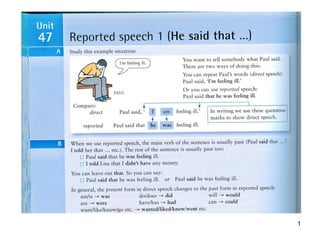
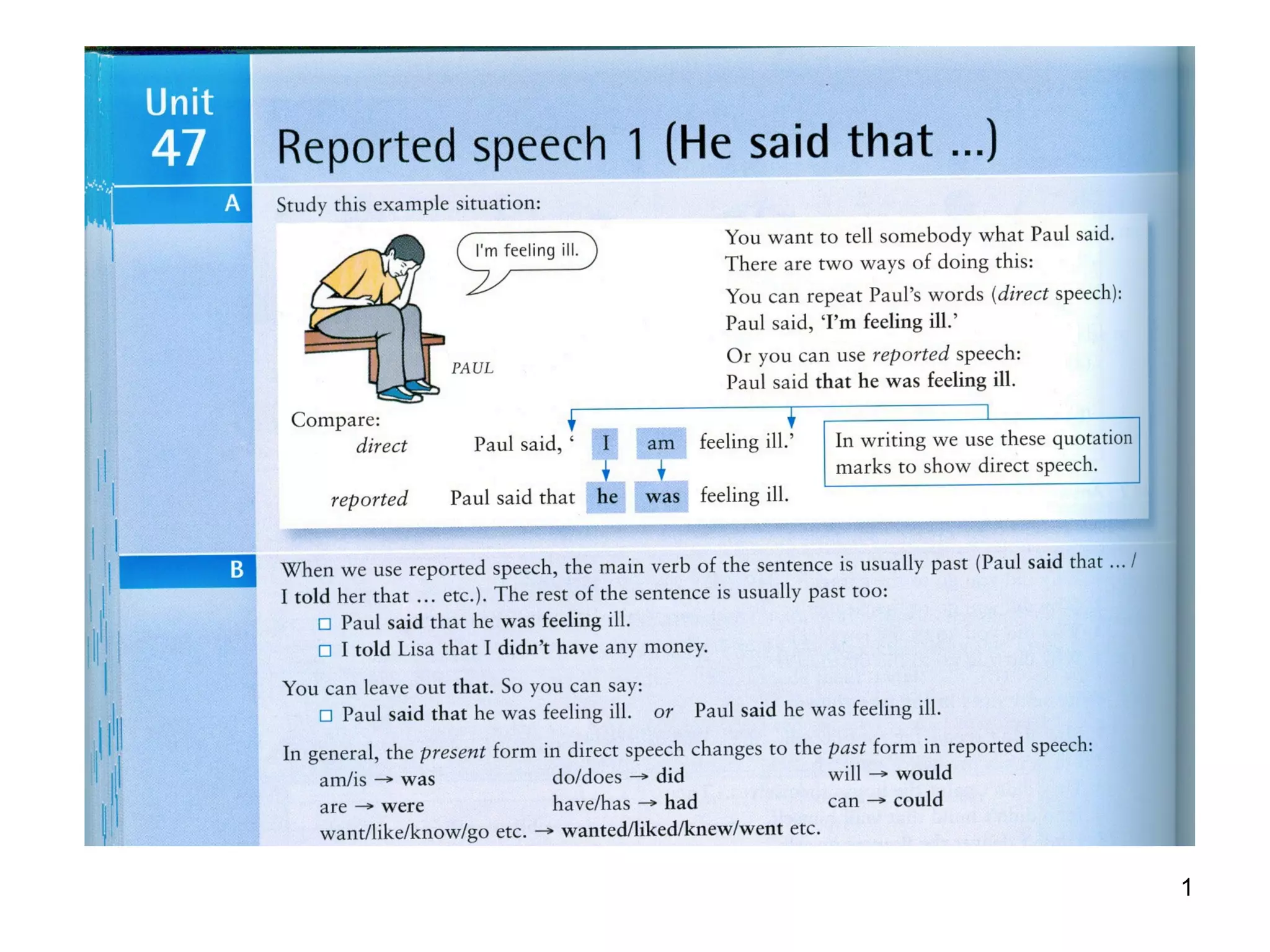
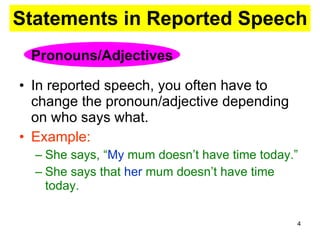
Statements in Reported Speech In reported speech, you often have to change the pronoun/adjective depending on who says what. Example: She says, “ My  mum doesn’t have time today.” She says that  her  mum doesn’t have time today. Pronouns/Adjectives
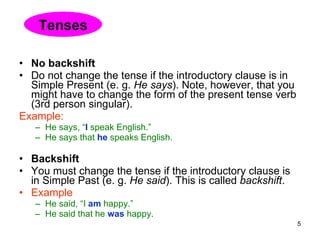
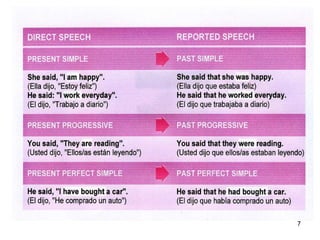
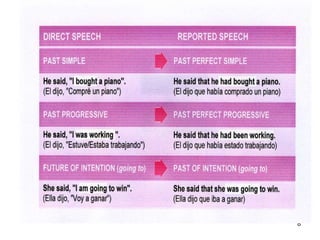
No backshift Do not change the tense if the introductory clause is in Simple Present (e. g.  He says ). Note, however, that you might have to change the form of the present tense verb (3rd person singular). Example: He says, “ I   speak English.”  He says that  he  speaks English. Backshift You must change the tense if the introductory clause is in Simple Past (e. g.  He said ). This is called  backshift . Example He said, “I  am  happy.”  He said that he  was  happy. Tenses
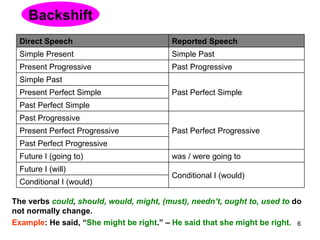
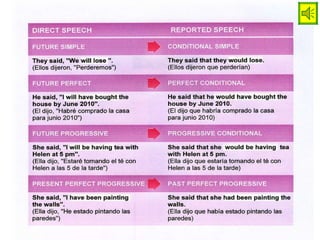
Backshift The verbs  could ,  should, would, might, (must), needn’t, ought to, used to  do not normally change. Example : He said, “ She might be right .” –  He said that she might be right. Conditional I (would) Conditional I (would) Future I (will) was / were going to Future I (going to) Past Perfect Progressive Present Perfect Progressive Past Perfect Progressive Past Progressive Past Perfect Simple Present Perfect Simple Past Perfect Simple Simple Past Past Progressive Present Progressive Simple Past Simple Present Reported Speech Direct Speech


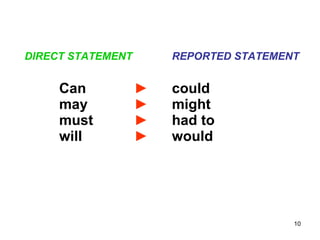
DIRECT STATEMENT REPORTED STATEMENT Can ► could may ►   might must ► had to will ► would
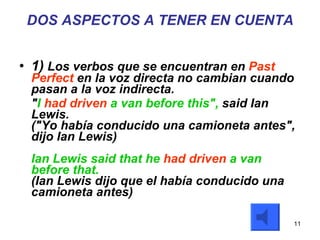
DOS ASPECTOS A TENER EN CUENTA 1)  Los verbos que se encuentran en  Past Perfect  en la voz directa no cambian cuando pasan a la voz indirecta.  " I  had driven  a van before this",  said Ian Lewis. ("Yo había conducido una camioneta antes", dijo Ian Lewis) Ian Lewis said that he  had driven  a van before that. (Ian Lewis dijo que el había conducido una camioneta antes)
2)  Otros verbos modales - could ,  might ,  ought to ,  should ,  would  - normalmente no cambian. En determinadas situaciones, incluso  must  puede permanecer sin cambios. " I  might  drive a van if I wanted to do it",  said Ian Lewis . ("Yo podría conducir una camioneta si quisiera hacerlo", dijo Ian Lewis) Ian Lewis said that he  might  drive a van if he wanted to do it. (Ian Lewis dijo que él podría conducir una camioneta si quisiera hacerlo) " Young people  ought to  drive more carefully ", said the policeman. (Los jóvenes deberían conducir con más cuidado", dijo el agente de policía) The policeman said that young people  ought to  drive more carefully . (El agente de policía dijo que los jóvenes deberían conducir con más cuidado)
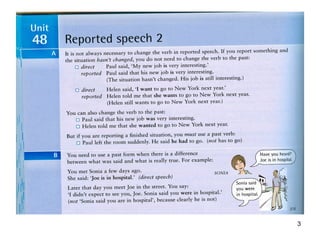
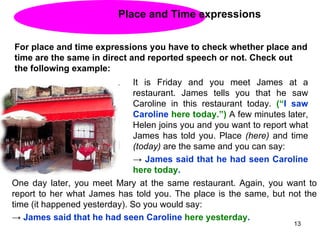
Place and Time expressions For place and time expressions you have to check whether place and time are the same in direct and reported speech or not. Check out the following example:  It is Friday and you meet James at a restaurant. James tells you that he saw Caroline in this restaurant today.  (“ I saw Caroline  here today.”)  A few minutes later, Helen joins you and you want to report what James has told you. Place  (here)  and time  (today)  are the same and you can say: ->  James said that he had seen Caroline  here   today . One day later, you meet Mary at the same restaurant. Again, you want to report to her what James has told you. The place is the same, but not the time (it happened yesterday). So you would say: ->  James said that he had seen Caroline  here yesterday .
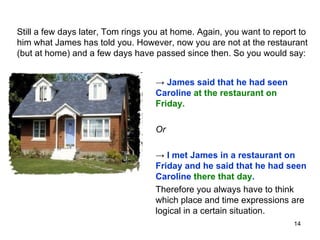
Still a few days later, Tom rings you at home. Again, you want to report to him what James has told you. However, now you are not at the restaurant (but at home) and a few days have passed since then. So you would say:  ->  James said that he had seen Caroline  at the restaurant on Friday. Or ->  I met James in a restaurant on Friday and he said that he had seen Caroline  there that day . Therefore you always have to think which place and time expressions are logical in a certain situation.
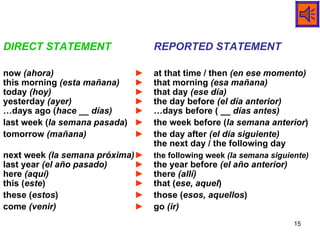
DIRECT STATEMENT REPORTED STATEMENT now  (ahora) ► at that time / then  (en ese momento) this morning  (esta mañana) ► that morning  (esa mañana) today  (hoy) ► that day  (ese día) yesterday  (ayer) ► the day before  (el día anterior) …days ago ( hace __ días) ► …days before (  __ días antes) last week ( la semana pasada ) ►   the week before ( la semana anterior ) tomorrow  (mañana) ► the day after  (el día siguiente) the next day / the following day next week  (la semana próxima) ► the following week  (la semana siguiente) last year  (el año pasado) ► the year before  (el año anterior) here  (aquí) ► there  (allí) this ( este ) ►   that ( ese, aquel ) these ( estos ) ►   those ( esos, aquellos ) come  (venir) ► go  (ir)
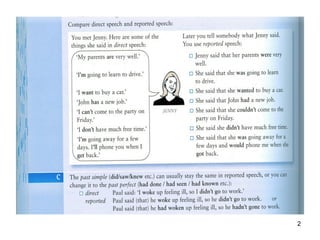
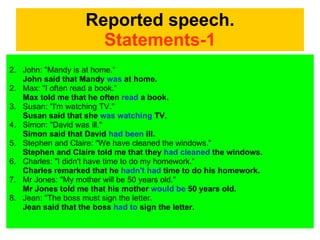
Reported speech. Statements-1 John: "Mandy is at home.“ John said that Mandy  was  at home.  2. Max: "I often read a book.“ Max told me that he often  read  a book.  3. Susan: "I'm watching TV."  Susan said that she  was watching  TV.  4. Simon: "David was ill."  Simon said that David  had been  ill.  5. Stephen and Claire: "We have cleaned the windows."  Stephen and Claire told me that they  had cleaned  the windows.  6. Charles: "I didn't have time to do my homework.“ Charles remarked that he  hadn't had  time to do his homework.  7. Mr Jones: "My mother will be 50 years old."  Mr Jones told me that his mother  would be  50 years old.  8. Jean: "The boss must sign the letter. Jean said that the boss  had to  sign the letter.
Reported speech. Statements-2 Emily: "My teacher will go to Leipzig tomorrow. Emily said that her teacher  would go  to Leipzig  the next day .  10.Helen: "I was writing a letter yesterday.“ Helen told me that she  had been writing  a letter  the day before .  Robert: "My father flew to Dallas last year.“ Robert said that his father  had flown  to Dallas  the year before .  12. Michael: "I'm going to read a book this week."  Michael told me that he  was going to  read a book  that week .  13. Jason: "I'll do my best in the exams tomorrow."  Jason told me that he  would do  his best in the exams  the next day .  14. Andrew: "We didn't eat fish two days ago."  Andrew said to me that they  hadn't eaten  fish  two days before .  15. Alice: "I spent all my pocket money last Monday."  Alice complained that she  had spent  all her pocket money  the Monday before.  David: "John had already gone at six. David said that John  had already gone  at six.

Reported speech statements

  • 1.
  • 2.
  • 3.
  • 4.
    Statements in ReportedSpeech In reported speech, you often have to change the pronoun/adjective depending on who says what. Example: She says, “ My mum doesn’t have time today.” She says that her mum doesn’t have time today. Pronouns/Adjectives
  • 5.
    No backshift Donot change the tense if the introductory clause is in Simple Present (e. g. He says ). Note, however, that you might have to change the form of the present tense verb (3rd person singular). Example: He says, “ I speak English.” He says that he speaks English. Backshift You must change the tense if the introductory clause is in Simple Past (e. g. He said ). This is called backshift . Example He said, “I am happy.” He said that he was happy. Tenses
  • 6.
    Backshift The verbs could , should, would, might, (must), needn’t, ought to, used to do not normally change. Example : He said, “ She might be right .” – He said that she might be right. Conditional I (would) Conditional I (would) Future I (will) was / were going to Future I (going to) Past Perfect Progressive Present Perfect Progressive Past Perfect Progressive Past Progressive Past Perfect Simple Present Perfect Simple Past Perfect Simple Simple Past Past Progressive Present Progressive Simple Past Simple Present Reported Speech Direct Speech
  • 7.
  • 8.
  • 9.
  • 10.
    DIRECT STATEMENT REPORTEDSTATEMENT Can ► could may ► might must ► had to will ► would
  • 11.
    DOS ASPECTOS ATENER EN CUENTA 1) Los verbos que se encuentran en Past Perfect en la voz directa no cambian cuando pasan a la voz indirecta. " I had driven a van before this", said Ian Lewis. ("Yo había conducido una camioneta antes", dijo Ian Lewis) Ian Lewis said that he had driven a van before that. (Ian Lewis dijo que el había conducido una camioneta antes)
  • 12.
    2) Otrosverbos modales - could , might , ought to , should , would - normalmente no cambian. En determinadas situaciones, incluso must puede permanecer sin cambios. " I might drive a van if I wanted to do it", said Ian Lewis . ("Yo podría conducir una camioneta si quisiera hacerlo", dijo Ian Lewis) Ian Lewis said that he might drive a van if he wanted to do it. (Ian Lewis dijo que él podría conducir una camioneta si quisiera hacerlo) " Young people ought to drive more carefully ", said the policeman. (Los jóvenes deberían conducir con más cuidado", dijo el agente de policía) The policeman said that young people ought to drive more carefully . (El agente de policía dijo que los jóvenes deberían conducir con más cuidado)
  • 13.
    Place and Timeexpressions For place and time expressions you have to check whether place and time are the same in direct and reported speech or not. Check out the following example: It is Friday and you meet James at a restaurant. James tells you that he saw Caroline in this restaurant today. (“ I saw Caroline here today.”) A few minutes later, Helen joins you and you want to report what James has told you. Place (here) and time (today) are the same and you can say: -> James said that he had seen Caroline here today . One day later, you meet Mary at the same restaurant. Again, you want to report to her what James has told you. The place is the same, but not the time (it happened yesterday). So you would say: -> James said that he had seen Caroline here yesterday .
  • 14.
    Still a fewdays later, Tom rings you at home. Again, you want to report to him what James has told you. However, now you are not at the restaurant (but at home) and a few days have passed since then. So you would say: -> James said that he had seen Caroline at the restaurant on Friday. Or -> I met James in a restaurant on Friday and he said that he had seen Caroline there that day . Therefore you always have to think which place and time expressions are logical in a certain situation.
  • 15.
    DIRECT STATEMENT REPORTEDSTATEMENT now (ahora) ► at that time / then (en ese momento) this morning (esta mañana) ► that morning (esa mañana) today (hoy) ► that day (ese día) yesterday (ayer) ► the day before (el día anterior) …days ago ( hace __ días) ► …days before ( __ días antes) last week ( la semana pasada ) ► the week before ( la semana anterior ) tomorrow (mañana) ► the day after (el día siguiente) the next day / the following day next week (la semana próxima) ► the following week (la semana siguiente) last year (el año pasado) ► the year before (el año anterior) here (aquí) ► there (allí) this ( este ) ► that ( ese, aquel ) these ( estos ) ► those ( esos, aquellos ) come (venir) ► go (ir)
  • 16.
    Reported speech. Statements-1John: "Mandy is at home.“ John said that Mandy was at home. 2. Max: "I often read a book.“ Max told me that he often read a book. 3. Susan: "I'm watching TV." Susan said that she was watching TV. 4. Simon: "David was ill." Simon said that David had been ill. 5. Stephen and Claire: "We have cleaned the windows." Stephen and Claire told me that they had cleaned the windows. 6. Charles: "I didn't have time to do my homework.“ Charles remarked that he hadn't had time to do his homework. 7. Mr Jones: "My mother will be 50 years old." Mr Jones told me that his mother would be 50 years old. 8. Jean: "The boss must sign the letter. Jean said that the boss had to sign the letter.
  • 17.
    Reported speech. Statements-2Emily: "My teacher will go to Leipzig tomorrow. Emily said that her teacher would go to Leipzig the next day . 10.Helen: "I was writing a letter yesterday.“ Helen told me that she had been writing a letter the day before . Robert: "My father flew to Dallas last year.“ Robert said that his father had flown to Dallas the year before . 12. Michael: "I'm going to read a book this week." Michael told me that he was going to read a book that week . 13. Jason: "I'll do my best in the exams tomorrow." Jason told me that he would do his best in the exams the next day . 14. Andrew: "We didn't eat fish two days ago." Andrew said to me that they hadn't eaten fish two days before . 15. Alice: "I spent all my pocket money last Monday." Alice complained that she had spent all her pocket money the Monday before. David: "John had already gone at six. David said that John had already gone at six.