InternshipReport
KCS-354
INTERNSHALA TRAININGS
submitted to the
DEPARTMENT OFCOMPUTERSCIENCE AND ENGINEERING
INSTITUTE OFENGINEERING AND TECHNOLOGY
(Sitapur Road, Lucknow, Uttar Pradesh, India)
Submitted By
Debarati Banik
2000520100033
Summer 2022
28/04/2022
This is to certify that the “Internship report” submitted by DEBARATI BANIK (Roll No 2000520100033). is work done by her and submitted
during 2021 – 2022 academic year, in partial fulfillment of the requirements for the award of the degree of BACHELOR OF TECHNOLOGY in
COMPUTER SCIENCEAND ENGINEERING, atINSTITUTE OF ENGINEERING& TECHNOLOGY(Sitapur Road, Lucknow, Uttar Pradesh, India)
Date: 28/04/2022
Place:Lucknow
Head of Department
Prof D S Yadav
DEPARTMENT OF COMPUTER SCIENCEAND TECHNOLOGY
INSTITUTE OF ENGINEERING AND TECHNOLOGY
(Sitapur Road, Lucknow, Uttar Pradesh, India
ACKNOWLEDGEMENT
• First, I would like to thank Training and Placement Cell for giving me the opportunity to do an internship with
Internshala Trainings. I also would like to thank all the Faculties of Internshala Trainings Who trained us, with
their patience and openness they created an enjoyable Online Session. It is indeed with a great sense of
pleasure and immense sense of gratitude that I acknowledge the help of these individuals. I am highly
indebted to Director Dr. Vineet Kansal sir for the facilities provided to accomplish this internship.I am
extremely great full to my department staff members and friends who helped me in successful completion
of this internship.
• DEBARATI BANIK
• 2000520100033
MODULES
1. Introduction to Python
2. Using Variables in Python
3. Basics of Programming in Python
4. Principles of Object-oriented Programming (OOP)
5. Connecting to SQLite Database, Developing a GUI with PyQT
6. Developing a GUI with PyQT
7. Applicationof Python in Various Disciplines
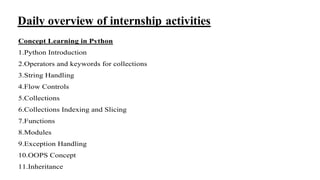
Daily overview of internship activities
Concept Learning in Python
1.Python Introduction
2.Operators and keywords for collections
3.String Handling
4.Flow Controls
5.Collections
6.Collections Indexing and Slicing
7.Functions
8.Modules
9.Exception Handling
10.OOPS Concept
11.Inheritance
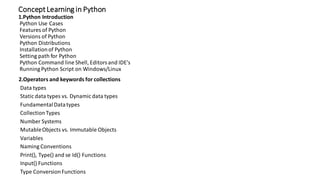
ConceptLearning in Python
1.Python Introduction
Python Use Cases
Features of Python
Versions of Python
Python Distributions
Installationof Python
Setting path for Python
Python Command line Shell, Editorsand IDE's
Running Python Script on Windows/Linux
2.Operators and keywords for collections
Data types
Static data types vs. Dynamic data types
FundamentalDatatypes
CollectionTypes
Number Systems
MutableObjects vs. Immutable Objects
Variables
Naming Conventions
Print(), Type() and se Id() Functions
Input() Functions
Type ConversionFunctions
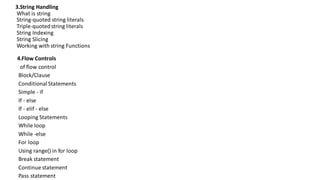
3.String Handling
What is string
String-quoted string literals
Triple-quotedstring literals
String Indexing
String Slicing
Working with string Functions
4.Flow Controls
of flow control
Block/Clause
ConditionalStatements
Simple - if
If - else
If - elif - else
Looping Statements
While loop
While -else
For loop
Using range() in for loop
Break statement
Continue statement
Pass statement
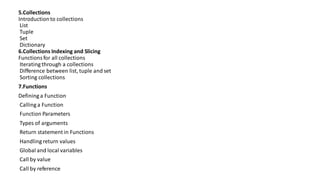
5.Collections
Introductionto collections
List
Tuple
Set
Dictionary
6.Collections Indexing and Slicing
Functionsfor all collections
Iterating through a collections
Difference between list, tuple and set
Sorting collections
7.Functions
Defining a Function
Calling a Function
Function Parameters
Types of arguments
Return statement in Functions
Handling return values
Global and local variables
Call by value
Call by reference
8.Modules
What is Module
Types of Modules
The import statement
Module aliases/ renaming a Module
From.. Import
Reloadinga Module
Working with pre-defined StandardModules (Math,Datetime,Os, Sys, String....)
9.Exception Handling
What is Exception?
Need of Exception Handling
Predefined Exceptions
Predefined Exceptions Hierarchy
Try, Except and FinallyClauses
Named Except Block
Default Except Block
Handling MultipleExceptions
Nested Try, Except and FinallyBlocks
User Defined Exceptions
10.OOPS Concept
Introductionto OOPs programming
Encapsulation
Defining Classes
Creating Objects
Constructor
Defining Methods
Objects Reference Count
Objects Garbage Collection
11.Inheritance
Types of Inheritances
Polymorphism
Super() Statement
Data Hiding
Custom Exception Classes
Inner Classes
INTRODUCTION TO PYTHON
Python Language Introduction
Python is a widely used general-purpose, high level programming language. It was initially designed by
Guido van Rossum in 1991 and developed by Python Software Foundation. It was mainly developed for
emphasis on code readability, and its syntax allows programmers to express conceptsin fewer lines of code.
Python is a programming language that lets you work quickly and integrate systems more efficiently.
Python is a high-level, interpreted, interactive and object-oriented scripting language. Python is designed to be highly readable. It uses
English keywords frequently whereas other languages use punctuation, and it has fewer syntactic constructions than other languages.
Python is Interpreted − Python is processed at runtime by the interpreter. You do not need to compile your program before executing it. This is
similar to PERL and PHP.
Python is Interactive − You can actually sit at a Python prompt and interact with the interpreter directly to write your programs.
Python is Object-Oriented − Python supports Object-Oriented style or technique of programming that encapsulates code within objects.
Python is a Beginner's Language − Python is a great language for the beginner-level programmers and supports the development of a wide
range of applications from simple text processing to WWW browsers to games.
Python Features
● Easy-to-learn − Python has few keywords, simple structure, and a clearly defined syntax. This allows the student to
pick up the language quickly.
● Easy-to-read − Python code is more clearly defined and visible to the eyes.
● Easy-to-maintain − Python's source code is fairly easy-to-maintain.
● A broad standard library − Python's bulk of the library is very portable and cross-platform compatible on UNIX,
Windows, and Macintosh.
● Interactive Mode − Python has support for an interactive mode which allows interactive testing and debugging of
snippets of code.
● Portable − Python can run on a wide variety of hardware platforms and has the same interface on all platforms.
● Extendable− You can add low-level modules to the Python interpreter. These modules enable programmers to add
to or customize their tools to be more efficient.
● Databases − Python provides interfaces to all major commercial databases.
● GUI Programming − Python supports GUI applications that can be created and ported to many system calls,
libraries and windows systems, such as Windows MFC, Macintosh, and the X Window system of Unix.
TRAINING CONTENTS
• 1. Introductionto Python
• Learn how to install Python, distinguish betweenimportant datatypes and use basic features of the Python interpreter,IDLE.
• 2. Using Variables in Python
• Learn about numeric,string, sequenceand dictionarydata types and relevant operations whilepracticingPython syntax.
• 3. Basics of Programmingin Python
• Learn how to write programs usingconditionals, loops, iterators and generators, functions and modulesand packages.
• 4. Principlesof Object-oriented Programming (OOP)
• Learn about the important features of Object-oriented Programmingwhile usingClasses and Objects,twomain aspects of the
OOP paradigm.
• 5. Connecting to SQLite Database
• Learn about relational databases while learninghow to store and retrieve datafrom an SQLite database through Python.
• 6. Developing a GUI with PyQT
• Learn how to install PyQt5 toolkit, Qt Designer and create a graphical user interfaceusingcommon widgets and menu
systems.
• 7. Applicationof Python in Various Disciplines
• Learn about various resources to extend your learningfor the Python programminglanguage.
ProblemAnalysis
• PRODUCT DEFINITION:-
It is a game where you create a team of real cricket players and score points depending on how
your chosen players perform in real life matches. To win a tournament, you must try and get the
maximum points and the No. 1 rank amongst other participants.
• FEASIBILITY ANALYSIS:-
I am building a software for gaming purposes using a specific technology named python. It is a
game software where you can create a virtual team according to your choice and score points to
win a tournament.
This software is created for motivating street cricket and adding more fun and entertainment to
cricket. The components that are used in this demo can be integrated to a high extent to provide
statistics to different components of cricket. This project helps in providing real time on field
actions thereby helping its user of the current actions happening on field
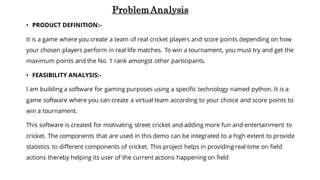
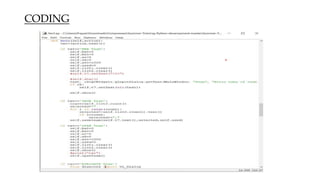
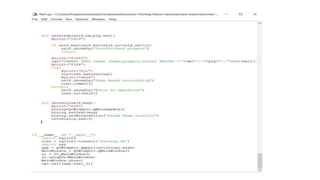
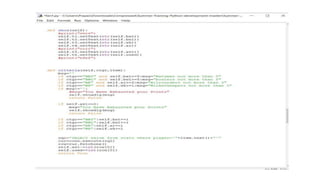
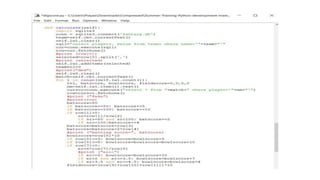
CODING
BIBLIOGRAPHY
● https://trainings.internshala.com/python-training
● https://www.w3schools.com/python/
● https://wiki.python.org/moin/PyQt/Tutorials
● https://www.tutorialspoint.com/pyqt/
● https://www.tutorialspoint.com/sqlite/sqlite_quick_guide.htm
● https://www.quora.com/
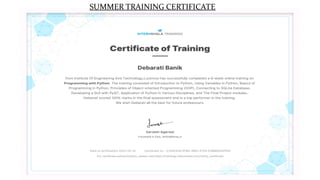
SUMMER TRAINING CERTIFICATE

report on internshala python training

  • 1.
    InternshipReport KCS-354 INTERNSHALA TRAININGS submitted tothe DEPARTMENT OFCOMPUTERSCIENCE AND ENGINEERING INSTITUTE OFENGINEERING AND TECHNOLOGY (Sitapur Road, Lucknow, Uttar Pradesh, India) Submitted By Debarati Banik 2000520100033 Summer 2022 28/04/2022
  • 2.
    This is tocertify that the “Internship report” submitted by DEBARATI BANIK (Roll No 2000520100033). is work done by her and submitted during 2021 – 2022 academic year, in partial fulfillment of the requirements for the award of the degree of BACHELOR OF TECHNOLOGY in COMPUTER SCIENCEAND ENGINEERING, atINSTITUTE OF ENGINEERING& TECHNOLOGY(Sitapur Road, Lucknow, Uttar Pradesh, India) Date: 28/04/2022 Place:Lucknow Head of Department Prof D S Yadav DEPARTMENT OF COMPUTER SCIENCEAND TECHNOLOGY INSTITUTE OF ENGINEERING AND TECHNOLOGY (Sitapur Road, Lucknow, Uttar Pradesh, India
  • 3.
    ACKNOWLEDGEMENT • First, Iwould like to thank Training and Placement Cell for giving me the opportunity to do an internship with Internshala Trainings. I also would like to thank all the Faculties of Internshala Trainings Who trained us, with their patience and openness they created an enjoyable Online Session. It is indeed with a great sense of pleasure and immense sense of gratitude that I acknowledge the help of these individuals. I am highly indebted to Director Dr. Vineet Kansal sir for the facilities provided to accomplish this internship.I am extremely great full to my department staff members and friends who helped me in successful completion of this internship. • DEBARATI BANIK • 2000520100033
  • 4.
    MODULES 1. Introduction toPython 2. Using Variables in Python 3. Basics of Programming in Python 4. Principles of Object-oriented Programming (OOP) 5. Connecting to SQLite Database, Developing a GUI with PyQT 6. Developing a GUI with PyQT 7. Applicationof Python in Various Disciplines
  • 5.
    Daily overview ofinternship activities Concept Learning in Python 1.Python Introduction 2.Operators and keywords for collections 3.String Handling 4.Flow Controls 5.Collections 6.Collections Indexing and Slicing 7.Functions 8.Modules 9.Exception Handling 10.OOPS Concept 11.Inheritance
  • 6.
    ConceptLearning in Python 1.PythonIntroduction Python Use Cases Features of Python Versions of Python Python Distributions Installationof Python Setting path for Python Python Command line Shell, Editorsand IDE's Running Python Script on Windows/Linux 2.Operators and keywords for collections Data types Static data types vs. Dynamic data types FundamentalDatatypes CollectionTypes Number Systems MutableObjects vs. Immutable Objects Variables Naming Conventions Print(), Type() and se Id() Functions Input() Functions Type ConversionFunctions
  • 7.
    3.String Handling What isstring String-quoted string literals Triple-quotedstring literals String Indexing String Slicing Working with string Functions 4.Flow Controls of flow control Block/Clause ConditionalStatements Simple - if If - else If - elif - else Looping Statements While loop While -else For loop Using range() in for loop Break statement Continue statement Pass statement
  • 8.
    5.Collections Introductionto collections List Tuple Set Dictionary 6.Collections Indexingand Slicing Functionsfor all collections Iterating through a collections Difference between list, tuple and set Sorting collections 7.Functions Defining a Function Calling a Function Function Parameters Types of arguments Return statement in Functions Handling return values Global and local variables Call by value Call by reference
  • 9.
    8.Modules What is Module Typesof Modules The import statement Module aliases/ renaming a Module From.. Import Reloadinga Module Working with pre-defined StandardModules (Math,Datetime,Os, Sys, String....) 9.Exception Handling What is Exception? Need of Exception Handling Predefined Exceptions Predefined Exceptions Hierarchy Try, Except and FinallyClauses Named Except Block Default Except Block Handling MultipleExceptions Nested Try, Except and FinallyBlocks User Defined Exceptions
  • 10.
    10.OOPS Concept Introductionto OOPsprogramming Encapsulation Defining Classes Creating Objects Constructor Defining Methods Objects Reference Count Objects Garbage Collection 11.Inheritance Types of Inheritances Polymorphism Super() Statement Data Hiding Custom Exception Classes Inner Classes
  • 11.
    INTRODUCTION TO PYTHON PythonLanguage Introduction Python is a widely used general-purpose, high level programming language. It was initially designed by Guido van Rossum in 1991 and developed by Python Software Foundation. It was mainly developed for emphasis on code readability, and its syntax allows programmers to express conceptsin fewer lines of code. Python is a programming language that lets you work quickly and integrate systems more efficiently. Python is a high-level, interpreted, interactive and object-oriented scripting language. Python is designed to be highly readable. It uses English keywords frequently whereas other languages use punctuation, and it has fewer syntactic constructions than other languages. Python is Interpreted − Python is processed at runtime by the interpreter. You do not need to compile your program before executing it. This is similar to PERL and PHP. Python is Interactive − You can actually sit at a Python prompt and interact with the interpreter directly to write your programs. Python is Object-Oriented − Python supports Object-Oriented style or technique of programming that encapsulates code within objects. Python is a Beginner's Language − Python is a great language for the beginner-level programmers and supports the development of a wide range of applications from simple text processing to WWW browsers to games.
  • 12.
    Python Features ● Easy-to-learn− Python has few keywords, simple structure, and a clearly defined syntax. This allows the student to pick up the language quickly. ● Easy-to-read − Python code is more clearly defined and visible to the eyes. ● Easy-to-maintain − Python's source code is fairly easy-to-maintain. ● A broad standard library − Python's bulk of the library is very portable and cross-platform compatible on UNIX, Windows, and Macintosh. ● Interactive Mode − Python has support for an interactive mode which allows interactive testing and debugging of snippets of code. ● Portable − Python can run on a wide variety of hardware platforms and has the same interface on all platforms. ● Extendable− You can add low-level modules to the Python interpreter. These modules enable programmers to add to or customize their tools to be more efficient. ● Databases − Python provides interfaces to all major commercial databases. ● GUI Programming − Python supports GUI applications that can be created and ported to many system calls, libraries and windows systems, such as Windows MFC, Macintosh, and the X Window system of Unix.
  • 13.
    TRAINING CONTENTS • 1.Introductionto Python • Learn how to install Python, distinguish betweenimportant datatypes and use basic features of the Python interpreter,IDLE. • 2. Using Variables in Python • Learn about numeric,string, sequenceand dictionarydata types and relevant operations whilepracticingPython syntax. • 3. Basics of Programmingin Python • Learn how to write programs usingconditionals, loops, iterators and generators, functions and modulesand packages. • 4. Principlesof Object-oriented Programming (OOP) • Learn about the important features of Object-oriented Programmingwhile usingClasses and Objects,twomain aspects of the OOP paradigm. • 5. Connecting to SQLite Database • Learn about relational databases while learninghow to store and retrieve datafrom an SQLite database through Python. • 6. Developing a GUI with PyQT • Learn how to install PyQt5 toolkit, Qt Designer and create a graphical user interfaceusingcommon widgets and menu systems. • 7. Applicationof Python in Various Disciplines • Learn about various resources to extend your learningfor the Python programminglanguage.
  • 14.
    ProblemAnalysis • PRODUCT DEFINITION:- Itis a game where you create a team of real cricket players and score points depending on how your chosen players perform in real life matches. To win a tournament, you must try and get the maximum points and the No. 1 rank amongst other participants. • FEASIBILITY ANALYSIS:- I am building a software for gaming purposes using a specific technology named python. It is a game software where you can create a virtual team according to your choice and score points to win a tournament. This software is created for motivating street cricket and adding more fun and entertainment to cricket. The components that are used in this demo can be integrated to a high extent to provide statistics to different components of cricket. This project helps in providing real time on field actions thereby helping its user of the current actions happening on field
  • 15.
  • 19.
    BIBLIOGRAPHY ● https://trainings.internshala.com/python-training ● https://www.w3schools.com/python/ ●https://wiki.python.org/moin/PyQt/Tutorials ● https://www.tutorialspoint.com/pyqt/ ● https://www.tutorialspoint.com/sqlite/sqlite_quick_guide.htm ● https://www.quora.com/
  • 20.