Python Programming
An Absolute Beginners Guide
What is Python?
• Python is a high-level, interpreted programming language known for
its readability, simplicity, and versatility.
• It was created by Guido van Rossum and first released in 1991.
• Python supports multiple programming paradigms, including
procedural, object-oriented, and functional programming.
Why to Learn Python?
• Python is simple and so easy to learn
• Python is Open Source which means its available free of cost.
• Python is versatile and can be used to create many different things.
• Python has powerful development libraries include AI, ML , Web
development , GUI etc.
Characteristics of Python
• Easy-to-learn − Python has few keywords, simple structure, and a clearly
defined syntax. This allows the student to pick up the language quickly.
• A broad standard library − Python's bulk of the library is very portable and
cross-platform compatible on UNIX, Windows, and Macintosh.
• Interactive Mode − Python has support for an interactive mode which
allows interactive testing and debugging of snippets of code.
• Easy-to-read − Python code is more clearly defined and visible to the eyes.
• Easy-to-maintain − Python's source code is fairly easy-to-maintain.
Characteristics of Python
• GUI Programming − Python supports GUI applications that can be created
and ported to many system
• Scalable − Python provides a better structure and support for large
programs than shell scripting.
• Portable − Python can run on a wide variety of hardware platforms and has
the same interface on all platforms.
• Extendable − You can add low-level modules to the Python interpreter.
These modules enable programmers to add to or customize their tools to
be more efficient.
• Databases − Python provides interfaces to all major commercial databases.
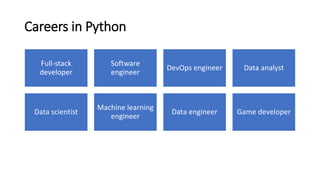
Careers in Python
Full-stack
developer
Software
engineer
DevOps engineer Data analyst
Data scientist
Machine learning
engineer
Data engineer Game developer
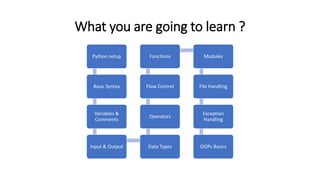
What you are going to learn ?
Python setup
Basic Syntax
Variables &
Comments
Input & Output Data Types
Operators
Flow Control
Functions Modules
File Handling
Exception
Handling
OOPs Basics
Thank You !

What is Python Programming for Beginners

  • 1.
  • 2.
    What is Python? •Python is a high-level, interpreted programming language known for its readability, simplicity, and versatility. • It was created by Guido van Rossum and first released in 1991. • Python supports multiple programming paradigms, including procedural, object-oriented, and functional programming.
  • 3.
    Why to LearnPython? • Python is simple and so easy to learn • Python is Open Source which means its available free of cost. • Python is versatile and can be used to create many different things. • Python has powerful development libraries include AI, ML , Web development , GUI etc.
  • 4.
    Characteristics of Python •Easy-to-learn − Python has few keywords, simple structure, and a clearly defined syntax. This allows the student to pick up the language quickly. • A broad standard library − Python's bulk of the library is very portable and cross-platform compatible on UNIX, Windows, and Macintosh. • Interactive Mode − Python has support for an interactive mode which allows interactive testing and debugging of snippets of code. • Easy-to-read − Python code is more clearly defined and visible to the eyes. • Easy-to-maintain − Python's source code is fairly easy-to-maintain.
  • 5.
    Characteristics of Python •GUI Programming − Python supports GUI applications that can be created and ported to many system • Scalable − Python provides a better structure and support for large programs than shell scripting. • Portable − Python can run on a wide variety of hardware platforms and has the same interface on all platforms. • Extendable − You can add low-level modules to the Python interpreter. These modules enable programmers to add to or customize their tools to be more efficient. • Databases − Python provides interfaces to all major commercial databases.
  • 6.
    Careers in Python Full-stack developer Software engineer DevOpsengineer Data analyst Data scientist Machine learning engineer Data engineer Game developer
  • 7.
    What you aregoing to learn ? Python setup Basic Syntax Variables & Comments Input & Output Data Types Operators Flow Control Functions Modules File Handling Exception Handling OOPs Basics
  • 8.