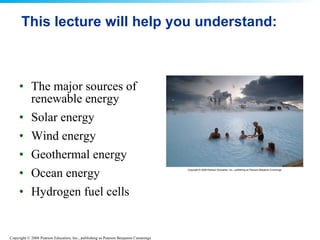
This lecture will help you understand: The major sources of renewable energy  Solar energy  Wind energy Geothermal energy  Ocean energy  Hydrogen fuel cells
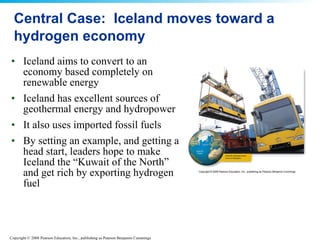
Central Case:  Iceland moves toward a hydrogen economy Iceland aims to convert to an economy based completely on renewable energy  Iceland has excellent sources of geothermal energy and hydropower  It also uses imported fossil fuels By setting an example, and getting a head start, leaders hope to make Iceland the “Kuwait of the North” and get rich by exporting hydrogen fuel
“New” renewable energy sources “ New” renewables are a group of alternative energy sources that include Energy from the Sun, wind, geothermal heat, and movement of the ocean water  They are commonly referred to as “new” because: They are not yet used on a wide scale  Their technologies are still in a rapid phase of development  They will play a much larger role in our energy use in the future
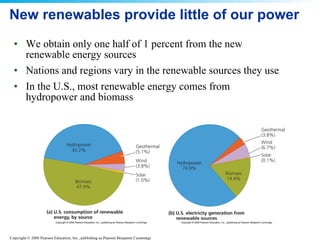
New renewables provide little of our power We obtain only one half of 1 percent from the new renewable energy sources Nations and regions vary in the renewable sources they use In the U.S., most renewable energy comes from hydropower and biomass
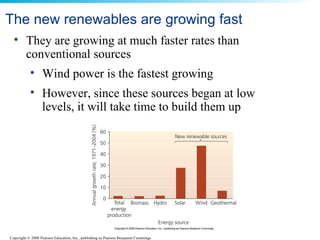
The new renewables are growing fast They are growing at much faster rates than conventional sources Wind power is the fastest growing However, since these sources began at low levels, it will take time to build them up
Use has expanded quickly because of: Growing concerns over diminishing fossil fuels The environmental impacts of fossil fuel combustion Advances in technology make it easier and less expensive Benefits of the new renewables include: They alleviate air pollution and greenhouse gas emissions that can cause climate change They are inexhaustible, unlike fossil fuels Help diversify a country’s energy economy They create jobs and are sources of income and taxes, especially in rural areas
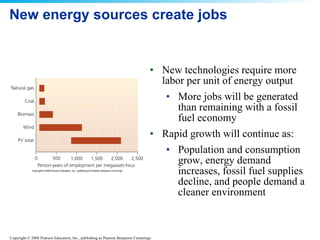
New technologies require more labor per unit of energy output More jobs will be generated than remaining with a fossil fuel economy Rapid growth will continue as:  Population and consumption grow, energy demand increases, fossil fuel supplies decline, and people demand a cleaner environment New energy sources create jobs
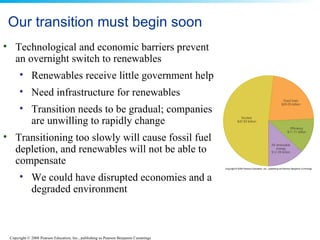
Our transition must begin soon Technological and economic barriers prevent an overnight switch to renewables Renewables receive little government help Need infrastructure for renewables Transition needs to be gradual; companies are unwilling to rapidly change Transitioning too slowly will cause fossil fuel depletion, and renewables will not be able to compensate We could have disrupted economies and a degraded environment
Solar energy Sun provides energy for almost all biological activity on Earth  Each square meter of Earth receives about 1 kilowatt of solar energy = 17 times more than a lightbulb There is great potential in solar energy Passive solar energy  = the most common way to harness solar energy  Buildings are designed to maximize direct absorption of sunlight in winter and keep cool in summer Active solar   energy collection = uses technology to focus, move, or store solar energy Solar energy has been used for hundreds of years
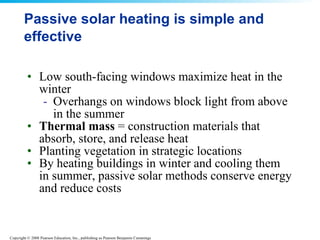
Passive solar heating is simple and effective  Low south-facing windows maximize heat in the winter  Overhangs on windows block light from above in the summer Thermal mass  = construction materials that absorb, store, and release heat Planting vegetation in strategic locations By heating buildings in winter and cooling them in summer, passive solar methods conserve energy and reduce costs
Active solar energy collection  Flat plate solar collectors (solar panels)  = one active method for harnessing solar energy Installed on rooftops  Dark-colored, heat-absorbing metal plates  Water, air, or antifreeze pass through the collectors, transferring heat throughout the building  Heated water is stored and used later
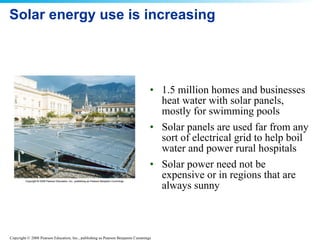
Solar energy use is increasing 1.5 million homes and businesses heat water with solar panels, mostly for swimming pools  Solar panels are used far from any sort of electrical grid to help boil water and power rural hospitals  Solar power need not be expensive or in regions that are always sunny
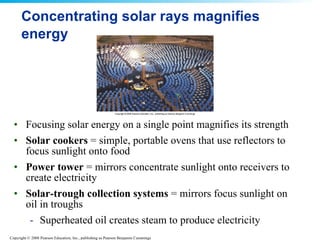
Concentrating solar rays magnifies energy Focusing solar energy on a single point magnifies its strength  Solar cookers  = simple, portable ovens that use reflectors to focus sunlight onto food  Power tower  = mirrors concentrate sunlight onto receivers to create electricity Solar-trough collection systems  = mirrors focus sunlight on oil in troughs Superheated oil creates steam to produce electricity
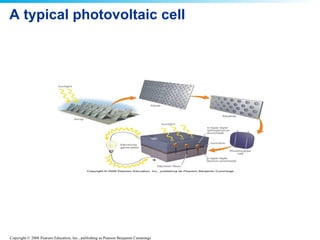
Photovoltaic cells generate electricity  Photovoltaic cells  = collect sunlight and convert it into electrical energy  These are used with wind turbines and diesel engines Photovoltaic (photoelectric) effect  = occurs when light strikes one of a pair of metal plates in a PV cell, causing the release of electrons, creating an electric current A PV cell has two silicon plates, the n-type layer (rich in electrons) and the p-type layer (electron poor) Sunlight causes electrons to flow from the n-type to the p-type layer, generating electricity
A typical photovoltaic cell
Solar power is little used but fast growing Solar energy was pushed to the sidelines as fossil fuels dominated our economy Funding for research and development has been erratic Because of a lack of investment, solar energy contributes only a miniscule amount of energy Solar energy is attractive in developing nations Hundreds of millions don’t have electricity Some multinational companies are investing in solar energy
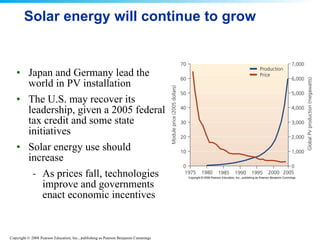
Solar energy will continue to grow Japan and Germany lead the world in PV installation The U.S. may recover its leadership, given a 2005 federal tax credit and some state initiatives Solar energy use should increase As prices fall, technologies improve and governments enact economic incentives
Solar power offers many benefits  The Sun will burn for 4 - 5 billion more years Solar technologies are quiet, safe, use no fuels, contain no moving parts, and require little maintenance They allow local, decentralized control over power Developing nations can use solar cookers, instead of gathering firewood Net metering  = PV owners can sell excess electricity to their local power utility New jobs are being created Solar power does not emit greenhouse gases and air pollution
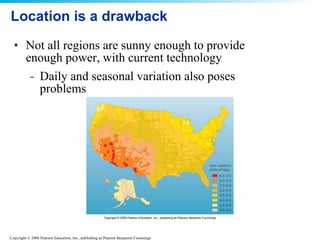
Location is a drawback Not all regions are sunny enough to provide enough power, with current technology Daily and seasonal variation also poses problems
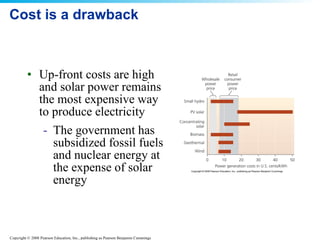
Cost is a drawback Up-front costs are high and solar power remains the most expensive way to produce electricity The government has subsidized fossil fuels and nuclear energy at the expense of solar energy
Wind has long been used for energy Wind turbines  = devices that harness power from wind Windmills have been used for 800 years to pump water The first windmill to generate electricity was built in the late 1800s After the 1973 oil embargo, governments funded research and development Today, wind power produces electricity for the same price as conventional sources
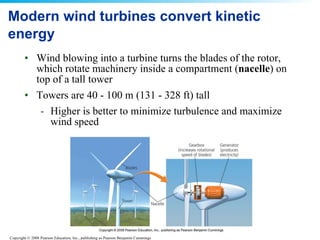
Modern wind turbines convert kinetic energy Wind blowing into a turbine turns the blades of the rotor, which rotate machinery inside a compartment ( nacelle ) on top of a tall tower Towers are 40 - 100 m (131 - 328 ft) tall Higher is better to minimize turbulence and maximize wind speed
Wind farms Wind farms  = turbines erected in groups of up to hundreds of turbines Turbines harness wind as efficiently as possible Different turbines turn at different speeds Slight increases in wind velocity yield significant power output
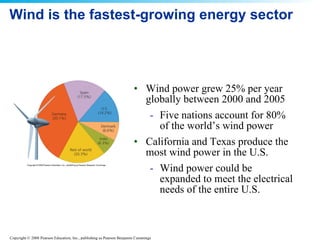
Wind is the fastest-growing energy sector Wind power grew 25% per year globally between 2000 and 2005 Five nations account for 80% of the world’s wind power California and Texas produce the most wind power in the U.S. Wind power could be expanded to meet the electrical needs of the entire U.S.
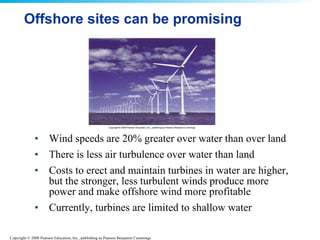
Offshore sites can be promising Wind speeds are 20% greater over water than over land There is less air turbulence over water than land  Costs to erect and maintain turbines in water are higher, but the stronger, less turbulent winds produce more power and make offshore wind more profitable  Currently, turbines are limited to shallow water
Wind power has many benefits Wind produces no emissions once installed  It prevents the release of CO 2 It is more efficient than conventional power sources  Turbines also use less water than conventional power plants  Farmers and ranchers can lease their land  Produces extra revenue  Landowners can still use their land for other uses Advancing technology is also driving down the cost of wind farm construction
Wind power has some downsides We have no control over when wind will occur  Causes major limitations in relying on it for electricity Companies have to invest a lot of research before building a costly wind farm  Good wind sources are not always near population centers that need energy  When wind farms are proposed near population centers, local residents often oppose them  Wind turbines also pose a threat to birds and bats, which can be killed when they fly into rotating blades
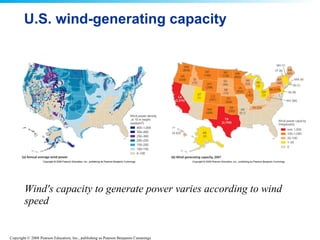
U.S. wind-generating capacity Wind's capacity to generate power varies according to wind speed
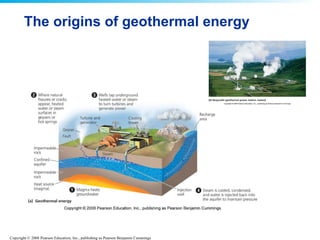
Geothermal energy Renewable energy that does not originate from the Sun It is generated from deep within the Earth Radioactive decay of elements under extremely high pressures deep inside the planet generates heat This heat rises through magma, fissures, and cracks Geothermal power plants use heated water and steam for direct heating and generating electricity
The origins of geothermal energy
Geothermal energy is renewable in principle But if a geothermal plant uses heated water faster than groundwater is recharged, the plant will run out of water Operators have begun injecting municipal wastewater into the ground to replenish the supply Patterns of geothermal activity shift naturally An area that produces hot groundwater now may not always do so
Geothermal energy produces heat and electricity Most often wells are drilled hundreds or thousands of meters toward heated groundwater Water at temperatures of 150 – 370 degrees Celsius is brought to the surface and converted to steam, which turns turbines that generate electricity Hot groundwater can be used directly to heat buildings Cheap and efficient
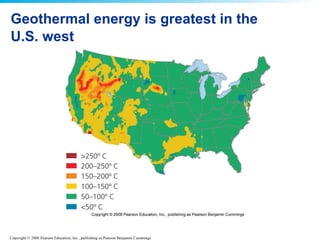
Geothermal energy is greatest in the U.S. west
Heat pumps are highly efficient Geothermal ground source heat pumps (GSHPs) use thermal energy from near-surface sources of earth and water The pumps heat buildings in the winter by transferring heat from the ground into buildings In the summer, heat is transferred through underground pipes from the building into the ground Highly efficient, because heat is simply moved
Use of geothermal power is growing Currently, geothermal energy provides less than 0.5% of the total energy used worldwide It provides more power than solar and wind combined But, much less than hydropower and biomass Geothermal energy in the U.S. provides enough power to supply electricity to more than 4 million people The U.S., Japan, and China lead the world in geothermal power use
Geothermal power has benefits and limits Benefits: Reduces emissions It does emit very small amounts of gases  Limitations: May not be sustainable Water is laced with salts and minerals that corrode equipment and pollute the air Limited to areas where the energy can be trapped
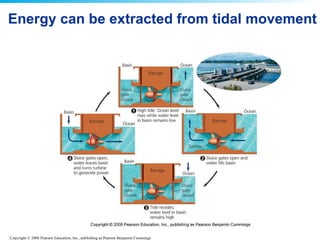
We can harness energy from the oceans  Scientists are devising ways to use kinetic energy from the natural motion of ocean water to generate electrical power The rising and falling of ocean tides twice each day throughout the world moves large amounts of water  Differences in height between low and high tides are especially great in long narrow bays  These areas are best for harnessing  tidal energy  by erecting dams across the outlets of tidal basins
Energy can be extracted from tidal movement
Wave energy  Can be developed at a greater variety of sites than tidal energy  The motion of wind-driven waves at the ocean’s surface is harnessed and converted from mechanical energy into electricity  Many designs exist, but few are adequately tested  Some designs are for offshore facilities and involve floating devices that move up and down the waves  Wave energy is greater at deep ocean sites, but transmitting electricity to shore is very expensive
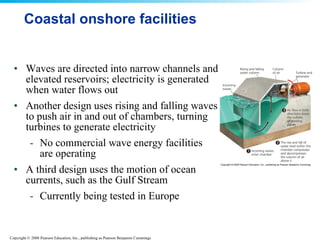
Coastal onshore facilities Waves are directed into narrow channels and elevated reservoirs; electricity is generated when water flows out  Another design uses rising and falling waves to push air in and out of chambers, turning turbines to generate electricity  No commercial wave energy facilities are operating A third design uses the motion of ocean currents, such as the Gulf Stream Currently being tested in Europe
The ocean stores thermal energy Each day, the tropical oceans absorb an amount of solar radiation equal to the heat content of 250 billion barrels of oil The ocean’s surface is warmer than deep water Ocean thermal energy conversion (OTEC)  is based on this gradient in temperature Closed cycle approach = warm surface water evaporates chemicals, which spin turbines Open cycle approach = warm surface water is evaporated in a vacuum and its steam turns turbines Costs remain high and no facility is commercially operational
A hydrogen economy  The development of fuel cells and hydrogen fuel shows promise to store energy in considerable quantities To produce clean, efficient electricity A hydrogen economy would provide a clean, safe, and efficient energy system By using the world’s simplest and most abundant element as fuel
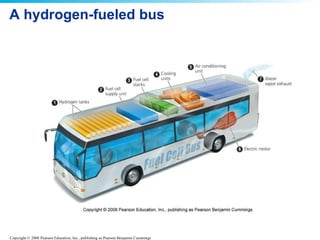
An energy system based on hydrogen Electricity generated from renewable sources could be used to produce hydrogen  Vehicles, computers, cell phones, home heating, and countless other applications could be powered Basing an energy system on hydrogen could alleviate dependence on foreign fuels and help fight climate change Governments are funding research into hydrogen and fuel cell technology to produce vehicles that run on hydrogen
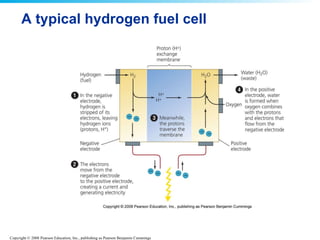
A typical hydrogen fuel cell
A hydrogen-fueled bus
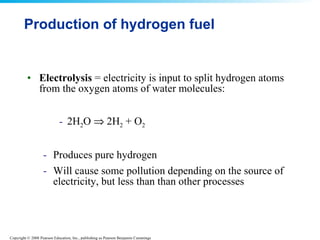
Production of hydrogen fuel Electrolysis  = electricity is input to split hydrogen atoms from the oxygen atoms of water molecules: 2H 2 O    2H 2  + O 2   Produces pure hydrogen Will cause some pollution depending on the source of electricity, but less than than other processes
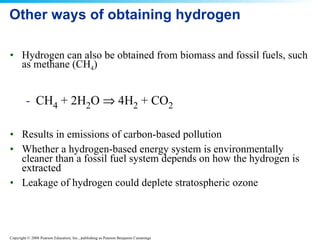
Other ways of obtaining hydrogen Hydrogen can also be obtained from biomass and fossil fuels, such as methane (CH 4 ) CH 4  + 2H 2 O    4H 2  + CO 2 Results in emissions of carbon-based pollution Whether a hydrogen-based energy system is environmentally cleaner than a fossil fuel system depends on how the hydrogen is extracted Leakage of hydrogen could deplete stratospheric ozone
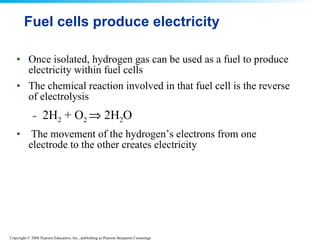
Fuel cells produce electricity Once isolated, hydrogen gas can be used as a fuel to produce electricity within fuel cells  The chemical reaction involved in that fuel cell is the reverse of electrolysis  2H 2  + O 2    2H 2 O The movement of the hydrogen’s electrons from one electrode to the other creates electricity
Hydrogen and fuel cells have many benefits We will never run out; hydrogen is the most abundant element in the universe Can be clean and nontoxic to use May produce few greenhouse gases and other pollutants Can be no more dangerous than gasoline in tanks Cells are energy efficient Fuel cells are silent and nonpolluting and won’t need to be recharged
Conclusion The coming decline of fossil fuels and the increasing concern over global climate change has convinced many people we need to shift to renewable energy Renewable sources include solar, wind, geothermal, and ocean energy sources and hydrogen fuel Renewable energy sources have been held back by inadequate funding and by artificially cheap prices for nonrenewable resources
QUESTION: Review Which of these is not a passive solar technique? The use of thermal mass Using flat-plate solar collectors Installing low, south-facing windows that will maximize sunlight capture in the winter Using strategically planted vegetation
QUESTION: Review In the United States, where does most renewable energy come from? Hydropower and geothermal energy Wind power and solar power Geothermal energy and biomass Biomass and hydropower
QUESTION: Review We can harness power from wind by using devices called: Wind turbines Wind parks Wind farms Solar cells     
QUESTION: Review Turbines can be erected singly, but they are most often erected in groups called: Wind turbines Wind farms Wind mills Solar cells              
QUESTION: Review Which energy source may not be renewable, and is laced with minerals that corrode equipment? a) Solar panels b) Wind energy c) Geothermal energy  d) Hydrogen fuel cells
QUESTION: Weighing the Issues Would you support wind turbines being put in your neighborhood? Yes, because it is healthier for the environment Yes, because the scene behind my house does not matter No, because I don't care about the environment No, because the scene behind my house matters to me
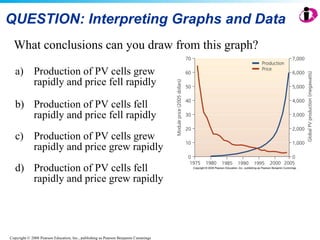
QUESTION: Interpreting Graphs and Data Production of PV cells grew rapidly and price fell rapidly Production of PV cells fell rapidly and price fell rapidly Production of PV cells grew rapidly and price grew rapidly Production of PV cells fell rapidly and price grew rapidly What conclusions can you draw from this graph?

Ch21 lecture 3e

  • 1.
  • 2.
    This lecture willhelp you understand: The major sources of renewable energy Solar energy Wind energy Geothermal energy Ocean energy Hydrogen fuel cells
  • 3.
    Central Case: Iceland moves toward a hydrogen economy Iceland aims to convert to an economy based completely on renewable energy Iceland has excellent sources of geothermal energy and hydropower It also uses imported fossil fuels By setting an example, and getting a head start, leaders hope to make Iceland the “Kuwait of the North” and get rich by exporting hydrogen fuel
  • 4.
    “New” renewable energysources “ New” renewables are a group of alternative energy sources that include Energy from the Sun, wind, geothermal heat, and movement of the ocean water They are commonly referred to as “new” because: They are not yet used on a wide scale Their technologies are still in a rapid phase of development They will play a much larger role in our energy use in the future
  • 5.
    New renewables providelittle of our power We obtain only one half of 1 percent from the new renewable energy sources Nations and regions vary in the renewable sources they use In the U.S., most renewable energy comes from hydropower and biomass
  • 6.
    The new renewablesare growing fast They are growing at much faster rates than conventional sources Wind power is the fastest growing However, since these sources began at low levels, it will take time to build them up
  • 7.
    Use has expandedquickly because of: Growing concerns over diminishing fossil fuels The environmental impacts of fossil fuel combustion Advances in technology make it easier and less expensive Benefits of the new renewables include: They alleviate air pollution and greenhouse gas emissions that can cause climate change They are inexhaustible, unlike fossil fuels Help diversify a country’s energy economy They create jobs and are sources of income and taxes, especially in rural areas
  • 8.
    New technologies requiremore labor per unit of energy output More jobs will be generated than remaining with a fossil fuel economy Rapid growth will continue as: Population and consumption grow, energy demand increases, fossil fuel supplies decline, and people demand a cleaner environment New energy sources create jobs
  • 9.
    Our transition mustbegin soon Technological and economic barriers prevent an overnight switch to renewables Renewables receive little government help Need infrastructure for renewables Transition needs to be gradual; companies are unwilling to rapidly change Transitioning too slowly will cause fossil fuel depletion, and renewables will not be able to compensate We could have disrupted economies and a degraded environment
  • 10.
    Solar energy Sunprovides energy for almost all biological activity on Earth Each square meter of Earth receives about 1 kilowatt of solar energy = 17 times more than a lightbulb There is great potential in solar energy Passive solar energy = the most common way to harness solar energy Buildings are designed to maximize direct absorption of sunlight in winter and keep cool in summer Active solar energy collection = uses technology to focus, move, or store solar energy Solar energy has been used for hundreds of years
  • 11.
    Passive solar heatingis simple and effective Low south-facing windows maximize heat in the winter Overhangs on windows block light from above in the summer Thermal mass = construction materials that absorb, store, and release heat Planting vegetation in strategic locations By heating buildings in winter and cooling them in summer, passive solar methods conserve energy and reduce costs
  • 12.
    Active solar energycollection Flat plate solar collectors (solar panels) = one active method for harnessing solar energy Installed on rooftops Dark-colored, heat-absorbing metal plates Water, air, or antifreeze pass through the collectors, transferring heat throughout the building Heated water is stored and used later
  • 13.
    Solar energy useis increasing 1.5 million homes and businesses heat water with solar panels, mostly for swimming pools Solar panels are used far from any sort of electrical grid to help boil water and power rural hospitals Solar power need not be expensive or in regions that are always sunny
  • 14.
    Concentrating solar raysmagnifies energy Focusing solar energy on a single point magnifies its strength Solar cookers = simple, portable ovens that use reflectors to focus sunlight onto food Power tower = mirrors concentrate sunlight onto receivers to create electricity Solar-trough collection systems = mirrors focus sunlight on oil in troughs Superheated oil creates steam to produce electricity
  • 15.
    Photovoltaic cells generateelectricity Photovoltaic cells = collect sunlight and convert it into electrical energy These are used with wind turbines and diesel engines Photovoltaic (photoelectric) effect = occurs when light strikes one of a pair of metal plates in a PV cell, causing the release of electrons, creating an electric current A PV cell has two silicon plates, the n-type layer (rich in electrons) and the p-type layer (electron poor) Sunlight causes electrons to flow from the n-type to the p-type layer, generating electricity
  • 16.
  • 17.
    Solar power islittle used but fast growing Solar energy was pushed to the sidelines as fossil fuels dominated our economy Funding for research and development has been erratic Because of a lack of investment, solar energy contributes only a miniscule amount of energy Solar energy is attractive in developing nations Hundreds of millions don’t have electricity Some multinational companies are investing in solar energy
  • 18.
    Solar energy willcontinue to grow Japan and Germany lead the world in PV installation The U.S. may recover its leadership, given a 2005 federal tax credit and some state initiatives Solar energy use should increase As prices fall, technologies improve and governments enact economic incentives
  • 19.
    Solar power offersmany benefits The Sun will burn for 4 - 5 billion more years Solar technologies are quiet, safe, use no fuels, contain no moving parts, and require little maintenance They allow local, decentralized control over power Developing nations can use solar cookers, instead of gathering firewood Net metering = PV owners can sell excess electricity to their local power utility New jobs are being created Solar power does not emit greenhouse gases and air pollution
  • 20.
    Location is adrawback Not all regions are sunny enough to provide enough power, with current technology Daily and seasonal variation also poses problems
  • 21.
    Cost is adrawback Up-front costs are high and solar power remains the most expensive way to produce electricity The government has subsidized fossil fuels and nuclear energy at the expense of solar energy
  • 22.
    Wind has longbeen used for energy Wind turbines = devices that harness power from wind Windmills have been used for 800 years to pump water The first windmill to generate electricity was built in the late 1800s After the 1973 oil embargo, governments funded research and development Today, wind power produces electricity for the same price as conventional sources
  • 23.
    Modern wind turbinesconvert kinetic energy Wind blowing into a turbine turns the blades of the rotor, which rotate machinery inside a compartment ( nacelle ) on top of a tall tower Towers are 40 - 100 m (131 - 328 ft) tall Higher is better to minimize turbulence and maximize wind speed
  • 24.
    Wind farms Windfarms = turbines erected in groups of up to hundreds of turbines Turbines harness wind as efficiently as possible Different turbines turn at different speeds Slight increases in wind velocity yield significant power output
  • 25.
    Wind is thefastest-growing energy sector Wind power grew 25% per year globally between 2000 and 2005 Five nations account for 80% of the world’s wind power California and Texas produce the most wind power in the U.S. Wind power could be expanded to meet the electrical needs of the entire U.S.
  • 26.
    Offshore sites canbe promising Wind speeds are 20% greater over water than over land There is less air turbulence over water than land Costs to erect and maintain turbines in water are higher, but the stronger, less turbulent winds produce more power and make offshore wind more profitable Currently, turbines are limited to shallow water
  • 27.
    Wind power hasmany benefits Wind produces no emissions once installed It prevents the release of CO 2 It is more efficient than conventional power sources Turbines also use less water than conventional power plants Farmers and ranchers can lease their land Produces extra revenue Landowners can still use their land for other uses Advancing technology is also driving down the cost of wind farm construction
  • 28.
    Wind power hassome downsides We have no control over when wind will occur Causes major limitations in relying on it for electricity Companies have to invest a lot of research before building a costly wind farm Good wind sources are not always near population centers that need energy When wind farms are proposed near population centers, local residents often oppose them Wind turbines also pose a threat to birds and bats, which can be killed when they fly into rotating blades
  • 29.
    U.S. wind-generating capacityWind's capacity to generate power varies according to wind speed
  • 30.
    Geothermal energy Renewableenergy that does not originate from the Sun It is generated from deep within the Earth Radioactive decay of elements under extremely high pressures deep inside the planet generates heat This heat rises through magma, fissures, and cracks Geothermal power plants use heated water and steam for direct heating and generating electricity
  • 31.
    The origins ofgeothermal energy
  • 32.
    Geothermal energy isrenewable in principle But if a geothermal plant uses heated water faster than groundwater is recharged, the plant will run out of water Operators have begun injecting municipal wastewater into the ground to replenish the supply Patterns of geothermal activity shift naturally An area that produces hot groundwater now may not always do so
  • 33.
    Geothermal energy producesheat and electricity Most often wells are drilled hundreds or thousands of meters toward heated groundwater Water at temperatures of 150 – 370 degrees Celsius is brought to the surface and converted to steam, which turns turbines that generate electricity Hot groundwater can be used directly to heat buildings Cheap and efficient
  • 34.
    Geothermal energy isgreatest in the U.S. west
  • 35.
    Heat pumps arehighly efficient Geothermal ground source heat pumps (GSHPs) use thermal energy from near-surface sources of earth and water The pumps heat buildings in the winter by transferring heat from the ground into buildings In the summer, heat is transferred through underground pipes from the building into the ground Highly efficient, because heat is simply moved
  • 36.
    Use of geothermalpower is growing Currently, geothermal energy provides less than 0.5% of the total energy used worldwide It provides more power than solar and wind combined But, much less than hydropower and biomass Geothermal energy in the U.S. provides enough power to supply electricity to more than 4 million people The U.S., Japan, and China lead the world in geothermal power use
  • 37.
    Geothermal power hasbenefits and limits Benefits: Reduces emissions It does emit very small amounts of gases Limitations: May not be sustainable Water is laced with salts and minerals that corrode equipment and pollute the air Limited to areas where the energy can be trapped
  • 38.
    We can harnessenergy from the oceans Scientists are devising ways to use kinetic energy from the natural motion of ocean water to generate electrical power The rising and falling of ocean tides twice each day throughout the world moves large amounts of water Differences in height between low and high tides are especially great in long narrow bays These areas are best for harnessing tidal energy by erecting dams across the outlets of tidal basins
  • 39.
    Energy can beextracted from tidal movement
  • 40.
    Wave energy Can be developed at a greater variety of sites than tidal energy The motion of wind-driven waves at the ocean’s surface is harnessed and converted from mechanical energy into electricity Many designs exist, but few are adequately tested Some designs are for offshore facilities and involve floating devices that move up and down the waves Wave energy is greater at deep ocean sites, but transmitting electricity to shore is very expensive
  • 41.
    Coastal onshore facilitiesWaves are directed into narrow channels and elevated reservoirs; electricity is generated when water flows out Another design uses rising and falling waves to push air in and out of chambers, turning turbines to generate electricity No commercial wave energy facilities are operating A third design uses the motion of ocean currents, such as the Gulf Stream Currently being tested in Europe
  • 42.
    The ocean storesthermal energy Each day, the tropical oceans absorb an amount of solar radiation equal to the heat content of 250 billion barrels of oil The ocean’s surface is warmer than deep water Ocean thermal energy conversion (OTEC) is based on this gradient in temperature Closed cycle approach = warm surface water evaporates chemicals, which spin turbines Open cycle approach = warm surface water is evaporated in a vacuum and its steam turns turbines Costs remain high and no facility is commercially operational
  • 43.
    A hydrogen economy The development of fuel cells and hydrogen fuel shows promise to store energy in considerable quantities To produce clean, efficient electricity A hydrogen economy would provide a clean, safe, and efficient energy system By using the world’s simplest and most abundant element as fuel
  • 44.
    An energy systembased on hydrogen Electricity generated from renewable sources could be used to produce hydrogen Vehicles, computers, cell phones, home heating, and countless other applications could be powered Basing an energy system on hydrogen could alleviate dependence on foreign fuels and help fight climate change Governments are funding research into hydrogen and fuel cell technology to produce vehicles that run on hydrogen
  • 45.
  • 46.
  • 47.
    Production of hydrogenfuel Electrolysis = electricity is input to split hydrogen atoms from the oxygen atoms of water molecules: 2H 2 O  2H 2 + O 2 Produces pure hydrogen Will cause some pollution depending on the source of electricity, but less than than other processes
  • 48.
    Other ways ofobtaining hydrogen Hydrogen can also be obtained from biomass and fossil fuels, such as methane (CH 4 ) CH 4 + 2H 2 O  4H 2 + CO 2 Results in emissions of carbon-based pollution Whether a hydrogen-based energy system is environmentally cleaner than a fossil fuel system depends on how the hydrogen is extracted Leakage of hydrogen could deplete stratospheric ozone
  • 49.
    Fuel cells produceelectricity Once isolated, hydrogen gas can be used as a fuel to produce electricity within fuel cells The chemical reaction involved in that fuel cell is the reverse of electrolysis 2H 2 + O 2  2H 2 O The movement of the hydrogen’s electrons from one electrode to the other creates electricity
  • 50.
    Hydrogen and fuelcells have many benefits We will never run out; hydrogen is the most abundant element in the universe Can be clean and nontoxic to use May produce few greenhouse gases and other pollutants Can be no more dangerous than gasoline in tanks Cells are energy efficient Fuel cells are silent and nonpolluting and won’t need to be recharged
  • 51.
    Conclusion The comingdecline of fossil fuels and the increasing concern over global climate change has convinced many people we need to shift to renewable energy Renewable sources include solar, wind, geothermal, and ocean energy sources and hydrogen fuel Renewable energy sources have been held back by inadequate funding and by artificially cheap prices for nonrenewable resources
  • 52.
    QUESTION: Review Whichof these is not a passive solar technique? The use of thermal mass Using flat-plate solar collectors Installing low, south-facing windows that will maximize sunlight capture in the winter Using strategically planted vegetation
  • 53.
    QUESTION: Review Inthe United States, where does most renewable energy come from? Hydropower and geothermal energy Wind power and solar power Geothermal energy and biomass Biomass and hydropower
  • 54.
    QUESTION: Review Wecan harness power from wind by using devices called: Wind turbines Wind parks Wind farms Solar cells     
  • 55.
    QUESTION: Review Turbinescan be erected singly, but they are most often erected in groups called: Wind turbines Wind farms Wind mills Solar cells              
  • 56.
    QUESTION: Review Whichenergy source may not be renewable, and is laced with minerals that corrode equipment? a) Solar panels b) Wind energy c) Geothermal energy d) Hydrogen fuel cells
  • 57.
    QUESTION: Weighing theIssues Would you support wind turbines being put in your neighborhood? Yes, because it is healthier for the environment Yes, because the scene behind my house does not matter No, because I don't care about the environment No, because the scene behind my house matters to me
  • 58.
    QUESTION: Interpreting Graphsand Data Production of PV cells grew rapidly and price fell rapidly Production of PV cells fell rapidly and price fell rapidly Production of PV cells grew rapidly and price grew rapidly Production of PV cells fell rapidly and price grew rapidly What conclusions can you draw from this graph?

Editor's Notes