
BIDHAN CHANDRA COLLEGE, RISHRA
SUBMITTED BY : XXXXXXXX XXXXXXXX
CLASS : B.COM. (Hons./Gen.)
ROLL NO. : XXX
REGISTRATION NO. : XXX-XXXX-XXXX-XX
GUIDED BY : Prof. XXXXXXXXXXXX
(Asst. Professor, Department of xxxxxxxxxx)
1) Introduction
2) Sources of Renewable Energy
3) Usefulness of Renewable Energy
4) Advantages & Disadvantages of Renewable Energy
5) Measurements of Renewable Energy
6) Conclusion
7) Bibliography
8) Acknowledgement
AGENDA
1
Renewable energy is energy produced from sources that do not deplete or
can be replenished within a human’s life time. The most common examples
include wind, solar, geothermal, biomass, and hydropower. This is in
contrast to non-renewable sources such as fossil fuels.
Renewable energy accounts for 13.5% of the world’s total energy supply,
and 22% of the world's electricity.
Renewable energy systems are a major topic when discussing the globe's
energy future for two main reasons:
1. Renewable energy systems provide energy from sources that will
never deplete.
2. Renewable energy systems produce less greenhouse gas emissions
than fuel energy systems.
While renewable energy systems are better for the environment and
produce less emissions than conventional energy sources, many of
these sources still face difficulties in being deployed at a large scale
including, but not limited to, technological barriers, high start-up capital
costs, and intermittency challenges.
It is important to note that the terms ‘renewable energy’, ‘green energy’ and
‘clean energy’ are not interchangeable in all cases; for example, a
‘clean’ coal plant is simply a coal plant with emissions reduction technology.
The coal plant itself is still not a ‘renewable energy’ source. ‘Green energy’ is
a subset of renewable energy, which boasts low or zero emissions and low
environmental impacts to systems such as land and water.
➢ Renewable energy is energy generated from natural resources such
as sunlight, wind, rain, tides and geothermal heat which are
renewable (naturally replenished).
➢ Solar energy
➢ Wind
➢ Hydropower
➢ Biomass
➢ Ocean energy
➢ Geothermal
➢ Waste to Energy
INTRODUCTION :
Renewable Energy Sources :
:
2
SOLAR ENERGY:
• Solar power is one of the best renewable energy sources available
because it is one the cleanest sources of energy.
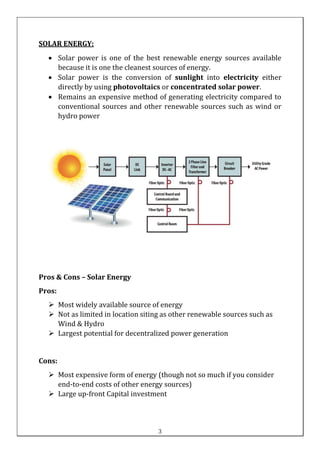
• Solar power is the conversion of sunlight into electricity either
directly by using photovoltaics or concentrated solar power.
• Remains an expensive method of generating electricity compared to
conventional sources and other renewable sources such as wind or
hydro power
Pros & Cons – Solar Energy
Pros:
➢ Most widely available source of energy
➢ Not as limited in location siting as other renewable sources such as
Wind & Hydro
➢ Largest potential for decentralized power generation
Cons:
➢ Most expensive form of energy (though not so much if you consider
end-to-end costs of other energy sources)
➢ Large up-front Capital investment
3
WIND ENERGY :
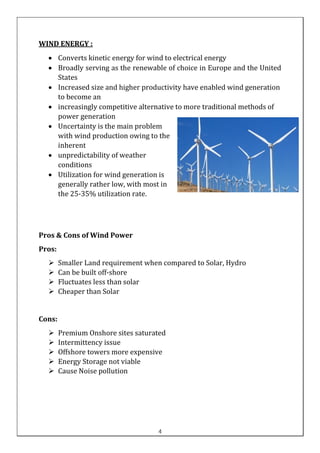
• Converts kinetic energy for wind to electrical energy
• Broadly serving as the renewable of choice in Europe and the United
States
• Increased size and higher productivity have enabled wind generation
to become an
• increasingly competitive alternative to more traditional methods of
power generation
• Uncertainty is the main problem
with wind production owing to the
inherent
• unpredictability of weather
conditions
• Utilization for wind generation is
generally rather low, with most in
the 25-35% utilization rate.
Pros & Cons of Wind Power
Pros:
➢ Smaller Land requirement when compared to Solar, Hydro
➢ Can be built off-shore
➢ Fluctuates less than solar
➢ Cheaper than Solar
Cons:
➢ Premium Onshore sites saturated
➢ Intermittency issue
➢ Offshore towers more expensive
➢ Energy Storage not viable
➢ Cause Noise pollution
4
HYDRO-POWER :
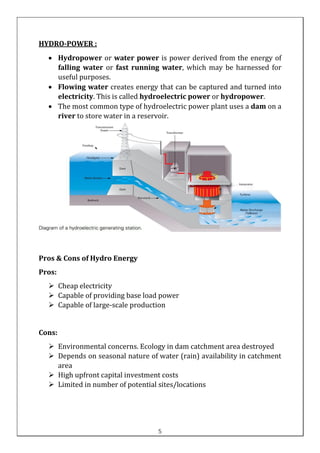
• Hydropower or water power is power derived from the energy of
falling water or fast running water, which may be harnessed for
useful purposes.
• Flowing water creates energy that can be captured and turned into
electricity. This is called hydroelectric power or hydropower.
• The most common type of hydroelectric power plant uses a dam on a
river to store water in a reservoir.
Pros & Cons of Hydro Energy
Pros:
➢ Cheap electricity
➢ Capable of providing base load power
➢ Capable of large-scale production
Cons:
➢ Environmental concerns. Ecology in dam catchment area destroyed
➢ Depends on seasonal nature of water (rain) availability in catchment
area
➢ High upfront capital investment costs
➢ Limited in number of potential sites/locations
5
GEOTHERMAL :
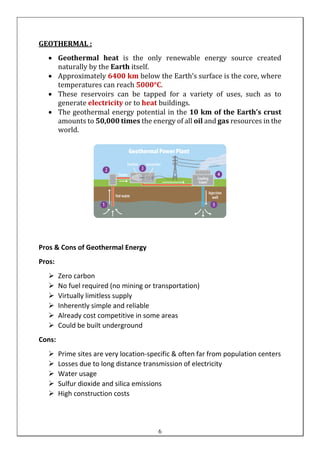
• Geothermal heat is the only renewable energy source created
naturally by the Earth itself.
• Approximately 6400 km below the Earth’s surface is the core, where
temperatures can reach 5000°C.
• These reservoirs can be tapped for a variety of uses, such as to
generate electricity or to heat buildings.
• The geothermal energy potential in the 10 km of the Earth’s crust
amounts to 50,000 times the energy of all oil and gas resources in the
world.
Pros & Cons of Geothermal Energy
Pros:
➢ Zero carbon
➢ No fuel required (no mining or transportation)
➢ Virtually limitless supply
➢ Inherently simple and reliable
➢ Already cost competitive in some areas
➢ Could be built underground
Cons:
➢ Prime sites are very location-specific & often far from population centers
➢ Losses due to long distance transmission of electricity
➢ Water usage
➢ Sulfur dioxide and silica emissions
➢ High construction costs
6
Marine and Hydrokinetic Energy (Ocean energy):
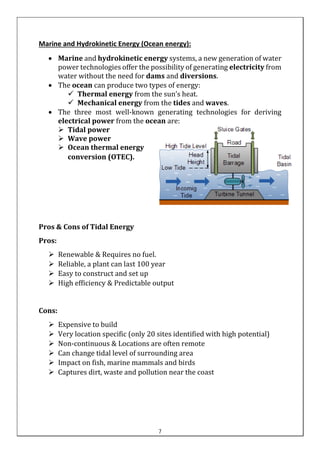
• Marine and hydrokinetic energy systems, a new generation of water
power technologies offer the possibility of generating electricity from
water without the need for dams and diversions.
• The ocean can produce two types of energy:
✓ Thermal energy from the sun’s heat.
✓ Mechanical energy from the tides and waves.
• The three most well-known generating technologies for deriving
electrical power from the ocean are:
➢ Tidal power
➢ Wave power
➢ Ocean thermal energy
conversion (OTEC).
Pros & Cons of Tidal Energy
Pros:
➢ Renewable & Requires no fuel.
➢ Reliable, a plant can last 100 year
➢ Easy to construct and set up
➢ High efficiency & Predictable output
Cons:
➢ Expensive to build
➢ Very location specific (only 20 sites identified with high potential)
➢ Non-continuous & Locations are often remote
➢ Can change tidal level of surrounding area
➢ Impact on fish, marine mammals and birds
➢ Captures dirt, waste and pollution near the coast
7
Biomass:
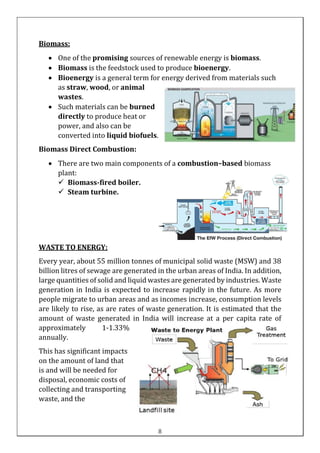
• One of the promising sources of renewable energy is biomass.
• Biomass is the feedstock used to produce bioenergy.
• Bioenergy is a general term for energy derived from materials such
as straw, wood, or animal
wastes.
• Such materials can be burned
directly to produce heat or
power, and also can be
converted into liquid biofuels.
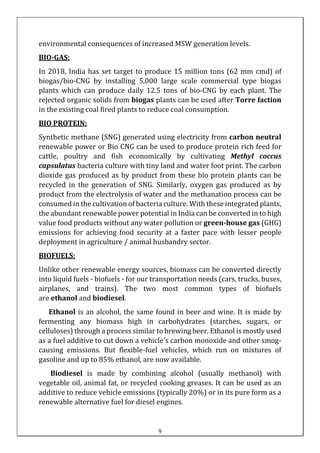
Biomass Direct Combustion:
• There are two main components of a combustion–based biomass
plant:
✓ Biomass-fired boiler.
✓ Steam turbine.
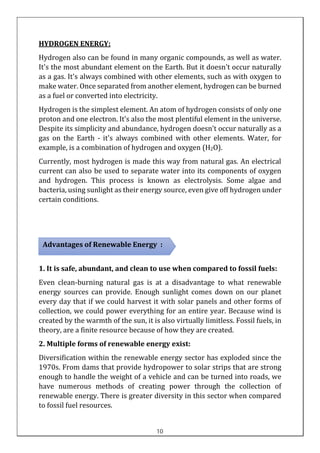
WASTE TO ENERGY:
Every year, about 55 million tonnes of municipal solid waste (MSW) and 38
billion litres of sewage are generated in the urban areas of India. In addition,
large quantities of solid and liquid wastes are generated by industries. Waste
generation in India is expected to increase rapidly in the future. As more
people migrate to urban areas and as incomes increase, consumption levels
are likely to rise, as are rates of waste generation. It is estimated that the
amount of waste generated in India will increase at a per capita rate of
approximately 1-1.33%
annually.
This has significant impacts
on the amount of land that
is and will be needed for
disposal, economic costs of
collecting and transporting
waste, and the
8
environmental consequences of increased MSW generation levels.
BIO-GAS:
In 2018, India has set target to produce 15 million tons (62 mm cmd) of
biogas/bio-CNG by installing 5,000 large scale commercial type biogas
plants which can produce daily 12.5 tons of bio-CNG by each plant. The
rejected organic solids from biogas plants can be used after Torre faction
in the existing coal fired plants to reduce coal consumption.
BIO PROTEIN:
Synthetic methane (SNG) generated using electricity from carbon neutral
renewable power or Bio CNG can be used to produce protein rich feed for
cattle, poultry and fish economically by cultivating Methyl coccus
capsulatus bacteria culture with tiny land and water foot print. The carbon
dioxide gas produced as by product from these bio protein plants can be
recycled in the generation of SNG. Similarly, oxygen gas produced as by
product from the electrolysis of water and the methanation process can be
consumed in the cultivation of bacteria culture. With these integrated plants,
the abundant renewable power potential in India can be converted in to high
value food products without any water pollution or green-house gas (GHG)
emissions for achieving food security at a faster pace with lesser people
deployment in agriculture / animal husbandry sector.
BIOFUELS:
Unlike other renewable energy sources, biomass can be converted directly
into liquid fuels - biofuels - for our transportation needs (cars, trucks, buses,
airplanes, and trains). The two most common types of biofuels
are ethanol and biodiesel.
Ethanol is an alcohol, the same found in beer and wine. It is made by
fermenting any biomass high in carbohydrates (starches, sugars, or
celluloses) through a process similar to brewing beer. Ethanol is mostly used
as a fuel additive to cut down a vehicle's carbon monoxide and other smog-
causing emissions. But flexible-fuel vehicles, which run on mixtures of
gasoline and up to 85% ethanol, are now available.
Biodiesel is made by combining alcohol (usually methanol) with
vegetable oil, animal fat, or recycled cooking greases. It can be used as an
additive to reduce vehicle emissions (typically 20%) or in its pure form as a
renewable alternative fuel for diesel engines.
9
Advantages of Renewable Energy :
HYDROGEN ENERGY:
Hydrogen also can be found in many organic compounds, as well as water.
It's the most abundant element on the Earth. But it doesn't occur naturally
as a gas. It's always combined with other elements, such as with oxygen to
make water. Once separated from another element, hydrogen can be burned
as a fuel or converted into electricity.
Hydrogen is the simplest element. An atom of hydrogen consists of only one
proton and one electron. It's also the most plentiful element in the universe.
Despite its simplicity and abundance, hydrogen doesn't occur naturally as a
gas on the Earth - it's always combined with other elements. Water, for
example, is a combination of hydrogen and oxygen (H2O).
Currently, most hydrogen is made this way from natural gas. An electrical
current can also be used to separate water into its components of oxygen
and hydrogen. This process is known as electrolysis. Some algae and
bacteria, using sunlight as their energy source, even give off hydrogen under
certain conditions.
1. It is safe, abundant, and clean to use when compared to fossil fuels:
Even clean-burning natural gas is at a disadvantage to what renewable
energy sources can provide. Enough sunlight comes down on our planet
every day that if we could harvest it with solar panels and other forms of
collection, we could power everything for an entire year. Because wind is
created by the warmth of the sun, it is also virtually limitless. Fossil fuels, in
theory, are a finite resource because of how they are created.
2. Multiple forms of renewable energy exist:
Diversification within the renewable energy sector has exploded since the
1970s. From dams that provide hydropower to solar strips that are strong
enough to handle the weight of a vehicle and can be turned into roads, we
have numerous methods of creating power through the collection of
renewable energy. There is greater diversity in this sector when compared
to fossil fuel resources.
10
3. It provides the foundation for energy independence:
Many nations rely on fossil fuels for their society to function under the
“modern” definition. These fuels come from a handful of countries that work
to control pricing and availability. By developing renewable energy
resources, countries can work toward energy independence with a
diversified portfolio of energy to access. Although these resources take time
to develop, it should be remembered that the current fossil fuel
infrastructure has more than a century of development behind it.
4. Renewable energy is stable:
When renewables are creating energy, the power produced is stable and
usable, just like any other form of “traditional” power. It is a dependable
resource when an infrastructure is available to support it. Jobs are created
within the sector as well, creating stability within local economic sectors at
the same time. The power created can be distributed through existing grids,
which can limit installation costs for some communities.
5. It is a technology instead of a fuel:
Coal must be mined and refined to make it useful. Natural gas must be
released and transported. A fossil fuel is created from natural resources,
whereas renewable energies are created thanks to the use of technology. For
this reason, the pricing of renewable energies will continue to go down as
improvements in technology occur. Fossil fuels can see price reductions
through mining and refining efficiency improvements, but there will always
be an underlying labor cost that will affect pricing and availability.
1. Not every form of renewable energy is commercially viable:
Many forms of renewable energy must be collected at a specific location,
which means distribution networks must be setup to take advantage of the
power that can be generated. These networks require a massive fossil fuel
investment that can take generations to neutralize with the use of renewable
energy. From tidal power to geothermal, the commercial viability of many
renewable energy resources is not available right now.
Disadvantages of Renewable Energy :
11
2. Many forms of renewable energy are location-specific:
Even solar energy has limited potential in some locations. In Seattle,
Washington, just 71 days per year are classified as “sunny,” or having a cloud
cover that is less than 30%. Northern cities may go prolonged periods
without any sunlight during the winter months. Because renewable energy
is often location-specific, it may not be available for every community to use.
3. Many forms of renewable energy require storage capabilities:
With traditional power resources, a home or business is connected to a local
distribution grid so that it can be accessed 24/7. When using a renewable
energy resource, back-up and storage resources must be included with the
power generation opportunity. Sunlight doesn’t happen at night. Wind
speeds are not always consistent. The storage capabilities that are required
can push the cost of a new renewable energy system beyond what the
average person or community can afford.
4. Pollution is still generated with renewable energy:
Renewable energies are cleaner than most fossil fuels, but “cleaner” and
“clean” are very different terms. A resource like biomass still burns waste
products and puts pollution into the atmosphere. This includes carbon and
methane, which are classified as greenhouse gases. The technologies and
facilities that are used to build renewable energy resources require fossil
fuels, as do the transportation and distribution networks. In many instances,
renewable energy relies on fossil fuels, whereas fossil fuels do not rely on
renewables.
5. Renewables often require subsidies to make them affordable:
In the United States, an emphasis on biofuels and renewable energies led to
the creation of ethanol as a crude oil replacement. Despite taxpayer-funded
subsidies in place for this corn-based fuel, only 430,000 barrels per day were
produced in 2007. That was enough to replace 2% of the oil that was being
consumed while corn prices skyrocketed because of the crops being
funneled into this renewable fuel.
6. Some forms of renewable energy require a massive amount of
space:
To produce 20 megawatts of energy, current solar technologies require 100
acres of space. In comparison, the footprint for a nuclear power plant is 1
square mile to produce 1,000 megawatts of energy. Solar is therefore 45
12
times less space efficient compared to nuclear power. Solar is even worse,
requiring up to 360 square miles to produce the same energy as one nuclear
power plant.
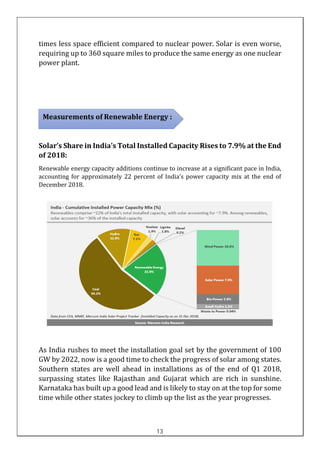
Solar’s Share in India’s Total Installed Capacity Rises to 7.9% at the End
of 2018:
Renewable energy capacity additions continue to increase at a significant pace in India,
accounting for approximately 22 percent of India’s power capacity mix at the end of
December 2018.
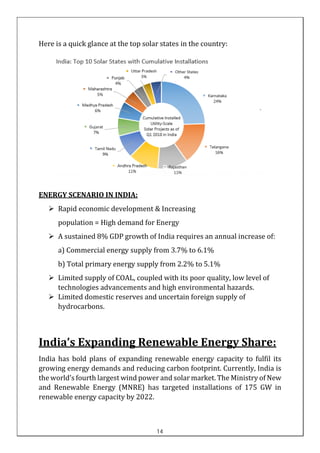
As India rushes to meet the installation goal set by the government of 100
GW by 2022, now is a good time to check the progress of solar among states.
Southern states are well ahead in installations as of the end of Q1 2018,
surpassing states like Rajasthan and Gujarat which are rich in sunshine.
Karnataka has built up a good lead and is likely to stay on at the top for some
time while other states jockey to climb up the list as the year progresses.
Measurements of Renewable Energy :
13
Here is a quick glance at the top solar states in the country:
ENERGY SCENARIO IN INDIA:
➢ Rapid economic development & Increasing
population = High demand for Energy
➢ A sustained 8% GDP growth of India requires an annual increase of:
a) Commercial energy supply from 3.7% to 6.1%
b) Total primary energy supply from 2.2% to 5.1%
➢ Limited supply of COAL, coupled with its poor quality, low level of
technologies advancements and high environmental hazards.
➢ Limited domestic reserves and uncertain foreign supply of
hydrocarbons.
India’s Expanding Renewable Energy Share:
India has bold plans of expanding renewable energy capacity to fulfil its
growing energy demands and reducing carbon footprint. Currently, India is
the world’s fourth largest wind power and solar market. The Ministry of New
and Renewable Energy (MNRE) has targeted installations of 175 GW in
renewable energy capacity by 2022.
14
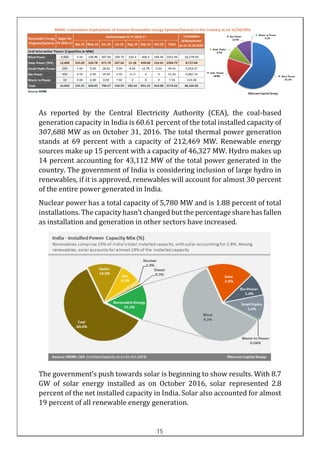
As reported by the Central Electricity Authority (CEA), the coal-based
generation capacity in India is 60.61 percent of the total installed capacity of
307,688 MW as on October 31, 2016. The total thermal power generation
stands at 69 percent with a capacity of 212,469 MW. Renewable energy
sources make up 15 percent with a capacity of 46,327 MW. Hydro makes up
14 percent accounting for 43,112 MW of the total power generated in the
country. The government of India is considering inclusion of large hydro in
renewables, if it is approved, renewables will account for almost 30 percent
of the entire power generated in India.
Nuclear power has a total capacity of 5,780 MW and is 1.88 percent of total
installations. The capacity hasn’t changed but the percentage share has fallen
as installation and generation in other sectors have increased.
The government’s push towards solar is beginning to show results. With 8.7
GW of solar energy installed as on October 2016, solar represented 2.8
percent of the net installed capacity in India. Solar also accounted for almost
19 percent of all renewable energy generation.
15
Recent policies and programs by the MNRE and the state nodal agencies have
spurred activity in the renewables sector in India.
INDIA’S RENEWABLE ENERGY FUTURE PROSPECTS :
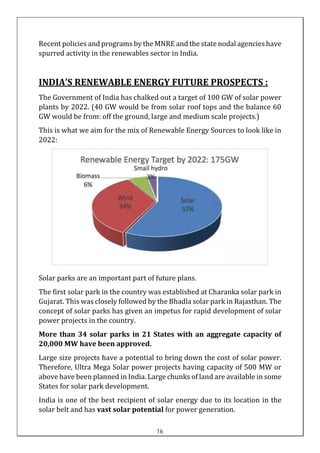
The Government of India has chalked out a target of 100 GW of solar power
plants by 2022. (40 GW would be from solar roof tops and the balance 60
GW would be from: off the ground, large and medium scale projects.)
This is what we aim for the mix of Renewable Energy Sources to look like in
2022:
Solar parks are an important part of future plans.
The first solar park in the country was established at Charanka solar park in
Gujarat. This was closely followed by the Bhadla solar park in Rajasthan. The
concept of solar parks has given an impetus for rapid development of solar
power projects in the country.
More than 34 solar parks in 21 States with an aggregate capacity of
20,000 MW have been approved.
Large size projects have a potential to bring down the cost of solar power.
Therefore, Ultra Mega Solar power projects having capacity of 500 MW or
above have been planned in India. Large chunks of land are available in some
States for solar park development.
India is one of the best recipient of solar energy due to its location in the
solar belt and has vast solar potential for power generation.
16
What we have achieved
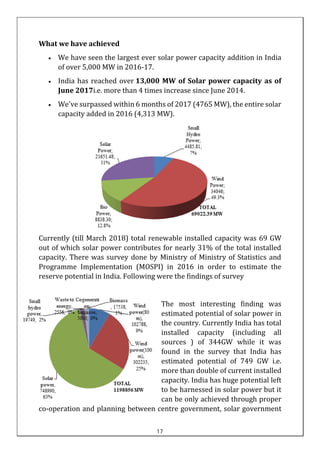
• We have seen the largest ever solar power capacity addition in India
of over 5,000 MW in 2016-17.
• India has reached over 13,000 MW of Solar power capacity as of
June 2017i.e. more than 4 times increase since June 2014.
• We've surpassed within 6 months of 2017 (4765 MW), the entire solar
capacity added in 2016 (4,313 MW).
Currently (till March 2018) total renewable installed capacity was 69 GW
out of which solar power contributes for nearly 31% of the total installed
capacity. There was survey done by Ministry of Ministry of Statistics and
Programme Implementation (MOSPI) in 2016 in order to estimate the
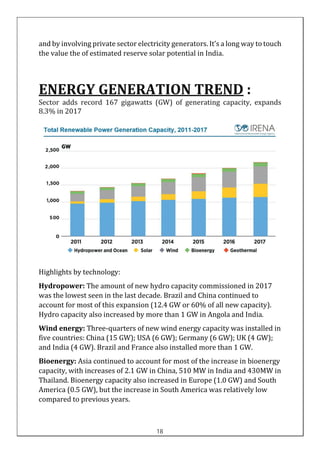
reserve potential in India. Following were the findings of survey
The most interesting finding was
estimated potential of solar power in
the country. Currently India has total
installed capacity (including all
sources ) of 344GW while it was
found in the survey that India has
estimated potential of 749 GW i.e.
more than double of current installed
capacity. India has huge potential left
to be harnessed in solar power but it
can be only achieved through proper
co-operation and planning between centre government, solar government
17
and by involving private sector electricity generators. It’s a long way to touch
the value the of estimated reserve solar potential in India.
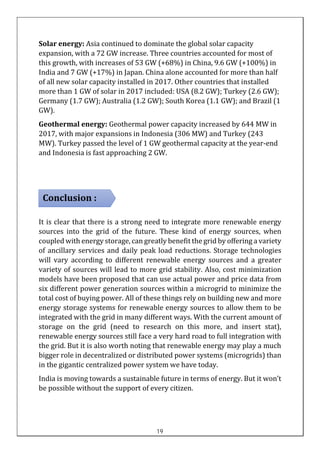
ENERGY GENERATION TREND :
Sector adds record 167 gigawatts (GW) of generating capacity, expands
8.3% in 2017
Highlights by technology:
Hydropower: The amount of new hydro capacity commissioned in 2017
was the lowest seen in the last decade. Brazil and China continued to
account for most of this expansion (12.4 GW or 60% of all new capacity).
Hydro capacity also increased by more than 1 GW in Angola and India.
Wind energy: Three-quarters of new wind energy capacity was installed in
five countries: China (15 GW); USA (6 GW); Germany (6 GW); UK (4 GW);
and India (4 GW). Brazil and France also installed more than 1 GW.
Bioenergy: Asia continued to account for most of the increase in bioenergy
capacity, with increases of 2.1 GW in China, 510 MW in India and 430MW in
Thailand. Bioenergy capacity also increased in Europe (1.0 GW) and South
America (0.5 GW), but the increase in South America was relatively low
compared to previous years.
18
Solar energy: Asia continued to dominate the global solar capacity
expansion, with a 72 GW increase. Three countries accounted for most of
this growth, with increases of 53 GW (+68%) in China, 9.6 GW (+100%) in
India and 7 GW (+17%) in Japan. China alone accounted for more than half
of all new solar capacity installed in 2017. Other countries that installed
more than 1 GW of solar in 2017 included: USA (8.2 GW); Turkey (2.6 GW);
Germany (1.7 GW); Australia (1.2 GW); South Korea (1.1 GW); and Brazil (1
GW).
Geothermal energy: Geothermal power capacity increased by 644 MW in
2017, with major expansions in Indonesia (306 MW) and Turkey (243
MW). Turkey passed the level of 1 GW geothermal capacity at the year-end
and Indonesia is fast approaching 2 GW.
It is clear that there is a strong need to integrate more renewable energy
sources into the grid of the future. These kind of energy sources, when
coupled with energy storage, can greatly benefit the grid by offering a variety
of ancillary services and daily peak load reductions. Storage technologies
will vary according to different renewable energy sources and a greater
variety of sources will lead to more grid stability. Also, cost minimization
models have been proposed that can use actual power and price data from
six different power generation sources within a microgrid to minimize the
total cost of buying power. All of these things rely on building new and more
energy storage systems for renewable energy sources to allow them to be
integrated with the grid in many different ways. With the current amount of
storage on the grid (need to research on this more, and insert stat),
renewable energy sources still face a very hard road to full integration with
the grid. But it is also worth noting that renewable energy may play a much
bigger role in decentralized or distributed power systems (microgrids) than
in the gigantic centralized power system we have today.
India is moving towards a sustainable future in terms of energy. But it won’t
be possible without the support of every citizen.
Conclusion :
19
One can make a difference at an individual level, from installing rooftop solar
setups to switching off the lights when not in use.
• Anyone can now download the ARUN (Atal Rooftop solar User
Navigator) Mobile Application to learn more about solar rooftop
systems and their installation, and get assistance for the same.
• SPIN (Solar Photovoltaic Installations) is another online platform that
is designed to monitor activities involved in Solar Rooftop
Installations.
So yes, the future of solar power in India looks “bright”!
• https://www.ntpc.co.in/en/power-generation/renewable-energy-
and-distributed-generation
• https://www.studentenergy.org/
• https://www.renewableenergyworld.com/index/tech.html
• https://mercomindia.com/solars-share-indias-total-installed-
capacity-7-9-end-2018/
• https://en.wikipedia.org/wiki/Renewable_energy
• https://www.slideshare.net
Bibliography :
20
Acknowledgement
I would like to express my special thanks of gratitude to my teacher
__________________________________ for his able guidance and support in
completing my project.
I would also like to extend my gratitude to the Principal
____________________________________ for providing me with all the facility that was
required.
I would also like to thank my parents and friends who helped me a lot in
finalizing this project within the limited time frame.
Date : (Your name)
Place : B.Com. (Hons./Gen.)
Roll No.:
Reg. No.:
21

Renewable energy

  • 1.
    BIDHAN CHANDRA COLLEGE,RISHRA SUBMITTED BY : XXXXXXXX XXXXXXXX CLASS : B.COM. (Hons./Gen.) ROLL NO. : XXX REGISTRATION NO. : XXX-XXXX-XXXX-XX GUIDED BY : Prof. XXXXXXXXXXXX (Asst. Professor, Department of xxxxxxxxxx)
  • 2.
    1) Introduction 2) Sourcesof Renewable Energy 3) Usefulness of Renewable Energy 4) Advantages & Disadvantages of Renewable Energy 5) Measurements of Renewable Energy 6) Conclusion 7) Bibliography 8) Acknowledgement AGENDA 1
  • 3.
    Renewable energy isenergy produced from sources that do not deplete or can be replenished within a human’s life time. The most common examples include wind, solar, geothermal, biomass, and hydropower. This is in contrast to non-renewable sources such as fossil fuels. Renewable energy accounts for 13.5% of the world’s total energy supply, and 22% of the world's electricity. Renewable energy systems are a major topic when discussing the globe's energy future for two main reasons: 1. Renewable energy systems provide energy from sources that will never deplete. 2. Renewable energy systems produce less greenhouse gas emissions than fuel energy systems. While renewable energy systems are better for the environment and produce less emissions than conventional energy sources, many of these sources still face difficulties in being deployed at a large scale including, but not limited to, technological barriers, high start-up capital costs, and intermittency challenges. It is important to note that the terms ‘renewable energy’, ‘green energy’ and ‘clean energy’ are not interchangeable in all cases; for example, a ‘clean’ coal plant is simply a coal plant with emissions reduction technology. The coal plant itself is still not a ‘renewable energy’ source. ‘Green energy’ is a subset of renewable energy, which boasts low or zero emissions and low environmental impacts to systems such as land and water. ➢ Renewable energy is energy generated from natural resources such as sunlight, wind, rain, tides and geothermal heat which are renewable (naturally replenished). ➢ Solar energy ➢ Wind ➢ Hydropower ➢ Biomass ➢ Ocean energy ➢ Geothermal ➢ Waste to Energy INTRODUCTION : Renewable Energy Sources : : 2
  • 4.
    SOLAR ENERGY: • Solarpower is one of the best renewable energy sources available because it is one the cleanest sources of energy. • Solar power is the conversion of sunlight into electricity either directly by using photovoltaics or concentrated solar power. • Remains an expensive method of generating electricity compared to conventional sources and other renewable sources such as wind or hydro power Pros & Cons – Solar Energy Pros: ➢ Most widely available source of energy ➢ Not as limited in location siting as other renewable sources such as Wind & Hydro ➢ Largest potential for decentralized power generation Cons: ➢ Most expensive form of energy (though not so much if you consider end-to-end costs of other energy sources) ➢ Large up-front Capital investment 3
  • 5.
    WIND ENERGY : •Converts kinetic energy for wind to electrical energy • Broadly serving as the renewable of choice in Europe and the United States • Increased size and higher productivity have enabled wind generation to become an • increasingly competitive alternative to more traditional methods of power generation • Uncertainty is the main problem with wind production owing to the inherent • unpredictability of weather conditions • Utilization for wind generation is generally rather low, with most in the 25-35% utilization rate. Pros & Cons of Wind Power Pros: ➢ Smaller Land requirement when compared to Solar, Hydro ➢ Can be built off-shore ➢ Fluctuates less than solar ➢ Cheaper than Solar Cons: ➢ Premium Onshore sites saturated ➢ Intermittency issue ➢ Offshore towers more expensive ➢ Energy Storage not viable ➢ Cause Noise pollution 4
  • 6.
    HYDRO-POWER : • Hydropoweror water power is power derived from the energy of falling water or fast running water, which may be harnessed for useful purposes. • Flowing water creates energy that can be captured and turned into electricity. This is called hydroelectric power or hydropower. • The most common type of hydroelectric power plant uses a dam on a river to store water in a reservoir. Pros & Cons of Hydro Energy Pros: ➢ Cheap electricity ➢ Capable of providing base load power ➢ Capable of large-scale production Cons: ➢ Environmental concerns. Ecology in dam catchment area destroyed ➢ Depends on seasonal nature of water (rain) availability in catchment area ➢ High upfront capital investment costs ➢ Limited in number of potential sites/locations 5
  • 7.
    GEOTHERMAL : • Geothermalheat is the only renewable energy source created naturally by the Earth itself. • Approximately 6400 km below the Earth’s surface is the core, where temperatures can reach 5000°C. • These reservoirs can be tapped for a variety of uses, such as to generate electricity or to heat buildings. • The geothermal energy potential in the 10 km of the Earth’s crust amounts to 50,000 times the energy of all oil and gas resources in the world. Pros & Cons of Geothermal Energy Pros: ➢ Zero carbon ➢ No fuel required (no mining or transportation) ➢ Virtually limitless supply ➢ Inherently simple and reliable ➢ Already cost competitive in some areas ➢ Could be built underground Cons: ➢ Prime sites are very location-specific & often far from population centers ➢ Losses due to long distance transmission of electricity ➢ Water usage ➢ Sulfur dioxide and silica emissions ➢ High construction costs 6
  • 8.
    Marine and HydrokineticEnergy (Ocean energy): • Marine and hydrokinetic energy systems, a new generation of water power technologies offer the possibility of generating electricity from water without the need for dams and diversions. • The ocean can produce two types of energy: ✓ Thermal energy from the sun’s heat. ✓ Mechanical energy from the tides and waves. • The three most well-known generating technologies for deriving electrical power from the ocean are: ➢ Tidal power ➢ Wave power ➢ Ocean thermal energy conversion (OTEC). Pros & Cons of Tidal Energy Pros: ➢ Renewable & Requires no fuel. ➢ Reliable, a plant can last 100 year ➢ Easy to construct and set up ➢ High efficiency & Predictable output Cons: ➢ Expensive to build ➢ Very location specific (only 20 sites identified with high potential) ➢ Non-continuous & Locations are often remote ➢ Can change tidal level of surrounding area ➢ Impact on fish, marine mammals and birds ➢ Captures dirt, waste and pollution near the coast 7
  • 9.
    Biomass: • One ofthe promising sources of renewable energy is biomass. • Biomass is the feedstock used to produce bioenergy. • Bioenergy is a general term for energy derived from materials such as straw, wood, or animal wastes. • Such materials can be burned directly to produce heat or power, and also can be converted into liquid biofuels. Biomass Direct Combustion: • There are two main components of a combustion–based biomass plant: ✓ Biomass-fired boiler. ✓ Steam turbine. WASTE TO ENERGY: Every year, about 55 million tonnes of municipal solid waste (MSW) and 38 billion litres of sewage are generated in the urban areas of India. In addition, large quantities of solid and liquid wastes are generated by industries. Waste generation in India is expected to increase rapidly in the future. As more people migrate to urban areas and as incomes increase, consumption levels are likely to rise, as are rates of waste generation. It is estimated that the amount of waste generated in India will increase at a per capita rate of approximately 1-1.33% annually. This has significant impacts on the amount of land that is and will be needed for disposal, economic costs of collecting and transporting waste, and the 8
  • 10.
    environmental consequences ofincreased MSW generation levels. BIO-GAS: In 2018, India has set target to produce 15 million tons (62 mm cmd) of biogas/bio-CNG by installing 5,000 large scale commercial type biogas plants which can produce daily 12.5 tons of bio-CNG by each plant. The rejected organic solids from biogas plants can be used after Torre faction in the existing coal fired plants to reduce coal consumption. BIO PROTEIN: Synthetic methane (SNG) generated using electricity from carbon neutral renewable power or Bio CNG can be used to produce protein rich feed for cattle, poultry and fish economically by cultivating Methyl coccus capsulatus bacteria culture with tiny land and water foot print. The carbon dioxide gas produced as by product from these bio protein plants can be recycled in the generation of SNG. Similarly, oxygen gas produced as by product from the electrolysis of water and the methanation process can be consumed in the cultivation of bacteria culture. With these integrated plants, the abundant renewable power potential in India can be converted in to high value food products without any water pollution or green-house gas (GHG) emissions for achieving food security at a faster pace with lesser people deployment in agriculture / animal husbandry sector. BIOFUELS: Unlike other renewable energy sources, biomass can be converted directly into liquid fuels - biofuels - for our transportation needs (cars, trucks, buses, airplanes, and trains). The two most common types of biofuels are ethanol and biodiesel. Ethanol is an alcohol, the same found in beer and wine. It is made by fermenting any biomass high in carbohydrates (starches, sugars, or celluloses) through a process similar to brewing beer. Ethanol is mostly used as a fuel additive to cut down a vehicle's carbon monoxide and other smog- causing emissions. But flexible-fuel vehicles, which run on mixtures of gasoline and up to 85% ethanol, are now available. Biodiesel is made by combining alcohol (usually methanol) with vegetable oil, animal fat, or recycled cooking greases. It can be used as an additive to reduce vehicle emissions (typically 20%) or in its pure form as a renewable alternative fuel for diesel engines. 9
  • 11.
    Advantages of RenewableEnergy : HYDROGEN ENERGY: Hydrogen also can be found in many organic compounds, as well as water. It's the most abundant element on the Earth. But it doesn't occur naturally as a gas. It's always combined with other elements, such as with oxygen to make water. Once separated from another element, hydrogen can be burned as a fuel or converted into electricity. Hydrogen is the simplest element. An atom of hydrogen consists of only one proton and one electron. It's also the most plentiful element in the universe. Despite its simplicity and abundance, hydrogen doesn't occur naturally as a gas on the Earth - it's always combined with other elements. Water, for example, is a combination of hydrogen and oxygen (H2O). Currently, most hydrogen is made this way from natural gas. An electrical current can also be used to separate water into its components of oxygen and hydrogen. This process is known as electrolysis. Some algae and bacteria, using sunlight as their energy source, even give off hydrogen under certain conditions. 1. It is safe, abundant, and clean to use when compared to fossil fuels: Even clean-burning natural gas is at a disadvantage to what renewable energy sources can provide. Enough sunlight comes down on our planet every day that if we could harvest it with solar panels and other forms of collection, we could power everything for an entire year. Because wind is created by the warmth of the sun, it is also virtually limitless. Fossil fuels, in theory, are a finite resource because of how they are created. 2. Multiple forms of renewable energy exist: Diversification within the renewable energy sector has exploded since the 1970s. From dams that provide hydropower to solar strips that are strong enough to handle the weight of a vehicle and can be turned into roads, we have numerous methods of creating power through the collection of renewable energy. There is greater diversity in this sector when compared to fossil fuel resources. 10
  • 12.
    3. It providesthe foundation for energy independence: Many nations rely on fossil fuels for their society to function under the “modern” definition. These fuels come from a handful of countries that work to control pricing and availability. By developing renewable energy resources, countries can work toward energy independence with a diversified portfolio of energy to access. Although these resources take time to develop, it should be remembered that the current fossil fuel infrastructure has more than a century of development behind it. 4. Renewable energy is stable: When renewables are creating energy, the power produced is stable and usable, just like any other form of “traditional” power. It is a dependable resource when an infrastructure is available to support it. Jobs are created within the sector as well, creating stability within local economic sectors at the same time. The power created can be distributed through existing grids, which can limit installation costs for some communities. 5. It is a technology instead of a fuel: Coal must be mined and refined to make it useful. Natural gas must be released and transported. A fossil fuel is created from natural resources, whereas renewable energies are created thanks to the use of technology. For this reason, the pricing of renewable energies will continue to go down as improvements in technology occur. Fossil fuels can see price reductions through mining and refining efficiency improvements, but there will always be an underlying labor cost that will affect pricing and availability. 1. Not every form of renewable energy is commercially viable: Many forms of renewable energy must be collected at a specific location, which means distribution networks must be setup to take advantage of the power that can be generated. These networks require a massive fossil fuel investment that can take generations to neutralize with the use of renewable energy. From tidal power to geothermal, the commercial viability of many renewable energy resources is not available right now. Disadvantages of Renewable Energy : 11
  • 13.
    2. Many formsof renewable energy are location-specific: Even solar energy has limited potential in some locations. In Seattle, Washington, just 71 days per year are classified as “sunny,” or having a cloud cover that is less than 30%. Northern cities may go prolonged periods without any sunlight during the winter months. Because renewable energy is often location-specific, it may not be available for every community to use. 3. Many forms of renewable energy require storage capabilities: With traditional power resources, a home or business is connected to a local distribution grid so that it can be accessed 24/7. When using a renewable energy resource, back-up and storage resources must be included with the power generation opportunity. Sunlight doesn’t happen at night. Wind speeds are not always consistent. The storage capabilities that are required can push the cost of a new renewable energy system beyond what the average person or community can afford. 4. Pollution is still generated with renewable energy: Renewable energies are cleaner than most fossil fuels, but “cleaner” and “clean” are very different terms. A resource like biomass still burns waste products and puts pollution into the atmosphere. This includes carbon and methane, which are classified as greenhouse gases. The technologies and facilities that are used to build renewable energy resources require fossil fuels, as do the transportation and distribution networks. In many instances, renewable energy relies on fossil fuels, whereas fossil fuels do not rely on renewables. 5. Renewables often require subsidies to make them affordable: In the United States, an emphasis on biofuels and renewable energies led to the creation of ethanol as a crude oil replacement. Despite taxpayer-funded subsidies in place for this corn-based fuel, only 430,000 barrels per day were produced in 2007. That was enough to replace 2% of the oil that was being consumed while corn prices skyrocketed because of the crops being funneled into this renewable fuel. 6. Some forms of renewable energy require a massive amount of space: To produce 20 megawatts of energy, current solar technologies require 100 acres of space. In comparison, the footprint for a nuclear power plant is 1 square mile to produce 1,000 megawatts of energy. Solar is therefore 45 12
  • 14.
    times less spaceefficient compared to nuclear power. Solar is even worse, requiring up to 360 square miles to produce the same energy as one nuclear power plant. Solar’s Share in India’s Total Installed Capacity Rises to 7.9% at the End of 2018: Renewable energy capacity additions continue to increase at a significant pace in India, accounting for approximately 22 percent of India’s power capacity mix at the end of December 2018. As India rushes to meet the installation goal set by the government of 100 GW by 2022, now is a good time to check the progress of solar among states. Southern states are well ahead in installations as of the end of Q1 2018, surpassing states like Rajasthan and Gujarat which are rich in sunshine. Karnataka has built up a good lead and is likely to stay on at the top for some time while other states jockey to climb up the list as the year progresses. Measurements of Renewable Energy : 13
  • 15.
    Here is aquick glance at the top solar states in the country: ENERGY SCENARIO IN INDIA: ➢ Rapid economic development & Increasing population = High demand for Energy ➢ A sustained 8% GDP growth of India requires an annual increase of: a) Commercial energy supply from 3.7% to 6.1% b) Total primary energy supply from 2.2% to 5.1% ➢ Limited supply of COAL, coupled with its poor quality, low level of technologies advancements and high environmental hazards. ➢ Limited domestic reserves and uncertain foreign supply of hydrocarbons. India’s Expanding Renewable Energy Share: India has bold plans of expanding renewable energy capacity to fulfil its growing energy demands and reducing carbon footprint. Currently, India is the world’s fourth largest wind power and solar market. The Ministry of New and Renewable Energy (MNRE) has targeted installations of 175 GW in renewable energy capacity by 2022. 14
  • 16.
    As reported bythe Central Electricity Authority (CEA), the coal-based generation capacity in India is 60.61 percent of the total installed capacity of 307,688 MW as on October 31, 2016. The total thermal power generation stands at 69 percent with a capacity of 212,469 MW. Renewable energy sources make up 15 percent with a capacity of 46,327 MW. Hydro makes up 14 percent accounting for 43,112 MW of the total power generated in the country. The government of India is considering inclusion of large hydro in renewables, if it is approved, renewables will account for almost 30 percent of the entire power generated in India. Nuclear power has a total capacity of 5,780 MW and is 1.88 percent of total installations. The capacity hasn’t changed but the percentage share has fallen as installation and generation in other sectors have increased. The government’s push towards solar is beginning to show results. With 8.7 GW of solar energy installed as on October 2016, solar represented 2.8 percent of the net installed capacity in India. Solar also accounted for almost 19 percent of all renewable energy generation. 15
  • 17.
    Recent policies andprograms by the MNRE and the state nodal agencies have spurred activity in the renewables sector in India. INDIA’S RENEWABLE ENERGY FUTURE PROSPECTS : The Government of India has chalked out a target of 100 GW of solar power plants by 2022. (40 GW would be from solar roof tops and the balance 60 GW would be from: off the ground, large and medium scale projects.) This is what we aim for the mix of Renewable Energy Sources to look like in 2022: Solar parks are an important part of future plans. The first solar park in the country was established at Charanka solar park in Gujarat. This was closely followed by the Bhadla solar park in Rajasthan. The concept of solar parks has given an impetus for rapid development of solar power projects in the country. More than 34 solar parks in 21 States with an aggregate capacity of 20,000 MW have been approved. Large size projects have a potential to bring down the cost of solar power. Therefore, Ultra Mega Solar power projects having capacity of 500 MW or above have been planned in India. Large chunks of land are available in some States for solar park development. India is one of the best recipient of solar energy due to its location in the solar belt and has vast solar potential for power generation. 16
  • 18.
    What we haveachieved • We have seen the largest ever solar power capacity addition in India of over 5,000 MW in 2016-17. • India has reached over 13,000 MW of Solar power capacity as of June 2017i.e. more than 4 times increase since June 2014. • We've surpassed within 6 months of 2017 (4765 MW), the entire solar capacity added in 2016 (4,313 MW). Currently (till March 2018) total renewable installed capacity was 69 GW out of which solar power contributes for nearly 31% of the total installed capacity. There was survey done by Ministry of Ministry of Statistics and Programme Implementation (MOSPI) in 2016 in order to estimate the reserve potential in India. Following were the findings of survey The most interesting finding was estimated potential of solar power in the country. Currently India has total installed capacity (including all sources ) of 344GW while it was found in the survey that India has estimated potential of 749 GW i.e. more than double of current installed capacity. India has huge potential left to be harnessed in solar power but it can be only achieved through proper co-operation and planning between centre government, solar government 17
  • 19.
    and by involvingprivate sector electricity generators. It’s a long way to touch the value the of estimated reserve solar potential in India. ENERGY GENERATION TREND : Sector adds record 167 gigawatts (GW) of generating capacity, expands 8.3% in 2017 Highlights by technology: Hydropower: The amount of new hydro capacity commissioned in 2017 was the lowest seen in the last decade. Brazil and China continued to account for most of this expansion (12.4 GW or 60% of all new capacity). Hydro capacity also increased by more than 1 GW in Angola and India. Wind energy: Three-quarters of new wind energy capacity was installed in five countries: China (15 GW); USA (6 GW); Germany (6 GW); UK (4 GW); and India (4 GW). Brazil and France also installed more than 1 GW. Bioenergy: Asia continued to account for most of the increase in bioenergy capacity, with increases of 2.1 GW in China, 510 MW in India and 430MW in Thailand. Bioenergy capacity also increased in Europe (1.0 GW) and South America (0.5 GW), but the increase in South America was relatively low compared to previous years. 18
  • 20.
    Solar energy: Asiacontinued to dominate the global solar capacity expansion, with a 72 GW increase. Three countries accounted for most of this growth, with increases of 53 GW (+68%) in China, 9.6 GW (+100%) in India and 7 GW (+17%) in Japan. China alone accounted for more than half of all new solar capacity installed in 2017. Other countries that installed more than 1 GW of solar in 2017 included: USA (8.2 GW); Turkey (2.6 GW); Germany (1.7 GW); Australia (1.2 GW); South Korea (1.1 GW); and Brazil (1 GW). Geothermal energy: Geothermal power capacity increased by 644 MW in 2017, with major expansions in Indonesia (306 MW) and Turkey (243 MW). Turkey passed the level of 1 GW geothermal capacity at the year-end and Indonesia is fast approaching 2 GW. It is clear that there is a strong need to integrate more renewable energy sources into the grid of the future. These kind of energy sources, when coupled with energy storage, can greatly benefit the grid by offering a variety of ancillary services and daily peak load reductions. Storage technologies will vary according to different renewable energy sources and a greater variety of sources will lead to more grid stability. Also, cost minimization models have been proposed that can use actual power and price data from six different power generation sources within a microgrid to minimize the total cost of buying power. All of these things rely on building new and more energy storage systems for renewable energy sources to allow them to be integrated with the grid in many different ways. With the current amount of storage on the grid (need to research on this more, and insert stat), renewable energy sources still face a very hard road to full integration with the grid. But it is also worth noting that renewable energy may play a much bigger role in decentralized or distributed power systems (microgrids) than in the gigantic centralized power system we have today. India is moving towards a sustainable future in terms of energy. But it won’t be possible without the support of every citizen. Conclusion : 19
  • 21.
    One can makea difference at an individual level, from installing rooftop solar setups to switching off the lights when not in use. • Anyone can now download the ARUN (Atal Rooftop solar User Navigator) Mobile Application to learn more about solar rooftop systems and their installation, and get assistance for the same. • SPIN (Solar Photovoltaic Installations) is another online platform that is designed to monitor activities involved in Solar Rooftop Installations. So yes, the future of solar power in India looks “bright”! • https://www.ntpc.co.in/en/power-generation/renewable-energy- and-distributed-generation • https://www.studentenergy.org/ • https://www.renewableenergyworld.com/index/tech.html • https://mercomindia.com/solars-share-indias-total-installed- capacity-7-9-end-2018/ • https://en.wikipedia.org/wiki/Renewable_energy • https://www.slideshare.net Bibliography : 20
  • 22.
    Acknowledgement I would liketo express my special thanks of gratitude to my teacher __________________________________ for his able guidance and support in completing my project. I would also like to extend my gratitude to the Principal ____________________________________ for providing me with all the facility that was required. I would also like to thank my parents and friends who helped me a lot in finalizing this project within the limited time frame. Date : (Your name) Place : B.Com. (Hons./Gen.) Roll No.: Reg. No.: 21