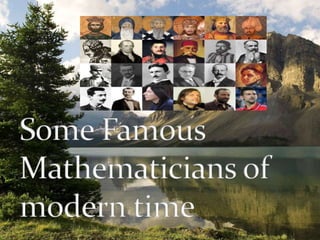
 In 18th century mathematics is already a
modern science
 Mathematics begins to develop very fast
because of introducing it to schools
 Therefore everyone have a chance to learn
the basic learnings of mathematics
 Thanks to that, large number of new
mathematicians appear on stage
 There are many new ideas, solutions to old
mathematical problems,researches which
lead to creating new fields of mathematics.
 Old fields of mathematics are also
expanding.
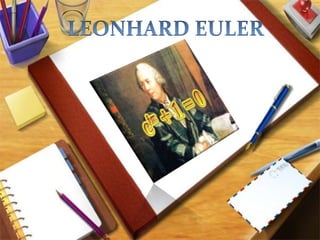
 He was a Swiss mathematician.
 Johann Bernoulli made the biggest influence on
Leonhard.
 1727 he went to St Petersburg where he worked in
the mathematics department and became in 1731
the head of this department.
 1741 went in Berlin and worked in Berlin Academy
for 25 years and after that he returned in St
Ptersburg where he spent the rest of his life..
 Euler worked in almost all areas of mathematics: geometry,
calculus, trigonometry, algebra,applied mathematics,
graph theory and number theory, as well as , lunar theory,
optics and other areas of physics.
 Concept of a function as we use today was introduced by
him;he was the first mathematician to write f(x) to denote
function
 He also introduced the modern notation for the
trigonometric functions, the letter e for the base of the
natural logarithm (now also known as Euler’s number), the
Greek letter Σ for summations and the letter i to denote the
imaginary unit
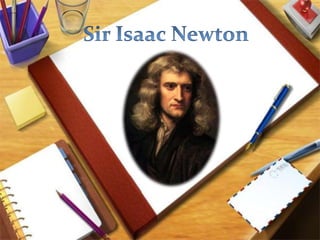
 There aren't many subjects that Newton didn't have a
huge impact in — he was one of the inventors of
calculus, built the first reflecting telescope and helped
establish the field of classical mechanics with his
seminal work, "Philosophiæ Naturalis Principia
Mathematica."
 He was the first to decompose white light into its
component colors and gave us the three laws of
motion, now known as Newton's laws.
 We would live in a very different world had Sir Isaac
Newton not been born.
 Other scientists would probably have worked out most
of his ideas eventually, but there is no telling how long
it would have taken and how far behind we might have
fallen from our current technological trajectory.
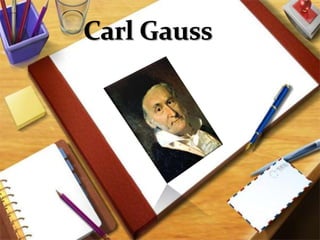
 Isaac Newton is a hard act to follow, but if anyone can
pull it off, it's Carl Gauss.
 If Newton is considered the greatest scientist of all
time, Gauss could easily be called the greatest
mathematician ever.
 Carl Friedrich Gauss was born to a poor family in
Germany in 1777 and quickly showed himself to be a
brilliant mathematician.
 You can find his influence throughout algebra,
statistics, geometry, optics, astronomy and many other
subjects that underlie our modern world.
 He published "Arithmetical Investigations," a
foundational textbook that laid out the tenets of
number theory (the study of whole numbers).
 Without number theory, you could kiss computers
goodbye.
 Computers operate, on a the most basic level, using
just two digits — 1 and 0, and many of the
advancements that we've made in using computers to
solve problems are solved using number theory.
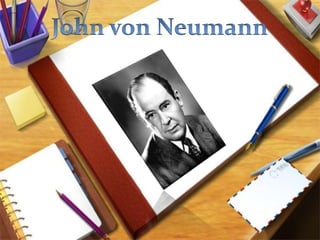
 John von Neumann was born in Budapest a few years
after the start of the 20th century, a well-timed birth
for all of us, for he went on to design the architecture
underlying nearly every single computer built on the
planet today.
 Von Neumann received his Ph.D in mathematics at
the age of 22 while also earning a degree in chemical
engineering to appease his father, who was keen on his
son having a good marketable skill.
 In 1930, he went to work at Princeton University with
Albert Einstein at the Institute of Advanced Study.
 Right now, whatever device or computer that you are
reading this on, be it phone or computer, is cycling
through a series of basic steps billions of times over each
second; steps that allow it to do things like render
Internet articles and play videos and music, steps that
were first thought up by John von Neumann.
 Before his death in 1957, von Neumann made important
discoveries in set theory, geometry, quantum mechanics,
game theory, statistics, computer science and was a vital
member of the Manhattan Project.
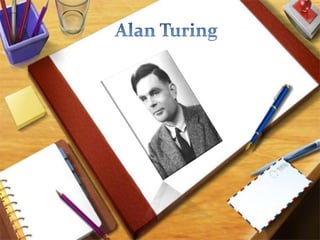
 Alan Turing a British mathematician who has been call the
father of computer science.
 During World War II, Turing bent his brain to the problem
of breaking Nazi crypto-code and was the one to finally
unravel messages protected by the infamous Enigma
machine.
 Alan Turing's career and life ended tragically when he was
arrested and prosecuted for being gay.
 He was found guilty and sentenced to undergo hormone
treatment to reduce his libido, losing his security clearance
as well. On June, 8, 1954, Alan Turing was found dead of
apparent suicide by his cleaning lady.

 Alan Turing was instrumental in the development of
the modern day computer.
 His design for a so-called "Turing machine" remains
central to how computers operate today.
 The "Turing test" is an exercise in artificial intelligence
that tests how well an AI program operates; a program
passes the
 Turing test if it can have a text chat conversation with
a human and fool that person into thinking that it too
is a person.
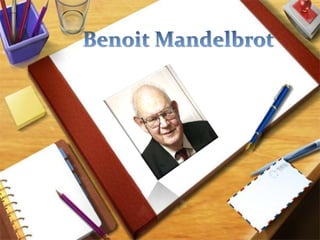
 Mandelbrot was born in Poland in 1924 and had to flee
to France with his family in 1936 to avoid Nazi
persecution.
 After studying in Paris, he moved to the U.S. where he
found a home as an IBM Fellow.
 Working at IBM meant that he had access to cutting-
edge technology, which allowed him to apply the
number-crunching abilities of electrical computer to
his projects and problems.
 Benoit Mandelbrot died of pancreatic cancer in 2010.
 Benoit Mandelbrot landed on this list thanks to his
discovery of fractal geometry.
 Fractals, often-fantastical and complex shapes built on
simple, self-replicable formulas, are fundamental to
computer graphics and animation.
 Without fractals, it's safe to say that we would be
decades behind where we are now in the field of
computer-generated images.
 Fractal formulas are also used to design cellphone
antennas and computer chips, which takes advantage of
the fractal's natural ability to minimize wasted space.
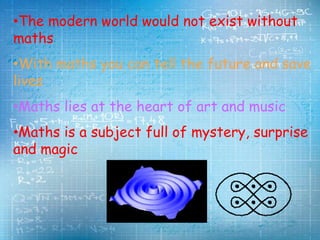
•The modern world would not exist without
maths
•With maths you can tell the future and save
lives
•Maths lies at the heart of art and music
•Maths is a subject full of mystery, surprise
and magic
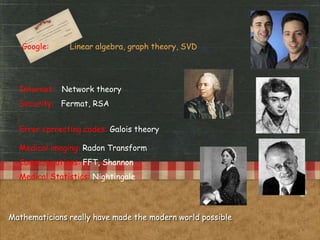
Linear algebra, graph theory, SVDGoogle:
Error correcting codes: Galois theory
Internet: Network theory
Security: Fermat, RSA
Mathematicians really have made the modern world possible
Medical imaging: Radon Transform
Communications: FFT, Shannon
Medical Statistics: Nightingale
MatheMatics and Modern World

MatheMatics and Modern World

  • 2.
     In 18thcentury mathematics is already a modern science  Mathematics begins to develop very fast because of introducing it to schools  Therefore everyone have a chance to learn the basic learnings of mathematics
  • 3.
     Thanks tothat, large number of new mathematicians appear on stage  There are many new ideas, solutions to old mathematical problems,researches which lead to creating new fields of mathematics.  Old fields of mathematics are also expanding.
  • 6.
     He wasa Swiss mathematician.  Johann Bernoulli made the biggest influence on Leonhard.  1727 he went to St Petersburg where he worked in the mathematics department and became in 1731 the head of this department.  1741 went in Berlin and worked in Berlin Academy for 25 years and after that he returned in St Ptersburg where he spent the rest of his life..
  • 7.
     Euler workedin almost all areas of mathematics: geometry, calculus, trigonometry, algebra,applied mathematics, graph theory and number theory, as well as , lunar theory, optics and other areas of physics.  Concept of a function as we use today was introduced by him;he was the first mathematician to write f(x) to denote function  He also introduced the modern notation for the trigonometric functions, the letter e for the base of the natural logarithm (now also known as Euler’s number), the Greek letter Σ for summations and the letter i to denote the imaginary unit
  • 9.
     There aren'tmany subjects that Newton didn't have a huge impact in — he was one of the inventors of calculus, built the first reflecting telescope and helped establish the field of classical mechanics with his seminal work, "Philosophiæ Naturalis Principia Mathematica."  He was the first to decompose white light into its component colors and gave us the three laws of motion, now known as Newton's laws.
  • 10.
     We wouldlive in a very different world had Sir Isaac Newton not been born.  Other scientists would probably have worked out most of his ideas eventually, but there is no telling how long it would have taken and how far behind we might have fallen from our current technological trajectory.
  • 12.
     Isaac Newtonis a hard act to follow, but if anyone can pull it off, it's Carl Gauss.  If Newton is considered the greatest scientist of all time, Gauss could easily be called the greatest mathematician ever.  Carl Friedrich Gauss was born to a poor family in Germany in 1777 and quickly showed himself to be a brilliant mathematician.  You can find his influence throughout algebra, statistics, geometry, optics, astronomy and many other subjects that underlie our modern world.
  • 13.
     He published"Arithmetical Investigations," a foundational textbook that laid out the tenets of number theory (the study of whole numbers).  Without number theory, you could kiss computers goodbye.  Computers operate, on a the most basic level, using just two digits — 1 and 0, and many of the advancements that we've made in using computers to solve problems are solved using number theory.
  • 15.
     John vonNeumann was born in Budapest a few years after the start of the 20th century, a well-timed birth for all of us, for he went on to design the architecture underlying nearly every single computer built on the planet today.  Von Neumann received his Ph.D in mathematics at the age of 22 while also earning a degree in chemical engineering to appease his father, who was keen on his son having a good marketable skill.  In 1930, he went to work at Princeton University with Albert Einstein at the Institute of Advanced Study.
  • 16.
     Right now,whatever device or computer that you are reading this on, be it phone or computer, is cycling through a series of basic steps billions of times over each second; steps that allow it to do things like render Internet articles and play videos and music, steps that were first thought up by John von Neumann.  Before his death in 1957, von Neumann made important discoveries in set theory, geometry, quantum mechanics, game theory, statistics, computer science and was a vital member of the Manhattan Project.
  • 18.
     Alan Turinga British mathematician who has been call the father of computer science.  During World War II, Turing bent his brain to the problem of breaking Nazi crypto-code and was the one to finally unravel messages protected by the infamous Enigma machine.  Alan Turing's career and life ended tragically when he was arrested and prosecuted for being gay.  He was found guilty and sentenced to undergo hormone treatment to reduce his libido, losing his security clearance as well. On June, 8, 1954, Alan Turing was found dead of apparent suicide by his cleaning lady. 
  • 19.
     Alan Turingwas instrumental in the development of the modern day computer.  His design for a so-called "Turing machine" remains central to how computers operate today.  The "Turing test" is an exercise in artificial intelligence that tests how well an AI program operates; a program passes the  Turing test if it can have a text chat conversation with a human and fool that person into thinking that it too is a person.
  • 21.
     Mandelbrot wasborn in Poland in 1924 and had to flee to France with his family in 1936 to avoid Nazi persecution.  After studying in Paris, he moved to the U.S. where he found a home as an IBM Fellow.  Working at IBM meant that he had access to cutting- edge technology, which allowed him to apply the number-crunching abilities of electrical computer to his projects and problems.  Benoit Mandelbrot died of pancreatic cancer in 2010.
  • 22.
     Benoit Mandelbrotlanded on this list thanks to his discovery of fractal geometry.  Fractals, often-fantastical and complex shapes built on simple, self-replicable formulas, are fundamental to computer graphics and animation.  Without fractals, it's safe to say that we would be decades behind where we are now in the field of computer-generated images.  Fractal formulas are also used to design cellphone antennas and computer chips, which takes advantage of the fractal's natural ability to minimize wasted space.
  • 23.
    •The modern worldwould not exist without maths •With maths you can tell the future and save lives •Maths lies at the heart of art and music •Maths is a subject full of mystery, surprise and magic
  • 25.
    Linear algebra, graphtheory, SVDGoogle: Error correcting codes: Galois theory Internet: Network theory Security: Fermat, RSA Mathematicians really have made the modern world possible Medical imaging: Radon Transform Communications: FFT, Shannon Medical Statistics: Nightingale