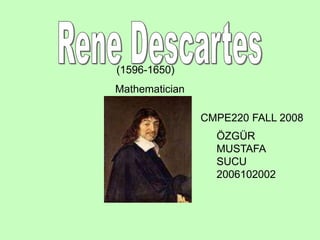
(1596-1650)
Mathematician
ÖZGÜR
MUSTAFA
SUCU
2006102002
CMPE220 FALL 2008
Background Information
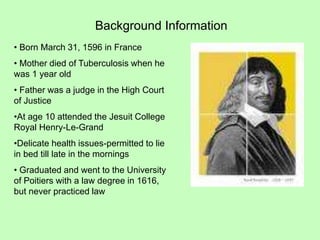
• Born March 31, 1596 in France
• Mother died of Tuberculosis when he
was 1 year old
• Father was a judge in the High Court
of Justice
•At age 10 attended the Jesuit College
Royal Henry-Le-Grand
•Delicate health issues-permitted to lie
in bed till late in the mornings
• Graduated and went to the University
of Poitiers with a law degree in 1616,
but never practiced law
Background Continued…
• In the army for a couple
years
• Traveled for 5 years
• Devoted the rest of his life
to philosophy and
mathematics
•Published a lot of his
works
Contributions
• Systematization of analytic
geometry
• First to attempt to classify curves
according to the types of equations
that produce them
• Theory of equations
•Law of Conservation of Momentum
• Last letters of the alphabet are
unknown quantities and first letters
are known ones
• Rule of Signs
•Exponential notation
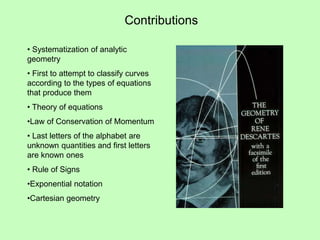
•Cartesian geometry
MORE DETAILED...
•As the inventor of the Cartesian coordinate system,
Decartes founded analytic geometry, the bridge between
algebra and geometry, crucial to the invention of calculus
and analysis.
•Descartes' reflections on mind and mechanism began the
strain of Western thought that much later, impelled by
invention of the electronic computer and by the possibility of
machine intelligence, blossomed into the Turing test and
related thought.
•Descartes' theory provided the basis for the calculus of Newton
and Leibniz, by applying infinitesimal calculus to the tangent line
problem, thus permitting the evolution of that branch of modern
mathematics.
•Descartes' rule of signs is also a commonly used method to
determine the number of positive and negative zeros of a
polynomial.
•He invented the notation which uses superscripts to show the
powers or exponents, for example the 2 used in x2 to indicate
squaring.
Cartesian geometry
vector space
definition of the plane
distance problems
the dot product, to get the angle of two vectors
the cross product, to get a perpendicular vector of two known
vectors (and also their spatial volume)
intersection problems
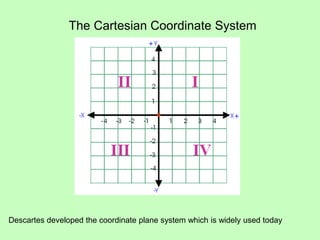
The Cartesian Coordinate System
Descartes developed the coordinate plane system which is widely used today
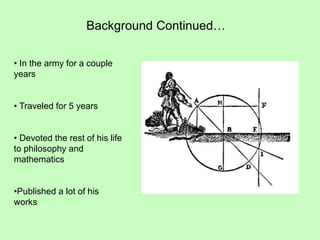
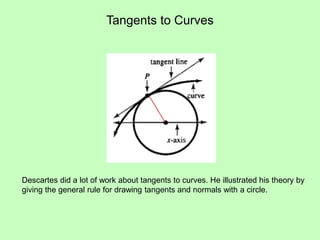
Tangents to Curves
Descartes did a lot of work about tangents to curves. He illustrated his theory by
giving the general rule for drawing tangents and normals with a circle.
In Closing…
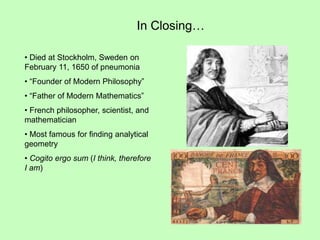
• Died at Stockholm, Sweden on
February 11, 1650 of pneumonia
• “Founder of Modern Philosophy”
• “Father of Modern Mathematics”
• French philosopher, scientist, and
mathematician
• Most famous for finding analytical
geometry
• Cogito ergo sum (I think, therefore
I am)
REFERENCES
http://en.wikipedia.org/wiki/Ren%C3%A9_Descartes
http://en.wikipedia.org/wiki/Cartesian_geometry
student.valpo.edu/kgross/portfolio/Rene%20Descartes.
ppt
THANKS FOR LISTENING...

rene_descartes.ppt

  • 1.
  • 2.
    Background Information • BornMarch 31, 1596 in France • Mother died of Tuberculosis when he was 1 year old • Father was a judge in the High Court of Justice •At age 10 attended the Jesuit College Royal Henry-Le-Grand •Delicate health issues-permitted to lie in bed till late in the mornings • Graduated and went to the University of Poitiers with a law degree in 1616, but never practiced law
  • 3.
    Background Continued… • Inthe army for a couple years • Traveled for 5 years • Devoted the rest of his life to philosophy and mathematics •Published a lot of his works
  • 4.
    Contributions • Systematization ofanalytic geometry • First to attempt to classify curves according to the types of equations that produce them • Theory of equations •Law of Conservation of Momentum • Last letters of the alphabet are unknown quantities and first letters are known ones • Rule of Signs •Exponential notation •Cartesian geometry
  • 5.
    MORE DETAILED... •As theinventor of the Cartesian coordinate system, Decartes founded analytic geometry, the bridge between algebra and geometry, crucial to the invention of calculus and analysis. •Descartes' reflections on mind and mechanism began the strain of Western thought that much later, impelled by invention of the electronic computer and by the possibility of machine intelligence, blossomed into the Turing test and related thought.
  • 6.
    •Descartes' theory providedthe basis for the calculus of Newton and Leibniz, by applying infinitesimal calculus to the tangent line problem, thus permitting the evolution of that branch of modern mathematics. •Descartes' rule of signs is also a commonly used method to determine the number of positive and negative zeros of a polynomial. •He invented the notation which uses superscripts to show the powers or exponents, for example the 2 used in x2 to indicate squaring.
  • 7.
    Cartesian geometry vector space definitionof the plane distance problems the dot product, to get the angle of two vectors the cross product, to get a perpendicular vector of two known vectors (and also their spatial volume) intersection problems
  • 8.
    The Cartesian CoordinateSystem Descartes developed the coordinate plane system which is widely used today
  • 9.
    Tangents to Curves Descartesdid a lot of work about tangents to curves. He illustrated his theory by giving the general rule for drawing tangents and normals with a circle.
  • 10.
    In Closing… • Diedat Stockholm, Sweden on February 11, 1650 of pneumonia • “Founder of Modern Philosophy” • “Father of Modern Mathematics” • French philosopher, scientist, and mathematician • Most famous for finding analytical geometry • Cogito ergo sum (I think, therefore I am)
  • 11.
  • 12.