Case Study - City of Ottawa  Rendering  Enterprise Content Management Strategies Operational Stephen Murray: Manager, Information Management Brenda Kallio: Program Manager, IM Program Development
Outline of Case Study   Purpose:  To provide an overview of the concepts that the City has used to implement its ECM strategy ECM Landscape The Shift - The City’s Change in ECM  The Driver - Service Delivery Transformation The Goal - ECM Target Service Architecture Strategic Message Achieving the Goal - Eight Simplifying Concepts  An Integrate Body of Knowledge - ECM Service Support  Conclusion From a Records Management Perspective
ECM LANDSCAPE The Shift The Driver And The Goal
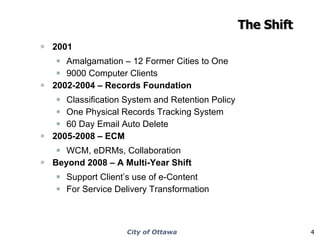
The Shift 2001 Amalgamation – 12 Former Cities to One 9000 Computer Clients 2002-2004 – Records Foundation Classification System and Retention Policy One Physical Records Tracking System 60 Day Email Auto Delete 2005-2008 – ECM WCM, eDRMs, Collaboration Beyond 2008 – A Multi-Year Shift Support Client’s use of e-Content For Service Delivery Transformation
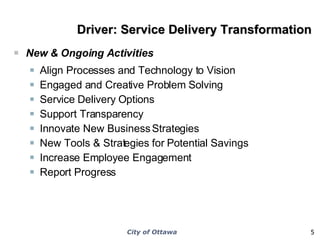
Driver: Service Delivery Transformation New & Ongoing Activities  Align Processes and Technology to Vision Engaged and Creative Problem Solving Service Delivery Options  Support Transparency  Innovate New Business Strategies New Tools & Strategies for Potential Savings Increase Employee Engagement  Report Progress
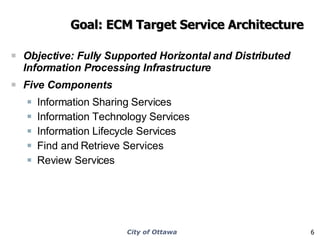
Goal: ECM Target Service Architecture Objective: Fully Supported Horizontal and Distributed Information Processing Infrastructure  Five Components Information Sharing Services Information Technology Services Information Lifecycle Services Find and Retrieve Services Review Services
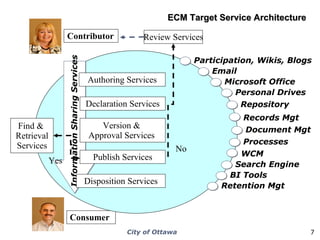
ECM Target Service Architecture Consumer Contributor No Review Services Participation, Wikis, Blogs Retention Mgt Records Mgt WCM Microsoft Office Personal Drives Repository Document Mgt Search Engine Processes BI Tools Email Information Sharing Services Disposition Services Authoring Services Declaration Services Publish Services Version &  Approval Services  Yes Find &  Retrieval Services
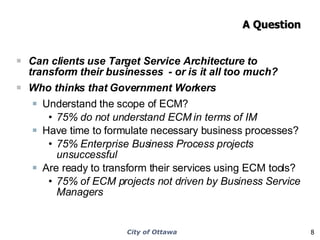
A Question Can clients use Target Service Architecture to transform their businesses  - or is it all too much? Who thinks that Government Workers  Understand the scope of ECM? 75% do not understand ECM in terms of IM Have time to formulate necessary business processes? 75% Enterprise Business Process projects unsuccessful Are ready to transform their services using ECM tools? 75% of ECM projects not driven by Business Service Managers
Eight Support Concepts Achieving the Goal
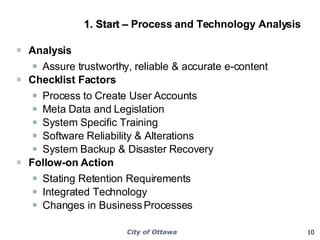
1. Start –  Process and Technology Analysis  Analysis Assure trustworthy, reliable & accurate e-content Checklist Factors Process to Create User Accounts Meta Data and Legislation System Specific Training Software Reliability & Alterations System Backup & Disaster Recovery Follow-on Action Stating Retention Requirements Integrated Technology Changes in Business Processes
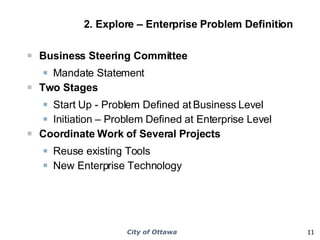
2. Explore – Enterprise Problem Definition Business Steering Committee Mandate Statement Two Stages Start Up - Problem Defined at Business Level Initiation – Problem Defined at Enterprise Level Coordinate Work of Several Projects Reuse existing Tools New Enterprise Technology
Example: Reduce Reliance on Shared Network Folders Process and Technology Analysis Shared Network Folders not managing content as records Start-Up Stage No lifecycle management of data  Back ups – very lengthy  No reporting on growth of data Initiation Stage Pilot with Employee Services From 10 to 3 Shared Network Folders Enterprise Problem –  Shared Network Folders support undesirable client behaviour Solution Convert clients off shared network folders to existing ECM tools  Reduce use of shared network folders where cost effective Start Date: Jan 09
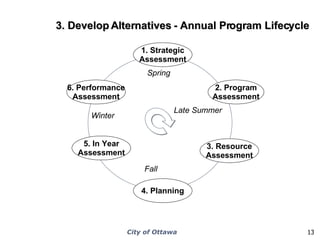
3. Develop Alternatives - Annual Program Lifecycle Spring Late Summer Fall Winter 2. Program Assessment 3. Resource Assessment 4. Planning 5. In Year Assessment 6. Performance Assessment 1. Strategic Assessment
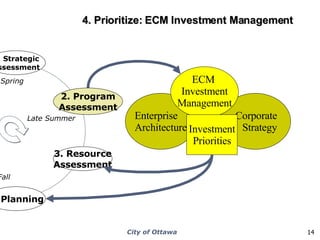
4. Prioritize: ECM Investment Management Investment Priorities Spring Late Summer Fall Winter 2. Program Assessment 3. Resource Assessment 4. Planning 5. In Year Assessment 6. Performance Assessment 1. Strategic Assessment Enterprise Architecture Corporate Strategy ECM  Investment Management
Example: 2009 IM Investment Plan 2009 Corporate Portfolio Priorities Improved Search Engines eDM Operations Reliance on Shared Drives Collaboration Services Email Archiving Scanning Services 2009 Client Portfolio Priorities Directors & Managers Building Code Services Drinking Water Services Public Health Services Public Works Services
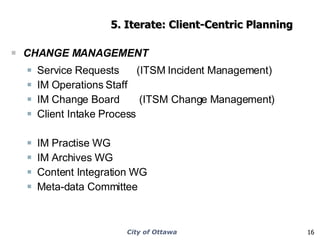
5. Iterate: Client-Centric Planning CHANGE MANAGEMENT Service Requests  (ITSM Incident Management) IM Operations Staff IM Change Board  (ITSM Change Management) Client Intake Process IM Practise WG IM Archives WG Content Integration WG Meta-data Committee
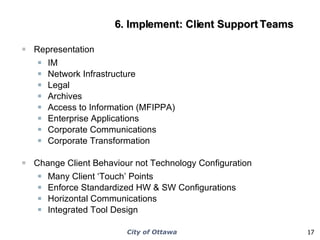
6. Implement: Client Support Teams Representation IM Network Infrastructure Legal Archives Access to Information (MFIPPA) Enterprise Applications Corporate Communications Corporate Transformation Change Client Behaviour not Technology Configuration Many Client ‘Touch’ Points Enforce Standardized HW & SW Configurations Horizontal Communications Integrated Tool Design
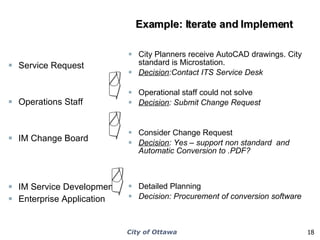
Example: Iterate and Implement Service Request  Operations Staff IM Change Board  IM Service Development Enterprise Application City Planners receive AutoCAD drawings. City standard is Microstation.  Decision :Contact ITS Service Desk   Operational staff could not solve Decision : Submit Change Request  Consider Change Request Decision : Yes – support non standard  and Automatic Conversion to .PDF?  Detailed Planning Decision: Procurement of conversion software
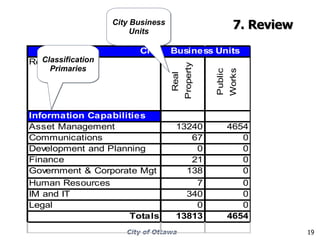
7. Review City Business Units Classification Primaries
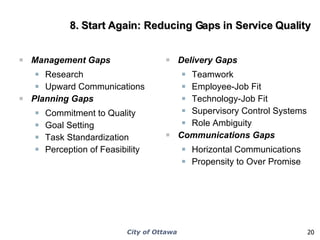
8. Start Again: Reducing Gaps in Service Quality   Delivery Gaps Teamwork Employee-Job Fit Technology-Job Fit Supervisory Control Systems Role Ambiguity Communications Gaps Horizontal Communications Propensity to Over Promise Management Gaps Research  Upward Communications Planning Gaps Commitment to Quality Goal Setting Task Standardization Perception of Feasibility
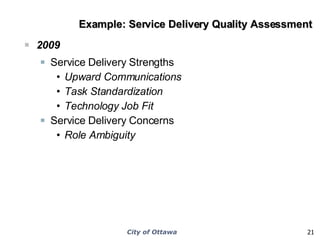
Example: Service Delivery Quality Assessment 2009  Service Delivery Strengths Upward Communications  Task Standardization Technology Job Fit Service Delivery Concerns Role Ambiguity
ECM Service Support An Integrated Body of Knowledge
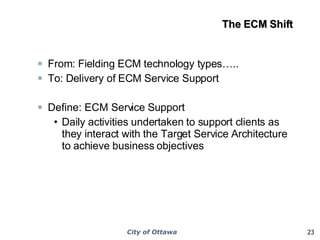
The ECM Shift From: Fielding ECM technology types…..  To: Delivery of ECM Service Support Define: ECM Service Support Daily activities undertaken to support clients as they interact with the Target Service Architecture to achieve business objectives
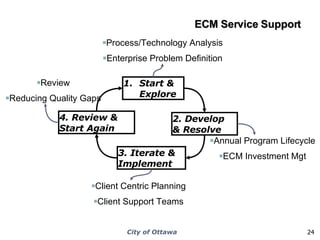
ECM Service Support Start & Explore 4. Review & Start Again 2. Develop  & Resolve 3. Iterate & Implement Process/Technology Analysis Enterprise Problem Definition Annual Program Lifecycle ECM Investment Mgt Client Centric Planning Client Support Teams Review Reducing Quality Gaps
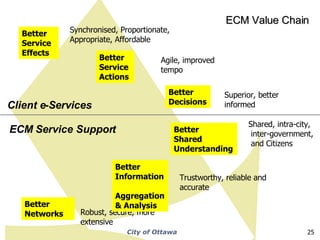
ECM Value Chain Client e-Services ECM Service Support Better Service Effects Synchronised, Proportionate, Appropriate, Affordable Better Service Actions Agile, improved tempo Better Decisions Superior, better informed Better Networks Robust, secure, more extensive Better  Information  Aggregation & Analysis Trustworthy, reliable and accurate Better  Shared  Understanding Shared, intra-city, inter-government, and Citizens
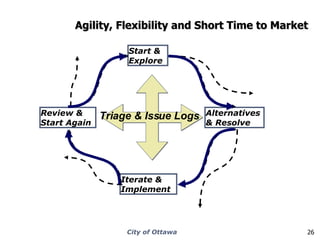
Agility, Flexibility and Short Time to Market   Start &  Explore Review & Start Again Alternatives & Resolve Iterate & Implement Triage & Issue Logs
CONCLUSION Strategic Message:  To render an ECM strategy operational, information managers must create a persistent pattern of behaviour through which ECM service staff can support clients to achieve business objectives
Stephen Murray Manager Information Management City of Ottawa 613-580-2424 Ext 15222 [email_address] Brenda Kallio Program Manager IM Program Development City of Ottawa 613-580-2424 Ext 28485 [email_address] Questions?

Rendering Enterprise Content Management Strategies Operational

  • 1.
    Case Study -City of Ottawa Rendering Enterprise Content Management Strategies Operational Stephen Murray: Manager, Information Management Brenda Kallio: Program Manager, IM Program Development
  • 2.
    Outline of CaseStudy Purpose: To provide an overview of the concepts that the City has used to implement its ECM strategy ECM Landscape The Shift - The City’s Change in ECM The Driver - Service Delivery Transformation The Goal - ECM Target Service Architecture Strategic Message Achieving the Goal - Eight Simplifying Concepts An Integrate Body of Knowledge - ECM Service Support Conclusion From a Records Management Perspective
  • 3.
    ECM LANDSCAPE TheShift The Driver And The Goal
  • 4.
    The Shift 2001Amalgamation – 12 Former Cities to One 9000 Computer Clients 2002-2004 – Records Foundation Classification System and Retention Policy One Physical Records Tracking System 60 Day Email Auto Delete 2005-2008 – ECM WCM, eDRMs, Collaboration Beyond 2008 – A Multi-Year Shift Support Client’s use of e-Content For Service Delivery Transformation
  • 5.
    Driver: Service DeliveryTransformation New & Ongoing Activities Align Processes and Technology to Vision Engaged and Creative Problem Solving Service Delivery Options Support Transparency Innovate New Business Strategies New Tools & Strategies for Potential Savings Increase Employee Engagement Report Progress
  • 6.
    Goal: ECM TargetService Architecture Objective: Fully Supported Horizontal and Distributed Information Processing Infrastructure Five Components Information Sharing Services Information Technology Services Information Lifecycle Services Find and Retrieve Services Review Services
  • 7.
    ECM Target ServiceArchitecture Consumer Contributor No Review Services Participation, Wikis, Blogs Retention Mgt Records Mgt WCM Microsoft Office Personal Drives Repository Document Mgt Search Engine Processes BI Tools Email Information Sharing Services Disposition Services Authoring Services Declaration Services Publish Services Version & Approval Services Yes Find & Retrieval Services
  • 8.
    A Question Canclients use Target Service Architecture to transform their businesses - or is it all too much? Who thinks that Government Workers Understand the scope of ECM? 75% do not understand ECM in terms of IM Have time to formulate necessary business processes? 75% Enterprise Business Process projects unsuccessful Are ready to transform their services using ECM tools? 75% of ECM projects not driven by Business Service Managers
  • 9.
    Eight Support ConceptsAchieving the Goal
  • 10.
    1. Start – Process and Technology Analysis Analysis Assure trustworthy, reliable & accurate e-content Checklist Factors Process to Create User Accounts Meta Data and Legislation System Specific Training Software Reliability & Alterations System Backup & Disaster Recovery Follow-on Action Stating Retention Requirements Integrated Technology Changes in Business Processes
  • 11.
    2. Explore –Enterprise Problem Definition Business Steering Committee Mandate Statement Two Stages Start Up - Problem Defined at Business Level Initiation – Problem Defined at Enterprise Level Coordinate Work of Several Projects Reuse existing Tools New Enterprise Technology
  • 12.
    Example: Reduce Relianceon Shared Network Folders Process and Technology Analysis Shared Network Folders not managing content as records Start-Up Stage No lifecycle management of data Back ups – very lengthy No reporting on growth of data Initiation Stage Pilot with Employee Services From 10 to 3 Shared Network Folders Enterprise Problem – Shared Network Folders support undesirable client behaviour Solution Convert clients off shared network folders to existing ECM tools Reduce use of shared network folders where cost effective Start Date: Jan 09
  • 13.
    3. Develop Alternatives- Annual Program Lifecycle Spring Late Summer Fall Winter 2. Program Assessment 3. Resource Assessment 4. Planning 5. In Year Assessment 6. Performance Assessment 1. Strategic Assessment
  • 14.
    4. Prioritize: ECMInvestment Management Investment Priorities Spring Late Summer Fall Winter 2. Program Assessment 3. Resource Assessment 4. Planning 5. In Year Assessment 6. Performance Assessment 1. Strategic Assessment Enterprise Architecture Corporate Strategy ECM Investment Management
  • 15.
    Example: 2009 IMInvestment Plan 2009 Corporate Portfolio Priorities Improved Search Engines eDM Operations Reliance on Shared Drives Collaboration Services Email Archiving Scanning Services 2009 Client Portfolio Priorities Directors & Managers Building Code Services Drinking Water Services Public Health Services Public Works Services
  • 16.
    5. Iterate: Client-CentricPlanning CHANGE MANAGEMENT Service Requests (ITSM Incident Management) IM Operations Staff IM Change Board (ITSM Change Management) Client Intake Process IM Practise WG IM Archives WG Content Integration WG Meta-data Committee
  • 17.
    6. Implement: ClientSupport Teams Representation IM Network Infrastructure Legal Archives Access to Information (MFIPPA) Enterprise Applications Corporate Communications Corporate Transformation Change Client Behaviour not Technology Configuration Many Client ‘Touch’ Points Enforce Standardized HW & SW Configurations Horizontal Communications Integrated Tool Design
  • 18.
    Example: Iterate andImplement Service Request Operations Staff IM Change Board IM Service Development Enterprise Application City Planners receive AutoCAD drawings. City standard is Microstation. Decision :Contact ITS Service Desk Operational staff could not solve Decision : Submit Change Request Consider Change Request Decision : Yes – support non standard and Automatic Conversion to .PDF? Detailed Planning Decision: Procurement of conversion software
  • 19.
    7. Review CityBusiness Units Classification Primaries
  • 20.
    8. Start Again:Reducing Gaps in Service Quality Delivery Gaps Teamwork Employee-Job Fit Technology-Job Fit Supervisory Control Systems Role Ambiguity Communications Gaps Horizontal Communications Propensity to Over Promise Management Gaps Research Upward Communications Planning Gaps Commitment to Quality Goal Setting Task Standardization Perception of Feasibility
  • 21.
    Example: Service DeliveryQuality Assessment 2009 Service Delivery Strengths Upward Communications Task Standardization Technology Job Fit Service Delivery Concerns Role Ambiguity
  • 22.
    ECM Service SupportAn Integrated Body of Knowledge
  • 23.
    The ECM ShiftFrom: Fielding ECM technology types….. To: Delivery of ECM Service Support Define: ECM Service Support Daily activities undertaken to support clients as they interact with the Target Service Architecture to achieve business objectives
  • 24.
    ECM Service SupportStart & Explore 4. Review & Start Again 2. Develop & Resolve 3. Iterate & Implement Process/Technology Analysis Enterprise Problem Definition Annual Program Lifecycle ECM Investment Mgt Client Centric Planning Client Support Teams Review Reducing Quality Gaps
  • 25.
    ECM Value ChainClient e-Services ECM Service Support Better Service Effects Synchronised, Proportionate, Appropriate, Affordable Better Service Actions Agile, improved tempo Better Decisions Superior, better informed Better Networks Robust, secure, more extensive Better Information Aggregation & Analysis Trustworthy, reliable and accurate Better Shared Understanding Shared, intra-city, inter-government, and Citizens
  • 26.
    Agility, Flexibility andShort Time to Market Start & Explore Review & Start Again Alternatives & Resolve Iterate & Implement Triage & Issue Logs
  • 27.
    CONCLUSION Strategic Message: To render an ECM strategy operational, information managers must create a persistent pattern of behaviour through which ECM service staff can support clients to achieve business objectives
  • 28.
    Stephen Murray ManagerInformation Management City of Ottawa 613-580-2424 Ext 15222 [email_address] Brenda Kallio Program Manager IM Program Development City of Ottawa 613-580-2424 Ext 28485 [email_address] Questions?