Clouds that work for your businessBSM for Cloud Computing
Current IT ChallengesIT cannot respond flexibly to business needsIT services exceed cost targetsBusiness turns to external providers outside IT’s controlService levels, compliance, cost and risk are difficult to balance
Cloud Computing BenefitsFlexibility to respond rapidly to business needsCost optimization through shared infrastructure utilizationFinancial transparency and increased business value and responsivenessConsistent, reliable service quality
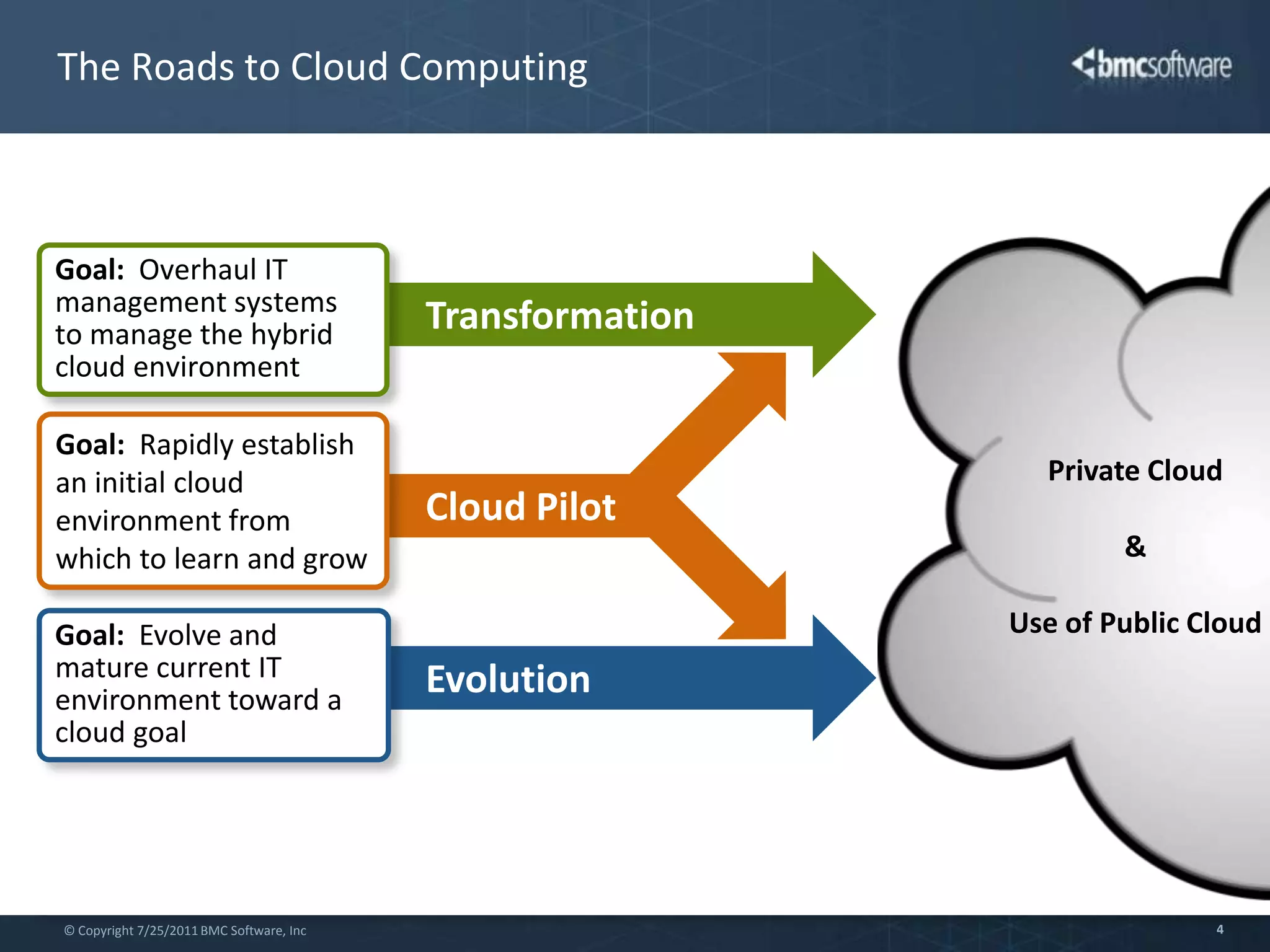
The Roads to Cloud ComputingGoal:  Overhaul IT management systems to manage the hybrid cloud environmentTransformationGoal:  Rapidly establish an initial cloud environment from which to learn and growPrivate Cloud&Use of Public CloudCloud PilotGoal:  Evolve and mature current IT environment toward a cloud goalEvolution
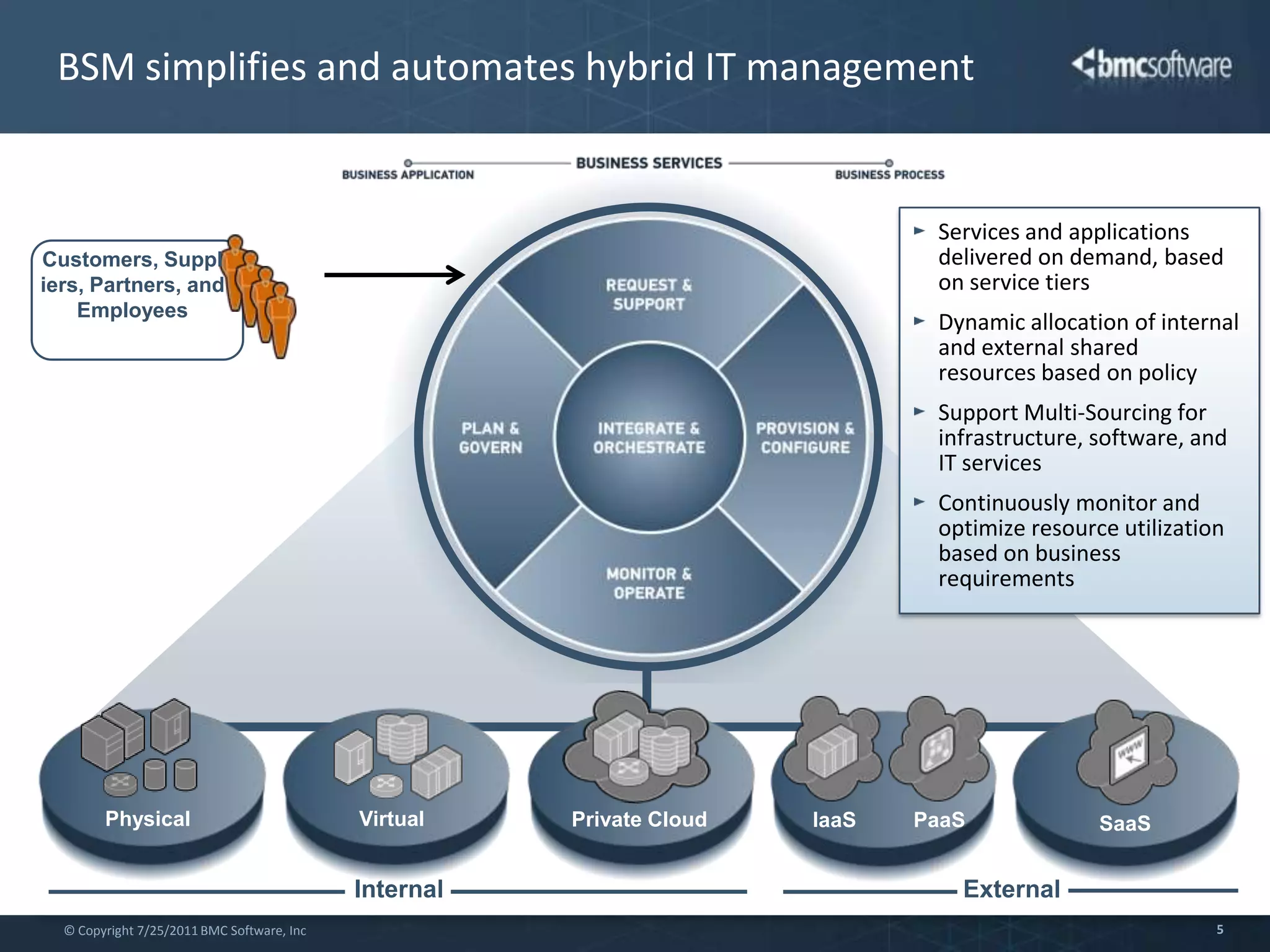
BSM simplifies and automates hybrid IT managementServices and applications delivered on demand, based on service tiersDynamic allocation of internal and external shared resources based on policySupport Multi-Sourcing for infrastructure, software, and IT servicesContinuously monitor and optimize resource utilization based on business requirementsCustomers, Suppliers, Partners, and EmployeesInternalExternalPhysicalVirtualPrivate CloudIaaSPaaSSaaS
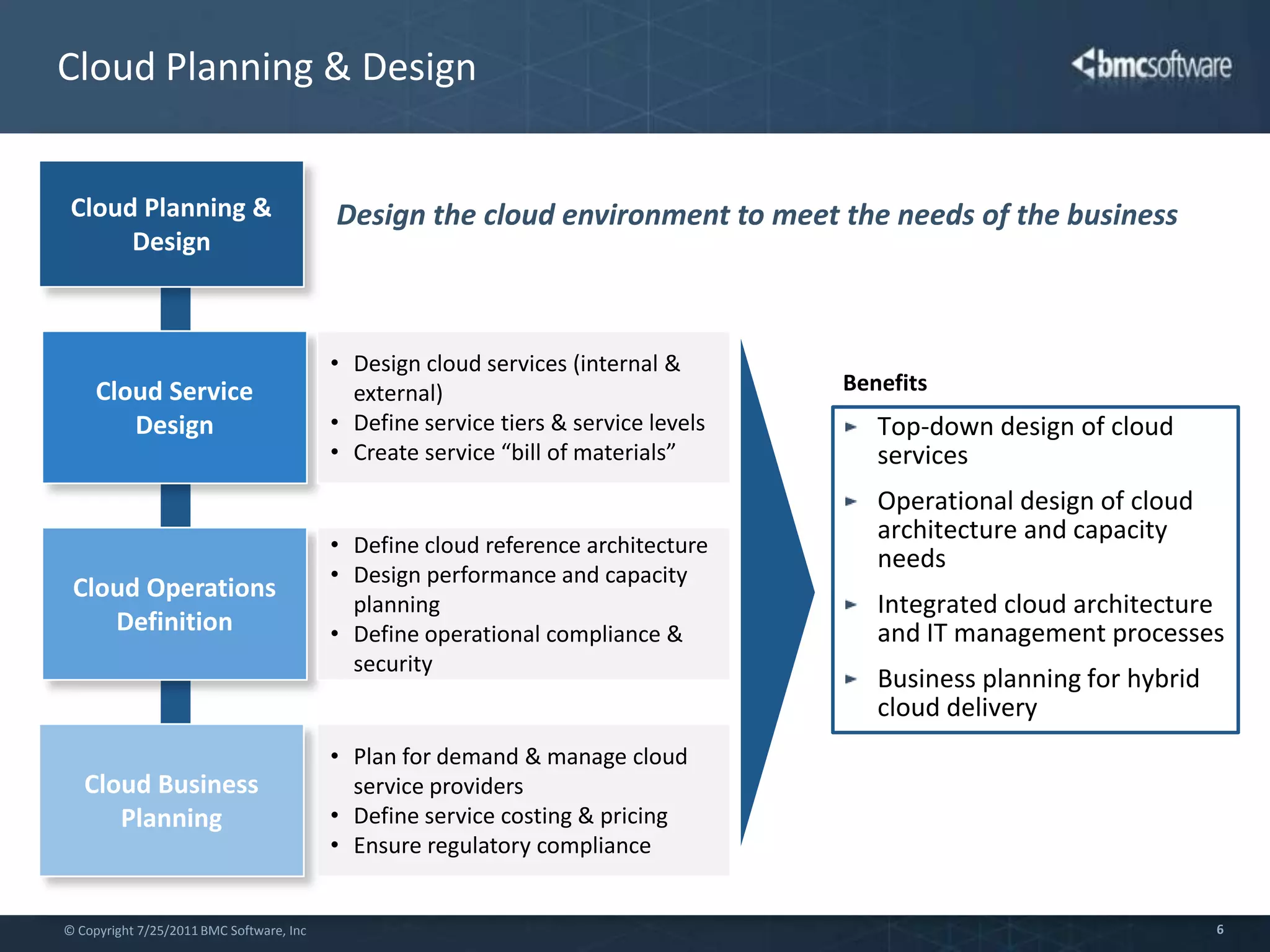
Cloud Planning & DesignCloud Planning & DesignDesign the cloud environment to meet the needs of the businessCloud Service DesignDesign cloud services (internal & external)
Define service tiers & service levels
Create service “bill of materials”BenefitsTop-down design of cloud servicesOperational design of cloud architecture and capacity needsIntegrated cloud architecture and IT management processesBusiness planning for hybrid cloud deliveryCloud Operations DefinitionDefine cloud reference architecture
Design performance and capacity planning
Define operational compliance &  security
Plan for demand & manage cloud service providers
Define service costing & pricing
Ensure regulatory complianceCloud Business Planning
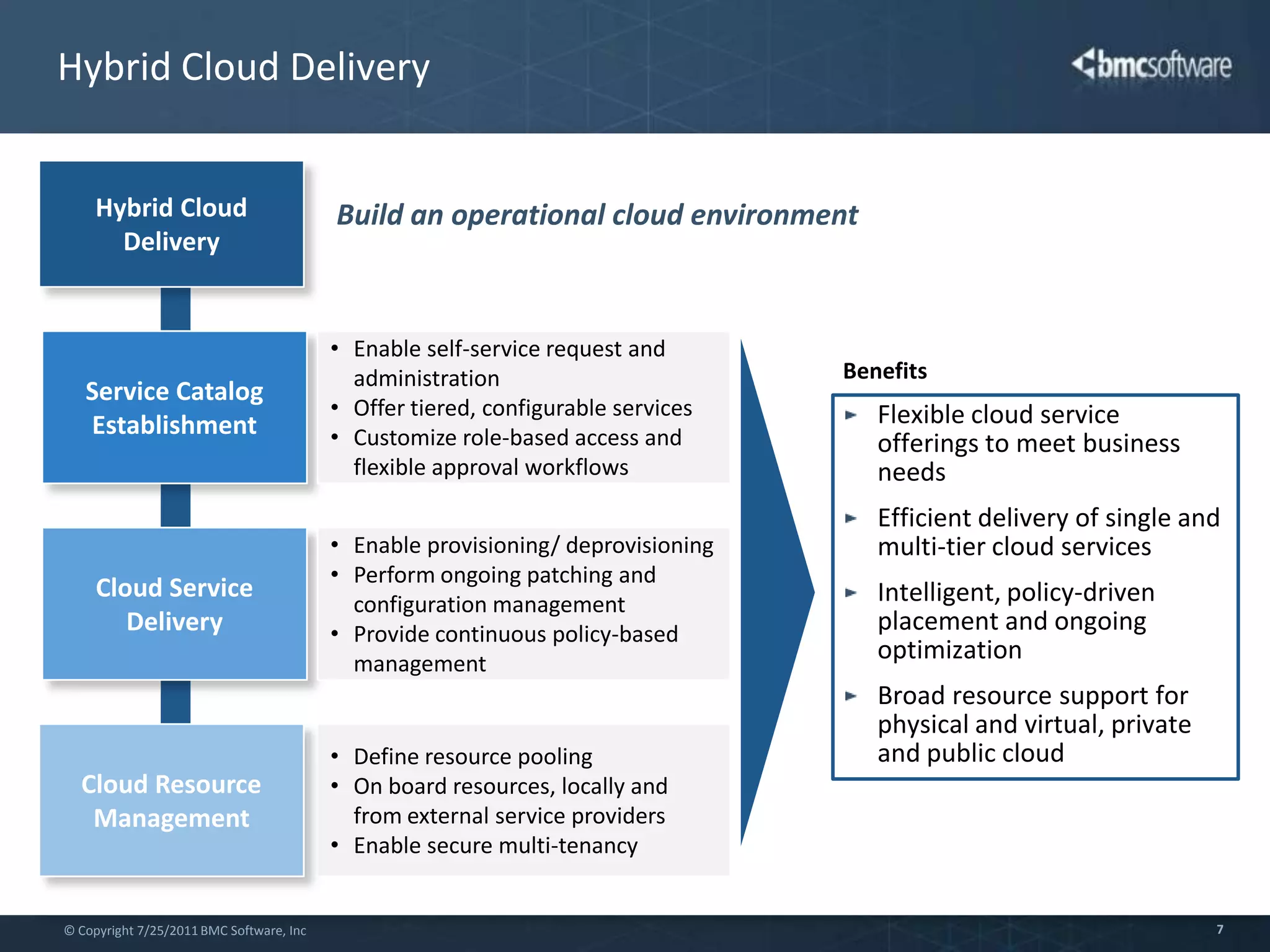
Hybrid Cloud DeliveryHybrid Cloud DeliveryBuild an operational cloud environmentService Catalog EstablishmentEnable self-service request and administration
Offer tiered, configurable services
Customize role-based access and flexible approval workflowsBenefitsFlexible cloud service offerings to meet business needsEfficient delivery of single and multi-tier cloud servicesIntelligent, policy-driven placement and ongoing optimizationBroad resource support for physical and virtual, private and public cloudCloud Service DeliveryEnable provisioning/ deprovisioning
Perform ongoing patching and configuration management
Provide continuous policy-based management

BSM for Cloud Computing

  • 1.
    Clouds that workfor your businessBSM for Cloud Computing
  • 2.
    Current IT ChallengesITcannot respond flexibly to business needsIT services exceed cost targetsBusiness turns to external providers outside IT’s controlService levels, compliance, cost and risk are difficult to balance
  • 3.
    Cloud Computing BenefitsFlexibilityto respond rapidly to business needsCost optimization through shared infrastructure utilizationFinancial transparency and increased business value and responsivenessConsistent, reliable service quality
  • 4.
    The Roads toCloud ComputingGoal: Overhaul IT management systems to manage the hybrid cloud environmentTransformationGoal: Rapidly establish an initial cloud environment from which to learn and growPrivate Cloud&Use of Public CloudCloud PilotGoal: Evolve and mature current IT environment toward a cloud goalEvolution
  • 5.
    BSM simplifies andautomates hybrid IT managementServices and applications delivered on demand, based on service tiersDynamic allocation of internal and external shared resources based on policySupport Multi-Sourcing for infrastructure, software, and IT servicesContinuously monitor and optimize resource utilization based on business requirementsCustomers, Suppliers, Partners, and EmployeesInternalExternalPhysicalVirtualPrivate CloudIaaSPaaSSaaS
  • 6.
    Cloud Planning &DesignCloud Planning & DesignDesign the cloud environment to meet the needs of the businessCloud Service DesignDesign cloud services (internal & external)
  • 7.
    Define service tiers& service levels
  • 8.
    Create service “billof materials”BenefitsTop-down design of cloud servicesOperational design of cloud architecture and capacity needsIntegrated cloud architecture and IT management processesBusiness planning for hybrid cloud deliveryCloud Operations DefinitionDefine cloud reference architecture
  • 9.
    Design performance andcapacity planning
  • 10.
  • 11.
    Plan for demand& manage cloud service providers
  • 12.
  • 13.
  • 14.
    Hybrid Cloud DeliveryHybridCloud DeliveryBuild an operational cloud environmentService Catalog EstablishmentEnable self-service request and administration
  • 15.
  • 16.
    Customize role-based accessand flexible approval workflowsBenefitsFlexible cloud service offerings to meet business needsEfficient delivery of single and multi-tier cloud servicesIntelligent, policy-driven placement and ongoing optimizationBroad resource support for physical and virtual, private and public cloudCloud Service DeliveryEnable provisioning/ deprovisioning
  • 17.
    Perform ongoing patchingand configuration management
  • 18.
  • 19.
  • 20.
    On board resources,locally and from external service providers
  • 21.
  • 22.
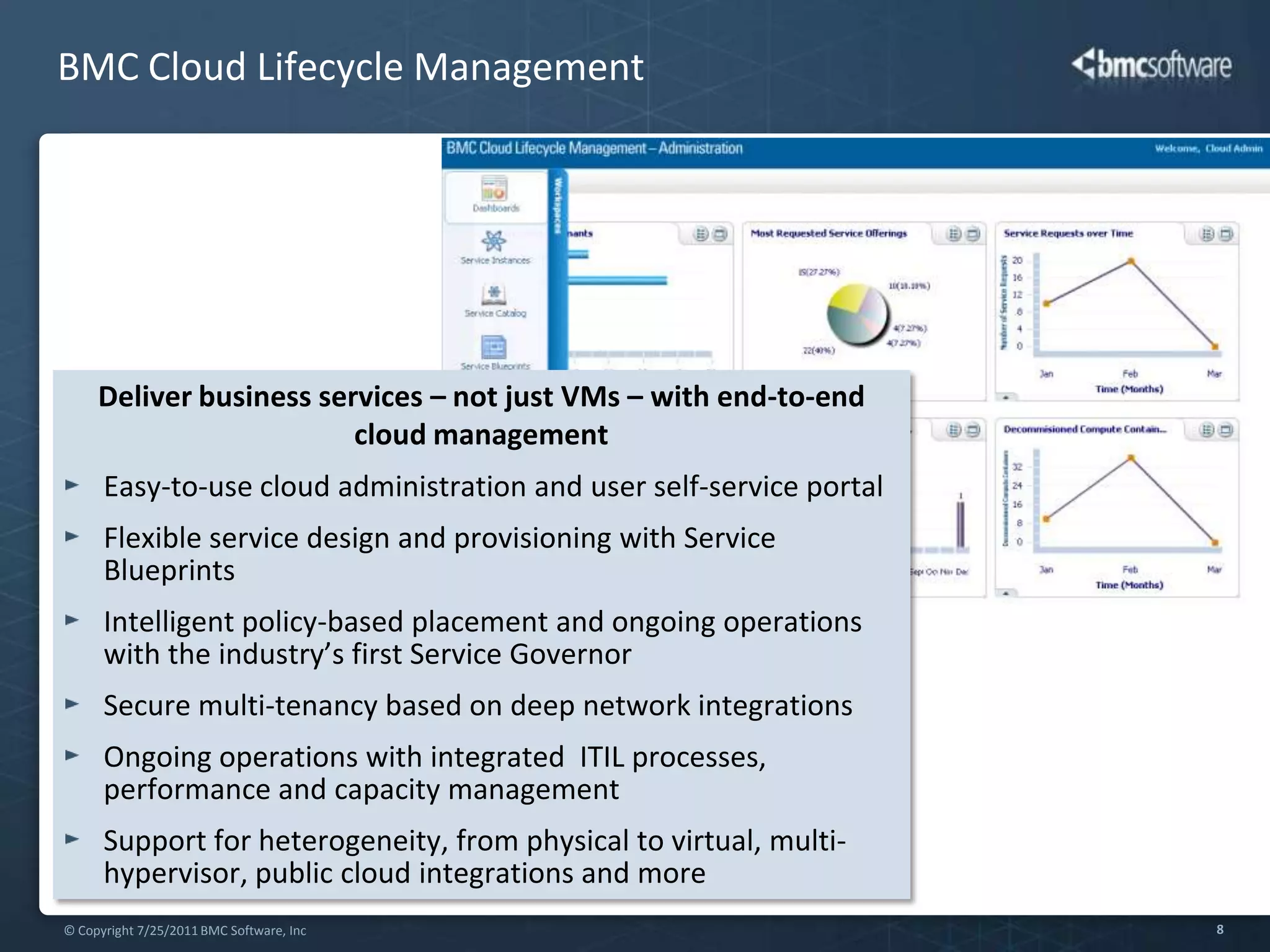
    BMC Cloud LifecycleManagementDeliver business services – not just VMs – with end-to-end cloud managementEasy-to-use cloud administration and user self-service portalFlexible service design and provisioning with Service BlueprintsIntelligent policy-based placement and ongoing operations with the industry’s first Service GovernorSecure multi-tenancy based on deep network integrationsOngoing operations with integrated ITIL processes, performance and capacity management Support for heterogeneity, from physical to virtual, multi-hypervisor, public cloud integrations and more
  • 23.
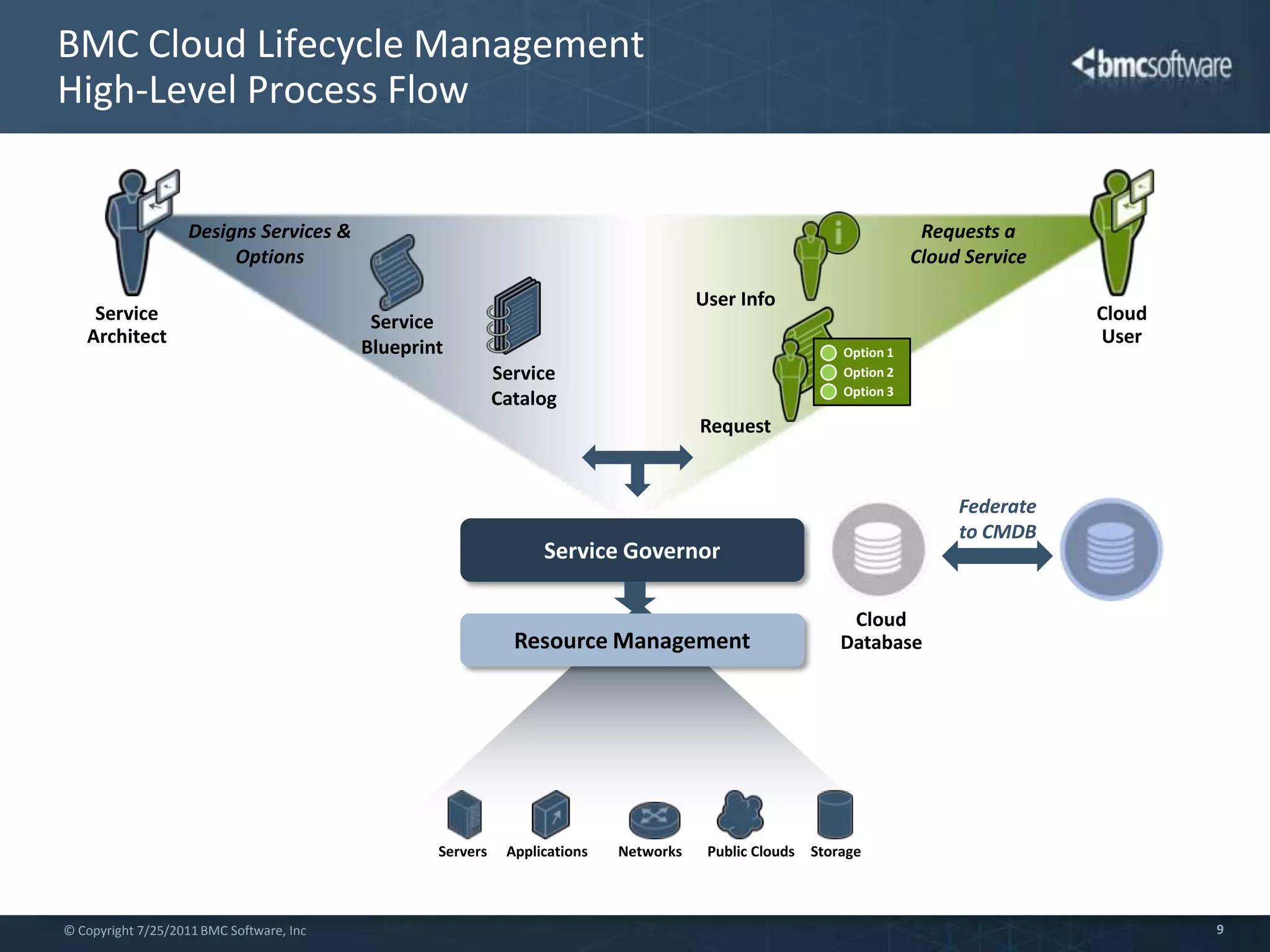
    BMC Cloud LifecycleManagementHigh-Level Process FlowDesigns Services & OptionsRequests aCloud ServiceUser InfoServiceArchitectCloudUserService BlueprintService CatalogRequestFederateto CMDBService GovernorCloudDatabaseResource ManagementOption 1Option 2ServersNetworksStorageApplicationsPublic CloudsOption 3
  • 24.
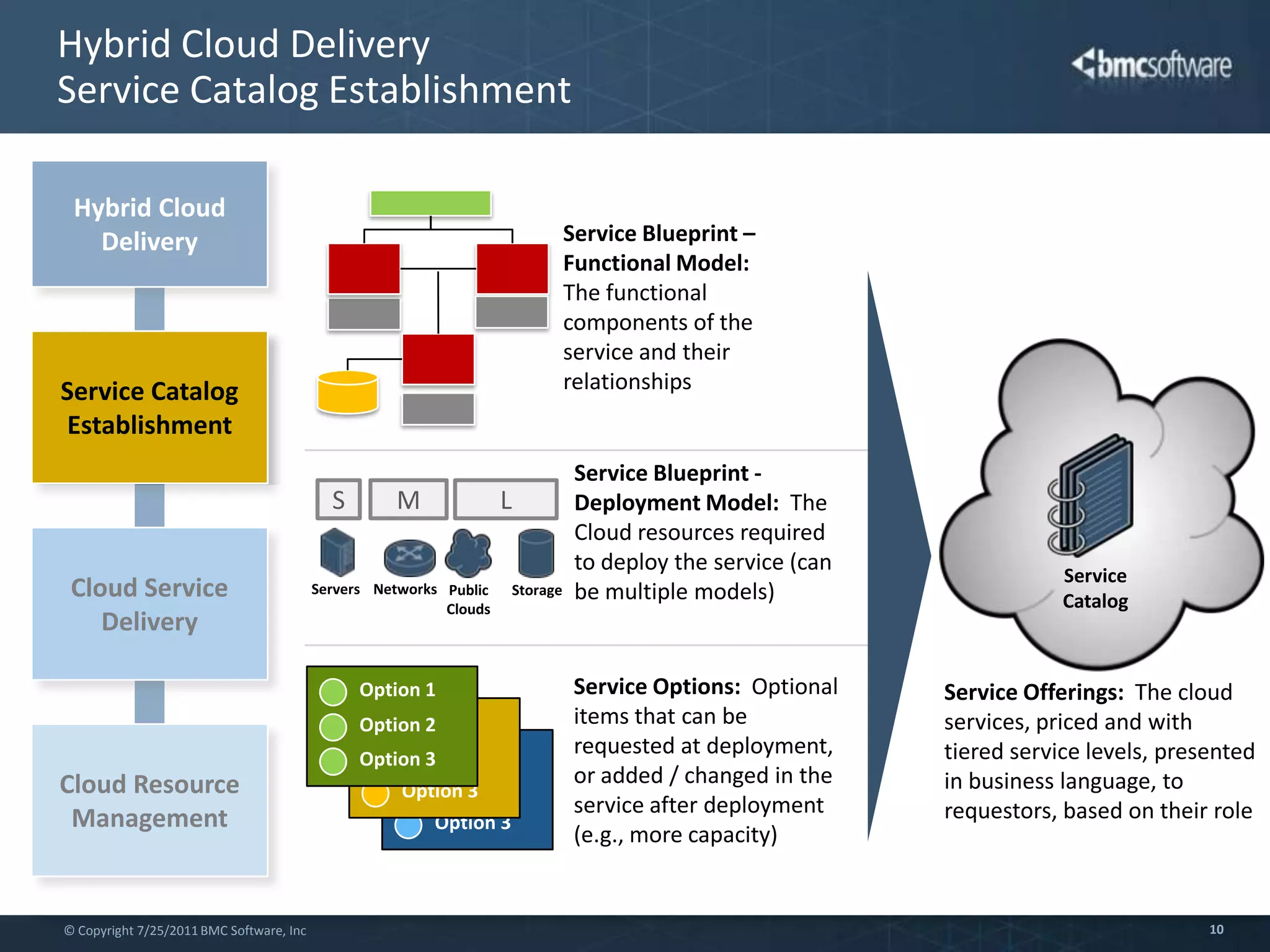
    Hybrid Cloud DeliveryServiceCatalog EstablishmentHybrid Cloud DeliveryService Blueprint – Functional Model: The functional components of the service and their relationshipsService Catalog EstablishmentService Blueprint - Deployment Model: The Cloud resources required to deploy the service (can be multiple models)SMLCloud Service DeliveryService CatalogServersNetworksStoragePublic CloudsService Options: Optional items that can be requested at deployment, or added / changed in the service after deployment (e.g., more capacity)Service Offerings: The cloud services, priced and with tiered service levels, presented in business language, to requestors, based on their roleOption 1Option 1Option 1Option 2Option 2Option 2Cloud Resource ManagementOption 3Option 3Option 3
  • 25.
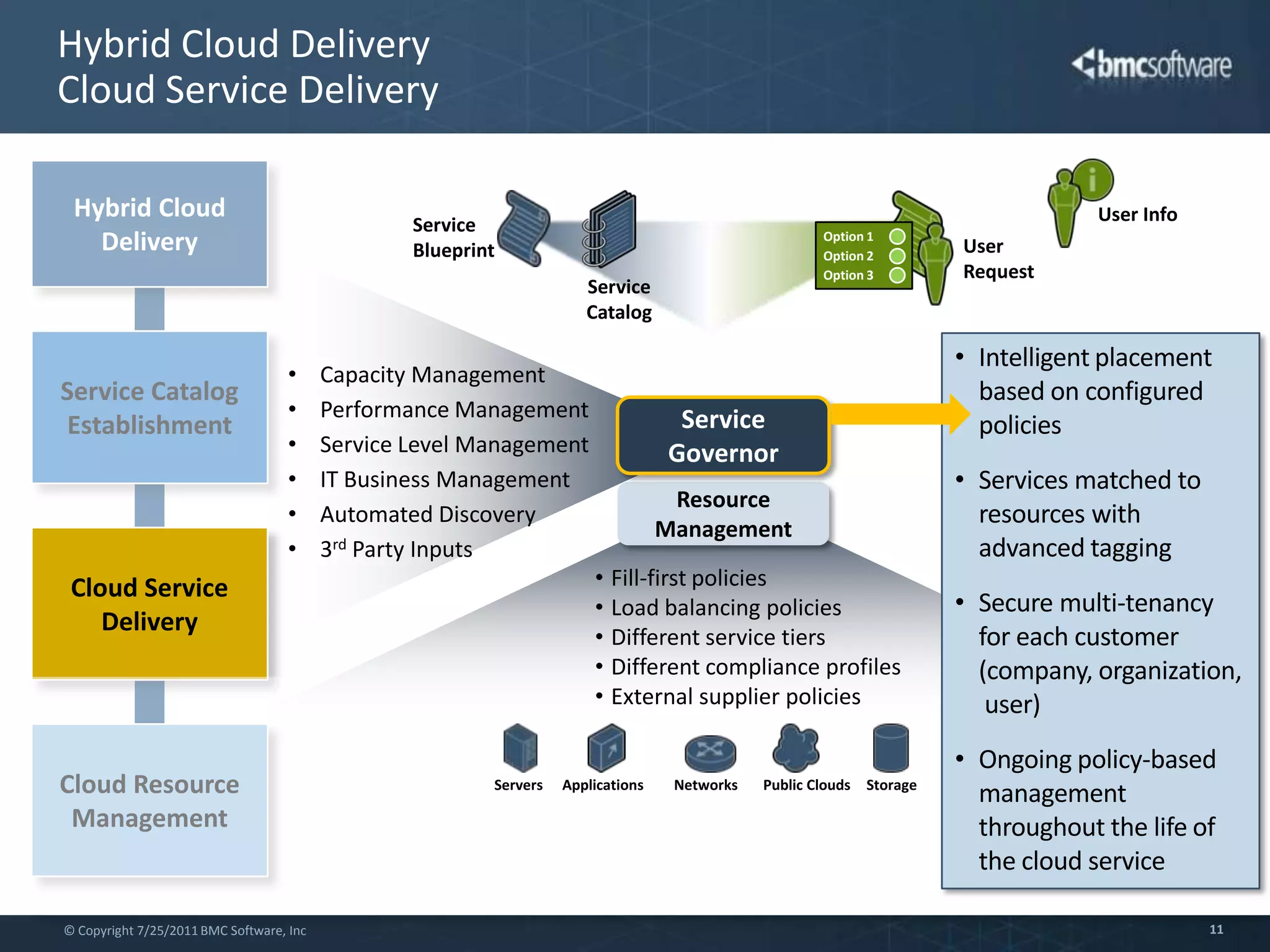
    Hybrid Cloud DeliveryCloudService DeliveryHybrid Cloud DeliveryService BlueprintUser InfoUserRequestService CatalogService Catalog EstablishmentIntelligent placement based on configured policies
  • 26.
    Services matched toresources with advanced tagging
  • 27.
    Secure multi-tenancy foreach customer (company, organization, user)
  • 28.
    Ongoing policy-based managementthroughout the life of the cloud service
  • 29.
  • 30.
  • 31.
  • 32.
  • 33.
  • 34.
    3rd Party InputsServiceGovernorResourceManagementCloud Service DeliveryFill-first policies
  • 35.
  • 36.
  • 37.
  • 38.
    External supplier policiesOption1Option 2Cloud Resource ManagementServersNetworksStorageApplicationsPublic CloudsOption 3
  • 39.
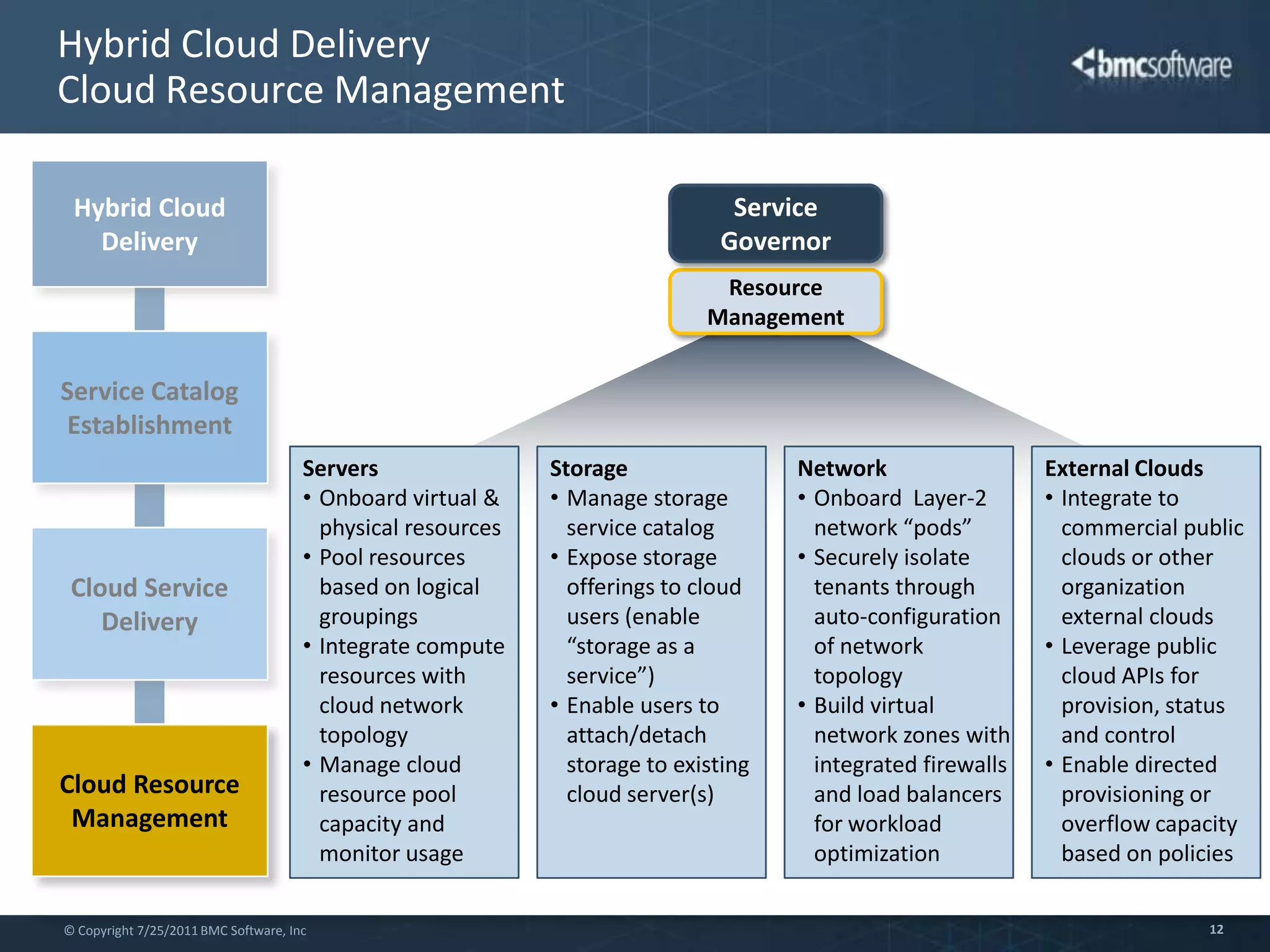
    Hybrid Cloud DeliveryCloudResource ManagementHybrid Cloud DeliveryServiceGovernorResource ManagementService Catalog EstablishmentServersOnboard virtual & physical resources
  • 40.
    Pool resources basedon logical groupings
  • 41.
    Integrate compute resourceswith cloud network topology
  • 42.
    Manage cloud resourcepool capacity and monitor usageNetworkOnboard Layer-2 network “pods”
  • 43.
    Securely isolate tenantsthrough auto-configuration of network topology
  • 44.
    Build virtual networkzones with integrated firewalls and load balancers for workload optimizationStorageManage storage service catalog
  • 45.
    Expose storage offeringsto cloud users (enable “storage as a service”)
  • 46.
    Enable users toattach/detach storage to existing cloud server(s)External CloudsIntegrate to commercial public clouds or other organization external clouds
  • 47.
    Leverage public cloudAPIs for provision, status and control
  • 48.
    Enable directed provisioningor overflow capacity based on policiesCloud Service DeliveryCloud Resource Management
  • 49.
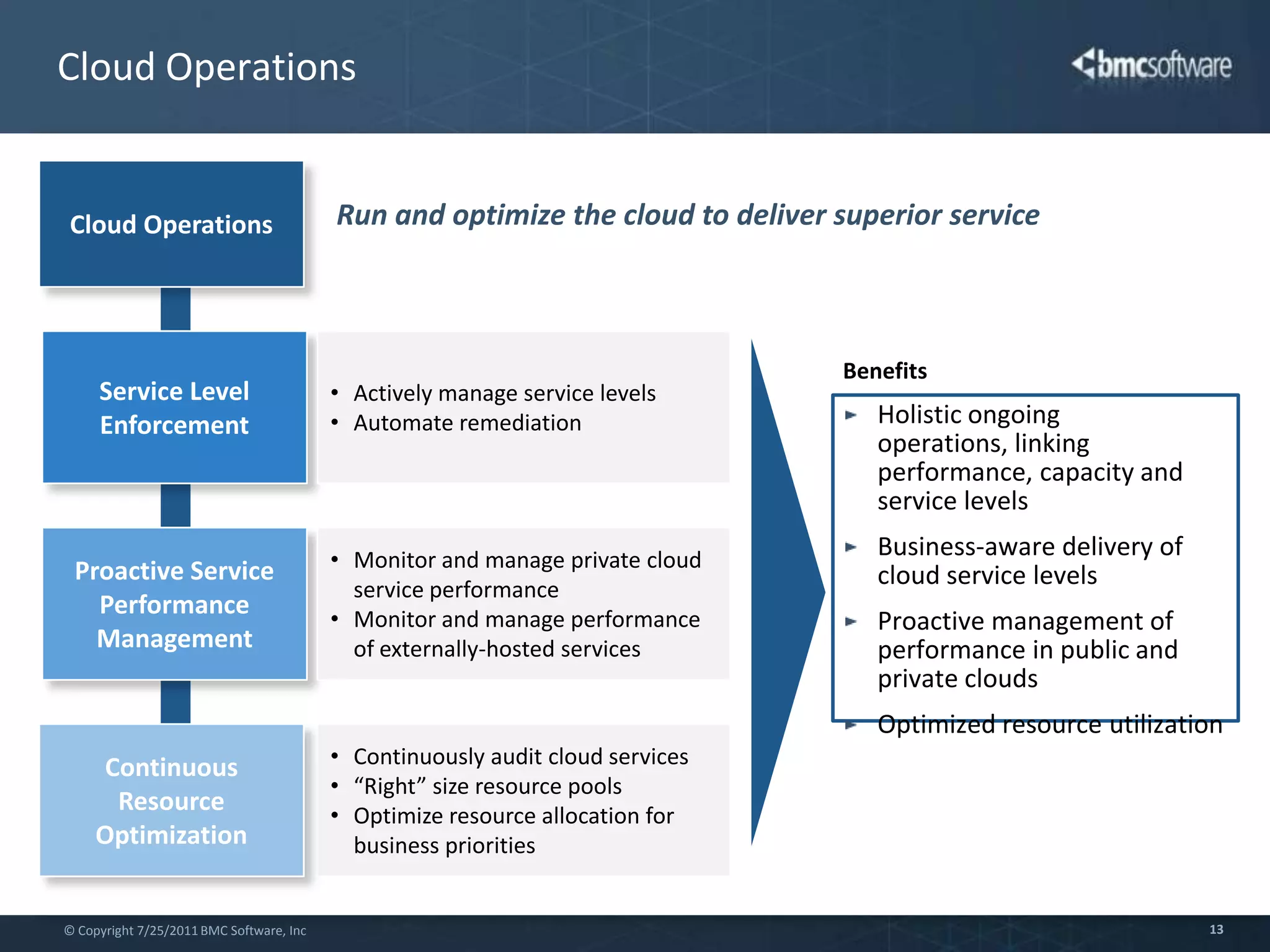
    Cloud OperationsCloud OperationsRunand optimize the cloud to deliver superior serviceService Level EnforcementActively manage service levels
  • 50.
    Automate remediationBenefitsHolistic ongoingoperations, linking performance, capacity and service levelsBusiness-aware delivery of cloud service levelsProactive management of performance in public and private cloudsOptimized resource utilizationProactive Service Performance ManagementMonitor and manage privatecloud service performance
  • 51.
    Monitor and manageperformance of externally-hosted services
  • 52.
  • 53.
  • 54.
    Optimize resource allocationfor business prioritiesContinuous Resource Optimization
  • 55.
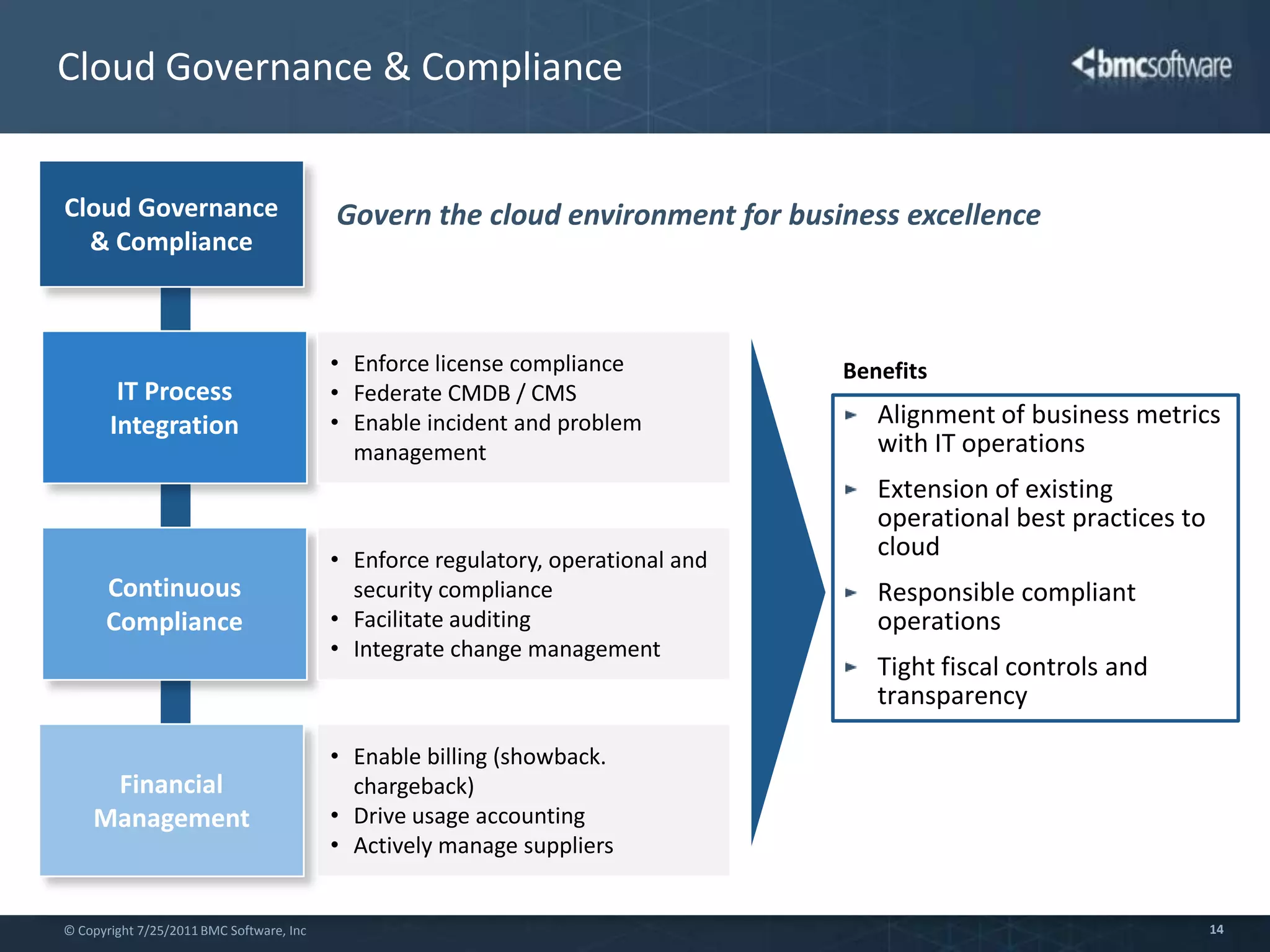
    Cloud Governance &ComplianceCloud Governance & ComplianceGovern the cloud environment for business excellenceIT Process IntegrationEnforce license compliance
  • 56.
  • 57.
    Enable incident andproblem managementBenefitsAlignment of business metrics with IT operationsExtension of existing operational best practices to cloudResponsible compliant operationsTight fiscal controls and transparencyContinuous ComplianceEnforce regulatory, operational and security compliance
  • 58.
  • 59.
  • 60.
  • 61.
  • 62.
  • 63.
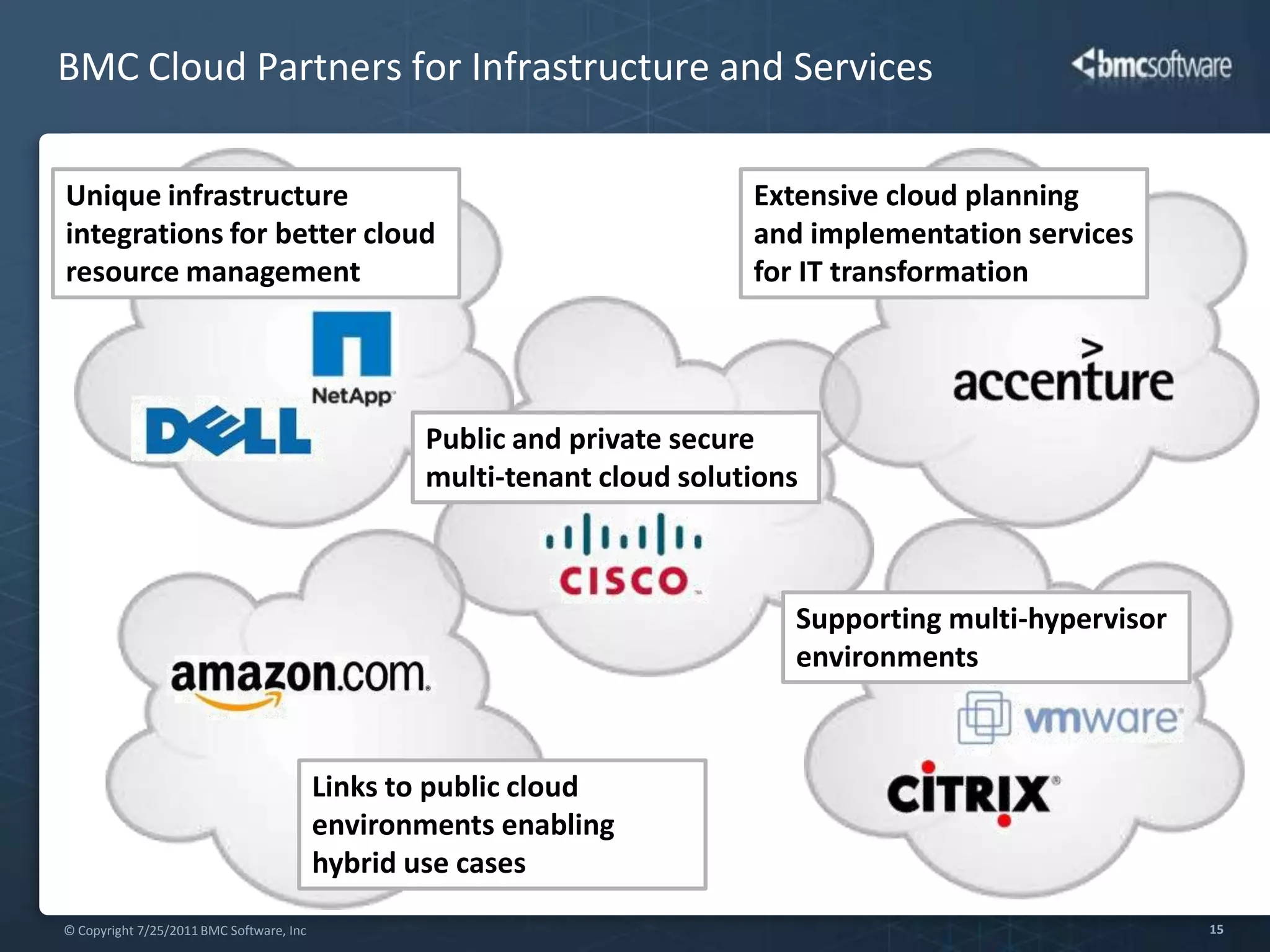
    BMC Cloud Partnersfor Infrastructure and ServicesUnique infrastructure integrations for better cloud resource managementExtensive cloud planning and implementation services for IT transformationPublic and private secure multi-tenant cloud solutionsSupporting multi-hypervisor environmentsLinks to public cloud environments enabling hybrid use cases
  • 64.
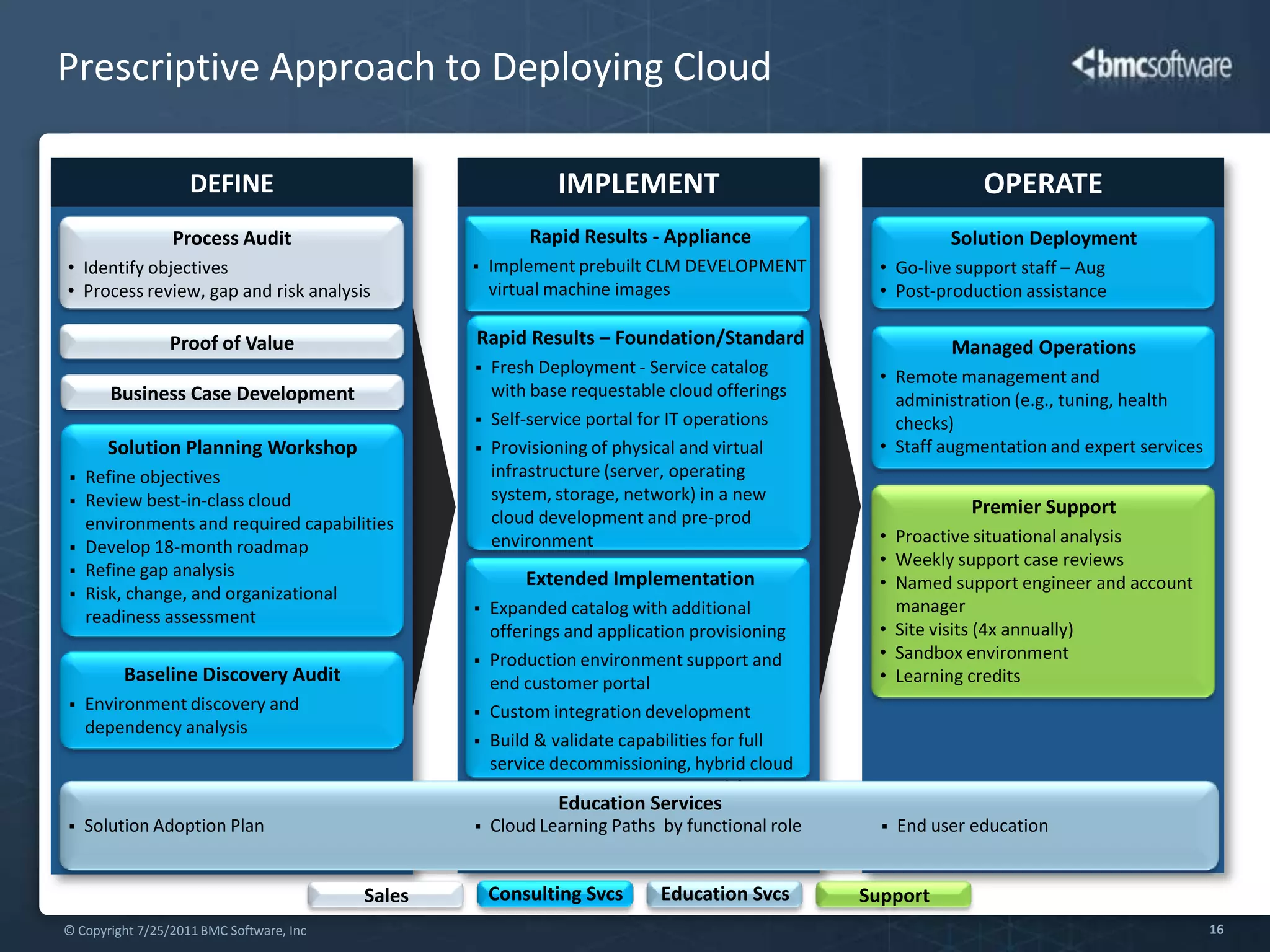
    DEFINEIMPLEMENTOPERATEPrescriptive Approach toDeploying CloudProcess AuditIdentify objectives
  • 65.
    Process review, gapand risk analysisSolution DeploymentGo-live support staff – Aug
  • 66.
    Post-production assistanceRapid Results- ApplianceImplement prebuilt CLM DEVELOPMENT virtual machine imagesRapid Results – Foundation/StandardFresh Deployment - Service catalog with base requestable cloud offerings
  • 67.
  • 68.
    Provisioning of physicaland virtual infrastructure (server, operating system, storage, network) in a new cloud development and pre-prod environmentProof of ValueManaged OperationsRemote management and administration (e.g., tuning, health checks)
  • 69.
    Staff augmentation andexpert servicesBusiness Case DevelopmentSolution Planning WorkshopRefine objectives
  • 70.
    Review best-in-class cloudenvironments and required capabilities
  • 71.
  • 72.
  • 73.
    Risk, change, andorganizational readiness assessmentPremier SupportProactive situational analysis
  • 74.
  • 75.
    Named support engineerand account manager
  • 76.
  • 77.
  • 78.
    Learning creditsExtended ImplementationExpandedcatalog with additional offerings and application provisioning
  • 79.
    Production environment supportand end customer portal
  • 80.
  • 81.
    Build & validatecapabilities for full service decommissioning, hybrid cloud operations, and integration with ITSM, CMDB, billing & chargeback solutionsBaseline Discovery AuditEnvironment discovery and dependency analysisEducation ServicesSolution Adoption Plan
  • 82.
    Cloud Learning Paths by functional role
  • 83.
    End user educationSalesConsultingSvcsEducation SvcsSupport
  • 84.
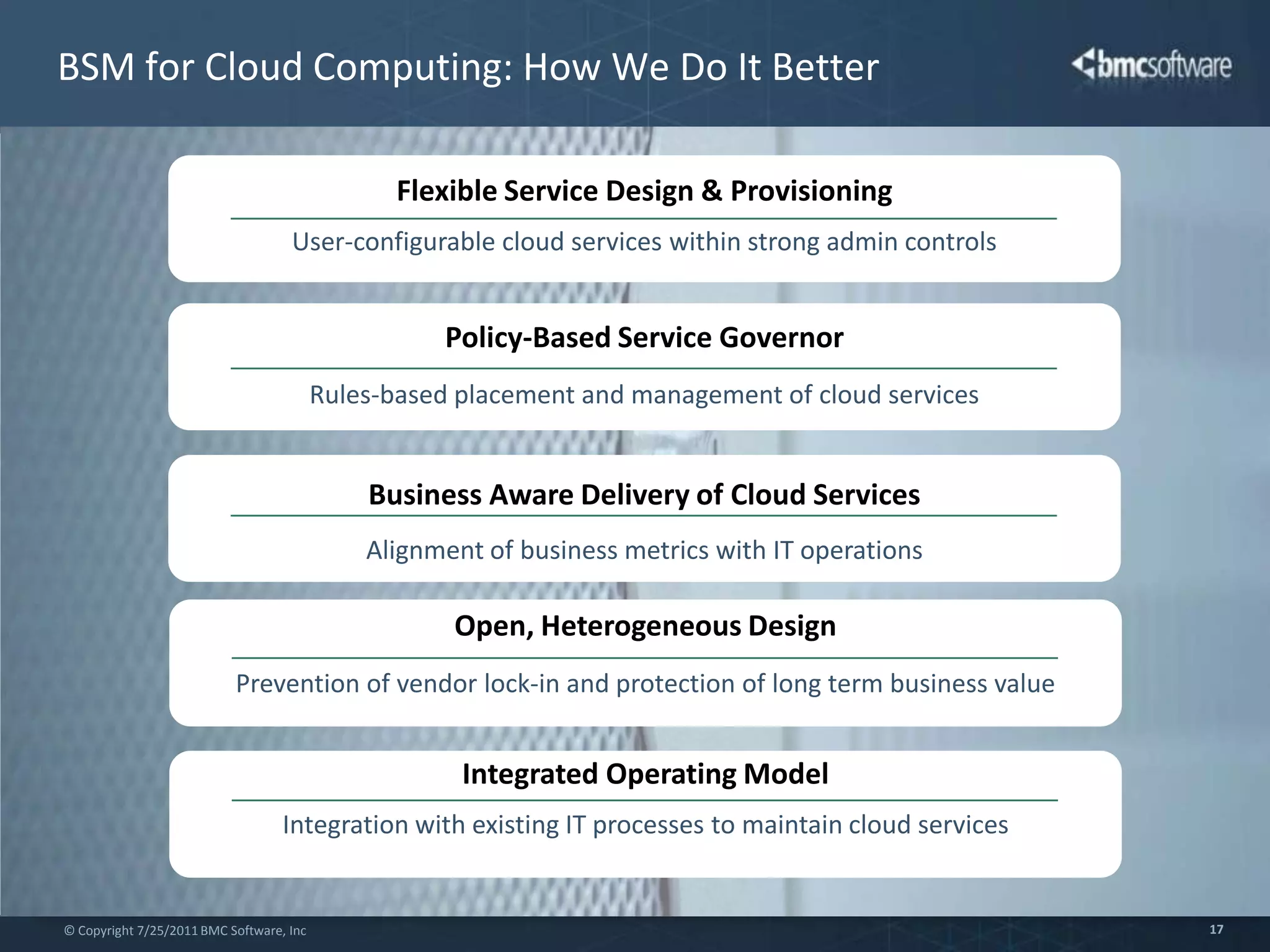
    BSM for CloudComputing: How We Do It BetterIntegrated Operating ModelOpen, Heterogeneous DesignFlexible Service Design & ProvisioningPolicy-Based Service GovernorIntegration with existing IT processes to maintain cloud servicesPrevention of vendor lock-in and protection of long term business valueUser-configurable cloud services within strong admin controlsRules-based placement and management of cloud servicesBusiness Aware Delivery of Cloud ServicesAlignment of business metrics with IT operations

Editor's Notes

  • #3 The cloud mandate seeks to address a set of key challenges that IT faces. While Cloud Computing promises to address these challenges, how you get a feeling for IT and business impacts prior to implementing cloud service delivery mechanisms is the purpose of this simulation exercise.First, it is clear that IT needs to become significantly more responsive to the needs of the business, provisioning services in minutes or hours, rather than days and weeks. Second, the quality of the service delivery is often gated by the physical infrastructure upon which a service is hosted. A more flexible environment would enable more resources to be applied to certain services, as appropriate. Third, the increasing prevalence of public cloud alternatives is highlighting the high cost of internal IT services. Many businesses are circumventing IT surreptitiously by provisioning public cloud resources outside the traditional IT process. As a result, at a minimum, IT needs to begin lowering its cost structure – and the first step to that is a better use of resources- both physical and human.Finally, the need for increasingly diligent and sophisticated financial transparency is further growing due to the dynamic virtualization and cloud environment. NOTE: Case Study Metrics: Macquarie Telecom- Cut provisioning time and effort by 50%Federal Agency- Reduce time to provision from nearly 10 weeks to 1 day Anticipated reclamation of 20% of resources that are currently unused Anticipated capacity planning savings in excess of 300K annuallyEdmunds.com-Reduced provisioning time on 95 servers from 3 months to 2 daysDoubled Server:Admin ratio from 60:1 to 120:1
  • #4 NOTE: Case Study Metrics: Macquarie Telecom- Cut provisioning time and effort by 50%Federal Agency- Reduce time to provision from nearly 10 weeks to 1 day Anticipated reclamation of 20% of resources that are currently unused Anticipated capacity planning savings in excess of 300K annuallyEdmunds.com-Reduced provisioning time on 95 servers from 3 months to 2 daysDoubled Server:Admin ratio from 60:1 to 120:1
  • #5 Transformation is an aggressive approach to migrate existing and new services to cloud computing. It involves the entire IT environment and requires comprehensive, rapid shifts in how services are delivered. Typically this approach is characterized by implementation of a new service delivery platform architecture along with associated new design services. This may be a greenfield opportunity or an enterprise that has committed to gain financial and other business advantages as quickly as possible.A Cloud Pilot approach can deal with specific pain points an enterprise may need to address quickly in isolation. This is also an opportunity to implement in parallel to gain experience before selecting applications to migrate to a cloud style of service delivery in full production. In some cases these may be the only use cases for cloud services an enterprise may have. Single department examples may includes dev & test and sales [e.g., salesforce.com, hr services, etc.]. Single applications may be project oriented, such as scientific calculations that are used periodically or occasionally with high peak resource demands for short periods of time. Mature and stable services may not be candidates for migration in any event. Provides flexibility to IT organizations.Evolving IT organizations taking a holistic approach to cloud computing can take advantage of comprehensive solutions and roadmap planning/adoption services to reach a well-defined structure for delivering a wide range of services using appropriate methods for each service. Here, Cloud Computing is both a delivery and an organizational transformation objective to which a roadmap is developed to fit the specific enterprise business and IT management position on a cloud maturity curve. This approach is ideal for managing steps of improvement for virtualization, automation, operations, service and business management on the way to reaching an optimized Cloud Computing service delivery environment.
  • #7 Self Explanatory
  • #8 Self Explanatory
  • #9 Describe the BMC CLM solution – introducing the major features. We’ll step into each in turn. If the customer has existing BMC technologies, this would be a good time to highlight the role of those solutions in this cloud environment.If not, this is a time to emphasize that this is an integrated, end to end solution
  • #10 Walk through as follows:The administrator (little blue man) designs a set of services as Service Blueprints from within an admin portalThe service blueprint is translated into a Service Offering in the Service Catalog. That offering is in business/user terms – not technical descriptionsUsers – the little green man – are exposed to the Service Offerings through their own self-service portal. They complete a service request – which can involve configuring the cloud service according to parameters offered in the designWith the Service Blueprint, which defines the service, the user’s request and configuration, and information about the user themselves, the Service Governor provisions and places the cloud service. This placement takes into account a complex range of factors and, leveraging configurable policies, makes both the initial placement decision and ongoing management choices for the cloud service.The cloud service is also mapped to the central CMDB, as one must maintain a central source of truth in the environmentFinally, to actually gartner the resources, the Service Governor calls the resource management layer, which acts as an interface to all underlying cloud resources, including external public cloud services
  • #11 Explain that BMC has a construct called a Service Blueprint… explain that:The initial component is a functional description of the service. Multi-tier, or single-tier. Physical or virtual. All the components.The second piece is the deployment model. There can be a one-to-many relationship between functional models and deployment models, so the same functional service description can be deployed small, medium, large, horizontally scalable, and so on.The third piece is a set of service options – a set of configurable choices pertaining to the service, which can be chosen by the user. Together, you have an outline for a service offering presented to the user in business language. The benefit of this construct is that a single functional description can drive a multitude of different cloud services. If this level of user choice and flexibility were executed with traditional template techniques, administrators would find themselves managing hundreds, if not thousands, of permutations of cloud services. Every time a patch has to happen, each one has to be maintained and updated. The administrative overhead would be astounding.
  • #12 Next, tough on the challenges of service delivery in the service governor. From the top, information on the service request, including user information and service blueprint. To the left, a set of inputs that can drive the decisions of the policy engine. From the bottom, a set of rules governing the use of resources. The service governor takes all these inputs and performs the actions in the blue box, in an automated, configurable, policy-based way.
  • #13 This slide is meant to cover the importance of broad support of a range of underlying platforms. Ensure you highlight the support of multiple hypervisors, as part of the “infrastructure”, as well as our plans to broaden the range of supported platforms. Highlight, if your customer is interested, the ability to tap into public cloud resources as well. BMC supports this heterogeneity with an open API to which additional providers can write adaptors.
  • #14 Self Explanatory
  • #15 Self Explanatory
  • #16 BMC has a commitment to heterogeneity which is exposed through its portfolio of partners and role in the ecosystem:Dell and Netapp represent a few of the strong partnerships we have with infrastructure providers. Underneath the cloud lie storage, server and network resources, and BMC supports choice on the part of the customer.Similarly, VMware and Citrix are strong infrastructure partners. We work with both to provide choice in the hypervisor layer of the infrastructure. Cisco represents a partnership in which both firms have invested a great deal, going to market together and integrating solutions for unique differentiation, like secure multi-tenant environments.Amazon – and many other cloud providers represent a different type of infrastructure openness – to public cloud resources. BMC has open APIs to support the provisioning of public cloud resources from many providers. BMC works strongly with Accenture to deliver cloud solutions to our customers. Accenture helps organizations with the organizational side of the transformation to cloud computing – as well as the technology implementation.
  • #17 Slide ObjectivesEngage the customer in a conversation about how BMC can help them be successful with their Cloud Computing initiative with a specific focus on the Cloud Lifecycle Management value pathDemonstrate that we have a proven and prescriptive approach to helping customers define, implement, run and manage a Cloud Lifecycle Management solution in as little as 4 monthsSample ScriptAs the market leader in providing Business Service Management solutions, BMC has developed a proven and prescriptive approach for helping our customers increase the success rate and speed the Duration-to-value for their Cloud Computing initiatives. With BMC, you will stand up a complete Cloud Lifecycle Management solution (across product, consulting, education, and support) in as little as four months or less.First, we will help you to define and set up your project for success. This starts with a process audit, where we will work with you to identify and document the project objectives, complete a current infrastructure assessment of your physical and virtual environments along with your core processes for requesting, approving, and provisioning new server builds and environments. We will then prove the value of the solution (via in-depth or custom demonstration, customer references, EBC visit, proof-of-concept, or a combination of these). Following this, we will lead a Solution Planning Workshop (typically 1 to 3 weeks in length) where we will refine objectives, review best practices for creating cloud environments, help you develop an 18-month roadmap for your initiative, refine the gap analysis between your current and desired state, and also identify any risks, people and process changes, and assess your organizational readiness. We will also work with you to create a compelling and financially-sound business case to justify the investment in the initiative. And finally, BMC can further increase the success rate of your initiative by helping to develop a solution adoption plan, which will increase organizational awareness for the project and coming changes, and ensure an effective plan is put in place for enabling your project team and end users. This includes awareness campaigns, certifications, job aids, etc… all focused on ensuring user acceptance and adoption of the solution.In the next 90 days, we will work with your in-house team to implement the Cloud Lifecycle Management solution with two base requestable cloud computing offerings. For example, Deploy a Linux or Windows OS with network and storage from pre-allocated pools. Includes OS, configuration, patch, and audit. Deploy a virtual machine with guest OS. Includes instantiate a VM, copy a VM, and delete a VM; Modify a VM (CPU + RAM only) with back-up snapshot; Firewall configuration; and add VM to a load balancer.The solution also includes:A self-service request portal for IT operations useProvisioning of physical and virtual infrastructure (including servers, Windows or Linux OS, and storage and network resources in a new cloud development environment). Note: Pools of network and storage must be pre-defined and all resource allocations (network, storage, load balancer, firewall) performed at provisioning – no post-provisioning management of resources is in scopeDecommissioning of virtual infrastructure. Note: Network and storage resources must be manually added back to poolsBMC will also act as overall project manager, including helping you analyze and design the architecture and ensure implementation best practices are utilized. BMC can also support an extended implementation by expanding service catalog to meet your unique requirements with additional offerings, enable the solution to operate in a production environment, full service decommissioning (including removal of user access rights and active directory integration), hybrid cloud operations, and ITSM, billing, and chargeback integrations (along with any additional custom integration development). Finally, we’ll educate the project team on the new processes and tools, and transfer any knowledge required to ensure the project team can successfully administer and maintain the solution once in production. In the Run and Manage phase, BMC will help you to deploy the solution into your production environment and educate your end users on how to use the solution. We can also provide go-live and post-production assistance, premier support, measure the value realized against the original business case that was defined, and can also provide Managed Operations to help you with future upgrades, tuning, periodic health checks of the solution, staff augmentation and more.As you can see, BMC has a well-thought through approach for helping our customers with their Cloud Lifecycle Management solutions; an offering that goes well beyond simply installing and configuring the software solution to ensure a successful outcome of your project and tangible business value.  
  • #18 Highlight each one of these differentiators of our cloud solution in-turn, spending time on what the implications of each are to your customer:Flexible service offerings enable IT to offer the business precisely what they need. Reference the use cases the customer is seeking to support.Policy-based governance is about making intelligent placement decisions. This is the right way to automate a cloud environment, optimizing for more than what a human admin could ever do.Business awareness is about tops down approach to cloud. Not starting with the infrastructure – but starting with the business problem, and aligning your cloud design to meet those business needs.Open commitment to heterogeneity means you can build you cloud on whatever resources you have – or whichever make business sense over the long-termOngoing operations refers to the integrated support for day 2 operations – capacity management, performance management, compliance – everything that has to happen AFTER the provisioning is done. Also, to the extent relevant, integration with the customer’s existing ITIL processes.
  • #19 This slide is designed to be an opening or closing slide. This will allow the presenter to have a presentation cued up in slideshow mode without being on the title slide. The audience can take their seats, leave, or have open discussion with this slide up.