How Wireless Technology Changes the Way Government Works  Rob Currie, TELUS October 29, 2008
Agenda Technological Improvements Networks and Devices Mobility & Government: Today’s View Public Sector Drivers and Mobility Mobile Government – The Art of the Possible
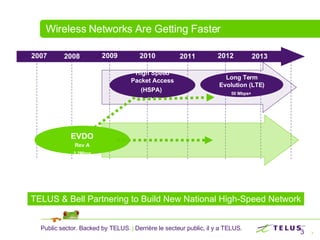
Wireless Networks Are Getting Faster 2007 2008 2009 2010 2011 2012 2013 Long Term Evolution (LTE) 50 Mbps+  High Speed Packet Access (HSPA)   7 – 30 Mbps EVDO Rev A 3.2Mbps TELUS & Bell Partnering to Build New National High-Speed Network
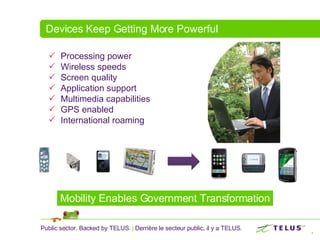
Processing power Wireless speeds Screen quality Application support Multimedia capabilities GPS enabled International roaming Devices Keep Getting More Powerful  Mobility Enables Government Transformation
Public Sector Adoption of Mobility Applications  N=[685,944] The Next Wave Government  Leads the Way
Next Wave Mobility Apps Address Government Drivers Citizen-Centric Service Delivery Optimizing Efficiency & Productivity Ensuring Safety & Security  Addressing the Demographic Challenge: Supporting Public Sector Renewal
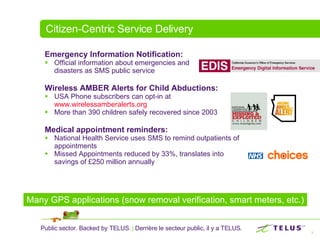
Citizen-Centric Service Delivery Emergency Information Notification: Official information about emergencies and  disasters as SMS public service Wireless AMBER Alerts for Child Abductions: USA Phone subscribers can opt-in at  www.wirelessamberalerts.org   More than 390 children safely recovered since 2003 Medical appointment reminders: National Health Service uses SMS to remind outpatients of appointments Missed Appointments reduced by 33%, translates into savings of  £250 million annually Many GPS applications (snow removal verification, smart meters, etc.)
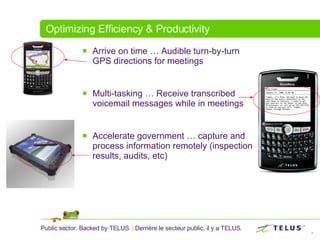
Optimizing Efficiency & Productivity Arrive on time … Audible turn-by-turn GPS directions for meetings Multi-tasking … Receive transcribed voicemail messages while in meetings Accelerate government … capture and process information remotely (inspection results, audits, etc)
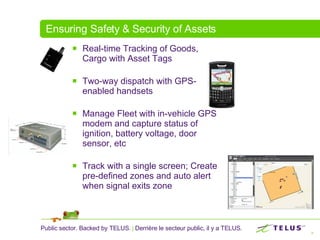
Ensuring Safety & Security of Assets Real-time Tracking of Goods, Cargo with Asset Tags Two-way dispatch with GPS-enabled handsets Manage Fleet with in-vehicle GPS modem and capture status of ignition, battery voltage, door sensor, etc Track with a single screen; Create pre-defined zones and auto alert when signal exits zone
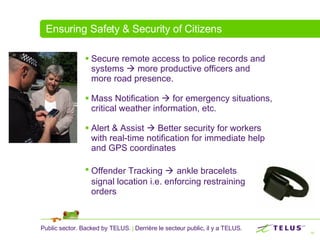
Ensuring Safety & Security of Citizens Secure remote access to police records and systems    more productive officers and more road presence.  Mass Notification    for emergency situations, critical weather information, etc. Alert & Assist    Better security for workers with real-time notification for immediate help and GPS coordinates Offender Tracking     ankle bracelets  signal location i.e. enforcing restraining  orders
Demographic Challenge: Supporting PS Renewal Planning Anytime/anywhere access to government planning information Recruitment Mobile enablement attracts Millennials Development/Retention Provide additional flexibility for employees through work-life balance, mobile tools for knowledge workers Enabling Infrastructure eTools, secure anywhere/anytime access to information, empower managers and execs to manage remotely, virtual teams
Mobile Government “The Art of the Possible”
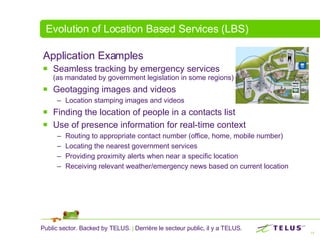
Evolution of Location Based Services (LBS) Application Examples Seamless tracking by emergency services  (as mandated by government legislation in some regions) Geotagging images and videos Location stamping images and videos  Finding the location of people in a contacts list  Use of presence information for real-time context Routing to appropriate contact number (office, home, mobile number) Locating the nearest government services  Providing proximity alerts when near a specific location Receiving relevant weather/emergency news based on current location
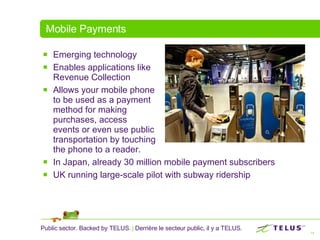
Mobile Payments Emerging technology Enables applications like  Revenue Collection  Allows your mobile phone to be used as a payment  method for making  purchases, access  events or even use public  transportation by touching  the phone to a reader.  In Japan, already 30 million mobile payment subscribers  UK running large-scale pilot with subway ridership
Key Points - Summary Mobility is already widely deployed for mission-critical applications and solutions Wireless technology is making departments more efficient and productive New capabilities like GPS tracking are introducing new ways of managing your assets effectively Mobility is Transformational to Government Service Delivery
Questions ? [email_address] Thank You

Wireless Technology Changes The Way Government Works

  • 1.
    How Wireless TechnologyChanges the Way Government Works Rob Currie, TELUS October 29, 2008
  • 2.
    Agenda Technological ImprovementsNetworks and Devices Mobility & Government: Today’s View Public Sector Drivers and Mobility Mobile Government – The Art of the Possible
  • 3.
    Wireless Networks AreGetting Faster 2007 2008 2009 2010 2011 2012 2013 Long Term Evolution (LTE) 50 Mbps+ High Speed Packet Access (HSPA) 7 – 30 Mbps EVDO Rev A 3.2Mbps TELUS & Bell Partnering to Build New National High-Speed Network
  • 4.
    Processing power Wirelessspeeds Screen quality Application support Multimedia capabilities GPS enabled International roaming Devices Keep Getting More Powerful Mobility Enables Government Transformation
  • 5.
    Public Sector Adoptionof Mobility Applications N=[685,944] The Next Wave Government Leads the Way
  • 6.
    Next Wave MobilityApps Address Government Drivers Citizen-Centric Service Delivery Optimizing Efficiency & Productivity Ensuring Safety & Security Addressing the Demographic Challenge: Supporting Public Sector Renewal
  • 7.
    Citizen-Centric Service DeliveryEmergency Information Notification: Official information about emergencies and disasters as SMS public service Wireless AMBER Alerts for Child Abductions: USA Phone subscribers can opt-in at www.wirelessamberalerts.org More than 390 children safely recovered since 2003 Medical appointment reminders: National Health Service uses SMS to remind outpatients of appointments Missed Appointments reduced by 33%, translates into savings of £250 million annually Many GPS applications (snow removal verification, smart meters, etc.)
  • 8.
    Optimizing Efficiency &Productivity Arrive on time … Audible turn-by-turn GPS directions for meetings Multi-tasking … Receive transcribed voicemail messages while in meetings Accelerate government … capture and process information remotely (inspection results, audits, etc)
  • 9.
    Ensuring Safety &Security of Assets Real-time Tracking of Goods, Cargo with Asset Tags Two-way dispatch with GPS-enabled handsets Manage Fleet with in-vehicle GPS modem and capture status of ignition, battery voltage, door sensor, etc Track with a single screen; Create pre-defined zones and auto alert when signal exits zone
  • 10.
    Ensuring Safety &Security of Citizens Secure remote access to police records and systems  more productive officers and more road presence. Mass Notification  for emergency situations, critical weather information, etc. Alert & Assist  Better security for workers with real-time notification for immediate help and GPS coordinates Offender Tracking  ankle bracelets signal location i.e. enforcing restraining orders
  • 11.
    Demographic Challenge: SupportingPS Renewal Planning Anytime/anywhere access to government planning information Recruitment Mobile enablement attracts Millennials Development/Retention Provide additional flexibility for employees through work-life balance, mobile tools for knowledge workers Enabling Infrastructure eTools, secure anywhere/anytime access to information, empower managers and execs to manage remotely, virtual teams
  • 12.
    Mobile Government “TheArt of the Possible”
  • 13.
    Evolution of LocationBased Services (LBS) Application Examples Seamless tracking by emergency services (as mandated by government legislation in some regions) Geotagging images and videos Location stamping images and videos Finding the location of people in a contacts list Use of presence information for real-time context Routing to appropriate contact number (office, home, mobile number) Locating the nearest government services Providing proximity alerts when near a specific location Receiving relevant weather/emergency news based on current location
  • 14.
    Mobile Payments Emergingtechnology Enables applications like Revenue Collection Allows your mobile phone to be used as a payment method for making purchases, access events or even use public transportation by touching the phone to a reader. In Japan, already 30 million mobile payment subscribers UK running large-scale pilot with subway ridership
  • 15.
    Key Points -Summary Mobility is already widely deployed for mission-critical applications and solutions Wireless technology is making departments more efficient and productive New capabilities like GPS tracking are introducing new ways of managing your assets effectively Mobility is Transformational to Government Service Delivery
  • 16.