RENAL FUNCTIONS &
GFR
Learning Objectives:
• Enumerate general functions of the kidney.
• Identify and describe that the nephron is the structural
and function unit of the kidney.
• Explain glomerular filtration membrane & filtration forces.
• Describe mechanism of filtration & composition of the
glomerular filtrate.
• Calculate the net filtration pressure using parameters of
Starling forces.
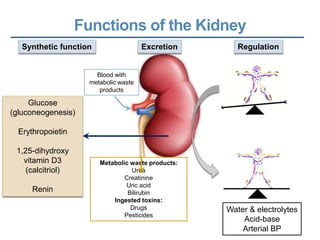
Functions of the Kidney
Blood with
metabolic waste
products
Water & electrolytes
Acid-base
Arterial BP
Regulation
Excretion
Synthetic function
Glucose
(gluconeogenesis)
Erythropoietin
1,25-dihydroxy
vitamin D3
(calcitriol)
Renin
Metabolic waste products:
Urea
Creatinine
Uric acid
Bilirubin
Ingested toxins:
Drugs
Pesticides
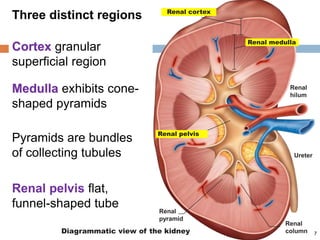
Diagrammatic view of the kidney
Three distinct regions
Cortex granular
superficial region
Medulla exhibits cone-
shaped pyramids
7
Pyramids are bundles
of collecting tubules
Renal cortex
Renal medulla
Renal pelvis
Ureter
Renal
column
Renal
pyramid
Renal
hilum
Renal pelvis flat,
funnel-shaped tube
What is the functional unit of the
kidney?
 The nephron is the functional and structural
unit of the kidney.
 Each kidney has 1 million nephrons, each
nephron is capable of urine formation.
Structure of a nephron
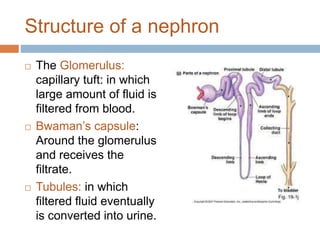
 The Glomerulus:
capillary tuft: in which
large amount of fluid is
filtered from blood.
 Bwaman’s capsule:
Around the glomerulus
and receives the
filtrate.
 Tubules: in which
filtered fluid eventually
is converted into urine.
Proximal
tubule cell
Efferent
arteriole
Afferent arteriole
Capsular
space
Renal corpuscle
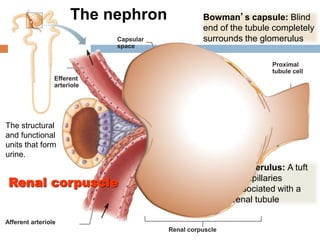
Bowman’s capsule: Blind
end of the tubule completely
surrounds the glomerulus
Glomerulus: A tuft
of capillaries
associated with a
renal tubule
Renal corpuscle
The structural
and functional
units that form
urine.
The nephron
Structure of a nephron, cont……
 The renal tubule is divided into different sections
with different structural and functional
characteristics:
 Proximal tubules ( in the cortex).
 Loop of Henle.
 Distal tubule (in the renal cortex).
 Connecting tubule, cortical collecting, and the
cortical collecting ducts, which run downward in
the medulla and become:
 Medullary collecting ducts.
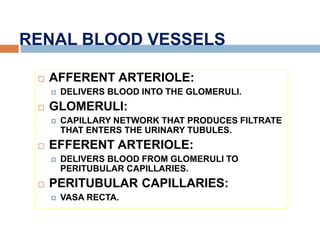
RENAL BLOOD VESSELS
 AFFERENT ARTERIOLE:
 DELIVERS BLOOD INTO THE GLOMERULI.
 GLOMERULI:
 CAPILLARY NETWORK THAT PRODUCES FILTRATE
THAT ENTERS THE URINARY TUBULES.
 EFFERENT ARTERIOLE:
 DELIVERS BLOOD FROM GLOMERULI TO
PERITUBULAR CAPILLARIES.
 PERITUBULAR CAPILLARIES:
 VASA RECTA.
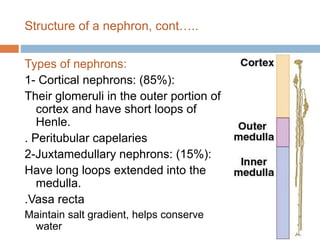
Structure of a nephron, cont…..
Types of nephrons:
1- Cortical nephrons: (85%):
Their glomeruli in the outer portion of
cortex and have short loops of
Henle.
. Peritubular capelaries
2-Juxtamedullary nephrons: (15%):
Have long loops extended into the
medulla.
.Vasa recta
Maintain salt gradient, helps conserve
water
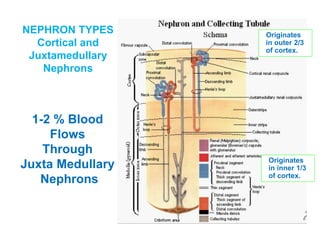
1-2 % Blood
Flows
Through
Juxta Medullary
Nephrons
NEPHRON TYPES
Cortical and
Juxtamedullary
Nephrons
Originates
in outer 2/3
of cortex.
Originates
in inner 1/3
of cortex.
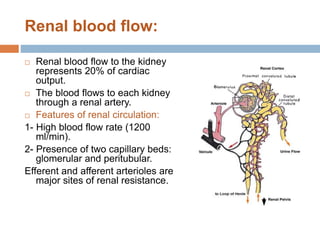
Renal blood flow:
 Renal blood flow to the kidney
represents 20% of cardiac
output.
 The blood flows to each kidney
through a renal artery.
 Features of renal circulation:
1- High blood flow rate (1200
ml/min).
2- Presence of two capillary beds:
glomerular and peritubular.
Efferent and afferent arterioles are
major sites of renal resistance.
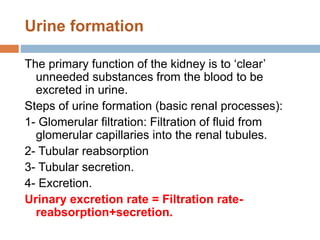
Urine formation
The primary function of the kidney is to ‘clear’
unneeded substances from the blood to be
excreted in urine.
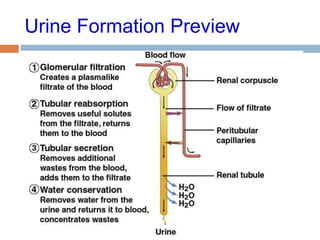
Steps of urine formation (basic renal processes):
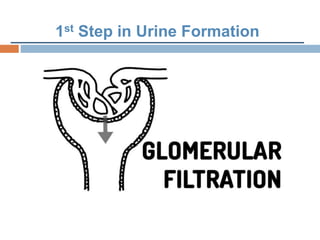
1- Glomerular filtration: Filtration of fluid from
glomerular capillaries into the renal tubules.
2- Tubular reabsorption
3- Tubular secretion.
4- Excretion.
Urinary excretion rate = Filtration rate-
reabsorption+secretion.
1st Step in Urine Formation
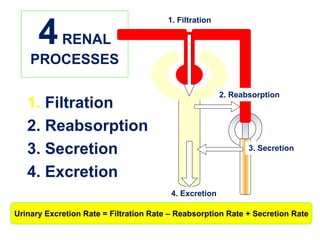
4RENAL
PROCESSES
1. Filtration
2. Reabsorption
3. Secretion
4. Excretion
1. Filtration
2. Reabsorption
3. Secretion
4. Excretion
Urinary Excretion Rate = Filtration Rate – Reabsorption Rate + Secretion Rate
Urine Formation Preview
Glomerular filtration rate (GFR)
 The first step in urine formation is glomerular
filtration.
 It is the filtration of fluid from the glomerular
capillaries into the renal tubules.
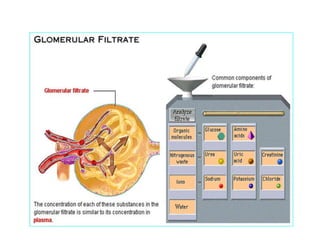
 It contains all substances present in plasma
except proteins.
 GFR is normally 125 ml/min = 20% renal
plasma flow.
 What is glomerular membrane?
 What will filter? (composition of filtrate)
 What determineGFR?
 What are the forces responsible for passage of
fluid (filtrate) through this membrane?
 Regulation of GFR
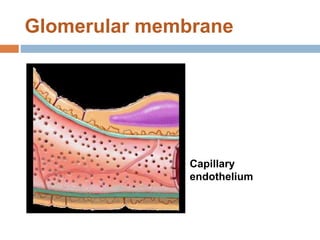
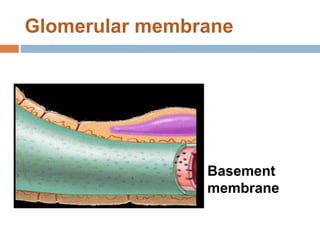
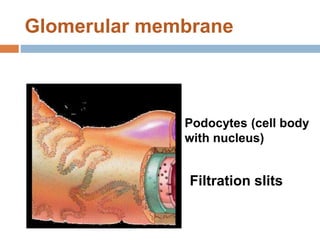
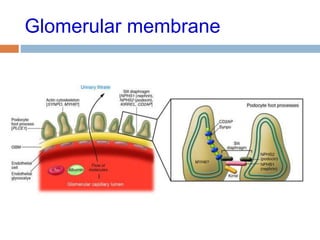
Glomerular membrane
Blood in the glomerulus is separated from the
fluid in the Bowman’s space by a filtration
barrier (glomerular membrane) consisting of
three layers:
1- Single layer of capillary endothelium.
2- Single epithelial lining of Bowman’s capsule
(Podocytes) During filtration the fluid moves
between their foot processes (psudopodia).
3- Basement membrane between endothelium
and epithelium.
Glomerular membrane
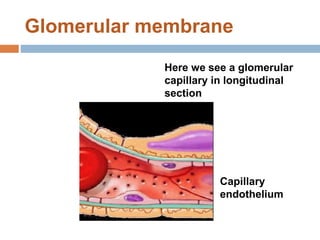
Here we see a glomerular
capillary in longitudinal
section
Capillary
endothelium
Glomerular membrane
Capillary
endothelium
Glomerular membrane
Basement
membrane
Glomerular membrane
Filtration slits
Podocytes (cell body
with nucleus)
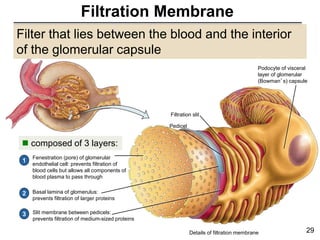
Details of filtration membrane
Filtration slit
1
Pedicel
Podocyte of visceral
layer of glomerular
(Bowman’s) capsule
Fenestration (pore) of glomerular
endothelial cell: prevents filtration of
blood cells but allows all components of
blood plasma to pass through
Basal lamina of glomerulus:
prevents filtration of larger proteins
Slit membrane between pedicels:
prevents filtration of medium-sized proteins
2
3
29
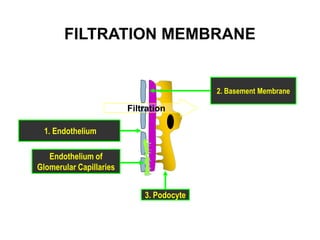
Filtration Membrane
Filter that lies between the blood and the interior
of the glomerular capsule
 composed of 3 layers:
FILTRATION MEMBRANE
1. Endothelium
3. Podocyte
Endothelium of
Glomerular Capillaries
2. Basement Membrane
Filtration
Glomerular membrane
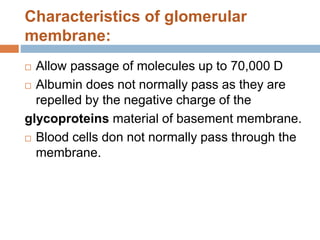
Characteristics of glomerular
membrane:
 Allow passage of molecules up to 70,000 D
 Albumin does not normally pass as they are
repelled by the negative charge of the
glycoproteins material of basement membrane.
 Blood cells don not normally pass through the
membrane.
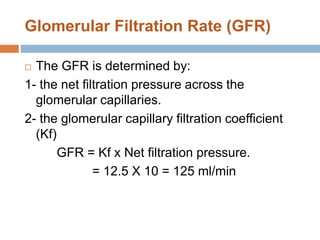
Glomerular Filtration Rate (GFR)
 The GFR is determined by:
1- the net filtration pressure across the
glomerular capillaries.
2- the glomerular capillary filtration coefficient
(Kf)
GFR = Kf x Net filtration pressure.
= 12.5 X 10 = 125 ml/min
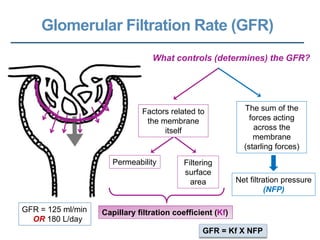
Glomerular Filtration Rate (GFR)
GFR = 125 ml/min
OR 180 L/day
What controls (determines) the GFR?
Factors related to
the membrane
itself
The sum of the
forces acting
across the
membrane
(starling forces)
Permeability Filtering
surface
area
Capillary filtration coefficient (Kf)
Net filtration pressure
(NFP)
GFR = Kf X NFP
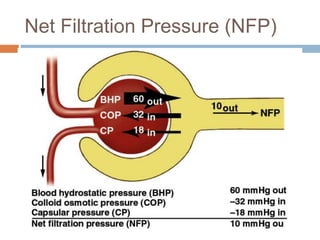
Net Filtration Pressure (NFP)
REGULATION OF GFR
Regulation of GFR
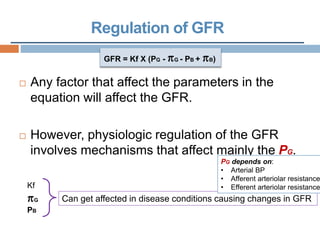
GFR = Kf X (PG - G - PB + B)
 Any factor that affect the parameters in the
equation will affect the GFR.
 However, physiologic regulation of the GFR
involves mechanisms that affect mainly the PG.
Kf
G
PB
Can get affected in disease conditions causing changes in GFR
PG depends on:
• Arterial BP
• Afferent arteriolar resistance
• Efferent arteriolar resistance
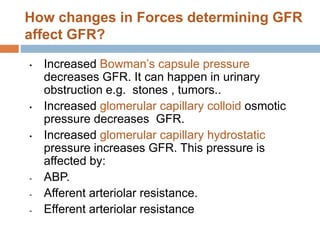
How changes in Forces determining GFR
affect GFR?
• Increased Bowman’s capsule pressure
decreases GFR. It can happen in urinary
obstruction e.g. stones , tumors..
• Increased glomerular capillary colloid osmotic
pressure decreases GFR.
• Increased glomerular capillary hydrostatic
pressure increases GFR. This pressure is
affected by:
- ABP.
- Afferent arteriolar resistance.
- Efferent arteriolar resistance
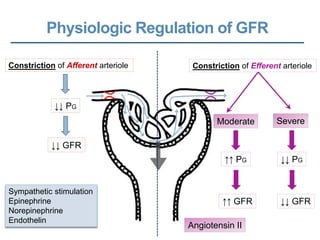
Physiologic Regulation of GFR
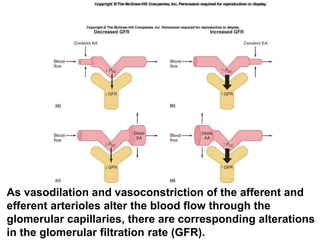
Constriction of Afferent arteriole Constriction of Efferent arteriole
↓↓ PG
↓↓ GFR
Moderate Severe
↑↑ PG
↑↑ GFR
↓↓ PG
↓↓ GFR
Sympathetic stimulation
Epinephrine
Norepinephrine
Endothelin
Angiotensin II
As vasodilation and vasoconstriction of the afferent and
efferent arterioles alter the blood flow through the
glomerular capillaries, there are corresponding alterations
in the glomerular filtration rate (GFR).
Factors affecting Renal blood flow and
GFR
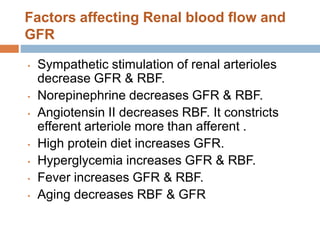
• Sympathetic stimulation of renal arterioles
decrease GFR & RBF.
• Norepinephrine decreases GFR & RBF.
• Angiotensin II decreases RBF. It constricts
efferent arteriole more than afferent .
• High protein diet increases GFR.
• Hyperglycemia increases GFR & RBF.
• Fever increases GFR & RBF.
• Aging decreases RBF & GFR
48
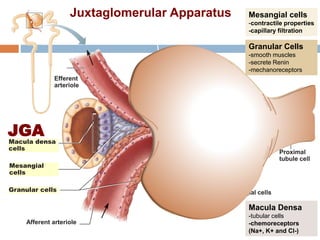
Proximal
tubule cell
Efferent
arteriole
Afferent arteriole
Granular Cells
-smooth muscles
-secrete Renin
-mechanoreceptors
Macula Densa
-tubular cells
-chemoreceptors
(Na+, K+ and Cl-)
Mesangial cells
-contractile properties
-capillary filtration
Macula densa
cells
Mesangial cells
Granular cells
Mesangial
cells
JGA
Juxtaglomerular Apparatus
L1-Renal physiology 2018.ppt

L1-Renal physiology 2018.ppt

  • 1.
  • 2.
    Learning Objectives: • Enumerategeneral functions of the kidney. • Identify and describe that the nephron is the structural and function unit of the kidney. • Explain glomerular filtration membrane & filtration forces. • Describe mechanism of filtration & composition of the glomerular filtrate. • Calculate the net filtration pressure using parameters of Starling forces.
  • 3.
    Functions of theKidney Blood with metabolic waste products Water & electrolytes Acid-base Arterial BP Regulation Excretion Synthetic function Glucose (gluconeogenesis) Erythropoietin 1,25-dihydroxy vitamin D3 (calcitriol) Renin Metabolic waste products: Urea Creatinine Uric acid Bilirubin Ingested toxins: Drugs Pesticides
  • 4.
    Diagrammatic view ofthe kidney Three distinct regions Cortex granular superficial region Medulla exhibits cone- shaped pyramids 7 Pyramids are bundles of collecting tubules Renal cortex Renal medulla Renal pelvis Ureter Renal column Renal pyramid Renal hilum Renal pelvis flat, funnel-shaped tube
  • 5.
    What is thefunctional unit of the kidney?  The nephron is the functional and structural unit of the kidney.  Each kidney has 1 million nephrons, each nephron is capable of urine formation.
  • 6.
    Structure of anephron  The Glomerulus: capillary tuft: in which large amount of fluid is filtered from blood.  Bwaman’s capsule: Around the glomerulus and receives the filtrate.  Tubules: in which filtered fluid eventually is converted into urine.
  • 7.
    Proximal tubule cell Efferent arteriole Afferent arteriole Capsular space Renalcorpuscle Bowman’s capsule: Blind end of the tubule completely surrounds the glomerulus Glomerulus: A tuft of capillaries associated with a renal tubule Renal corpuscle The structural and functional units that form urine. The nephron
  • 8.
    Structure of anephron, cont……  The renal tubule is divided into different sections with different structural and functional characteristics:  Proximal tubules ( in the cortex).  Loop of Henle.  Distal tubule (in the renal cortex).  Connecting tubule, cortical collecting, and the cortical collecting ducts, which run downward in the medulla and become:  Medullary collecting ducts.
  • 9.
    RENAL BLOOD VESSELS AFFERENT ARTERIOLE:  DELIVERS BLOOD INTO THE GLOMERULI.  GLOMERULI:  CAPILLARY NETWORK THAT PRODUCES FILTRATE THAT ENTERS THE URINARY TUBULES.  EFFERENT ARTERIOLE:  DELIVERS BLOOD FROM GLOMERULI TO PERITUBULAR CAPILLARIES.  PERITUBULAR CAPILLARIES:  VASA RECTA.
  • 10.
    Structure of anephron, cont….. Types of nephrons: 1- Cortical nephrons: (85%): Their glomeruli in the outer portion of cortex and have short loops of Henle. . Peritubular capelaries 2-Juxtamedullary nephrons: (15%): Have long loops extended into the medulla. .Vasa recta Maintain salt gradient, helps conserve water
  • 11.
    1-2 % Blood Flows Through JuxtaMedullary Nephrons NEPHRON TYPES Cortical and Juxtamedullary Nephrons Originates in outer 2/3 of cortex. Originates in inner 1/3 of cortex.
  • 12.
    Renal blood flow: Renal blood flow to the kidney represents 20% of cardiac output.  The blood flows to each kidney through a renal artery.  Features of renal circulation: 1- High blood flow rate (1200 ml/min). 2- Presence of two capillary beds: glomerular and peritubular. Efferent and afferent arterioles are major sites of renal resistance.
  • 13.
    Urine formation The primaryfunction of the kidney is to ‘clear’ unneeded substances from the blood to be excreted in urine. Steps of urine formation (basic renal processes): 1- Glomerular filtration: Filtration of fluid from glomerular capillaries into the renal tubules. 2- Tubular reabsorption 3- Tubular secretion. 4- Excretion. Urinary excretion rate = Filtration rate- reabsorption+secretion.
  • 14.
    1st Step inUrine Formation
  • 15.
    4RENAL PROCESSES 1. Filtration 2. Reabsorption 3.Secretion 4. Excretion 1. Filtration 2. Reabsorption 3. Secretion 4. Excretion Urinary Excretion Rate = Filtration Rate – Reabsorption Rate + Secretion Rate
  • 16.
  • 17.
    Glomerular filtration rate(GFR)  The first step in urine formation is glomerular filtration.  It is the filtration of fluid from the glomerular capillaries into the renal tubules.  It contains all substances present in plasma except proteins.  GFR is normally 125 ml/min = 20% renal plasma flow.
  • 18.
     What isglomerular membrane?  What will filter? (composition of filtrate)  What determineGFR?  What are the forces responsible for passage of fluid (filtrate) through this membrane?  Regulation of GFR
  • 19.
    Glomerular membrane Blood inthe glomerulus is separated from the fluid in the Bowman’s space by a filtration barrier (glomerular membrane) consisting of three layers: 1- Single layer of capillary endothelium. 2- Single epithelial lining of Bowman’s capsule (Podocytes) During filtration the fluid moves between their foot processes (psudopodia). 3- Basement membrane between endothelium and epithelium.
  • 20.
    Glomerular membrane Here wesee a glomerular capillary in longitudinal section Capillary endothelium
  • 21.
  • 22.
  • 23.
  • 24.
    Details of filtrationmembrane Filtration slit 1 Pedicel Podocyte of visceral layer of glomerular (Bowman’s) capsule Fenestration (pore) of glomerular endothelial cell: prevents filtration of blood cells but allows all components of blood plasma to pass through Basal lamina of glomerulus: prevents filtration of larger proteins Slit membrane between pedicels: prevents filtration of medium-sized proteins 2 3 29 Filtration Membrane Filter that lies between the blood and the interior of the glomerular capsule  composed of 3 layers:
  • 25.
    FILTRATION MEMBRANE 1. Endothelium 3.Podocyte Endothelium of Glomerular Capillaries 2. Basement Membrane Filtration
  • 26.
  • 27.
    Characteristics of glomerular membrane: Allow passage of molecules up to 70,000 D  Albumin does not normally pass as they are repelled by the negative charge of the glycoproteins material of basement membrane.  Blood cells don not normally pass through the membrane.
  • 29.
    Glomerular Filtration Rate(GFR)  The GFR is determined by: 1- the net filtration pressure across the glomerular capillaries. 2- the glomerular capillary filtration coefficient (Kf) GFR = Kf x Net filtration pressure. = 12.5 X 10 = 125 ml/min
  • 30.
    Glomerular Filtration Rate(GFR) GFR = 125 ml/min OR 180 L/day What controls (determines) the GFR? Factors related to the membrane itself The sum of the forces acting across the membrane (starling forces) Permeability Filtering surface area Capillary filtration coefficient (Kf) Net filtration pressure (NFP) GFR = Kf X NFP
  • 31.
  • 32.
  • 33.
    Regulation of GFR GFR= Kf X (PG - G - PB + B)  Any factor that affect the parameters in the equation will affect the GFR.  However, physiologic regulation of the GFR involves mechanisms that affect mainly the PG. Kf G PB Can get affected in disease conditions causing changes in GFR PG depends on: • Arterial BP • Afferent arteriolar resistance • Efferent arteriolar resistance
  • 34.
    How changes inForces determining GFR affect GFR? • Increased Bowman’s capsule pressure decreases GFR. It can happen in urinary obstruction e.g. stones , tumors.. • Increased glomerular capillary colloid osmotic pressure decreases GFR. • Increased glomerular capillary hydrostatic pressure increases GFR. This pressure is affected by: - ABP. - Afferent arteriolar resistance. - Efferent arteriolar resistance
  • 35.
    Physiologic Regulation ofGFR Constriction of Afferent arteriole Constriction of Efferent arteriole ↓↓ PG ↓↓ GFR Moderate Severe ↑↑ PG ↑↑ GFR ↓↓ PG ↓↓ GFR Sympathetic stimulation Epinephrine Norepinephrine Endothelin Angiotensin II
  • 36.
    As vasodilation andvasoconstriction of the afferent and efferent arterioles alter the blood flow through the glomerular capillaries, there are corresponding alterations in the glomerular filtration rate (GFR).
  • 37.
    Factors affecting Renalblood flow and GFR • Sympathetic stimulation of renal arterioles decrease GFR & RBF. • Norepinephrine decreases GFR & RBF. • Angiotensin II decreases RBF. It constricts efferent arteriole more than afferent . • High protein diet increases GFR. • Hyperglycemia increases GFR & RBF. • Fever increases GFR & RBF. • Aging decreases RBF & GFR
  • 38.
    48 Proximal tubule cell Efferent arteriole Afferent arteriole GranularCells -smooth muscles -secrete Renin -mechanoreceptors Macula Densa -tubular cells -chemoreceptors (Na+, K+ and Cl-) Mesangial cells -contractile properties -capillary filtration Macula densa cells Mesangial cells Granular cells Mesangial cells JGA Juxtaglomerular Apparatus

Editor's Notes

  • #49 Juxtaglomerular apparatus is where the distal tubule lies against the afferent (sometimes efferent) arteriole Arteriole walls have juxtaglomerular (JG) cells - Enlarged, smooth muscle cells - Have secretory granules containing renin - Act as mechanoreceptors Macula densa - tall, closely packed distal tubule cells - lie adjacent to JG cells - function as chemoreceptors or osmoreceptors - sensitive to the ionic content and water volume of the fluid in the tubule produce molecular signals that promote renin secretion by JG cells Mesangial cells - have phagocytic and contractile properties - influence capillary filtration - provide structural support and regulate blood flow of the glomerular capillaries by their contractile activity