Renal function- basic data for students and residents Department of Paediatrics Section for Pediatric Nephrology  University Hospital  Motol, Prague
Functions   of the kidney regulation e.g. homeostasis, water, acid/base excretion e.g. urea, creatinine endocrine  e.g.  renin, erythropoietin,  1,25 dihydroxycholecalciferol- conversion only in kidney!
Renal function tests detect renal damage monitor functional damage help determine etiology
Laboratory tests of renal function glomerular filtration rate (GFR) plasma creatinine plasma urea urine volume urine urea minerals in urine urine protein urine glucose hematuria osmolality
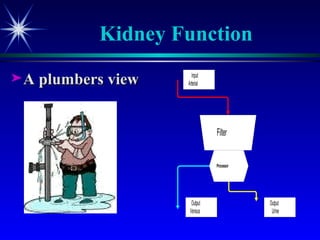
Kidney Function A plumbers view
Kidney – basic data Urine excreted daily in adults: cca 1.5L Kidney only ca 1% of total body weight, despite it The renal blood flow=  20% of cardiac output Plasma renal flow= PRF ca 600 mL/Min./1.73 M 2  Reflects two processes  Ultrafiltration (GFR): 180 L/day Reabsorption:  >99% of the amount filtered
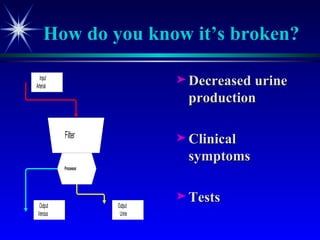
How do you know it’s broken? Decreased urine production Clinical symptoms Tests
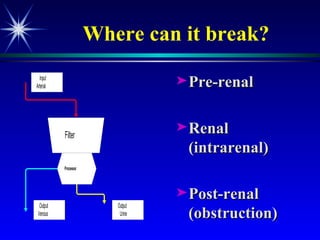
Where can it break? Pre-renal Renal (intrarenal) Post-renal (obstruction)
Causes of kidney functional disorders Pre-renal  e.g.  decreased intravascular volum  Renal  e.g.  acute tubular necrosis Postrenal  e.g.  ureteral obstruction
Tests of renal function glomerular filtration rate=GFR plasma creatinine= P cr plasma urea-P urea urine volume= V urine urea- U urea cystatin C in plasma? urine protein urine glucose hematuria osmolality
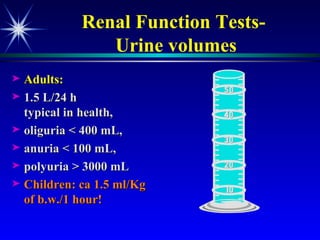
Renal Function Tests-  Urine volumes Adults:  1.5 L/24 h typical in health,  oliguria < 400 mL,  anuria < 100 mL,  polyuria > 3000 mL Children: ca 1.5 ml/Kg of b.w./1 hour!
Principle of of Clearance Some substances when filtered enter the tubules are not reabsorbed and so 100% excreted= GFR (inulin= gold standard for GFR,  creatinine (but this one partially reabsorbed, particularly in uremia, then clearance <GFR Some substances are filtered, enter tubules,  and more of the substance is secreted enters the tubules by excretion. Clearance>GFR Some substances are filtered, enter tubules, but are completely reabsorbed, so they did not reach the final urine (e.g. cystatin C)
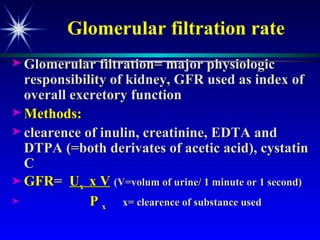
Glomerular filtration rate Glomerular filtration= major physiologic responsibility of kidney, GFR used as index of overall excretory function Methods: clearence of inulin, creatinine, EDTA and DTPA (=both derivates of acetic acid), cystatin C  GFR =  U x  x V   (V=volum of urine/ 1 minute or 1 second) P  x  x= clearence of substance used
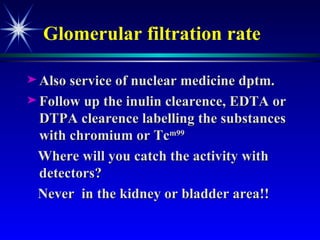
Glomerular filtration rate Also service of nuclear medicine dptm. Follow up the inulin clearence, EDTA or DTPA clearence labelling the substances with chromium or Tc m99  Where will you catch the activity with detectors?  Never  in the kidney or bladder area!!
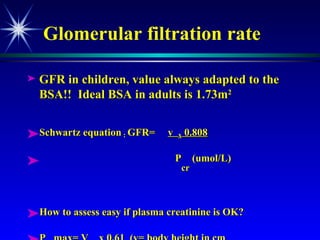
Glomerular filtration rate GFR in children, value always adapted to the BSA!!  Ideal BSA in adults is 1.73m 2 Schwartz equation  :  GFR=  v  x  0.808 P cr  (umol/L) How to assess easy if plasma creatinine is OK? P cr  max= V cm  x 0.61  (v= body height in cm
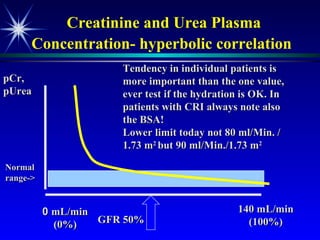
Creatinine and Urea Plasma Concentration- hyperbolic correlation   GFR 50% pCr, pUrea 140 mL/min (100%) 0   mL/min (0%) Tendency in individual patients is more important than the one value, ever test if the hydration is OK. In patients with CRI always note also the BSA!  Lower limit today not 80 ml/Min. /1.73 m 2  but 90 ml/Min./1.73 m 2   Normal  range->
Plasma urea (BUN) = BUN ( b lood  u rea  n itrogen) Urea: product of protein catabolism Synthesized by liver, majority excreted by kidney, partially reabsorbed in tubuli  Plasma concentration increases with decreased GFR
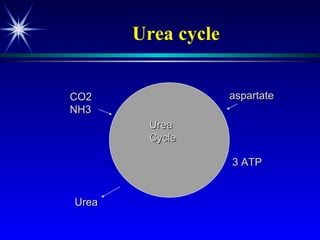
Urea cycle CO2 NH3 aspartate Urea 3 ATP Urea Cycle
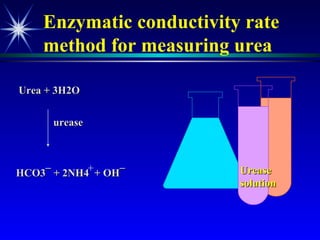
Enzymatic conductivity rate method for measuring urea Urease solution Urea + 3H2O HCO3¯ + 2NH4  + OH¯ urease
Urea in patients  with kidney diseases Useful test but must be interpreted with great care, urea plasma level is more than creatinine dependent on protein intake  Most useful when considered along with creatinine High in high protein intake, low in severe liver dysfunction  Urea EF may be useful in pts. on diuretics
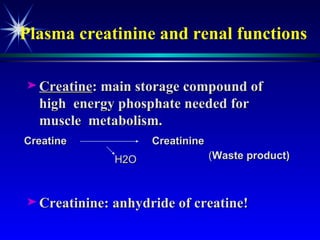
Plasma creatinine and renal functions Creatine : main storage compound of high  energy phosphate needed for muscle  metabolism. Creatinine: anhydride of creatine! Creatine Creatinine ( Waste product) H2O
Plasma creatinine vs. GFR not linear, hyperbolic correlation! GFR [pCreat] 140 mL/min (100%) 0 mL/min (0%) Change within an individual patient is usually more important than the absolute value
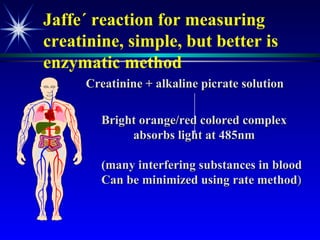
Jaffe´ reaction for measuring creatinine, simple, but better is enzymatic method   Creatinine + alkaline picrate solution Bright orange/red colored complex absorbs light at 485nm (many interfering substances in blood Can be minimized using rate method )
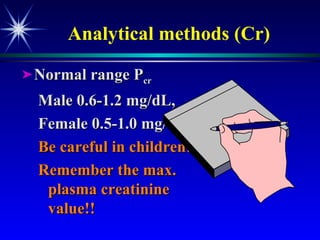
Analytical methods (Cr) Normal range P cr Male 0.6-1.2 mg/dL, Female 0.5-1.0 mg/dL Be careful in children!! Remember the max. plasma creatinine value!!
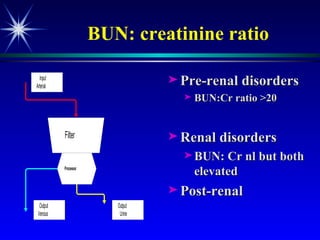
BUN: creatinine ratio Pre-renal disorders BUN:Cr ratio >20 Renal disorders BUN: Cr nl but both elevated Post-renal
Osmolality of urine Measures urine concentrating ability Depends on # of particles, not size or charge Largely due to ADH ( a nti- d iuretic  h ormone) Can reach maximum of 1200 mOsm/L Normal range: 300-900mOsm/L, plasma 285 + 10 prior to collection, fluid intake restricted, first void submitted for evaluation Measuring using the fact of freezing point depression
Standardized renal  concentration capacity test  1 . Voiding completely  at 9 p.m. (WC) 2.  Desmopressin administration (since 2006 as nasal spray).  DDAVP is a Czech invention !! 3. Collection of urine (9 p.m. – 7 a.m.) 4. Testing of urine osmolality in this sample (not the morning urine only !) 5.  The lower limit of normal value= 950  mOsm/kg of urine 6.  Short testing- Desmopressin, collection for 4  hours only= at least 900 mOsm/kg of urine
Urine dipsticks Strip impregnated with reagents for the substances in question within a urine sample Substance level can be altered in the setting of pathology within the urinary tract Measured substances: Modern dipsticks with multiplied zones: Protein, hemoglobin, glucose, urobilinogen, nitrite,  leukocytes,  specific gravity, and pH Should be a tool everywhere on the level of primary care !!!

Renal Functions In Children

  • 1.
    Renal function- basicdata for students and residents Department of Paediatrics Section for Pediatric Nephrology University Hospital Motol, Prague
  • 2.
    Functions of the kidney regulation e.g. homeostasis, water, acid/base excretion e.g. urea, creatinine endocrine e.g. renin, erythropoietin, 1,25 dihydroxycholecalciferol- conversion only in kidney!
  • 3.
    Renal function testsdetect renal damage monitor functional damage help determine etiology
  • 4.
    Laboratory tests ofrenal function glomerular filtration rate (GFR) plasma creatinine plasma urea urine volume urine urea minerals in urine urine protein urine glucose hematuria osmolality
  • 5.
    Kidney Function Aplumbers view
  • 6.
    Kidney – basicdata Urine excreted daily in adults: cca 1.5L Kidney only ca 1% of total body weight, despite it The renal blood flow= 20% of cardiac output Plasma renal flow= PRF ca 600 mL/Min./1.73 M 2 Reflects two processes Ultrafiltration (GFR): 180 L/day Reabsorption: >99% of the amount filtered
  • 7.
    How do youknow it’s broken? Decreased urine production Clinical symptoms Tests
  • 8.
    Where can itbreak? Pre-renal Renal (intrarenal) Post-renal (obstruction)
  • 9.
    Causes of kidneyfunctional disorders Pre-renal e.g. decreased intravascular volum Renal e.g. acute tubular necrosis Postrenal e.g. ureteral obstruction
  • 10.
    Tests of renalfunction glomerular filtration rate=GFR plasma creatinine= P cr plasma urea-P urea urine volume= V urine urea- U urea cystatin C in plasma? urine protein urine glucose hematuria osmolality
  • 11.
    Renal Function Tests- Urine volumes Adults: 1.5 L/24 h typical in health, oliguria < 400 mL, anuria < 100 mL, polyuria > 3000 mL Children: ca 1.5 ml/Kg of b.w./1 hour!
  • 12.
    Principle of ofClearance Some substances when filtered enter the tubules are not reabsorbed and so 100% excreted= GFR (inulin= gold standard for GFR, creatinine (but this one partially reabsorbed, particularly in uremia, then clearance <GFR Some substances are filtered, enter tubules, and more of the substance is secreted enters the tubules by excretion. Clearance>GFR Some substances are filtered, enter tubules, but are completely reabsorbed, so they did not reach the final urine (e.g. cystatin C)
  • 13.
    Glomerular filtration rateGlomerular filtration= major physiologic responsibility of kidney, GFR used as index of overall excretory function Methods: clearence of inulin, creatinine, EDTA and DTPA (=both derivates of acetic acid), cystatin C GFR = U x x V (V=volum of urine/ 1 minute or 1 second) P x x= clearence of substance used
  • 14.
    Glomerular filtration rateAlso service of nuclear medicine dptm. Follow up the inulin clearence, EDTA or DTPA clearence labelling the substances with chromium or Tc m99 Where will you catch the activity with detectors? Never in the kidney or bladder area!!
  • 15.
    Glomerular filtration rateGFR in children, value always adapted to the BSA!! Ideal BSA in adults is 1.73m 2 Schwartz equation : GFR= v x 0.808 P cr (umol/L) How to assess easy if plasma creatinine is OK? P cr max= V cm x 0.61 (v= body height in cm
  • 16.
    Creatinine and UreaPlasma Concentration- hyperbolic correlation GFR 50% pCr, pUrea 140 mL/min (100%) 0 mL/min (0%) Tendency in individual patients is more important than the one value, ever test if the hydration is OK. In patients with CRI always note also the BSA! Lower limit today not 80 ml/Min. /1.73 m 2 but 90 ml/Min./1.73 m 2 Normal range->
  • 17.
    Plasma urea (BUN)= BUN ( b lood u rea n itrogen) Urea: product of protein catabolism Synthesized by liver, majority excreted by kidney, partially reabsorbed in tubuli Plasma concentration increases with decreased GFR
  • 18.
    Urea cycle CO2NH3 aspartate Urea 3 ATP Urea Cycle
  • 19.
    Enzymatic conductivity ratemethod for measuring urea Urease solution Urea + 3H2O HCO3¯ + 2NH4 + OH¯ urease
  • 20.
    Urea in patients with kidney diseases Useful test but must be interpreted with great care, urea plasma level is more than creatinine dependent on protein intake Most useful when considered along with creatinine High in high protein intake, low in severe liver dysfunction Urea EF may be useful in pts. on diuretics
  • 21.
    Plasma creatinine andrenal functions Creatine : main storage compound of high energy phosphate needed for muscle metabolism. Creatinine: anhydride of creatine! Creatine Creatinine ( Waste product) H2O
  • 22.
    Plasma creatinine vs.GFR not linear, hyperbolic correlation! GFR [pCreat] 140 mL/min (100%) 0 mL/min (0%) Change within an individual patient is usually more important than the absolute value
  • 23.
    Jaffe´ reaction formeasuring creatinine, simple, but better is enzymatic method Creatinine + alkaline picrate solution Bright orange/red colored complex absorbs light at 485nm (many interfering substances in blood Can be minimized using rate method )
  • 24.
    Analytical methods (Cr)Normal range P cr Male 0.6-1.2 mg/dL, Female 0.5-1.0 mg/dL Be careful in children!! Remember the max. plasma creatinine value!!
  • 25.
    BUN: creatinine ratioPre-renal disorders BUN:Cr ratio >20 Renal disorders BUN: Cr nl but both elevated Post-renal
  • 26.
    Osmolality of urineMeasures urine concentrating ability Depends on # of particles, not size or charge Largely due to ADH ( a nti- d iuretic h ormone) Can reach maximum of 1200 mOsm/L Normal range: 300-900mOsm/L, plasma 285 + 10 prior to collection, fluid intake restricted, first void submitted for evaluation Measuring using the fact of freezing point depression
  • 27.
    Standardized renal concentration capacity test 1 . Voiding completely at 9 p.m. (WC) 2. Desmopressin administration (since 2006 as nasal spray). DDAVP is a Czech invention !! 3. Collection of urine (9 p.m. – 7 a.m.) 4. Testing of urine osmolality in this sample (not the morning urine only !) 5. The lower limit of normal value= 950 mOsm/kg of urine 6. Short testing- Desmopressin, collection for 4 hours only= at least 900 mOsm/kg of urine
  • 28.
    Urine dipsticks Stripimpregnated with reagents for the substances in question within a urine sample Substance level can be altered in the setting of pathology within the urinary tract Measured substances: Modern dipsticks with multiplied zones: Protein, hemoglobin, glucose, urobilinogen, nitrite, leukocytes, specific gravity, and pH Should be a tool everywhere on the level of primary care !!!

Editor's Notes

  • #3 The kidneys excrete the end products of metabolism, urea from amino acid breakdown, uric acid from purine (nucleic acids) metabolism and creatinine from the catabolism of creatine an amino acid found in muscle. Homeostatic functions include the maintenance of water balance by regulating urine volume, acid base balance by altering hydrogen ion excretion, sodium balance by altering the rate of sodium reabsorption. Endocrine functions include the secretion of renin from the JGA which influences aldosterone. Erythropoietin effects the rate of red cell production and 1,25-dihydroxycholecalciferol is the active form of vitamin D, effecting calcium homeostasis. Patients with chronic renal disease and impaired renal functions will show defects in endocrine and excretory functions before the loss of homeostatic control. When the homeostatic functions cease then the patient is in renal failure and would die if there were no interventions.
  • #4 From a clinical perspective it is important to have test which would have these characteristics. No such test exists. An early test to detect renal damage, for instance a simple strip test for haematuria is important in screening for heavy metal poisoning. There is a clinical need to monitor a patient with renal disease and this is achieved by serial plasma measurements. We need to know when to start dialysis in renal failure and laboratory tests assist the clinical decision making. There are about a million nephrons in each kidney and this represents a considerable functional reserve. In renal disease about half the nephrons have to lose their functioning before the abnormality can be detected by conventional laboratory tests.
  • #5 I shall review the tests in the left column today. The measurement of urine protein is important in certain conditions, e.g.diabetes. The detection of substances such as red cells or glucose could be an early indicator of renal damage.
  • #10 Oliguria is a significant finding in a patient. An example is provided by Case 3 in the Chem Path tutorials. The traditional classification of causes is into prerenal, renal and postrenal. Usually the cause of the oliguria is obvious and can be appropriately managed.
  • #11 I shall review the tests in the left column today. The measurement of urine protein is important in certain conditions, e.g.diabetes. The detection of substances such as red cells or glucose could be an early indicator of renal damage.
  • #12 Urine volume depends on how much you drink and sweat. In health it is closely matched to water balance by the hormone ADH or vasopressin, AVP. We define abnormally low urine volume as a 24 hour volume less than 400 mL. This is known as oliguria. A patient is considered anuric when there is no or little urine, less than 100 mL/24 h. There is no absolute definition for polyuria as some people can drink an awful lot and match it with a high urine output. If a patient has a urine volume greater than 3 litres per day and is not drinking then this is polyuria.
  • #13 I shall review the tests in the left column today. The measurement of urine protein is important in certain conditions, e.g.diabetes. The detection of substances such as red cells or glucose could be an early indicator of renal damage.
  • #14 Urea is easily measured. It has a wide reference range and the value increases after a meal. Its concentration is increased in many different conditions which makes it sensitive to the presence of disease but a non-specific test.
  • #18 Urea is easily measured. It has a wide reference range and the value increases after a meal. Its concentration is increased in many different conditions which makes it sensitive to the presence of disease but a non-specific test.
  • #19 In health only about 60% of filtered urea is excreted the rest is reabsorbed passively by the renal tubules. The rate of urea reabsorption is variable and depends on the rate of tubular flow. More urea is reabsorbed if the flow rate is slow as there is more time for urea to diffuse into the peritubular capillaries. Flow rate is slow when there is a decrease in RBF, following myocardial infarction for example. More urea is reabsorbed and plasma urea increases. Many conditions result in renal hypoperfusion including fluid loss, circulatory insufficiency, renal artery stenosis
  • #20 From a clinical perspective it is important to have test which would have these characteristics. No such test exists. An early test to detect renal damage, for instance a simple strip test for haematuria is important in screening for heavy metal poisoning. There is a clinical need to monitor a patient with renal disease and this is achieved by serial plasma measurements. We need to know when to start dialysis in renal failure and laboratory tests assist the clinical decision making. There are about a million nephrons in each kidney and this represents a considerable functional reserve. In renal disease about half the nephrons have to lose their functioning before the abnormality can be detected by conventional laboratory tests.
  • #22 In most circumstances the measurement of plasma creatinine can provide a specific test of glomerular function. The reference range is wide. A body builder may have a plasma creatinine at the top end and an old lady a value at the low end and this reflects muscle mass. Plasma creatinine should not be measured until 8 hours after a meal as there is some evidence that the concentration increases after meat ingestion. Plasma creatinine concentration increases when GFR falls. The problem is that GFR has to fall quite a bit before plasma creatinine concentration reliably increases. There are some important analytical interferences which you should check with the laboratory. A patient with ketoacidosis, jaundice or infection might have agents in the plasma which could invalidate the measurement of creatinine. Overhead 1 follows
  • #24 GFR is not often measured in clinical practice. It requires a patient to come to hospital. Currently people who are considering donating a kidney whilst they are alive have their GFR measured. Before administering a drug with potentially toxic effects some patients will require a GFR measurement before the chemotherapy. This enables the oncologist to calculate the exact dose of drug after estimating its elimination rate. GFR used to be measured by calculating the clearance of inulin. Nowadays radioactive substances are used, either technetium labelled diethylenediaminetetra acetic acid DTPA or 51-chromium labelled EDTA ethylenediaminetetra acetic acid.