Renal function- basic data
for students and residents
Department of Paediatrics
Section for Pediatric Nephrology
University Hospital Motol, Prague
Functions of the kidney
regulation e.g. homeostasis,
water, acid/base
excretion e.g. urea, creatinine
endocrine e.g. renin,
erythropoietin,
1,25 dihydroxycholecalciferol-
conversion only in kidney!
Renal function tests
 detect renal
damage
 monitor functional
damage
 help determine
etiology
Laboratory tests of renal function
 glomerular filtration
rate (GFR)
 plasma creatinine
 plasma urea
 urine volume
 urine urea
 minerals in urine
 urine protein
 urine glucose
 hematuria
 osmolality
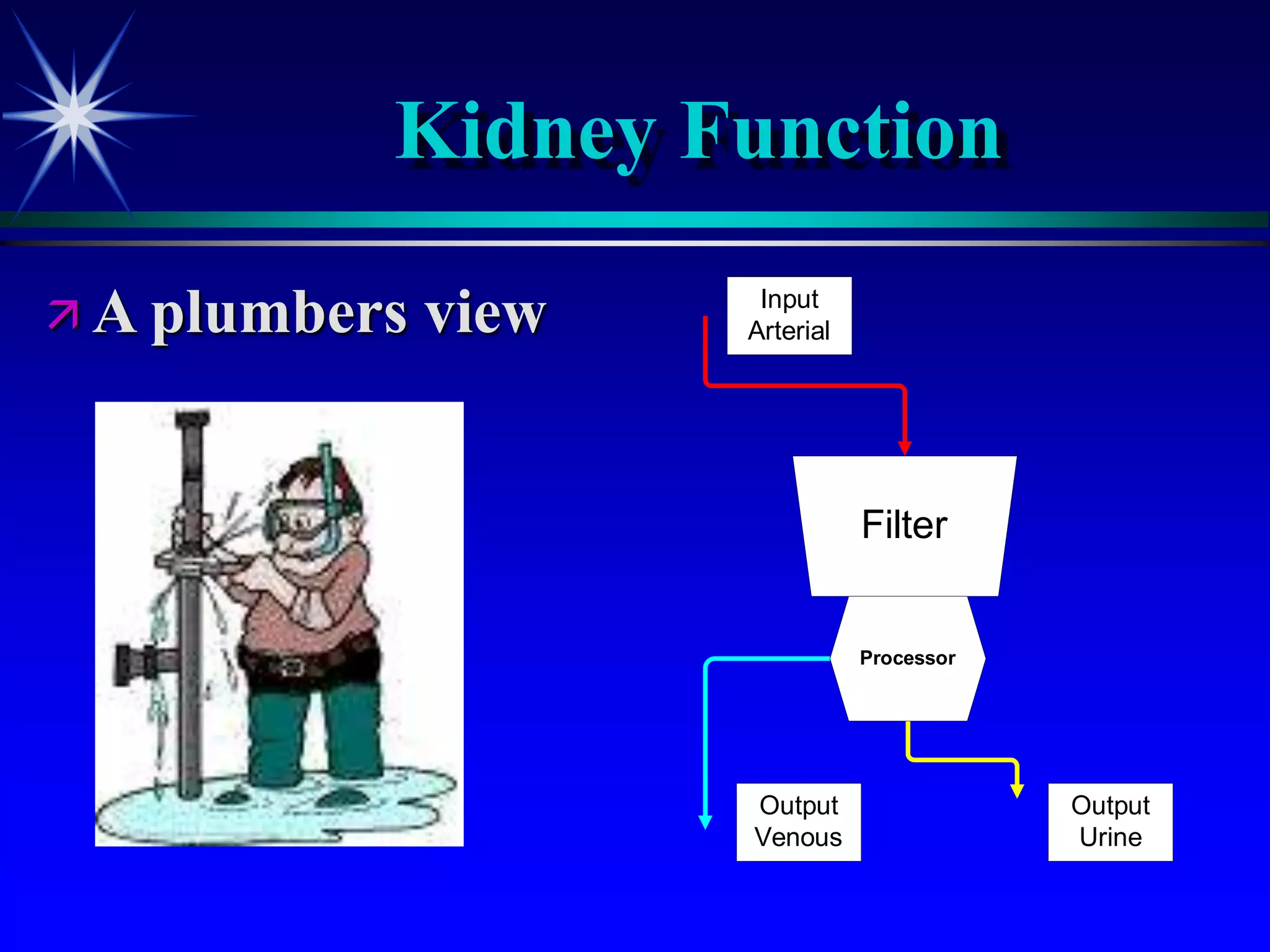
Kidney Function
 A plumbers view
Filter
Processor
Input
Arterial
Output
Venous
Output
Urine
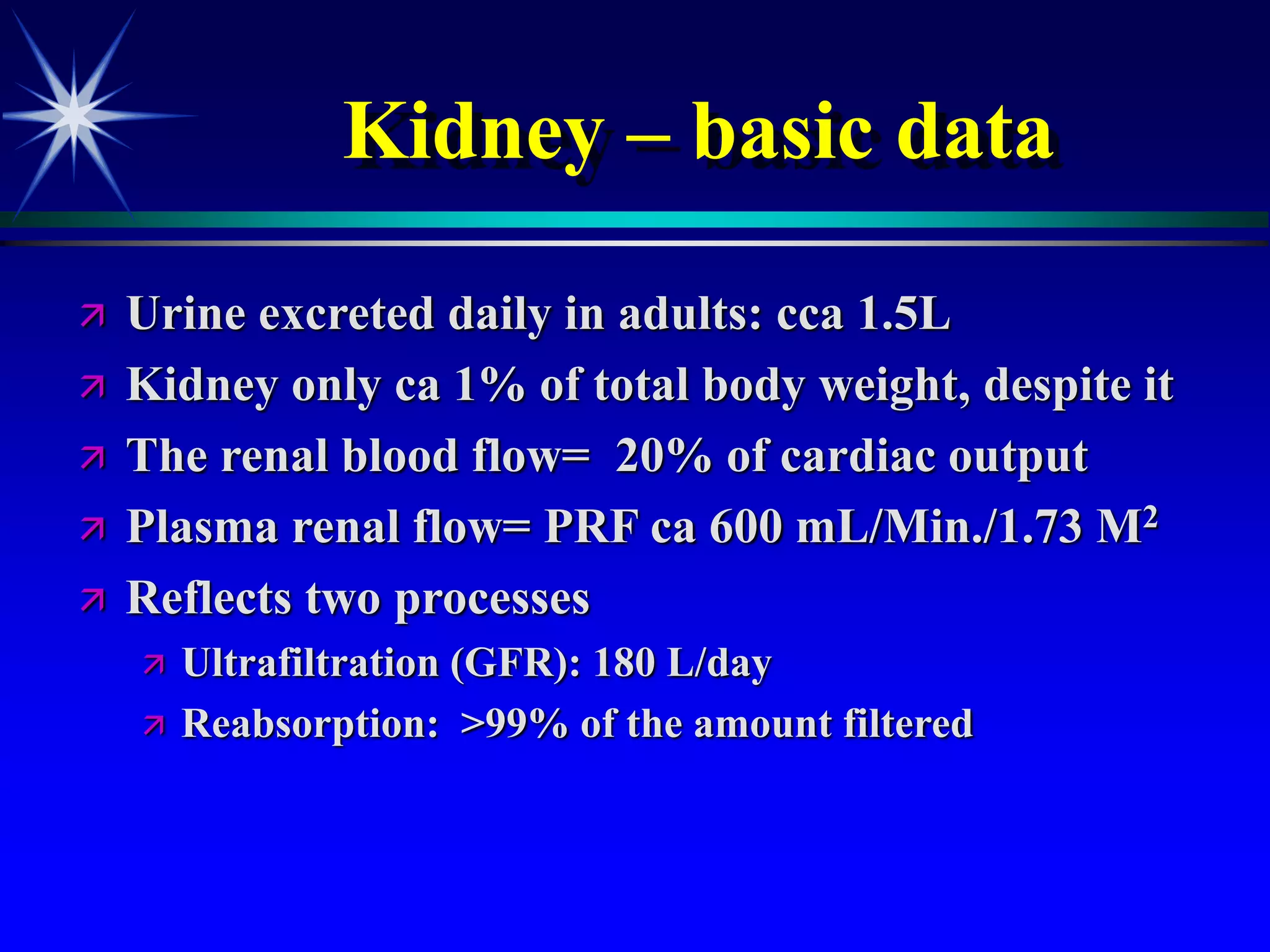
Kidney – basic data
 Urine excreted daily in adults: cca 1.5L
 Kidney only ca 1% of total body weight, despite it
 The renal blood flow= 20% of cardiac output
 Plasma renal flow= PRF ca 600 mL/Min./1.73 M2
 Reflects two processes
 Ultrafiltration (GFR): 180 L/day
 Reabsorption: >99% of the amount filtered
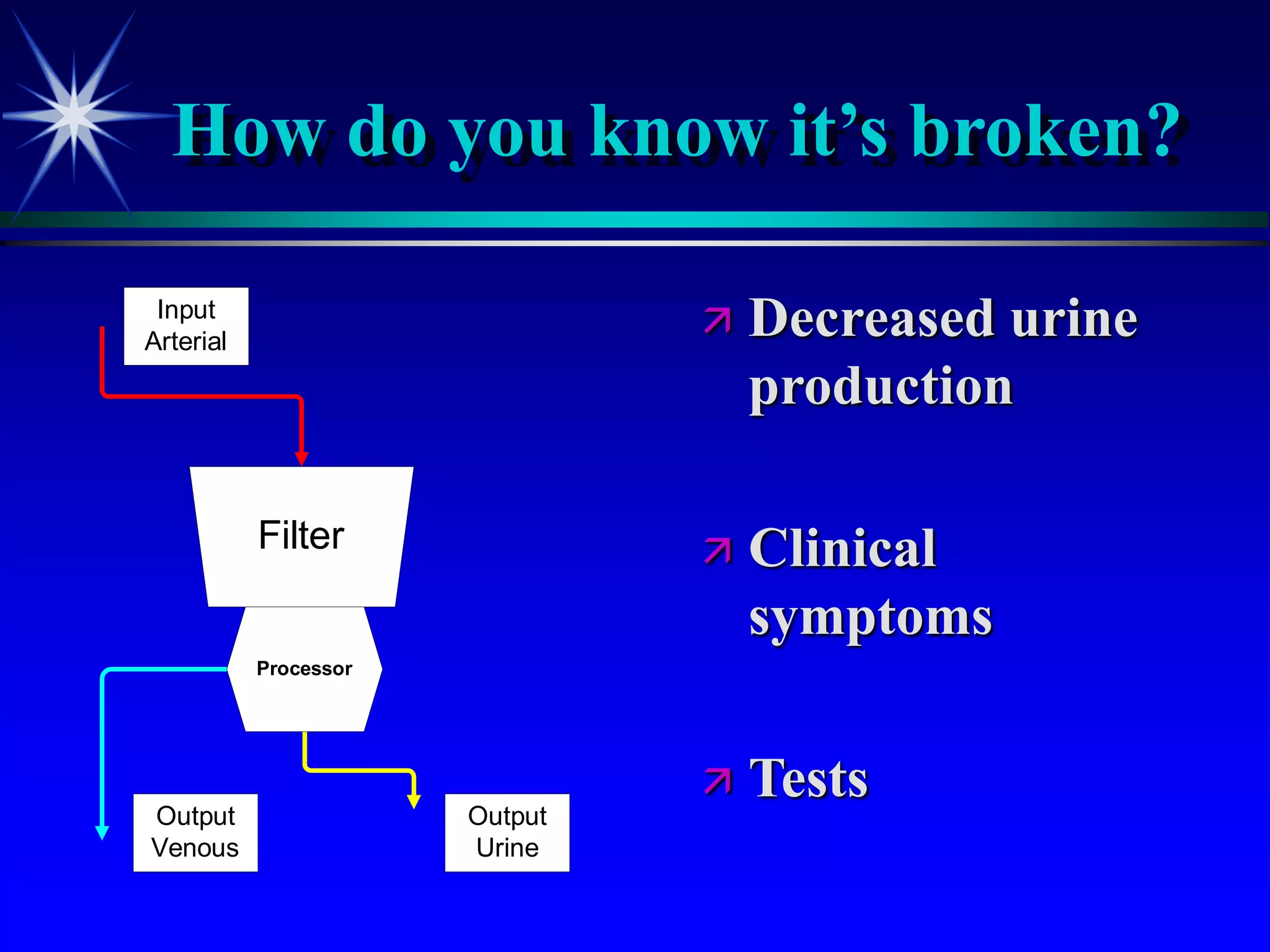
How do you know it’s broken?
 Decreased urine
production
 Clinical
symptoms
 Tests
Filter
Processor
Input
Arterial
Output
Venous
Output
Urine
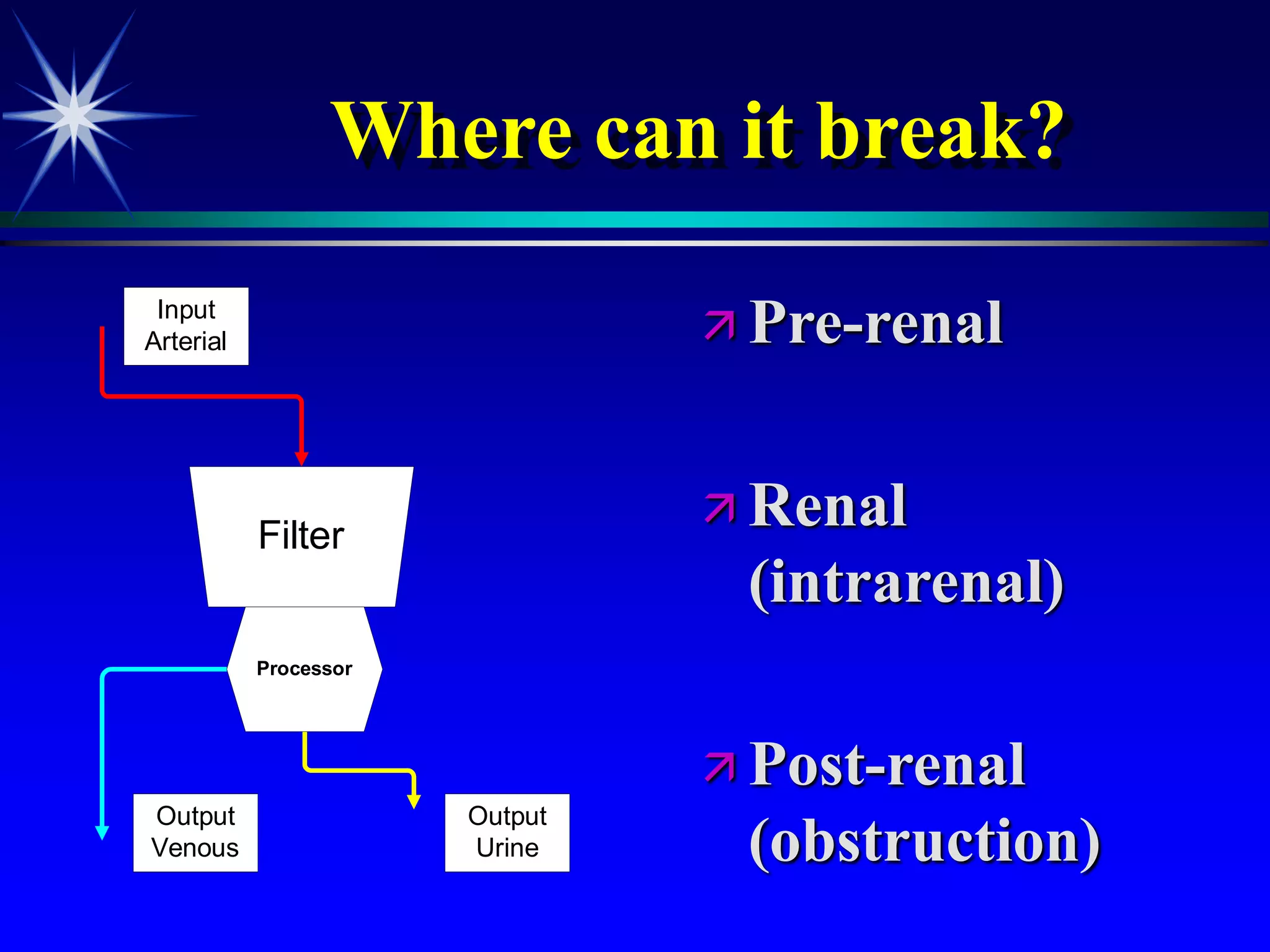
Where can it break?
 Pre-renal
 Renal
(intrarenal)
 Post-renal
(obstruction)
Filter
Processor
Input
Arterial
Output
Venous
Output
Urine
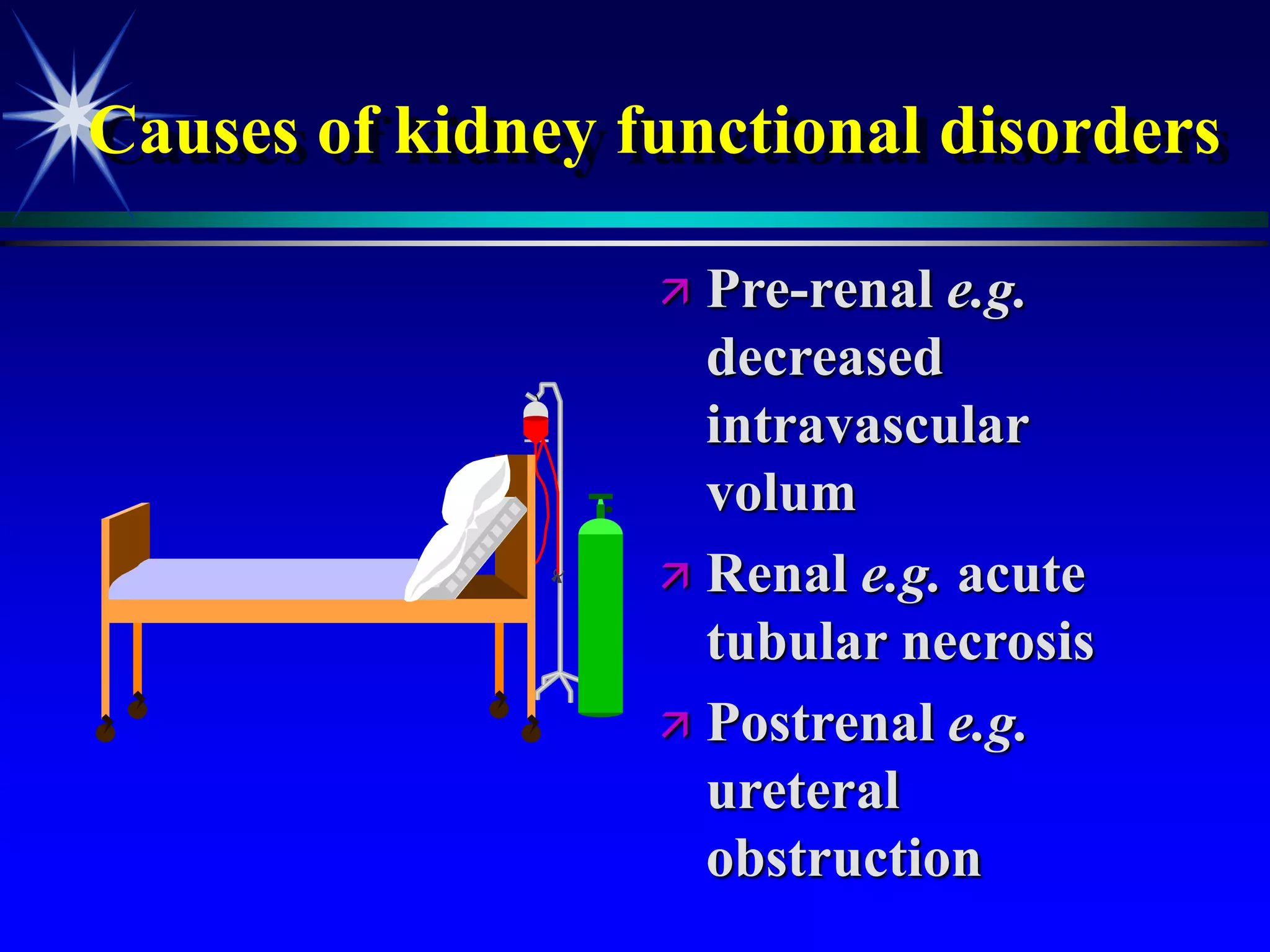
Causes of kidney functional disorders
 Pre-renal e.g.
decreased
intravascular
volum
 Renal e.g. acute
tubular necrosis
 Postrenal e.g.
ureteral
obstruction
Tests of renal function
 glomerular filtration
rate=GFR
 plasma creatinine= Pcr
 plasma urea-Purea
 urine volume= V
 urine urea- Uurea
 cystatin C in plasma?
 urine protein
 urine glucose
 hematuria
 osmolality
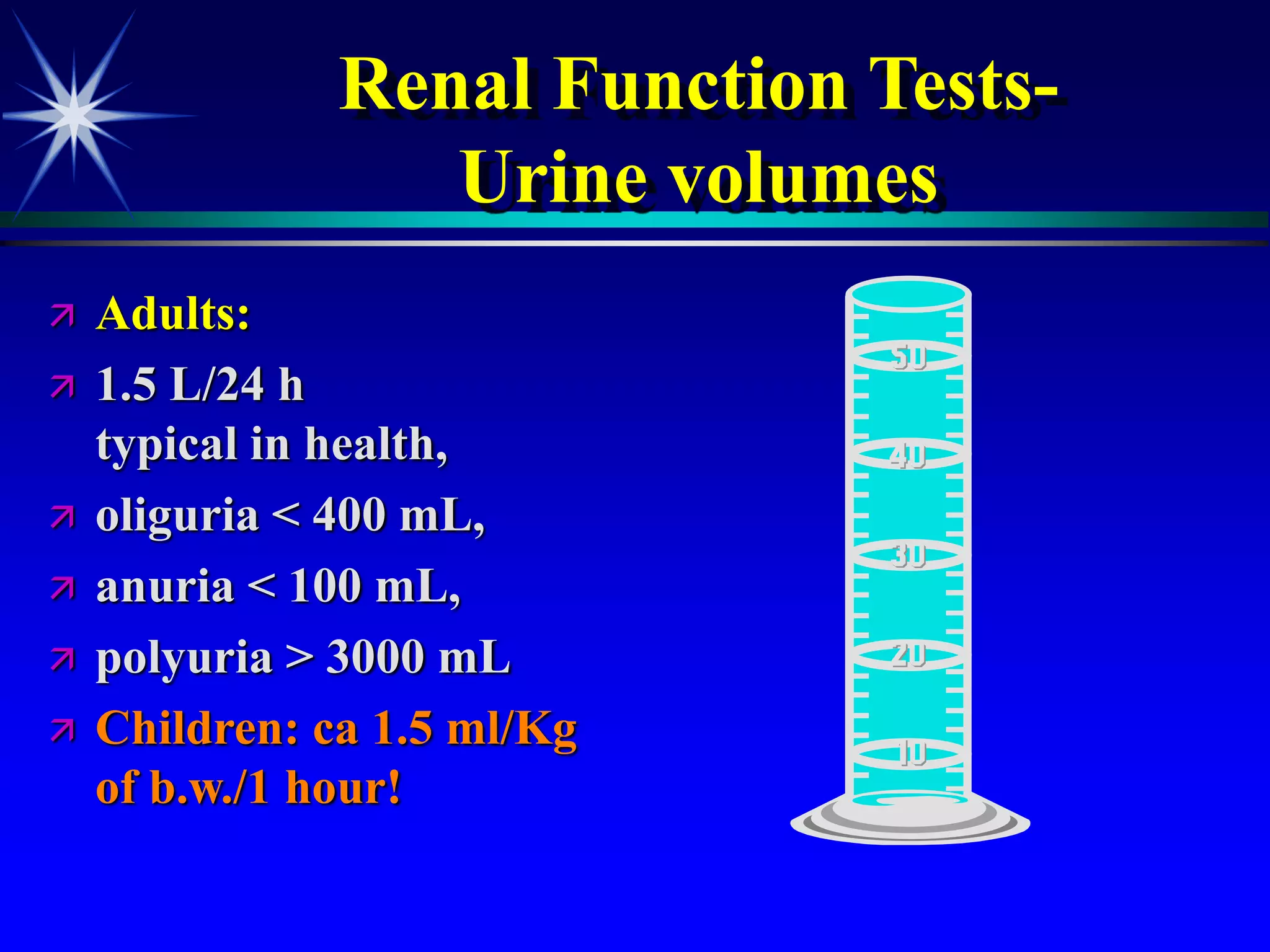
Renal Function Tests-
Urine volumes
 Adults:
 1.5 L/24 h
typical in health,
 oliguria < 400 mL,
 anuria < 100 mL,
 polyuria > 3000 mL
 Children: ca 1.5 ml/Kg
of b.w./1 hour!
Principle of of Clearance
 Some substances when filtered enter the tubules
are not reabsorbed and so 100% excreted= GFR
(inulin= gold standard for GFR, creatinine (but
this one partially reabsorbed, particularly in
uremia, then clearance <GFR
 Some substances are filtered, enter tubules, and
more of the substance is secreted enters the
tubules by excretion. Clearance>GFR
 Some substances are filtered, enter tubules, but
are completely reabsorbed, so they did not
reach the final urine (e.g. cystatin C)
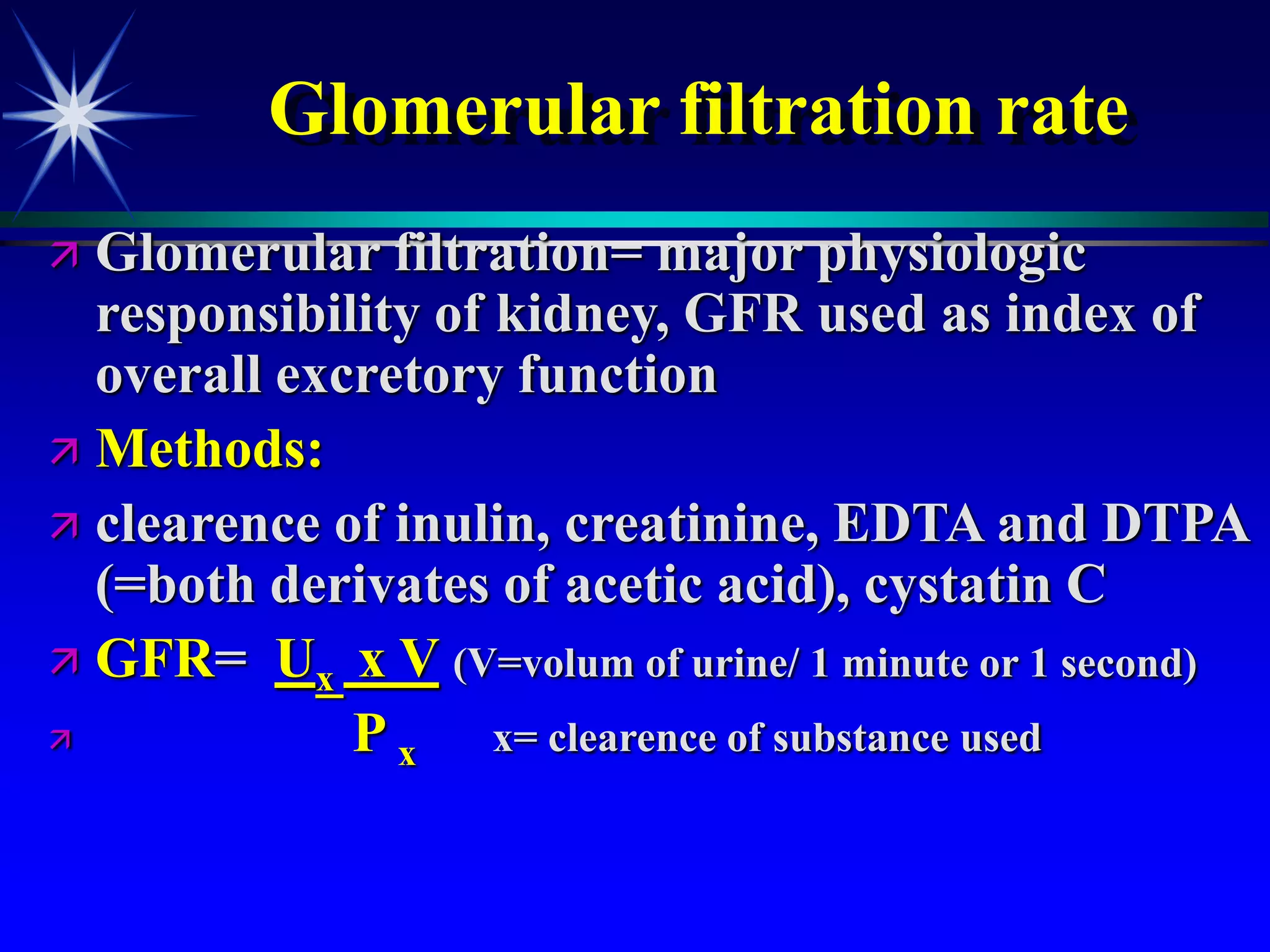
Glomerular filtration rate
 Glomerular filtration= major physiologic
responsibility of kidney, GFR used as index of
overall excretory function
 Methods:
 clearence of inulin, creatinine, EDTA and DTPA
(=both derivates of acetic acid), cystatin C
 GFR= Ux x V (V=volum of urine/ 1 minute or 1 second)
 P x x= clearence of substance used
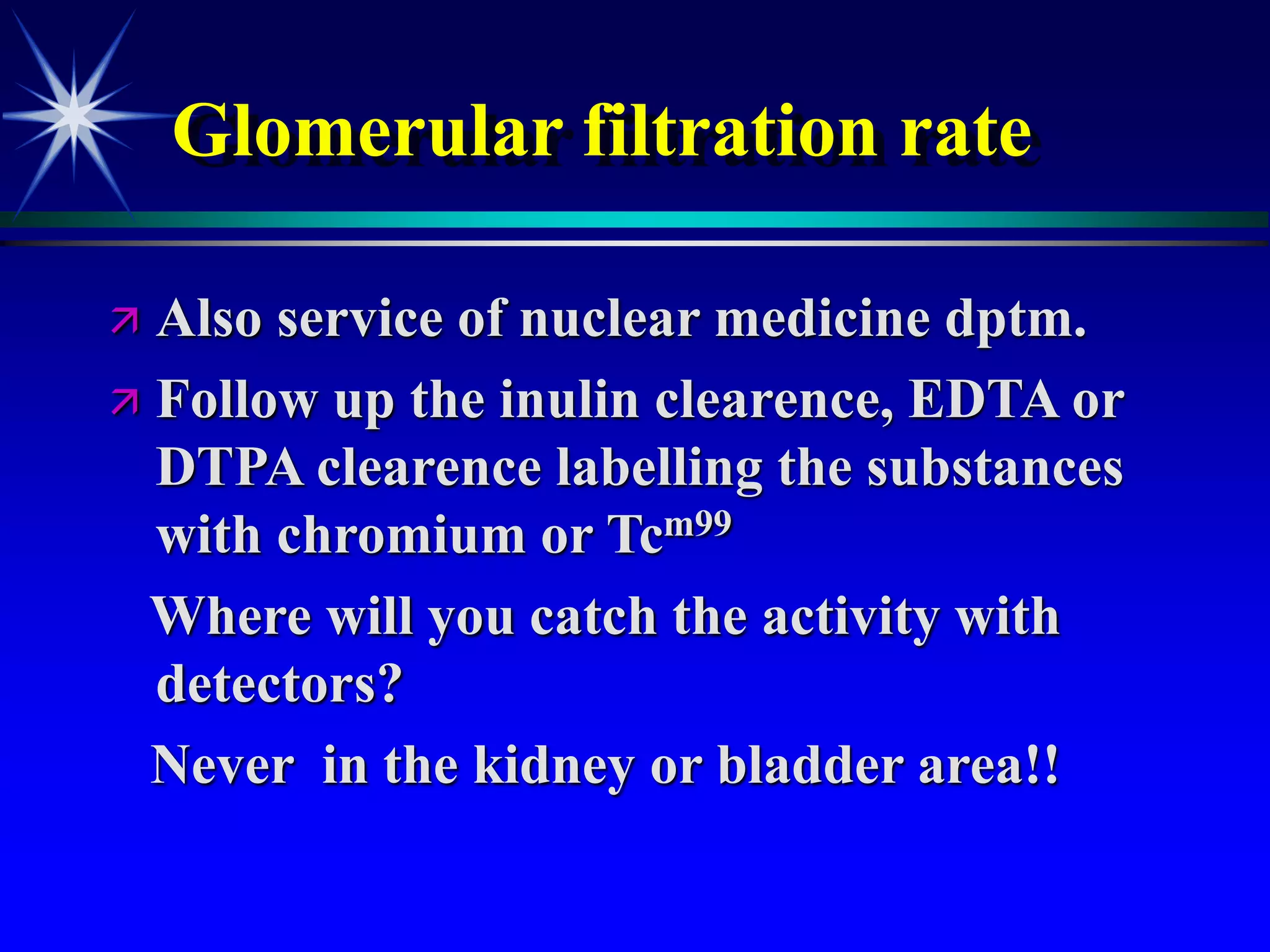
Glomerular filtration rate
 Also service of nuclear medicine dptm.
 Follow up the inulin clearence, EDTA or
DTPA clearence labelling the substances
with chromium or Tcm99
Where will you catch the activity with
detectors?
Never in the kidney or bladder area!!
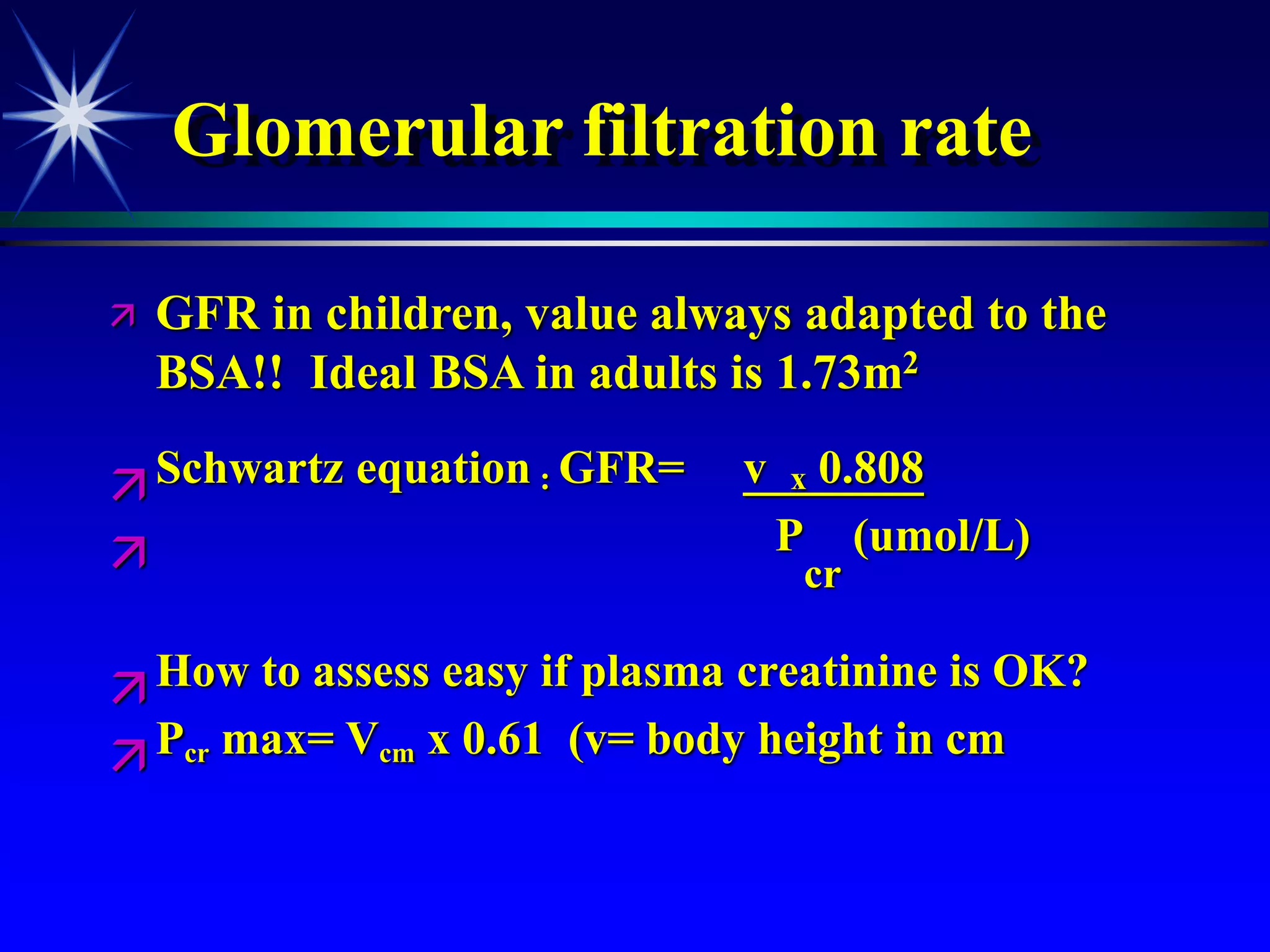
Glomerular filtration rate
 GFR in children, value always adapted to the
BSA!! Ideal BSA in adults is 1.73m2
Schwartz equation : GFR= v x 0.808
 P
cr
(umol/L)
How to assess easy if plasma creatinine is OK?
Pcr max= Vcm x 0.61 (v= body height in cm
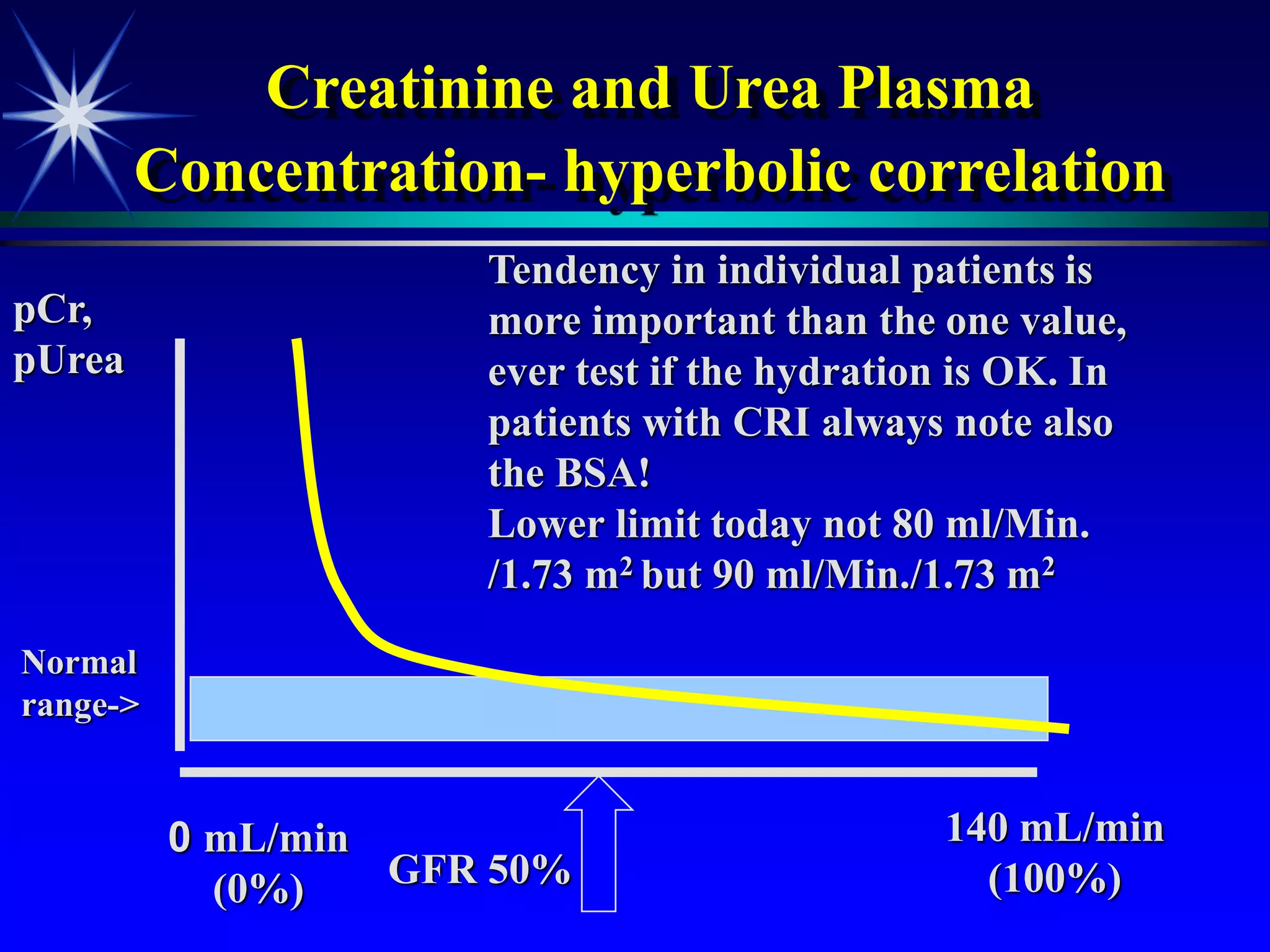
Creatinine and Urea Plasma
Concentration- hyperbolic correlation
GFR 50%
pCr,
pUrea
140 mL/min
(100%)
0 mL/min
(0%)
Tendency in individual patients is
more important than the one value,
ever test if the hydration is OK. In
patients with CRI always note also
the BSA!
Lower limit today not 80 ml/Min.
/1.73 m2 but 90 ml/Min./1.73 m2
Normal
range->
Plasma urea (BUN)
 = BUN (blood urea nitrogen)
 Urea: product of protein catabolism
 Synthesized by liver, majority
excreted by kidney, partially
reabsorbed in tubuli
 Plasma concentration increases with
decreased GFR
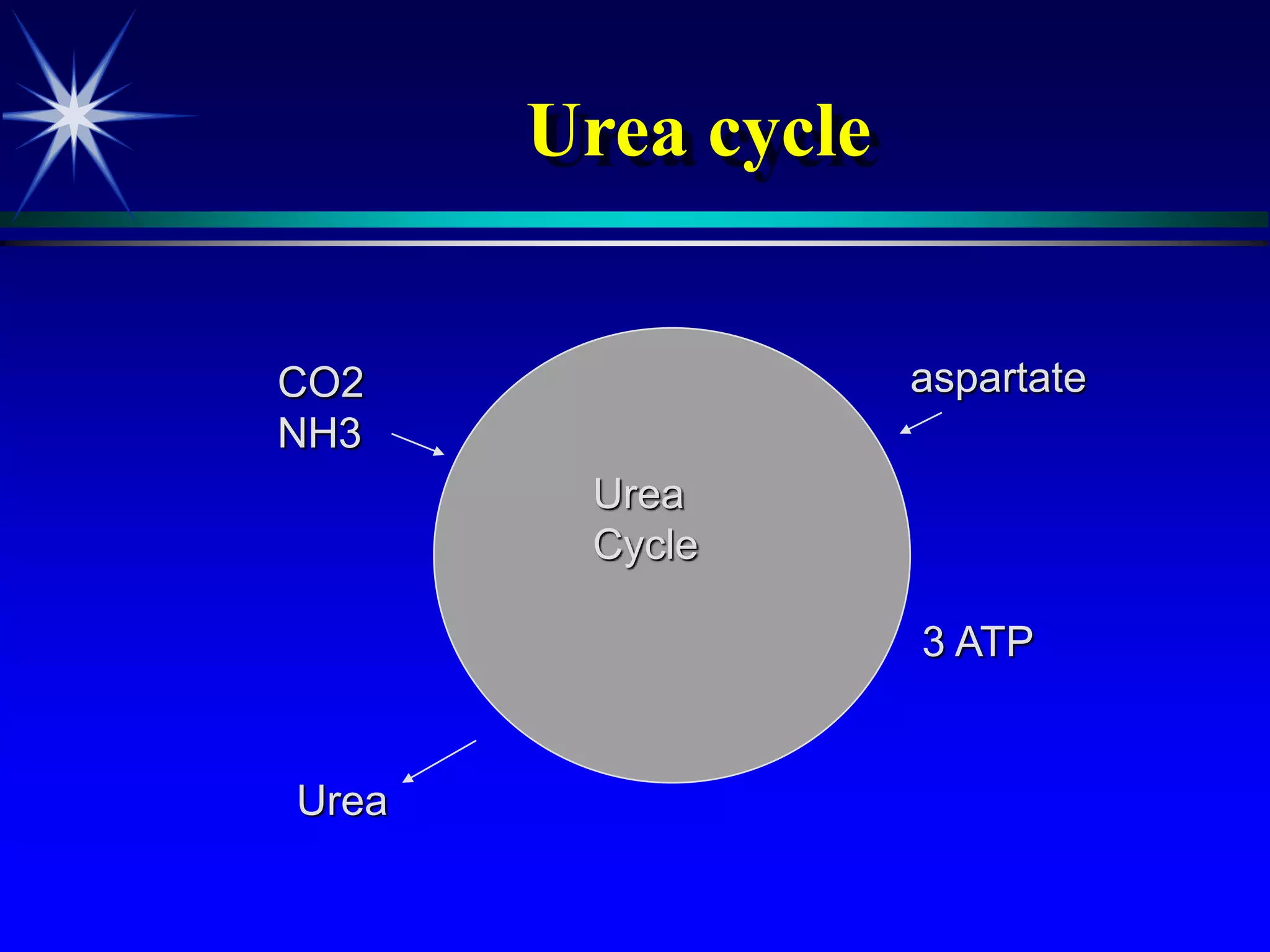
Urea cycle
CO2
NH3
aspartate
Urea
3 ATP
Urea
Cycle
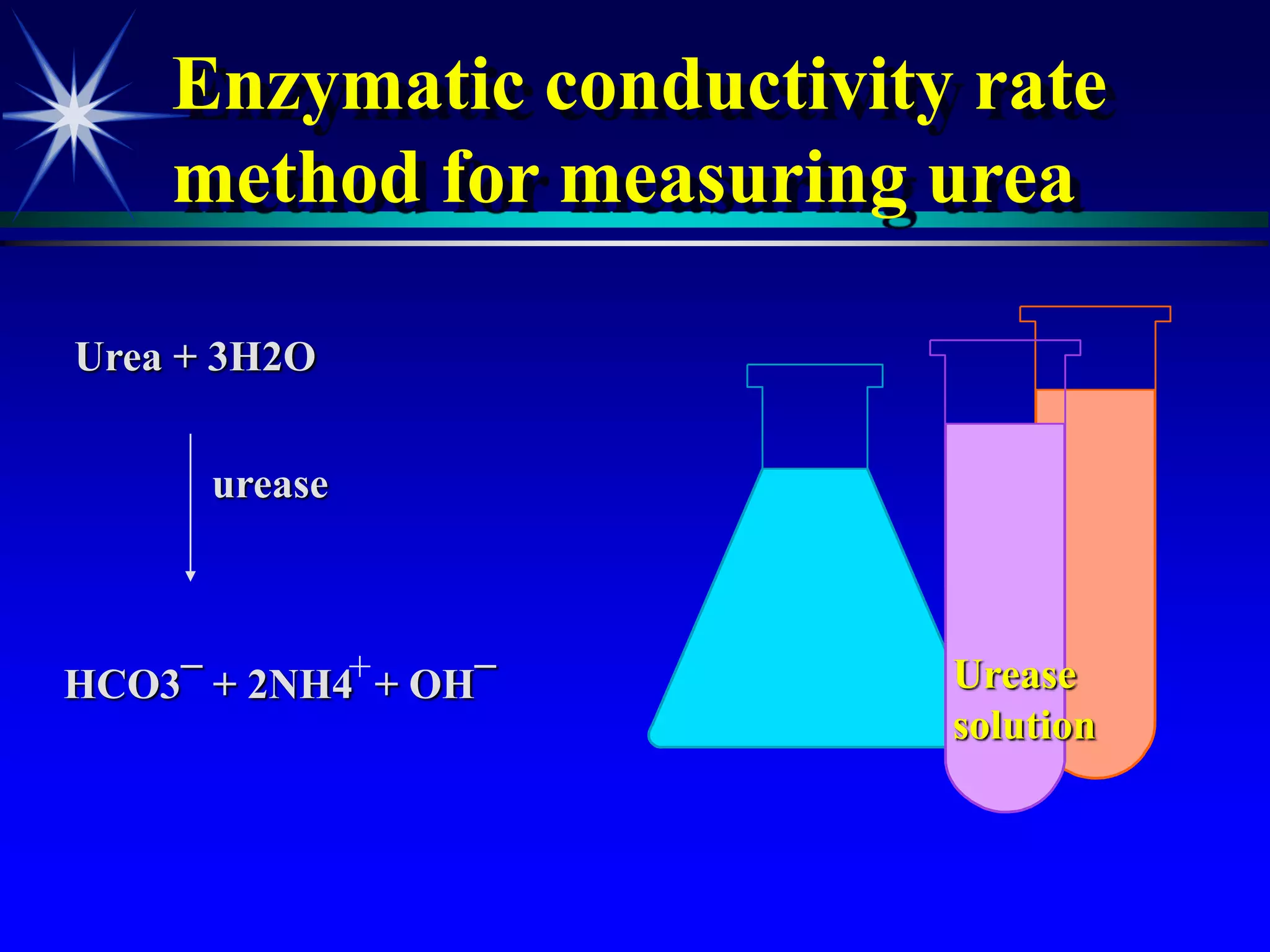
Enzymatic conductivity rate
method for measuring urea
Urease
solution
Urea + 3H2O
HCO3¯ + 2NH4 + OH¯
urease
Urea in patients
with kidney diseases
 Useful test but must be interpreted with
great care, urea plasma level is more than
creatinine dependent on protein intake
Most useful when considered along with
creatinine
 High in high protein intake, low in severe
liver dysfunction
 Urea EF may be useful in pts. on diuretics
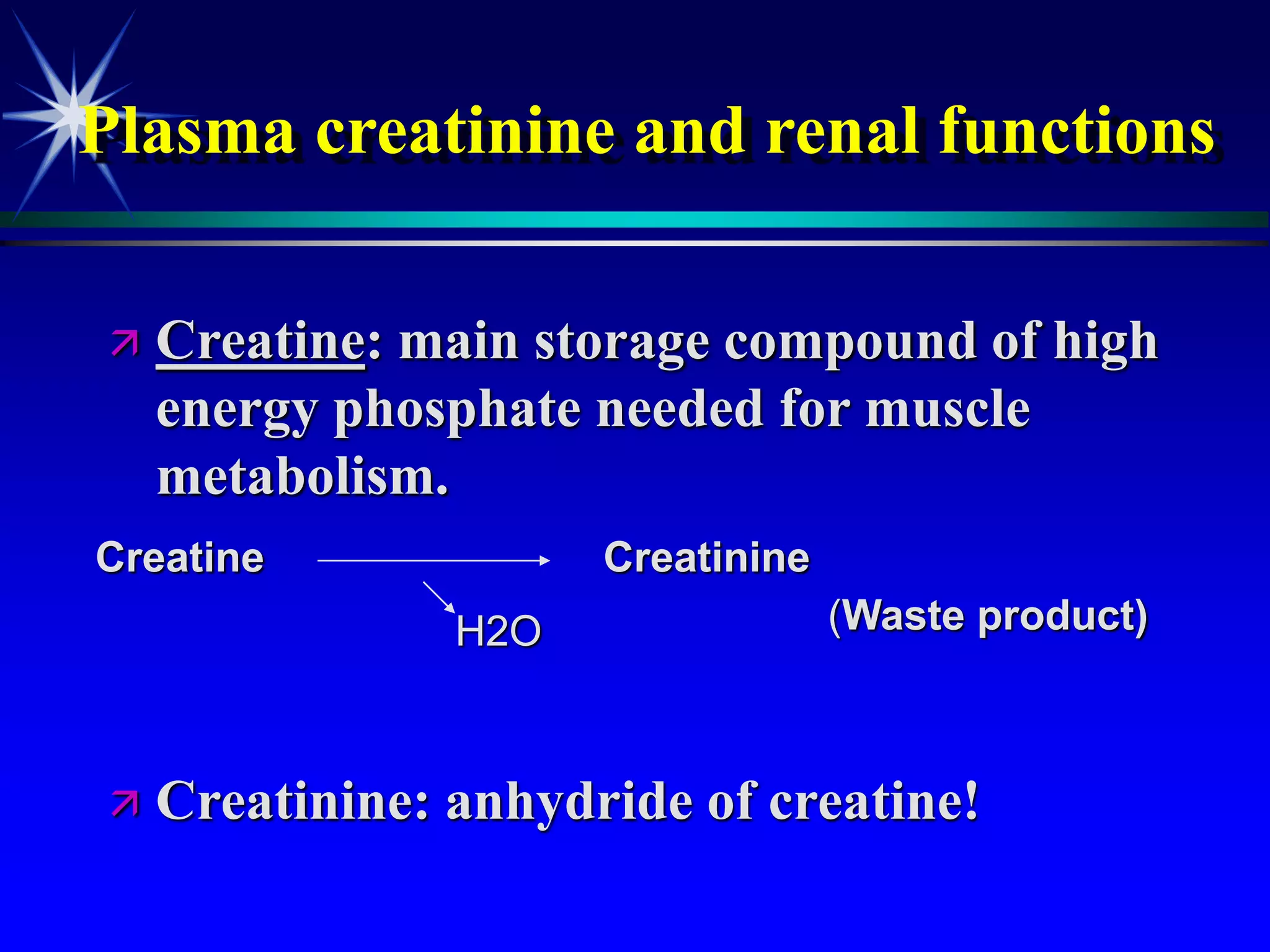
Plasma creatinine and renal functions
 Creatine: main storage compound of high
energy phosphate needed for muscle
metabolism.
 Creatinine: anhydride of creatine!
Creatine Creatinine
(Waste product)
H2O
Plasma creatinine vs. GFR
not linear, hyperbolic correlation!
GFR
[pCreat]
140 mL/min
(100%)
0 mL/min
(0%)
Change within an
individual patient is usually
more important than the
absolute value
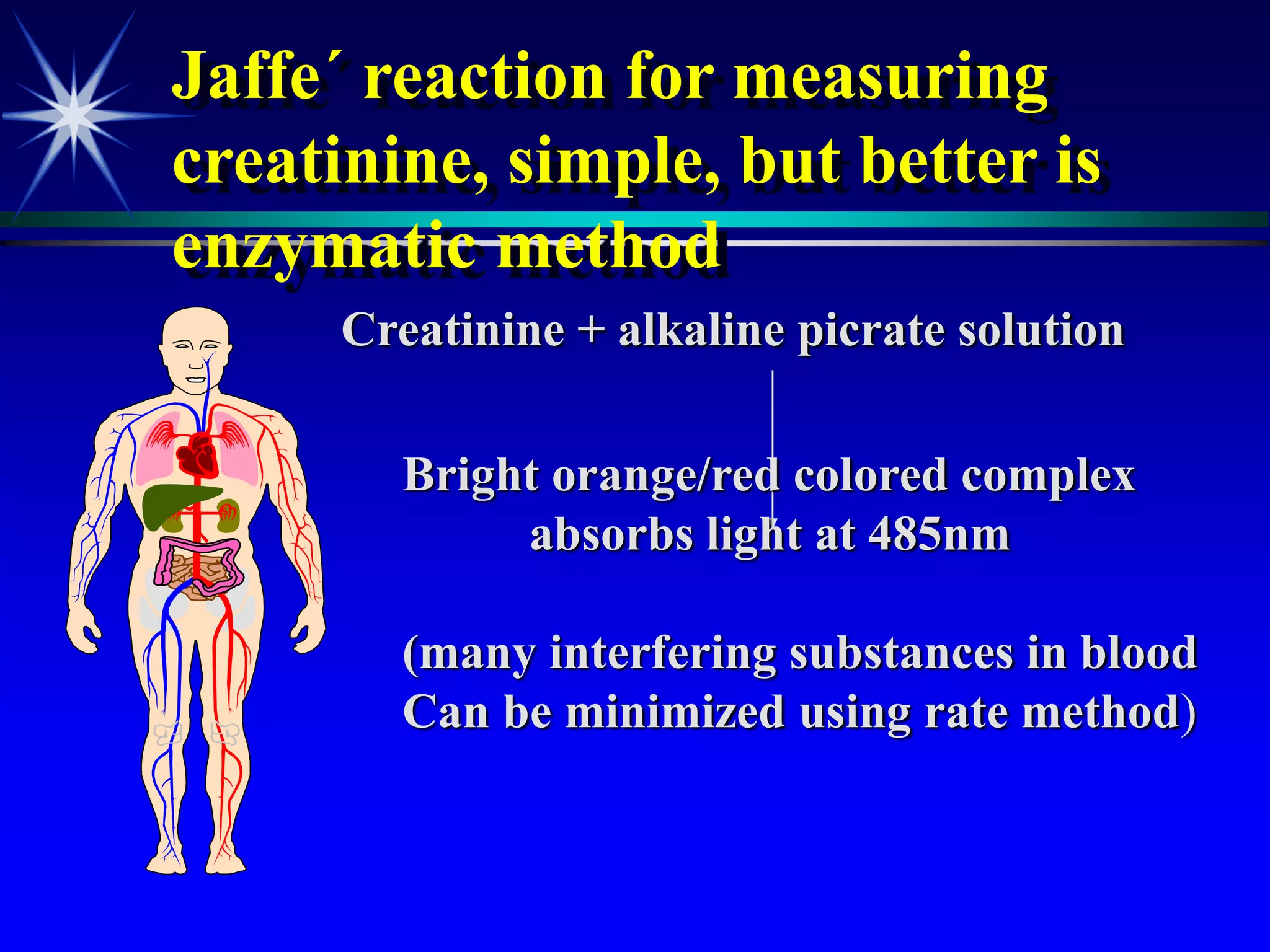
Jaffe´ reaction for measuring
creatinine, simple, but better is
enzymatic method
Creatinine + alkaline picrate solution
Bright orange/red colored complex
absorbs light at 485nm
(many interfering substances in blood
Can be minimized using rate method)
Analytical methods (Cr)
 Normal range Pcr
Male 0.6-1.2 mg/dL,
Female 0.5-1.0 mg/dL
Be careful in children!!
Remember the max.
plasma creatinine
value!!
BUN: creatinine ratio
 Pre-renal disorders
 BUN:Cr ratio >20
 Renal disorders
 BUN: Cr nl but both
elevated
 Post-renal
Filter
Processor
Input
Arterial
Output
Venous
Output
Urine
Osmolality of urine
 Measures urine concentrating ability
 Depends on # of particles, not size or charge
 Largely due to ADH (anti-diuretic hormone)
 Can reach maximum of 1200 mOsm/L
 Normal range: 300-900mOsm/L, plasma 285+10
 prior to collection, fluid intake restricted, first
void submitted for evaluation
 Measuring using the fact of freezing point
depression
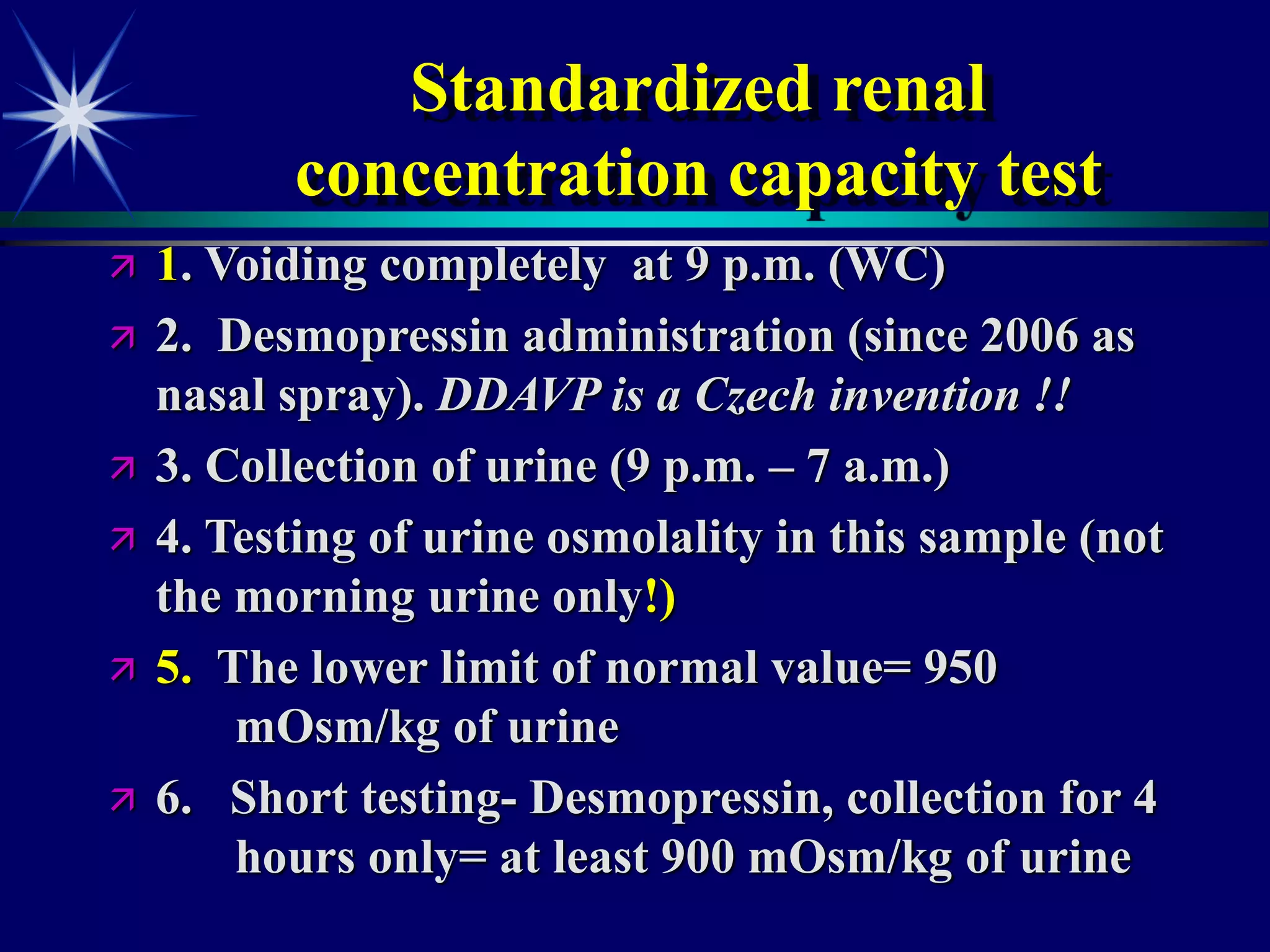
Standardized renal
concentration capacity test
 1. Voiding completely at 9 p.m. (WC)
 2. Desmopressin administration (since 2006 as
nasal spray). DDAVP is a Czech invention !!
 3. Collection of urine (9 p.m. – 7 a.m.)
 4. Testing of urine osmolality in this sample (not
the morning urine only!)
 5. The lower limit of normal value= 950
mOsm/kg of urine
 6. Short testing- Desmopressin, collection for 4
hours only= at least 900 mOsm/kg of urine
Urine dipsticks
 Strip impregnated with reagents for the substances in
question within a urine sample
 Substance level can be altered in the setting of pathology
within the urinary tract
 Measured substances:
 Modern dipsticks with multiplied zones:
 Protein, hemoglobin, glucose, urobilinogen, nitrite,
leukocytes, specific gravity, and pH
 Should be a tool everywhere on the level of primary
care!!!

Renal functions.ppt

  • 1.
    Renal function- basicdata for students and residents Department of Paediatrics Section for Pediatric Nephrology University Hospital Motol, Prague
  • 2.
    Functions of thekidney regulation e.g. homeostasis, water, acid/base excretion e.g. urea, creatinine endocrine e.g. renin, erythropoietin, 1,25 dihydroxycholecalciferol- conversion only in kidney!
  • 3.
    Renal function tests detect renal damage  monitor functional damage  help determine etiology
  • 4.
    Laboratory tests ofrenal function  glomerular filtration rate (GFR)  plasma creatinine  plasma urea  urine volume  urine urea  minerals in urine  urine protein  urine glucose  hematuria  osmolality
  • 5.
    Kidney Function  Aplumbers view Filter Processor Input Arterial Output Venous Output Urine
  • 6.
    Kidney – basicdata  Urine excreted daily in adults: cca 1.5L  Kidney only ca 1% of total body weight, despite it  The renal blood flow= 20% of cardiac output  Plasma renal flow= PRF ca 600 mL/Min./1.73 M2  Reflects two processes  Ultrafiltration (GFR): 180 L/day  Reabsorption: >99% of the amount filtered
  • 7.
    How do youknow it’s broken?  Decreased urine production  Clinical symptoms  Tests Filter Processor Input Arterial Output Venous Output Urine
  • 8.
    Where can itbreak?  Pre-renal  Renal (intrarenal)  Post-renal (obstruction) Filter Processor Input Arterial Output Venous Output Urine
  • 9.
    Causes of kidneyfunctional disorders  Pre-renal e.g. decreased intravascular volum  Renal e.g. acute tubular necrosis  Postrenal e.g. ureteral obstruction
  • 10.
    Tests of renalfunction  glomerular filtration rate=GFR  plasma creatinine= Pcr  plasma urea-Purea  urine volume= V  urine urea- Uurea  cystatin C in plasma?  urine protein  urine glucose  hematuria  osmolality
  • 11.
    Renal Function Tests- Urinevolumes  Adults:  1.5 L/24 h typical in health,  oliguria < 400 mL,  anuria < 100 mL,  polyuria > 3000 mL  Children: ca 1.5 ml/Kg of b.w./1 hour!
  • 12.
    Principle of ofClearance  Some substances when filtered enter the tubules are not reabsorbed and so 100% excreted= GFR (inulin= gold standard for GFR, creatinine (but this one partially reabsorbed, particularly in uremia, then clearance <GFR  Some substances are filtered, enter tubules, and more of the substance is secreted enters the tubules by excretion. Clearance>GFR  Some substances are filtered, enter tubules, but are completely reabsorbed, so they did not reach the final urine (e.g. cystatin C)
  • 13.
    Glomerular filtration rate Glomerular filtration= major physiologic responsibility of kidney, GFR used as index of overall excretory function  Methods:  clearence of inulin, creatinine, EDTA and DTPA (=both derivates of acetic acid), cystatin C  GFR= Ux x V (V=volum of urine/ 1 minute or 1 second)  P x x= clearence of substance used
  • 14.
    Glomerular filtration rate Also service of nuclear medicine dptm.  Follow up the inulin clearence, EDTA or DTPA clearence labelling the substances with chromium or Tcm99 Where will you catch the activity with detectors? Never in the kidney or bladder area!!
  • 15.
    Glomerular filtration rate GFR in children, value always adapted to the BSA!! Ideal BSA in adults is 1.73m2 Schwartz equation : GFR= v x 0.808  P cr (umol/L) How to assess easy if plasma creatinine is OK? Pcr max= Vcm x 0.61 (v= body height in cm
  • 16.
    Creatinine and UreaPlasma Concentration- hyperbolic correlation GFR 50% pCr, pUrea 140 mL/min (100%) 0 mL/min (0%) Tendency in individual patients is more important than the one value, ever test if the hydration is OK. In patients with CRI always note also the BSA! Lower limit today not 80 ml/Min. /1.73 m2 but 90 ml/Min./1.73 m2 Normal range->
  • 17.
    Plasma urea (BUN) = BUN (blood urea nitrogen)  Urea: product of protein catabolism  Synthesized by liver, majority excreted by kidney, partially reabsorbed in tubuli  Plasma concentration increases with decreased GFR
  • 18.
  • 19.
    Enzymatic conductivity rate methodfor measuring urea Urease solution Urea + 3H2O HCO3¯ + 2NH4 + OH¯ urease
  • 20.
    Urea in patients withkidney diseases  Useful test but must be interpreted with great care, urea plasma level is more than creatinine dependent on protein intake Most useful when considered along with creatinine  High in high protein intake, low in severe liver dysfunction  Urea EF may be useful in pts. on diuretics
  • 21.
    Plasma creatinine andrenal functions  Creatine: main storage compound of high energy phosphate needed for muscle metabolism.  Creatinine: anhydride of creatine! Creatine Creatinine (Waste product) H2O
  • 22.
    Plasma creatinine vs.GFR not linear, hyperbolic correlation! GFR [pCreat] 140 mL/min (100%) 0 mL/min (0%) Change within an individual patient is usually more important than the absolute value
  • 23.
    Jaffe´ reaction formeasuring creatinine, simple, but better is enzymatic method Creatinine + alkaline picrate solution Bright orange/red colored complex absorbs light at 485nm (many interfering substances in blood Can be minimized using rate method)
  • 24.
    Analytical methods (Cr) Normal range Pcr Male 0.6-1.2 mg/dL, Female 0.5-1.0 mg/dL Be careful in children!! Remember the max. plasma creatinine value!!
  • 25.
    BUN: creatinine ratio Pre-renal disorders  BUN:Cr ratio >20  Renal disorders  BUN: Cr nl but both elevated  Post-renal Filter Processor Input Arterial Output Venous Output Urine
  • 26.
    Osmolality of urine Measures urine concentrating ability  Depends on # of particles, not size or charge  Largely due to ADH (anti-diuretic hormone)  Can reach maximum of 1200 mOsm/L  Normal range: 300-900mOsm/L, plasma 285+10  prior to collection, fluid intake restricted, first void submitted for evaluation  Measuring using the fact of freezing point depression
  • 27.
    Standardized renal concentration capacitytest  1. Voiding completely at 9 p.m. (WC)  2. Desmopressin administration (since 2006 as nasal spray). DDAVP is a Czech invention !!  3. Collection of urine (9 p.m. – 7 a.m.)  4. Testing of urine osmolality in this sample (not the morning urine only!)  5. The lower limit of normal value= 950 mOsm/kg of urine  6. Short testing- Desmopressin, collection for 4 hours only= at least 900 mOsm/kg of urine
  • 28.
    Urine dipsticks  Stripimpregnated with reagents for the substances in question within a urine sample  Substance level can be altered in the setting of pathology within the urinary tract  Measured substances:  Modern dipsticks with multiplied zones:  Protein, hemoglobin, glucose, urobilinogen, nitrite, leukocytes, specific gravity, and pH  Should be a tool everywhere on the level of primary care!!!