Renal  Failure Nico Caponi
Overview Why I chose it? What is it? Causes Diagnostic Approach Treatment
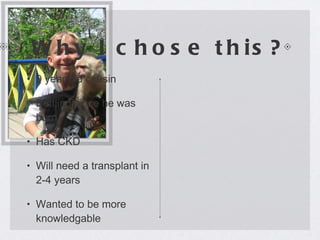
Why I chose this? 9 year old cousin Battling since he was born Has CKD Will need a transplant in 2-4 years Wanted to be more knowledgable
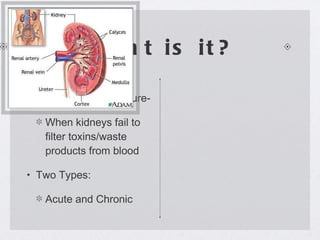
What is it? Renal or Kidney Failure- When kidneys fail to filter toxins/waste products from blood Two Types: Acute and Chronic
Acute Kidney Injury (AKI) (AKI) Rapid loss of kidney function Caused by numerous things Prerenal - decrease blood flow to kidney Intrinsic - damage to glomeruli, renal tubules, or interstitium Postrenal - Urinary tract obstruction
Diagnosis of AKI Based on clinical history and laboratory data Rapid reduction in kidney function - Serum creatinine levels Rapid reduction in urine output Further testing Urine sediment analysis, renal ultrasound, or kidney biopsy
AKI  Treatment Specific Therapies AKI without fluid overload- Administer intravenous fluids AKI with low BP- Inotropes may be administered  i.e.- norepinephrine or dobutamine Intrinsic AKI- Each have specific therapies pending on what causes it i.e. Wegener’s granulomatosis would require steroid medication Renal replacement
Chronic Kidney Disease (CKD) (CKD) Progressive loss in kidney function over a period of months or years Range of symptoms feeling generally unwell reduced appetite may not be found until you have a disease related to it i.e. Cardiovascular disease, anemia, or pericarditis
Causes of CKD 3 Most Common Diabetes mellitus, hypertension, and glomerulonephritis Others Vascular: Large/small vessel diseases Glomerular: Primary/Secondary glomerular disease Tubulointerstitial: Polycystic kidney disease Obstructive: Kidney stones and diseases of the prostate
Diagnosis of CKD Many times previous renal disease or other disease are present Glomerular filtration rate (GFR) <60mL/min/1.73m 2  for 3 months CKD and AKI contrasts CKD = smaller kidneys CKD serum creatinine levels increase over months and years  Tests Nuclear medicine MAG3 scan, DMSA
Stages of CKD Stage 1: Slightly diminished function, normal/high GFR Stage 2: Kidney Damage, mild reduction in GFR Stage 3: Moderate reduction in GFR Stage 4: Preparing for failure, severe reduction in GFR Stage 5: Kidney failure
Treatment Goal is to slow or halt CKD before Stage 5 Control BP Treat original disease (when possible) Angiotensin Converting Enzyme Inhibitors (ACEIs) or Angiotensin II Receptor Antagonists (ARBs) If Stage 5 is reached either dialysis or a transplant is necessary The most common cause of death in people with CKD is  NOT  renal failure
Bibliography  http://en.wikipedia.org/wiki/Renal_failure http://en.wikipedia.org/wiki/Chronic_kidney_disease http://en.wikipedia.org/wiki/Acute_kidney_injury

Renal failure

  • 1.
    Renal FailureNico Caponi
  • 2.
    Overview Why Ichose it? What is it? Causes Diagnostic Approach Treatment
  • 3.
    Why I chosethis? 9 year old cousin Battling since he was born Has CKD Will need a transplant in 2-4 years Wanted to be more knowledgable
  • 4.
    What is it?Renal or Kidney Failure- When kidneys fail to filter toxins/waste products from blood Two Types: Acute and Chronic
  • 5.
    Acute Kidney Injury(AKI) (AKI) Rapid loss of kidney function Caused by numerous things Prerenal - decrease blood flow to kidney Intrinsic - damage to glomeruli, renal tubules, or interstitium Postrenal - Urinary tract obstruction
  • 6.
    Diagnosis of AKIBased on clinical history and laboratory data Rapid reduction in kidney function - Serum creatinine levels Rapid reduction in urine output Further testing Urine sediment analysis, renal ultrasound, or kidney biopsy
  • 7.
    AKI TreatmentSpecific Therapies AKI without fluid overload- Administer intravenous fluids AKI with low BP- Inotropes may be administered i.e.- norepinephrine or dobutamine Intrinsic AKI- Each have specific therapies pending on what causes it i.e. Wegener’s granulomatosis would require steroid medication Renal replacement
  • 8.
    Chronic Kidney Disease(CKD) (CKD) Progressive loss in kidney function over a period of months or years Range of symptoms feeling generally unwell reduced appetite may not be found until you have a disease related to it i.e. Cardiovascular disease, anemia, or pericarditis
  • 9.
    Causes of CKD3 Most Common Diabetes mellitus, hypertension, and glomerulonephritis Others Vascular: Large/small vessel diseases Glomerular: Primary/Secondary glomerular disease Tubulointerstitial: Polycystic kidney disease Obstructive: Kidney stones and diseases of the prostate
  • 10.
    Diagnosis of CKDMany times previous renal disease or other disease are present Glomerular filtration rate (GFR) <60mL/min/1.73m 2 for 3 months CKD and AKI contrasts CKD = smaller kidneys CKD serum creatinine levels increase over months and years Tests Nuclear medicine MAG3 scan, DMSA
  • 11.
    Stages of CKDStage 1: Slightly diminished function, normal/high GFR Stage 2: Kidney Damage, mild reduction in GFR Stage 3: Moderate reduction in GFR Stage 4: Preparing for failure, severe reduction in GFR Stage 5: Kidney failure
  • 12.
    Treatment Goal isto slow or halt CKD before Stage 5 Control BP Treat original disease (when possible) Angiotensin Converting Enzyme Inhibitors (ACEIs) or Angiotensin II Receptor Antagonists (ARBs) If Stage 5 is reached either dialysis or a transplant is necessary The most common cause of death in people with CKD is NOT renal failure
  • 13.
    Bibliography http://en.wikipedia.org/wiki/Renal_failurehttp://en.wikipedia.org/wiki/Chronic_kidney_disease http://en.wikipedia.org/wiki/Acute_kidney_injury