RCS 6080
Medical and Psychosocial Aspects of
Rehabilitation Counseling
Renal Failure
Function of Kidneys
 Remove toxic waste products
 Remove excess water and salts
 Play a part in controlling blood pressure
 Produce erythropoetin (epo) which
stimulates red cell production
 Helps to keep calcium and phosphate in
balance for healthy bones
 Maintains proper pH for the blood
Definitions
 Azotemia: Elevated blood urea nitrogen
 (BUN>28mg/dL) & Creatinine (Cr>1.5mg/dL)
 Uremia: azotemia with symptoms or signs of renal
failure
 End Stage Renal Disease (ESRD): uremia
requiring transplantation or dialysis
 Chronic Renal Failure (CRF): irreversible kidney
dysfunction with azotemia >3 mos.
 Creatinine Clearance (CCr): rate of filtration of
creatinine by the kidney (marker for GFR)
 Glomerular Filtration Rate (GFR): the total rate of
filtration of blood by the kidney.
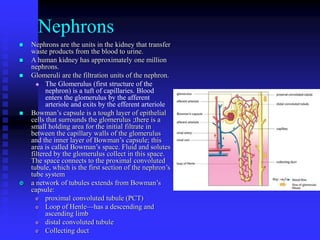
Nephrons
 Nephrons are the units in the kidney that transfer
waste products from the blood to urine.
 A human kidney has approximately one million
nephrons.
 Glomeruli are the filtration units of the nephron.
 The Glomerulus (first structure of the
nephron) is a tuft of capillaries. Blood
enters the glomerulus by the afferent
arteriole and exits by the efferent arteriole
 Bowman’s capsule is a tough layer of epithelial
cells that surrounds the glomerulus ;there is a
small holding area for the initial filtrate in
between the capillary walls of the glomerulus
and the inner layer of Bowman’s capsule; this
area is called Bowman’s space. Fluid and solutes
filtered by the glomerulus collect in this space.
The space connects to the proximal convoluted
tubule, which is the first section of the nephron’s
tube system
 a network of tubules extends from Bowman’s
capsule:
 proximal convoluted tubule (PCT)
 Loop of Henle—has a descending and
ascending limb
 distal convoluted tubule
 Collecting duct
Renal Failure
 Acute Renal Failure
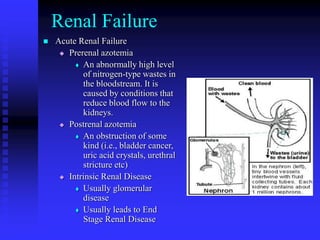
 Prerenal azotemia
 An abnormally high level
of nitrogen-type wastes in
the bloodstream. It is
caused by conditions that
reduce blood flow to the
kidneys.
 Postrenal azotemia
 An obstruction of some
kind (i.e., bladder cancer,
uric acid crystals, urethral
stricture etc)
 Intrinsic Renal Disease
 Usually glomerular
disease
 Usually leads to End
Stage Renal Disease
Chronic Renal Failure
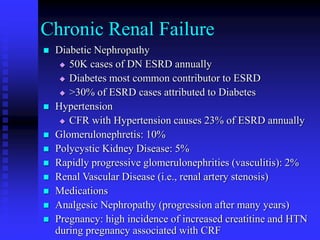
 Diabetic Nephropathy
 50K cases of DN ESRD annually
 Diabetes most common contributor to ESRD
 >30% of ESRD cases attributed to Diabetes
 Hypertension
 CFR with Hypertension causes 23% of ESRD annually
 Glomerulonephretis: 10%
 Polycystic Kidney Disease: 5%
 Rapidly progressive glomerulonephrities (vasculitis): 2%
 Renal Vascular Disease (i.e., renal artery stenosis)
 Medications
 Analgesic Nephropathy (progression after many years)
 Pregnancy: high incidence of increased creatitine and HTN
during pregnancy associated with CRF
Chronic Renal Failure
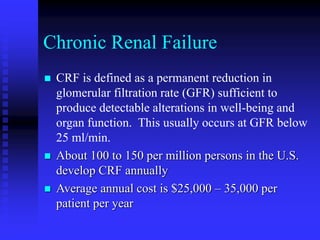
 CRF is defined as a permanent reduction in
glomerular filtration rate (GFR) sufficient to
produce detectable alterations in well-being and
organ function. This usually occurs at GFR below
25 ml/min.
 About 100 to 150 per million persons in the U.S.
develop CRF annually
 Average annual cost is $25,000 – 35,000 per
patient per year
Stages of Chronic Renal Failure
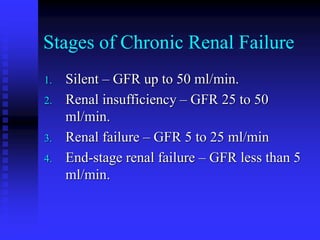
1. Silent – GFR up to 50 ml/min.
2. Renal insufficiency – GFR 25 to 50
ml/min.
3. Renal failure – GFR 5 to 25 ml/min
4. End-stage renal failure – GFR less than 5
ml/min.
Diabetic Nephropathy
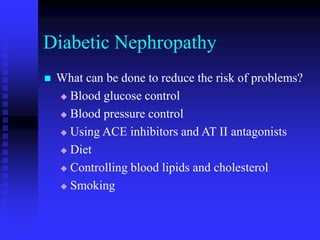
 What can be done to reduce the risk of problems?
 Blood glucose control
 Blood pressure control
 Using ACE inhibitors and AT II antagonists
 Diet
 Controlling blood lipids and cholesterol
 Smoking
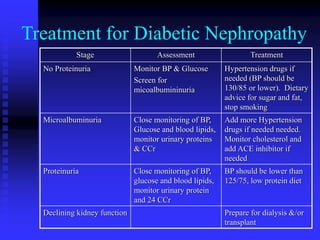
Treatment for Diabetic Nephropathy
Stage Assessment Treatment
No Proteinuria Monitor BP & Glucose
Screen for
micoalbumininuria
Hypertension drugs if
needed (BP should be
130/85 or lower). Dietary
advice for sugar and fat,
stop smoking
Microalbuminuria Close monitoring of BP,
Glucose and blood lipids,
monitor urinary proteins
& CCr
Add more Hypertension
drugs if needed needed.
Monitor cholesterol and
add ACE inhibitor if
needed
Proteinuria Close monitoring of BP,
glucose and blood lipids,
monitor urinary protein
and 24 CCr
BP should be lower than
125/75, low protein diet
Declining kidney function Prepare for dialysis &/or
transplant
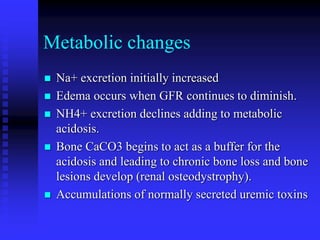
Metabolic changes
 Na+ excretion initially increased
 Edema occurs when GFR continues to diminish.
 NH4+ excretion declines adding to metabolic
acidosis.
 Bone CaCO3 begins to act as a buffer for the
acidosis and leading to chronic bone loss and bone
lesions develop (renal osteodystrophy).
 Accumulations of normally secreted uremic toxins
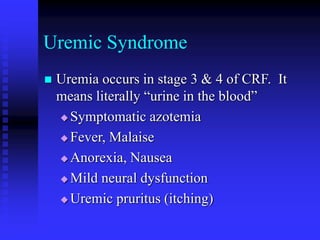
Uremic Syndrome
 Uremia occurs in stage 3 & 4 of CRF. It
means literally “urine in the blood”
 Symptomatic azotemia
 Fever, Malaise
 Anorexia, Nausea
 Mild neural dysfunction
 Uremic pruritus (itching)
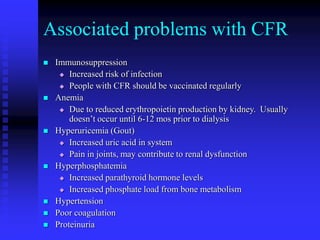
Associated problems with CFR
 Immunosuppression
 Increased risk of infection
 People with CFR should be vaccinated regularly
 Anemia
 Due to reduced erythropoietin production by kidney. Usually
doesn’t occur until 6-12 mos prior to dialysis
 Hyperuricemia (Gout)
 Increased uric acid in system
 Pain in joints, may contribute to renal dysfunction
 Hyperphosphatemia
 Increased parathyroid hormone levels
 Increased phosphate load from bone metabolism
 Hypertension
 Poor coagulation
 Proteinuria
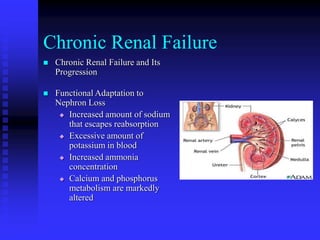
Chronic Renal Failure
 Chronic Renal Failure and Its
Progression
 Functional Adaptation to
Nephron Loss
 Increased amount of sodium
that escapes reabsorption
 Excessive amount of
potassium in blood
 Increased ammonia
concentration
 Calcium and phosphorus
metabolism are markedly
altered
Treatment of Chronic Renal Failure
Hypertension
 Metabolic Acidosis
 Anemia
 Renal Osteodystrophy
 Uremic Neuropathy
 Sexual Dysfunction
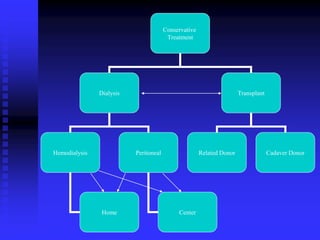
Conservative
Treatment
Dialysis Transplant
Hemodialysis Peritoneal Related Donor Cadaver Donor
Home Center
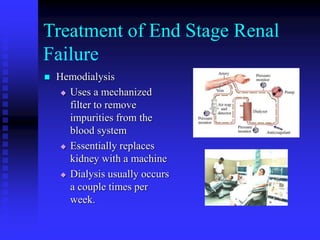
Treatment of End Stage Renal
Failure
 Hemodialysis
 Uses a mechanized
filter to remove
impurities from the
blood system
 Essentially replaces
kidney with a machine
 Dialysis usually occurs
a couple times per
week.
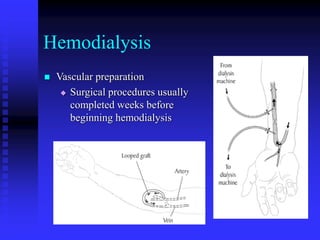
Hemodialysis
 Vascular preparation
 Surgical procedures usually
completed weeks before
beginning hemodialysis
Treatment of End Stage Renal
Failure
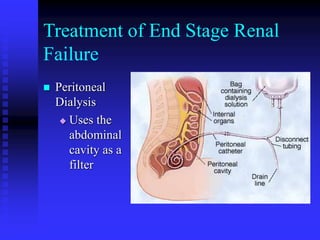
 Peritoneal
Dialysis
 Uses the
abdominal
cavity as a
filter
Treatment of End Stage Renal
Failure
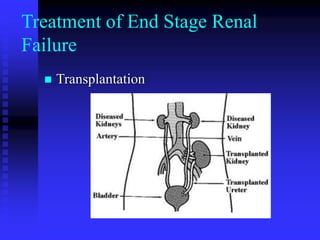
 Transplantation
Treatment of End Stage Renal
Disease
 Survival of People with ESRD
 Data show a mean expected remaining life span
of just under 8 years for people 40-44
beginning dialysis and just over 4 years for
people 60-64
 Adequacy of Dialysis
 Nutrition
Chronic Renal Failure
 Physical Rehabilitation – benefits of exercise
 Vocational Rehabilitation
 The goal should be to help the person with chronic
renal failure to resume all the duties, responsibilities
and benefits he or she enjoyed prior to the illness
 Gainful employment is extremely important for an adult
in the earning period of his or her life, to regain self-
esteem and to interact with society confidently
 Fear of losing financial benefits may deter some
people
 Some research has shown that multidisciplinary
predialysis intervention leads to maintenance of job
Additional Resources and
Information from the Web
 Florida End Stage Renal Disease Network
(http://www.fmqai.com/ESRD/esrd.htm)
 University Renal Research and Education Association
(www.urrea.org)
 National Institute of Diabetes & Digestive & Kidney Diseases
(www.niddk.nih.gov)
 National Kidney & Urologic Diseases Information
Clearinghouse (NKUDIC) (http://kidney.niddk.nih.gov/)
 Life Options Rehabilitation Program (www.lifeoptions.org)
 United Network for Organ Sharing (UNOS)
(http://www.unos.org)
 American Society of Nephrology (www.asn-online.org)
 National Kidney Foundation (www.kidney.org)
 JAN’s webpage (www.jan.wvu.edu/soar/other/renal.html)

Chronic renal failure

  • 1.
    RCS 6080 Medical andPsychosocial Aspects of Rehabilitation Counseling Renal Failure
  • 2.
    Function of Kidneys Remove toxic waste products  Remove excess water and salts  Play a part in controlling blood pressure  Produce erythropoetin (epo) which stimulates red cell production  Helps to keep calcium and phosphate in balance for healthy bones  Maintains proper pH for the blood
  • 3.
    Definitions  Azotemia: Elevatedblood urea nitrogen  (BUN>28mg/dL) & Creatinine (Cr>1.5mg/dL)  Uremia: azotemia with symptoms or signs of renal failure  End Stage Renal Disease (ESRD): uremia requiring transplantation or dialysis  Chronic Renal Failure (CRF): irreversible kidney dysfunction with azotemia >3 mos.  Creatinine Clearance (CCr): rate of filtration of creatinine by the kidney (marker for GFR)  Glomerular Filtration Rate (GFR): the total rate of filtration of blood by the kidney.
  • 4.
    Nephrons  Nephrons arethe units in the kidney that transfer waste products from the blood to urine.  A human kidney has approximately one million nephrons.  Glomeruli are the filtration units of the nephron.  The Glomerulus (first structure of the nephron) is a tuft of capillaries. Blood enters the glomerulus by the afferent arteriole and exits by the efferent arteriole  Bowman’s capsule is a tough layer of epithelial cells that surrounds the glomerulus ;there is a small holding area for the initial filtrate in between the capillary walls of the glomerulus and the inner layer of Bowman’s capsule; this area is called Bowman’s space. Fluid and solutes filtered by the glomerulus collect in this space. The space connects to the proximal convoluted tubule, which is the first section of the nephron’s tube system  a network of tubules extends from Bowman’s capsule:  proximal convoluted tubule (PCT)  Loop of Henle—has a descending and ascending limb  distal convoluted tubule  Collecting duct
  • 5.
    Renal Failure  AcuteRenal Failure  Prerenal azotemia  An abnormally high level of nitrogen-type wastes in the bloodstream. It is caused by conditions that reduce blood flow to the kidneys.  Postrenal azotemia  An obstruction of some kind (i.e., bladder cancer, uric acid crystals, urethral stricture etc)  Intrinsic Renal Disease  Usually glomerular disease  Usually leads to End Stage Renal Disease
  • 6.
    Chronic Renal Failure Diabetic Nephropathy  50K cases of DN ESRD annually  Diabetes most common contributor to ESRD  >30% of ESRD cases attributed to Diabetes  Hypertension  CFR with Hypertension causes 23% of ESRD annually  Glomerulonephretis: 10%  Polycystic Kidney Disease: 5%  Rapidly progressive glomerulonephrities (vasculitis): 2%  Renal Vascular Disease (i.e., renal artery stenosis)  Medications  Analgesic Nephropathy (progression after many years)  Pregnancy: high incidence of increased creatitine and HTN during pregnancy associated with CRF
  • 7.
    Chronic Renal Failure CRF is defined as a permanent reduction in glomerular filtration rate (GFR) sufficient to produce detectable alterations in well-being and organ function. This usually occurs at GFR below 25 ml/min.  About 100 to 150 per million persons in the U.S. develop CRF annually  Average annual cost is $25,000 – 35,000 per patient per year
  • 8.
    Stages of ChronicRenal Failure 1. Silent – GFR up to 50 ml/min. 2. Renal insufficiency – GFR 25 to 50 ml/min. 3. Renal failure – GFR 5 to 25 ml/min 4. End-stage renal failure – GFR less than 5 ml/min.
  • 9.
    Diabetic Nephropathy  Whatcan be done to reduce the risk of problems?  Blood glucose control  Blood pressure control  Using ACE inhibitors and AT II antagonists  Diet  Controlling blood lipids and cholesterol  Smoking
  • 10.
    Treatment for DiabeticNephropathy Stage Assessment Treatment No Proteinuria Monitor BP & Glucose Screen for micoalbumininuria Hypertension drugs if needed (BP should be 130/85 or lower). Dietary advice for sugar and fat, stop smoking Microalbuminuria Close monitoring of BP, Glucose and blood lipids, monitor urinary proteins & CCr Add more Hypertension drugs if needed needed. Monitor cholesterol and add ACE inhibitor if needed Proteinuria Close monitoring of BP, glucose and blood lipids, monitor urinary protein and 24 CCr BP should be lower than 125/75, low protein diet Declining kidney function Prepare for dialysis &/or transplant
  • 11.
    Metabolic changes  Na+excretion initially increased  Edema occurs when GFR continues to diminish.  NH4+ excretion declines adding to metabolic acidosis.  Bone CaCO3 begins to act as a buffer for the acidosis and leading to chronic bone loss and bone lesions develop (renal osteodystrophy).  Accumulations of normally secreted uremic toxins
  • 12.
    Uremic Syndrome  Uremiaoccurs in stage 3 & 4 of CRF. It means literally “urine in the blood”  Symptomatic azotemia  Fever, Malaise  Anorexia, Nausea  Mild neural dysfunction  Uremic pruritus (itching)
  • 13.
    Associated problems withCFR  Immunosuppression  Increased risk of infection  People with CFR should be vaccinated regularly  Anemia  Due to reduced erythropoietin production by kidney. Usually doesn’t occur until 6-12 mos prior to dialysis  Hyperuricemia (Gout)  Increased uric acid in system  Pain in joints, may contribute to renal dysfunction  Hyperphosphatemia  Increased parathyroid hormone levels  Increased phosphate load from bone metabolism  Hypertension  Poor coagulation  Proteinuria
  • 14.
    Chronic Renal Failure Chronic Renal Failure and Its Progression  Functional Adaptation to Nephron Loss  Increased amount of sodium that escapes reabsorption  Excessive amount of potassium in blood  Increased ammonia concentration  Calcium and phosphorus metabolism are markedly altered
  • 15.
    Treatment of ChronicRenal Failure Hypertension  Metabolic Acidosis  Anemia  Renal Osteodystrophy  Uremic Neuropathy  Sexual Dysfunction
  • 16.
  • 17.
    Treatment of EndStage Renal Failure  Hemodialysis  Uses a mechanized filter to remove impurities from the blood system  Essentially replaces kidney with a machine  Dialysis usually occurs a couple times per week.
  • 18.
    Hemodialysis  Vascular preparation Surgical procedures usually completed weeks before beginning hemodialysis
  • 19.
    Treatment of EndStage Renal Failure  Peritoneal Dialysis  Uses the abdominal cavity as a filter
  • 20.
    Treatment of EndStage Renal Failure  Transplantation
  • 21.
    Treatment of EndStage Renal Disease  Survival of People with ESRD  Data show a mean expected remaining life span of just under 8 years for people 40-44 beginning dialysis and just over 4 years for people 60-64  Adequacy of Dialysis  Nutrition
  • 22.
    Chronic Renal Failure Physical Rehabilitation – benefits of exercise  Vocational Rehabilitation  The goal should be to help the person with chronic renal failure to resume all the duties, responsibilities and benefits he or she enjoyed prior to the illness  Gainful employment is extremely important for an adult in the earning period of his or her life, to regain self- esteem and to interact with society confidently  Fear of losing financial benefits may deter some people  Some research has shown that multidisciplinary predialysis intervention leads to maintenance of job
  • 23.
    Additional Resources and Informationfrom the Web  Florida End Stage Renal Disease Network (http://www.fmqai.com/ESRD/esrd.htm)  University Renal Research and Education Association (www.urrea.org)  National Institute of Diabetes & Digestive & Kidney Diseases (www.niddk.nih.gov)  National Kidney & Urologic Diseases Information Clearinghouse (NKUDIC) (http://kidney.niddk.nih.gov/)  Life Options Rehabilitation Program (www.lifeoptions.org)  United Network for Organ Sharing (UNOS) (http://www.unos.org)  American Society of Nephrology (www.asn-online.org)  National Kidney Foundation (www.kidney.org)  JAN’s webpage (www.jan.wvu.edu/soar/other/renal.html)