Relining & Rebasing
3rd year Revision class
by Dr Sushen sharma
Sr Lecturer, Manav Rachna Dental College
• Due to Residual ridge resorption, the residual
ridges shrink & the dentures become loose
over a period of time.
• Thus, dentures need to be relined periodically
(every 2-3 years) in order to fill this gap
between the altered tissue contours of oral
cavity and the existing intaglio denture
surface.
Relining / rebasing procedure consists of 2
separate procedures
1. Making of new impression using the existing
denture : Relining impression
2. Replacing the impression material with
denture base material : Laboratory
processing of the relined impression
Relining impression material can be
1. Zinc oxide eugenol
2. Rubberbase impression materials
3. Tissue conditioners
4. Mouth temperature waxes
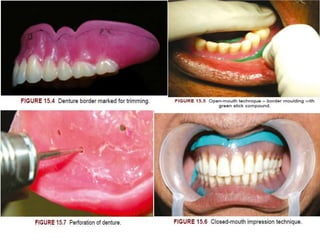
Steps in relining impression:
1. Denture preparation : trimming borders &
intaglio surface of existing denture by 1.5-
2.0mm. Hole in palate & labial flange to ovoid
increase in V.D
2. Border moulding : using green stick on flat &
trimmed borders.
3. Impression making : using ZnOE/ Light body etc
Functional reline Technique
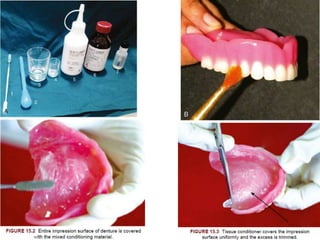
When tissue conditioners or mouth temperature waxes are
used for relining impression, the technique is called as
Functional Reline.
Most commonly, tissue conditioners are used in this technique
as mouth temperature waxes are too cumbersome to handle.
This technique is employed especially when the patient has
inflamed ridges and sore spots but can’t afford to keep dentures
out of mouth
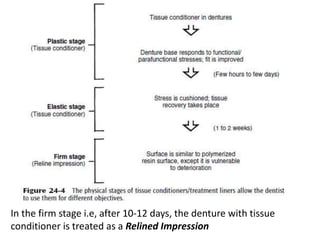
In the firm stage i.e, after 10-12 days, the denture with tissue
conditioner is treated as a Relined Impression
Once we have obtained a reline impression,
we pour & make a cast, preferably by beading
and boxing.
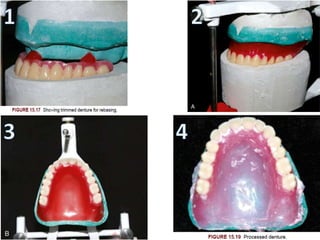
Next step is to replace the relining impression
material into denture base material.
Laboratory procedures replace the impression material from
the relined impression into new denture base material.
This can be done in 3 ways :
1. Flask Method
Here, conventional denture processing method is utilized where the
new denture base material can be a heat cured resin or cold cured
resin or Silicone resin liner
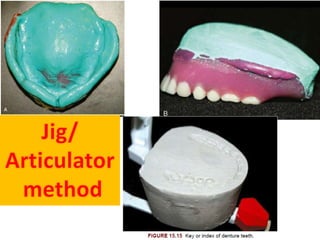
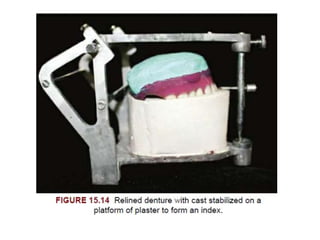
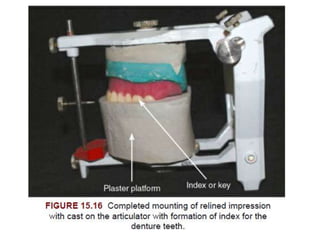
2. Articulator method
3. Jig method
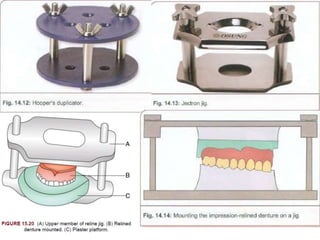
In The above 2, the relined impression cast to be mounted over a
plaster base which serves as an index. The relining material is a
Self/Cold curing Acrylic (hard) or chemically cured Silicone ( soft or
hard)
Flask method of relining/rebasing
Jig method of relining
Chair-side technique of relining
Here, a self curing silicone (usually soft) is
employed to serve as a denture base for
temporary periods (upto 6 months).
The silicone material binds to the denture base
quite efficiently .
Thus, no laboratory step is needed and relining is
accomplished in same appointment
The relining needs to be repeated after 6 months
or permanently relined with Cold –Cure material
afterwards.
Chair-side relining technique
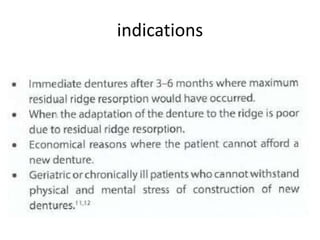
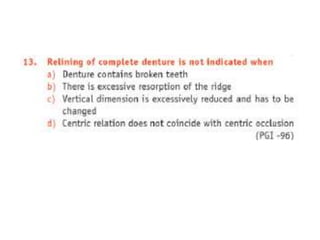
indications
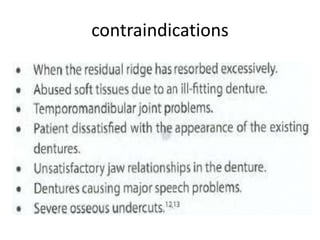
contraindications
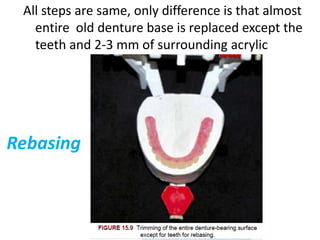
Rebasing
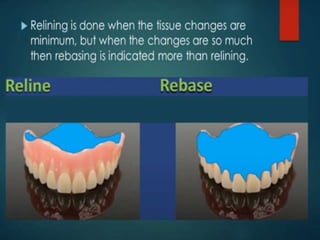
All steps are same, only difference is that almost
entire old denture base is replaced except the
teeth and 2-3 mm of surrounding acrylic
Relining and rebasing in complete dentures

Relining and rebasing in complete dentures

  • 1.
    Relining & Rebasing 3rdyear Revision class by Dr Sushen sharma Sr Lecturer, Manav Rachna Dental College
  • 2.
    • Due toResidual ridge resorption, the residual ridges shrink & the dentures become loose over a period of time. • Thus, dentures need to be relined periodically (every 2-3 years) in order to fill this gap between the altered tissue contours of oral cavity and the existing intaglio denture surface.
  • 4.
    Relining / rebasingprocedure consists of 2 separate procedures 1. Making of new impression using the existing denture : Relining impression 2. Replacing the impression material with denture base material : Laboratory processing of the relined impression
  • 5.
    Relining impression materialcan be 1. Zinc oxide eugenol 2. Rubberbase impression materials 3. Tissue conditioners 4. Mouth temperature waxes
  • 6.
    Steps in reliningimpression: 1. Denture preparation : trimming borders & intaglio surface of existing denture by 1.5- 2.0mm. Hole in palate & labial flange to ovoid increase in V.D 2. Border moulding : using green stick on flat & trimmed borders. 3. Impression making : using ZnOE/ Light body etc
  • 8.
    Functional reline Technique Whentissue conditioners or mouth temperature waxes are used for relining impression, the technique is called as Functional Reline. Most commonly, tissue conditioners are used in this technique as mouth temperature waxes are too cumbersome to handle. This technique is employed especially when the patient has inflamed ridges and sore spots but can’t afford to keep dentures out of mouth
  • 10.
    In the firmstage i.e, after 10-12 days, the denture with tissue conditioner is treated as a Relined Impression
  • 11.
    Once we haveobtained a reline impression, we pour & make a cast, preferably by beading and boxing. Next step is to replace the relining impression material into denture base material.
  • 12.
    Laboratory procedures replacethe impression material from the relined impression into new denture base material. This can be done in 3 ways : 1. Flask Method Here, conventional denture processing method is utilized where the new denture base material can be a heat cured resin or cold cured resin or Silicone resin liner 2. Articulator method 3. Jig method In The above 2, the relined impression cast to be mounted over a plaster base which serves as an index. The relining material is a Self/Cold curing Acrylic (hard) or chemically cured Silicone ( soft or hard)
  • 13.
    Flask method ofrelining/rebasing
  • 18.
    Jig method ofrelining
  • 19.
    Chair-side technique ofrelining Here, a self curing silicone (usually soft) is employed to serve as a denture base for temporary periods (upto 6 months). The silicone material binds to the denture base quite efficiently . Thus, no laboratory step is needed and relining is accomplished in same appointment The relining needs to be repeated after 6 months or permanently relined with Cold –Cure material afterwards.
  • 20.
  • 21.
  • 22.
  • 24.
    Rebasing All steps aresame, only difference is that almost entire old denture base is replaced except the teeth and 2-3 mm of surrounding acrylic