RELIGION IN A GLOBAL 
CONTEXT
India 
Globalisation has brought rapid economic 
growth and has seen India become important 
in politics and prosperous. 
Nanda examines the role of Hinduism in 
legitimating the rise of a new Hindu ‘ultra 
nationalism’ and the prosperity of the middle 
class.
Hinduism and Consumerism 
Globalisation created a prosperous, urban, scientifically 
educated middle class. These are the people 
secularisation theorists predicted would abandon religion 
first. But, Nanda observes this class continue to believe in 
the supernatural. 
The Centre for the Study of Developing societies found (30% 
of) Indians are becoming more religious. It also found that 
“urban educated Indians are more religious than their rural 
and illiterate counterparts”.
Nanda notes it is becoming fashionable to be 
religious. The religious middle class are also 
attracted to what were once low status village 
Gods and Goddesses who the poor 
worshipped. This is because these deities are 
seen as being more responsive to peoples 
needs.
Nanda examines what motivates the 
sophisticated, urban middle class to believe in 
miracles and supernatural beings. She rejects 
poverty or existential security as they aren’t poor 
and that religiosity is a defence against 
modernisation and Westernisation. The Indian 
middle class are optimistic about what 
globalisation brings them. She argues their 
increasing religiosity is the result of their 
ambivalence about their new wealth.
This ambivalence stems from tension between 
the traditional Hindu belief of renunciation of 
materialism and wordly-desires and the new 
prosperity of the middle class. This is resolved 
by the modern holy men and TV gurus to 
whom they turn and who preach the message 
that desire is not bad, but a manifestation of 
divinity that motivates people to do things.
Similarly, they dispense business-friendly versions of 
Hinduism and take the edge off guilt by teaching 
middle class consumerism can be ‘spiritually 
balanced’ by paying for the performance of 
appropriate (and extravagant) rituals. 
Modern versions of Hinduism therefore legitimate 
the position of the middle class and allow them to 
adjust to globalised consumer capitalism.
Hindu Ultra-Nationalism 
Nanda looks at the role of Hinduism in 
legitimating a triumphant version of Indian 
nationalism. 
The Pew Global Attitude found 93% agreed with: 
“Our people aren’t perfect but our culture is 
superior to others” 
This percentage is higher than any other 
country.
Nanda notes India’s success in the global 
market is increasingly attributed to the 
superiority of ‘Hindu values’ which the media 
promote and the idea that Hinduism is the 
essence of Indian culture and identity. 
In this Hindu ‘ultra nationalism’, the worship of 
Hindu Gods has become the same as 
worshipping the nation of India; Hinduism has 
become a civil religion.
But, she notes this is creating a widening gulf between 
Hindu and non-Hindu minorities. Hinduism also 
penetrated public life, so that the supposedly secular 
state is increasingly influenced by religion. ‘Hindu 
sciences’ (e.g. Astrology) are being taught in education 
and are being used to predict natural disasters; the 
Ministry of Defence is sponsoring research into weapons 
with magical powers (mentioned in ancient Hindu texts); 
the Health Ministry is investing in research into cow 
urine as a cure for every ailment (cows are sacred in 
Hinduism)
East Asia 
The success of capitalism in East Asia led some 
sociologists to argue religion played a similar role to 
Calvinism in its development. Redding sees the spirit of 
capitalism amongst Chinese entrepreneurs in tiger 
economies as having ‘post-Confucian’ values which 
encourage hard-work, self-discipline and commitment to 
education and improvement. The effect of this value 
system is that it leads to economic productivity and the 
accumulation of Capital.
Pentecostalism in Latin America 
Berger argues Pentecostalism in Latin America 
acts as a ‘functional equivalent’ to Weber’s 
Protestant ethic. That is, it encourages the 
development of capitalism (like Calvinism). He 
concludes Pentecostalism has a strong affinity 
with modern capitalism. Berger agrees it is 
necessary to promote economic development 
and raise society out of poverty. This process 
can be led by an active minority with this-wordly 
ascetism.
Pentecostalism: Global & Local 
Lehmann distinguishes between two phases in 
the Pentecostalism expansion 
 1st  Christianity accompanies colonisation 
and was imposed on the indigenous 
populations by conquest, often forcibly 
suppressing local religions 
 2nd  it has spread as it gained a popular 
following from below
Lehmann attributes the success of 
Pentecostalism as a global religion in part to 
its ability to ‘plug into’ and incorporate local 
beliefs. It preaches a similar message 
worldwide, but uses symbolism and imagery 
drawn from local cultures and existing beliefs. 
It creates new local religious forms, rather than 
replacing existing ones. It appeals to the poor 
and uses global communication to spread its 
message.
Religion and the ‘clash of civilisations’
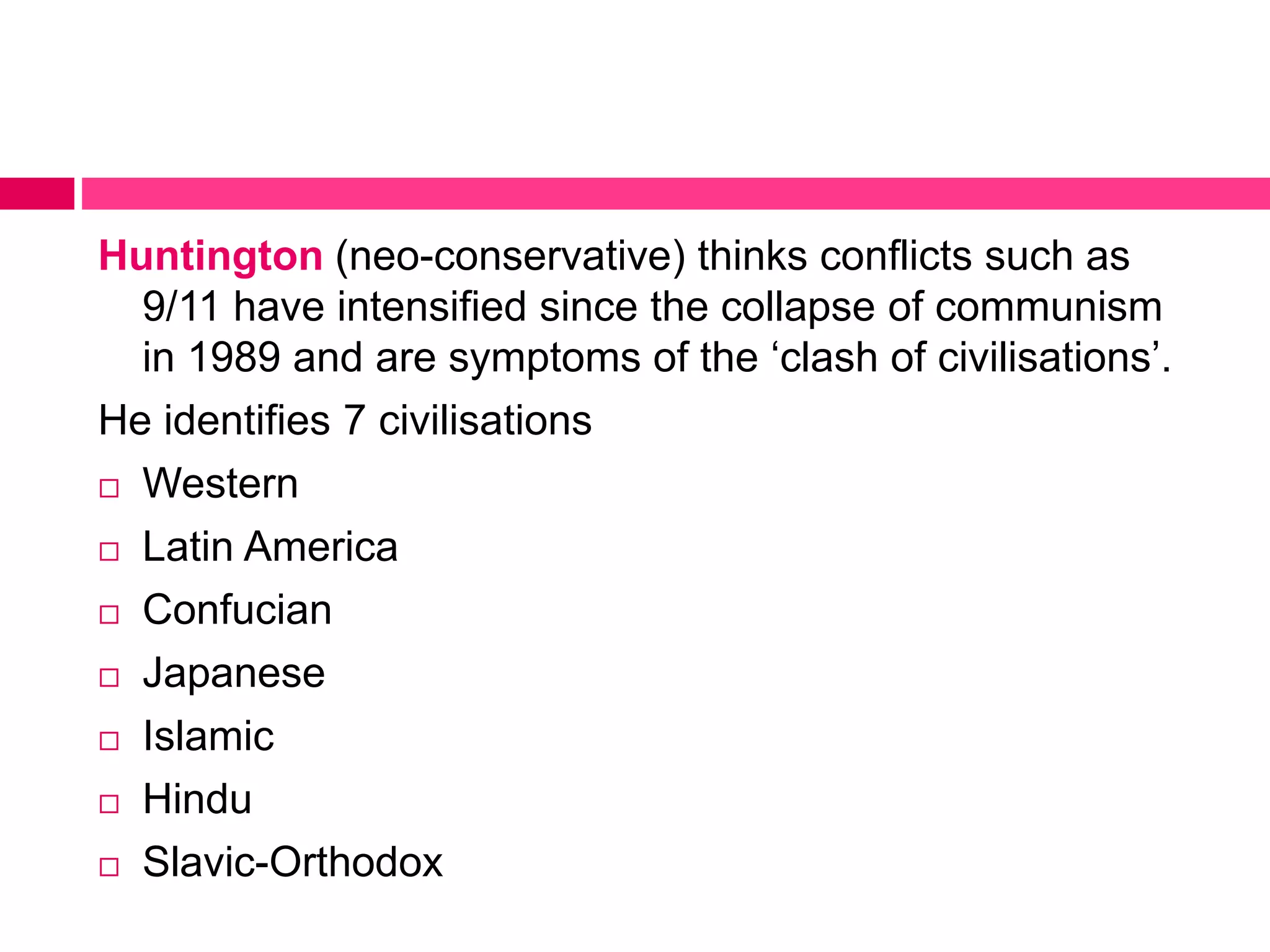
Huntington (neo-conservative) thinks conflicts such as 
9/11 have intensified since the collapse of communism 
in 1989 and are symptoms of the ‘clash of civilisations’. 
He identifies 7 civilisations 
 Western 
 Latin America 
 Confucian 
 Japanese 
 Islamic 
 Hindu 
 Slavic-Orthodox
Each civilisation has a common cultural background and 
history and is closely identified with one of the world’s 
great religions. 
Shared religion creates social cohesion within 
civilisations but can cause conflict between them.
Religious differences have become a source of identity... 
 With the fall of communism, political differences between nations 
have become less important as a source of identity 
 Globalisation has made nation-states less significant as a source of 
identity, creating a gap that religion has filled 
 It also makes contact between civilisations easier and more 
frequent, increasing the likelihood of old conflicts re-emerging
In Huntington’s view, religious differences are creating a 
new set of hostile ‘us and them’ relationships with 
increased competition between civilisations for 
economic and military power. He sees religious 
differences as harder than political ones to resolve as 
they are deeply rooted in culture and history. 
Huntington sees History as a struggle of ‘progress against 
barbarism’. He believes the West is under threat and 
predicts growing conflict between ‘the West and the 
rest’. He fears the emergence of new anti-Western 
military alliances and urges the West to reassert its 
Christian identity.
Criticisms 
 Jackson sees his work as an example of Orientalism – 
a western ideology that stereotypes Eastern nations and 
people as untrustworthy and inferior. 
 Casanova argues he ignores important religious 
divisions with the ‘civilisations’ 
 Horrie and Chippindale see the ‘clash of civilisations’ 
as a grossly misleading neo-conservative ideology that 
portrays the whole of Islam as an enemy. In reality, only 
a tiny minority of Muslims are remotely interested in a 
‘holy war’ against the West. 
 Armstrong argues hostility towards the West doesn’t 
stem from Fundamentalist Islam but is a reaction to 
Western foreign policy.
The Real Clash of Civilisations? 
Using data from the World Values survey, Inglehart and Norris 
conclude the issue that divides the West from the Muslim world is 
sexuality, not democracy. There are great differences in attitudes 
when it comes to abortion, gender equality, divorce and gay rights; 
Western attitudes are liberal whilst Muslim’s are traditional. 
Inglehart and Norris comment that in the last decade, democracy has 
become the political ideology to gain global appeal. But, there is no 
global agreement about self-expression values. In their view, ‘these 
divergent values constitute in the real clash of civilisations between 
Muslin societies and the West’

Religion in a Global Context (1)

  • 1.
    RELIGION IN AGLOBAL CONTEXT
  • 2.
    India Globalisation hasbrought rapid economic growth and has seen India become important in politics and prosperous. Nanda examines the role of Hinduism in legitimating the rise of a new Hindu ‘ultra nationalism’ and the prosperity of the middle class.
  • 3.
    Hinduism and Consumerism Globalisation created a prosperous, urban, scientifically educated middle class. These are the people secularisation theorists predicted would abandon religion first. But, Nanda observes this class continue to believe in the supernatural. The Centre for the Study of Developing societies found (30% of) Indians are becoming more religious. It also found that “urban educated Indians are more religious than their rural and illiterate counterparts”.
  • 4.
    Nanda notes itis becoming fashionable to be religious. The religious middle class are also attracted to what were once low status village Gods and Goddesses who the poor worshipped. This is because these deities are seen as being more responsive to peoples needs.
  • 5.
    Nanda examines whatmotivates the sophisticated, urban middle class to believe in miracles and supernatural beings. She rejects poverty or existential security as they aren’t poor and that religiosity is a defence against modernisation and Westernisation. The Indian middle class are optimistic about what globalisation brings them. She argues their increasing religiosity is the result of their ambivalence about their new wealth.
  • 6.
    This ambivalence stemsfrom tension between the traditional Hindu belief of renunciation of materialism and wordly-desires and the new prosperity of the middle class. This is resolved by the modern holy men and TV gurus to whom they turn and who preach the message that desire is not bad, but a manifestation of divinity that motivates people to do things.
  • 7.
    Similarly, they dispensebusiness-friendly versions of Hinduism and take the edge off guilt by teaching middle class consumerism can be ‘spiritually balanced’ by paying for the performance of appropriate (and extravagant) rituals. Modern versions of Hinduism therefore legitimate the position of the middle class and allow them to adjust to globalised consumer capitalism.
  • 8.
    Hindu Ultra-Nationalism Nandalooks at the role of Hinduism in legitimating a triumphant version of Indian nationalism. The Pew Global Attitude found 93% agreed with: “Our people aren’t perfect but our culture is superior to others” This percentage is higher than any other country.
  • 9.
    Nanda notes India’ssuccess in the global market is increasingly attributed to the superiority of ‘Hindu values’ which the media promote and the idea that Hinduism is the essence of Indian culture and identity. In this Hindu ‘ultra nationalism’, the worship of Hindu Gods has become the same as worshipping the nation of India; Hinduism has become a civil religion.
  • 10.
    But, she notesthis is creating a widening gulf between Hindu and non-Hindu minorities. Hinduism also penetrated public life, so that the supposedly secular state is increasingly influenced by religion. ‘Hindu sciences’ (e.g. Astrology) are being taught in education and are being used to predict natural disasters; the Ministry of Defence is sponsoring research into weapons with magical powers (mentioned in ancient Hindu texts); the Health Ministry is investing in research into cow urine as a cure for every ailment (cows are sacred in Hinduism)
  • 11.
    East Asia Thesuccess of capitalism in East Asia led some sociologists to argue religion played a similar role to Calvinism in its development. Redding sees the spirit of capitalism amongst Chinese entrepreneurs in tiger economies as having ‘post-Confucian’ values which encourage hard-work, self-discipline and commitment to education and improvement. The effect of this value system is that it leads to economic productivity and the accumulation of Capital.
  • 12.
    Pentecostalism in LatinAmerica Berger argues Pentecostalism in Latin America acts as a ‘functional equivalent’ to Weber’s Protestant ethic. That is, it encourages the development of capitalism (like Calvinism). He concludes Pentecostalism has a strong affinity with modern capitalism. Berger agrees it is necessary to promote economic development and raise society out of poverty. This process can be led by an active minority with this-wordly ascetism.
  • 13.
    Pentecostalism: Global &Local Lehmann distinguishes between two phases in the Pentecostalism expansion  1st  Christianity accompanies colonisation and was imposed on the indigenous populations by conquest, often forcibly suppressing local religions  2nd  it has spread as it gained a popular following from below
  • 14.
    Lehmann attributes thesuccess of Pentecostalism as a global religion in part to its ability to ‘plug into’ and incorporate local beliefs. It preaches a similar message worldwide, but uses symbolism and imagery drawn from local cultures and existing beliefs. It creates new local religious forms, rather than replacing existing ones. It appeals to the poor and uses global communication to spread its message.
  • 15.
    Religion and the‘clash of civilisations’
  • 16.
    Huntington (neo-conservative) thinksconflicts such as 9/11 have intensified since the collapse of communism in 1989 and are symptoms of the ‘clash of civilisations’. He identifies 7 civilisations  Western  Latin America  Confucian  Japanese  Islamic  Hindu  Slavic-Orthodox
  • 17.
    Each civilisation hasa common cultural background and history and is closely identified with one of the world’s great religions. Shared religion creates social cohesion within civilisations but can cause conflict between them.
  • 18.
    Religious differences havebecome a source of identity...  With the fall of communism, political differences between nations have become less important as a source of identity  Globalisation has made nation-states less significant as a source of identity, creating a gap that religion has filled  It also makes contact between civilisations easier and more frequent, increasing the likelihood of old conflicts re-emerging
  • 19.
    In Huntington’s view,religious differences are creating a new set of hostile ‘us and them’ relationships with increased competition between civilisations for economic and military power. He sees religious differences as harder than political ones to resolve as they are deeply rooted in culture and history. Huntington sees History as a struggle of ‘progress against barbarism’. He believes the West is under threat and predicts growing conflict between ‘the West and the rest’. He fears the emergence of new anti-Western military alliances and urges the West to reassert its Christian identity.
  • 20.
    Criticisms  Jacksonsees his work as an example of Orientalism – a western ideology that stereotypes Eastern nations and people as untrustworthy and inferior.  Casanova argues he ignores important religious divisions with the ‘civilisations’  Horrie and Chippindale see the ‘clash of civilisations’ as a grossly misleading neo-conservative ideology that portrays the whole of Islam as an enemy. In reality, only a tiny minority of Muslims are remotely interested in a ‘holy war’ against the West.  Armstrong argues hostility towards the West doesn’t stem from Fundamentalist Islam but is a reaction to Western foreign policy.
  • 21.
    The Real Clashof Civilisations? Using data from the World Values survey, Inglehart and Norris conclude the issue that divides the West from the Muslim world is sexuality, not democracy. There are great differences in attitudes when it comes to abortion, gender equality, divorce and gay rights; Western attitudes are liberal whilst Muslim’s are traditional. Inglehart and Norris comment that in the last decade, democracy has become the political ideology to gain global appeal. But, there is no global agreement about self-expression values. In their view, ‘these divergent values constitute in the real clash of civilisations between Muslin societies and the West’