Reliable Plated Through-Via 
Design and Fabrication 
Cheryl Tulkoff 
DfR Solutions 
ctulkoff@dfrsolutions.com 
5129138624
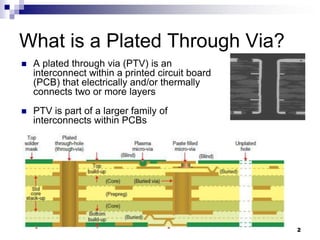
A plated through via (PTV) is an interconnect within a printed circuit board (PCB) that electrically and/or thermally connects two or more layers 
PTV is part of a larger family of interconnects within PCBs 
What is a Plated Through Via? 
2
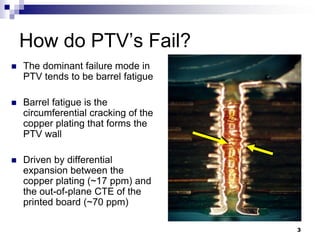
The dominant failure mode in PTV tends to be barrel fatigue 
Barrel fatigue is the circumferential cracking of the copper plating that forms the PTV wall 
Driven by differential expansion between the copper plating (~17 ppm) and the out-of-plane CTE of the printed board (~70 ppm) 
How do PTV’s Fail? 
3
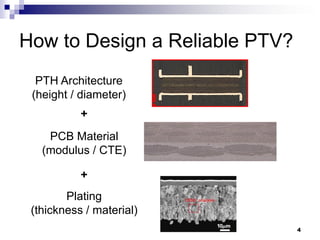
How to Design a Reliable PTV? 
PTH Architecture 
(height / diameter) 
Plating (thickness / material) 
PCB Material 
(modulus / CTE) 
+ 
+ 
4
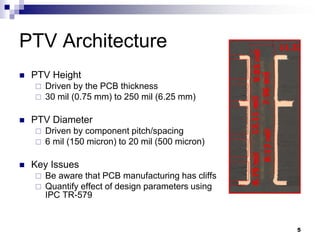
PTV Height 
Driven by the PCB thickness 
30 mil (0.75 mm) to 250 mil (6.25 mm) 
PTV Diameter 
Driven by component pitch/spacing 
6 mil (150 micron) to 20 mil (500 micron) 
Key Issues 
Be aware that PCB manufacturing has cliffs 
Quantify effect of design parameters using IPC TR-579 
PTV Architecture 
5
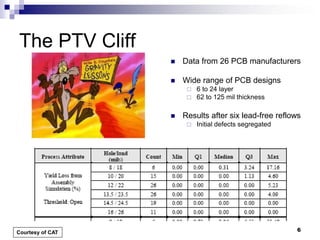
Data from 26 PCB manufacturers 
Wide range of PCB designs 
6 to 24 layer 
62 to 125 mil thickness 
Results after six lead-free reflows 
Initial defects segregated 
The PTV Cliff 
Courtesy of CAT 
6
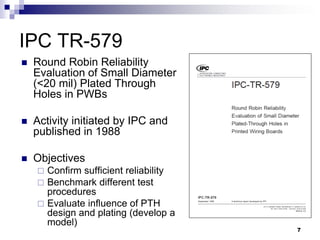
Round Robin Reliability Evaluation of Small Diameter (<20 mil) Plated Through Holes in PWBs 
Activity initiated by IPC and published in 1988 
Objectives 
Confirm sufficient reliability 
Benchmark different test procedures 
Evaluate influence of PTH design and plating (develop a model) 
IPC TR-579 
7
Advantages 
Analytical (calculation straightforward) 
Validated through testing 
Provides guidance on relative influence of design/material parameters 
Disadvantages 
No ownership 
Validation data is ~18 years old 
Unable to assess complex geometries (PTH spacing, PTH pads) 
Complex geometries tend to extend lifetime 
Difficult to assess effect of multiple temperature cycles 
Can be performed using Miner’s Rule 
Simplified assumptions (linear stress-strain above yield point) 
How does one determine the quality index in the design phase? 
Does not account for the effect of fill 
Does not consider other failure modes (knee cracking, wall-pad separation, etc.) 
Assessment of IPC-TR-579 
8
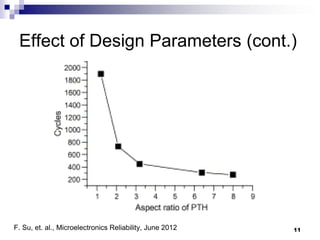
Reduce the PTV Height (PCB Thickness) 
Reduce laminate/prepreg thickness (2.7 to 4 mil is current limitation) 
Results in minimal cost changes and minimal effect on design 
Has the least effect on PTH reliability 
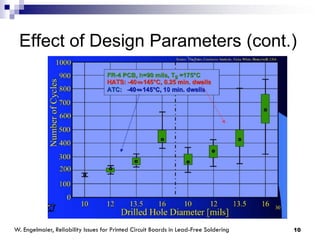
Increase PTV Diameter 
Typically not an option due to spacing issues 
An important, but significant effect (dependent on a number of other variables) 
Example: Moving from 10 mil to 12 mil diameter on a 120 mil board, 50C temp cycle, will result in approximately 20% improvement 
The Effect of Design Parameters (Height / Diameter) 
9
Effect of Design Parameters (cont.) 
W. Engelmaier, Reliability Issues for Printed Circuit Boards in Lead-Free Soldering 
10
F. Su, et. al., Microelectronics Reliability, June 2012 
Effect of Design Parameters (cont.) 
11
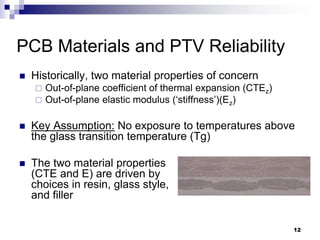
Historically, two material properties of concern 
Out-of-plane coefficient of thermal expansion (CTEz) 
Out-of-plane elastic modulus (‘stiffness’)(Ez) 
Key Assumption: No exposure to temperatures above the glass transition temperature (Tg) 
The two material properties (CTE and E) are driven by choices in resin, glass style, and filler 
PCB Materials and PTV Reliability 
12
Out-of-plane CTE (CTEz) is almost always provided on the laminate datasheet 
Sometimes in ppm/C above and below the Tg 
Sometimes in % between 50-260C 
Out-of-plane modulus (Ez) is almost never provided on the laminate datasheet 
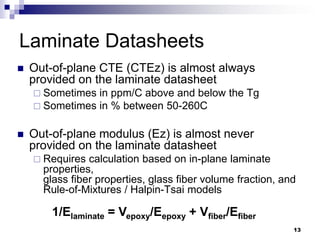
Requires calculation based on in-plane laminate properties, glass fiber properties, glass fiber volume fraction, and Rule-of-Mixtures / Halpin-Tsai models 
Laminate Datasheets 
1/Elaminate = Vepoxy/Eepoxy + Vfiber/Efiber 
13
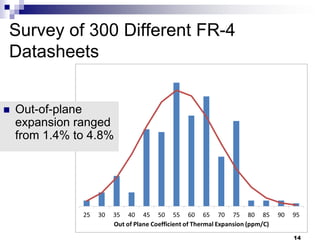
Survey of 300 Different FR-4 Datasheets 
Out-of-plane expansion ranged from 1.4% to 4.8% 
14
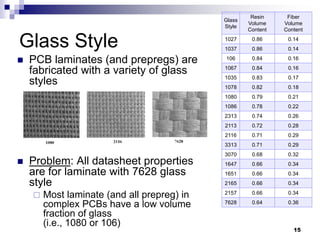
PCB laminates (and prepregs) are fabricated with a variety of glass styles 
Problem: All datasheet properties are for laminate with 7628 glass style 
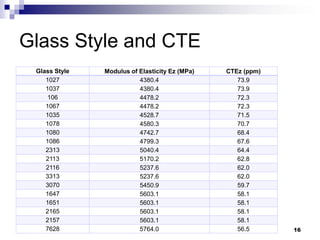
Most laminate (and all prepreg) in complex PCBs have a low volume fraction of glass (i.e., 1080 or 106) 
Glass Style 
Glass 
Style 
Resin 
Volume Content 
Fiber 
Volume 
Content 
1027 
0.86 
0.14 
1037 
0.86 
0.14 
106 
0.84 
0.16 
1067 
0.84 
0.16 
1035 
0.83 
0.17 
1078 
0.82 
0.18 
1080 
0.79 
0.21 
1086 
0.78 
0.22 
2313 
0.74 
0.26 
2113 
0.72 
0.28 
2116 
0.71 
0.29 
3313 
0.71 
0.29 
3070 
0.68 
0.32 
1647 
0.66 
0.34 
1651 
0.66 
0.34 
2165 
0.66 
0.34 
2157 
0.66 
0.34 
7628 
0.64 
0.36 
15
Glass Style and CTE 
Glass Style 
Modulus of Elasticity Ez (MPa) 
CTEz (ppm) 
1027 
4380.4 
73.9 
1037 
4380.4 
73.9 
106 
4478.2 
72.3 
1067 
4478.2 
72.3 
1035 
4528.7 
71.5 
1078 
4580.3 
70.7 
1080 
4742.7 
68.4 
1086 
4799.3 
67.6 
2313 
5040.4 
64.4 
2113 
5170.2 
62.8 
2116 
5237.6 
62.0 
3313 
5237.6 
62.0 
3070 
5450.9 
59.7 
1647 
5603.1 
58.1 
1651 
5603.1 
58.1 
2165 
5603.1 
58.1 
2157 
5603.1 
58.1 
7628 
5764.0 
56.5 
16
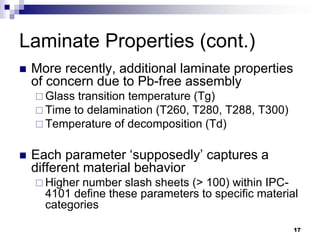
More recently, additional laminate properties of concern due to Pb-free assembly 
Glass transition temperature (Tg) 
Time to delamination (T260, T280, T288, T300) 
Temperature of decomposition (Td) 
Each parameter ‘supposedly’ captures a different material behavior 
Higher number slash sheets (> 100) within IPC- 4101 define these parameters to specific material categories 
Laminate Properties (cont.) 
17
Glass transition temperature (Tg) (IPC-TM-650, 2.4.24/2.4.25c) 
Characterizes complex material transformation (increase in CTE, decrease in modulus) 
Time to delamination (T-260/280/288/300) (IPC-TM-650, 2.4.24.1) 
Characterizes interfacial adhesion 
Temperature of decomposition (Td) (IPC-TM-650, 2.3.40) 
Characterizes breakdown of epoxy material 
Thermal Parameters of Laminate 
18
19 
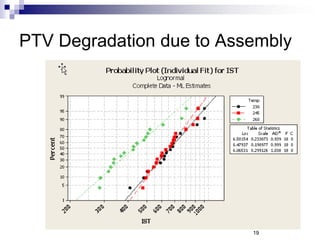
PTV Degradation due to Assembly 
19
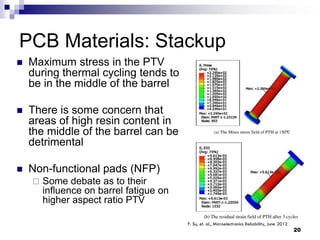
Maximum stress in the PTV during thermal cycling tends to be in the middle of the barrel 
There is some concern that areas of high resin content in the middle of the barrel can be detrimental 
Non-functional pads (NFP) 
Some debate as to their influence on barrel fatigue on higher aspect ratio PTV 
PCB Materials: Stackup 
F. Su, et. al., Microelectronics Reliability, June 2012 
20
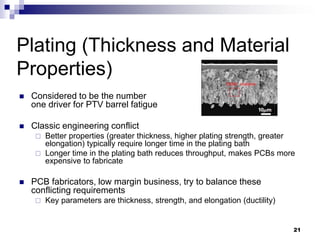
Considered to be the number one driver for PTV barrel fatigue 
Classic engineering conflict 
Better properties (greater thickness, higher plating strength, greater elongation) typically require longer time in the plating bath 
Longer time in the plating bath reduces throughput, makes PCBs more expensive to fabricate 
PCB fabricators, low margin business, try to balance these conflicting requirements 
Key parameters are thickness, strength, and elongation (ductility) 
Plating (Thickness and Material Properties) 
21
Specifications tend to range from 0.8 mil (20 microns) to 1.0 mil (25 microns) to 1.2 mil (30 microns) 
Plating thickness can be less of an issue than previously 
New formulations to fill microvias can drive an accelerated plating process 
Some PCB manufacturers, depending on the design and production volume, will plate the PTV almost closed 
Plating Thickness 
22
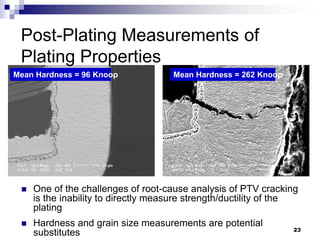
Mean Hardness = 96 Knoop 
 One of the challenges of root-cause analysis of PTV cracking 
is the inability to directly measure strength/ductility of the 
plating 
 Hardness and grain size measurements are potential 
substitutes 
Post-Plating Measurements of 
Plating Properties 
Mean Hardness = 262 Knoop 
23
Post-Plating Measurements 
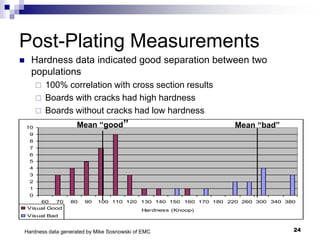
 Hardness data indicated good separation between two 
populations 
 100% correlation with cross section results 
 Boards with cracks had high hardness 
 Boards without cracks had low hardness 
0 
1 
2 
3 
4 
5 
6 
7 
8 
9 
10 
60 70 80 90 100 110 120 130 140 150 160 170 180 220 260 300 340 380 
Visual Good Hardness (Knoop) 
Visual Bad 
Mean “good” Mean “bad” 
24 
Hardness data generated by Mike Sosnowski of EMC
How to Manufacture a Reliable PTV? 
+ 
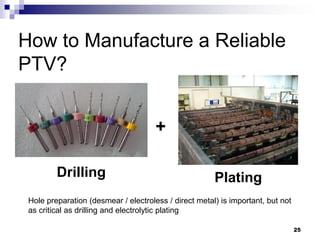
Drilling 
Plating 
Hole preparation (desmear / electroless / direct metal) is important, but not as critical as drilling and electrolytic plating 
25
Drill bit manufacturers tend to provide PCB manufacturers recommendations on key process parameters 
Speeds and feeds 
Stackup guidelines (number of PCBs of a given thickness that can be stacked during drilling) 
Entry and exit material 
Number of drilling operations before repointing 
Number of repoints / sharpening 
There is no ‘right’ answer for process parameters 
PCB manufacturer may buy a more expensive drill bit, but repoint more often 
Drilling 
26
Just like drilling, plating chemistry manufacturers tend to provide PCB manufacturers with guidance on process parameters and equipment 
Many will provide a ‘turn-key’ installation 
Can result in a lack of knowledge if PCB manufacturers do not perform their own DoE 
Large variation in plating chemistries, process and equipment 
Plating (Electrolytic) 
27
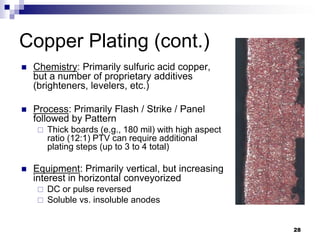
Chemistry: Primarily sulfuric acid copper, but a number of proprietary additives (brighteners, levelers, etc.) 
Process: Primarily Flash / Strike / Panel followed by Pattern 
Thick boards (e.g., 180 mil) with high aspect ratio (12:1) PTV can require additional plating steps (up to 3 to 4 total) 
Equipment: Primarily vertical, but increasing interest in horizontal conveyorized 
DC or pulse reversed 
Soluble vs. insoluble anodes 
Copper Plating (cont.) 
28
Insufficient Plating Thickness 
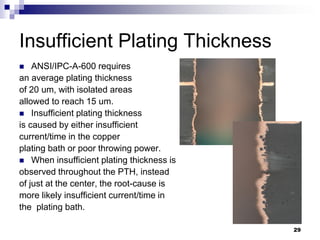
ANSI/IPC-A-600 requires an average plating thickness of 20 um, with isolated areas allowed to reach 15 um. 
Insufficient plating thickness is caused by either insufficient current/time in the copper plating bath or poor throwing power. 
When insufficient plating thickness is observed throughout the PTH, instead of just at the center, the root-cause is more likely insufficient current/time in the plating bath. 
29
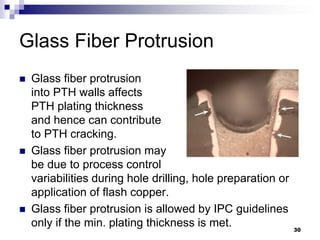
Glass Fiber Protrusion 
Glass fiber protrusion into PTH walls affects PTH plating thickness and hence can contribute to PTH cracking. 
Glass fiber protrusion may be due to process control variabilities during hole drilling, hole preparation or application of flash copper. 
Glass fiber protrusion is allowed by IPC guidelines only if the min. plating thickness is met. 
30
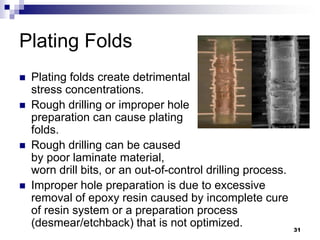
Plating Folds 
Plating folds create detrimental stress concentrations. 
Rough drilling or improper hole preparation can cause plating folds. 
Rough drilling can be caused by poor laminate material, worn drill bits, or an out-of-control drilling process. 
Improper hole preparation is due to excessive removal of epoxy resin caused by incomplete cure of resin system or a preparation process (desmear/etchback) that is not optimized. 
31
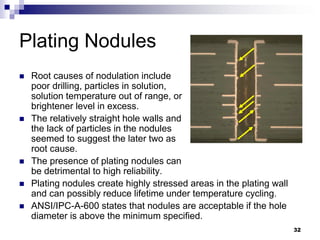
Plating Nodules 
Root causes of nodulation include poor drilling, particles in solution, solution temperature out of range, or brightener level in excess. 
The relatively straight hole walls and the lack of particles in the nodules seemed to suggest the later two as root cause. 
The presence of plating nodules can be detrimental to high reliability. 
Plating nodules create highly stressed areas in the plating wall and can possibly reduce lifetime under temperature cycling. 
ANSI/IPC-A-600 states that nodules are acceptable if the hole diameter is above the minimum specified. 
32
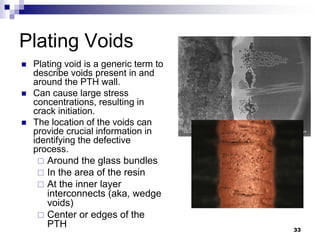
Plating void is a generic term to describe voids present in and around the PTH wall. 
Can cause large stress concentrations, resulting in crack initiation. 
The location of the voids can provide crucial information in identifying the defective process. 
Around the glass bundles 
In the area of the resin 
At the inner layer interconnects (aka, wedge voids) 
Center or edges of the PTH 
Plating Voids 
33
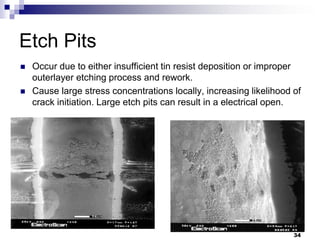
Etch Pits 
Occur due to either insufficient tin resist deposition or improper outerlayer etching process and rework. 
Cause large stress concentrations locally, increasing likelihood of crack initiation. Large etch pits can result in a electrical open. 
34
There are currently six procedures for testing/qualifying a PTV 
Modeling and simulation 
Cross-sectioning + solder float/shock 
Thermal shock testing (also thermal cycling) 
Interconnect stress testing (IST) 
Printed Board Process Capability, Quality, and Relative Reliability (PCQR2) 
Highly Accelerated Thermal Shock (HATS) 
How to Test/Qualify a Reliable PTV? 
35
Qualifying PTV is a two-step process 
The first step is to qualify the design and the PCB manufacturer 
Initial qualification 
The second step is to initiate ongoing testing to monitor outgoing quality 
Lot qualification 
Test / Qualify PTV 
36
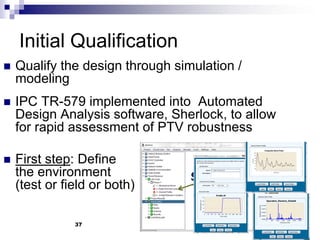
Qualify the design through simulation / modeling 
IPC TR-579 implemented into Automated Design Analysis software, Sherlock, to allow for rapid assessment of PTV robustness 
First step: Define the environment (test or field or both) 
Initial Qualification 
37
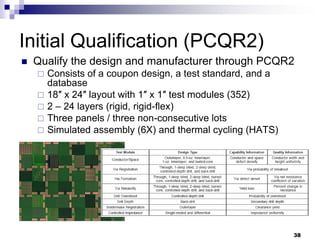
Qualify the design and manufacturer through PCQR2 
Consists of a coupon design, a test standard, and a database 
18″ x 24″ layout with 1″ x 1″ test modules (352) 
2 – 24 layers (rigid, rigid-flex) 
Three panels / three non-consecutive lots 
Simulated assembly (6X) and thermal cycling (HATS) 
Initial Qualification (PCQR2) 
38
Advantages 
Industry standard (IPC-9151) 
Plug and play 
Provides real data for understanding of PCB supplier capabilities and comparison to the rest of the industry through the use of an anonymous database 
Disadvantages 
Industry-certified single source 
$2K - $5K, not including panel costs 
PCQR2 (cont.) 
39
Interconnect stress testing (IST) is the overwhelming favorite of high reliability organizations 
Small (1 x 4) coupon can fit along the edge of the panel 
Testing is automated 
Widely used 
Ability to drive barrel fatigue and post separation 
Large number of holes (up to 300) and continuous resistance monitoring makes it far superior to cross- sectioning 
And it should be cheaper! 
Lot Qualification 
40
Coupon design is critical (IST can be prone to problems) 
Need to specify preconditioning (IST or real reflow oven?) 
Need to specify frequency (every lot, every month, every quarter) 
Need to specify maximum temperature (some debate on the validity of results when above the Tg) 
130, 150, and 175C are the most common 
Need to specify requirements 
Different markets/organizations specify different times to failure (300, 500, and 1000 cycles are most common) 
IST – Issues / Awareness 
41
The base knowledge and understanding of PTV Fatigue is robust 
Decades of testing and simulation 
Use of reliability physics is best practice 
Detailed understanding is still missing 
Key expertise (process parameters, material properties, simulation, testing) is rarely in the same organization 
Not a pure science activity (significant amount of human influence) 
Improvements in out-of-plane CTE and plating properties have greatly improved PTV performance 
Avoiding defects continues to be the biggest risk 
Conclusion 
42
Speaker Biography 
Cheryl Tulkoff has over 22 years of experience in electronics manufacturing with an emphasis on failure analysis and reliability. She has worked throughout the electronics manufacturing life cycle beginning with semiconductor fabrication processes, into printed circuit board fabrication and assembly, through functional and reliability testing, and culminating in the analysis and evaluation of field returns. She has also managed no clean and RoHS-compliant conversion programs and has developed and managed comprehensive reliability programs. 
Cheryl earned her Bachelor of Mechanical Engineering degree from Georgia Tech. She is a published author, experienced public speaker and trainer and a Senior member of both ASQ and IEEE. She has held leadership positions in the IEEE Central Texas Chapter, IEEE WIE (Women In Engineering), and IEEE ASTR (Accelerated Stress Testing and Reliability) sections. She chaired the annual IEEE ASTR workshop for four years, is an ASQ Certified Reliability Engineer and a member of SMTA and iMAPS. 
She has a strong passion for pre-college STEM (Science, Technology, Engineering, and Math) outreach and volunteers with several organizations that specialize in encouraging pre-college students to pursue careers in these fields. 
43
Thank You! 
•Questions? 
•Contact Cheryl Tulkoff, ctulkoff@dfrsolutions.com, 512-913-8624 
•www.dfrsolutions.com 
•Connect with me in LinkedIn as well! 
44

Reliable Plated Through-Via Design and Fabrication

  • 1.
    Reliable Plated Through-Via Design and Fabrication Cheryl Tulkoff DfR Solutions ctulkoff@dfrsolutions.com 5129138624
  • 2.
    A plated throughvia (PTV) is an interconnect within a printed circuit board (PCB) that electrically and/or thermally connects two or more layers PTV is part of a larger family of interconnects within PCBs What is a Plated Through Via? 2
  • 3.
    The dominant failuremode in PTV tends to be barrel fatigue Barrel fatigue is the circumferential cracking of the copper plating that forms the PTV wall Driven by differential expansion between the copper plating (~17 ppm) and the out-of-plane CTE of the printed board (~70 ppm) How do PTV’s Fail? 3
  • 4.
    How to Designa Reliable PTV? PTH Architecture (height / diameter) Plating (thickness / material) PCB Material (modulus / CTE) + + 4
  • 5.
    PTV Height Drivenby the PCB thickness 30 mil (0.75 mm) to 250 mil (6.25 mm) PTV Diameter Driven by component pitch/spacing 6 mil (150 micron) to 20 mil (500 micron) Key Issues Be aware that PCB manufacturing has cliffs Quantify effect of design parameters using IPC TR-579 PTV Architecture 5
  • 6.
    Data from 26PCB manufacturers Wide range of PCB designs 6 to 24 layer 62 to 125 mil thickness Results after six lead-free reflows Initial defects segregated The PTV Cliff Courtesy of CAT 6
  • 7.
    Round Robin ReliabilityEvaluation of Small Diameter (<20 mil) Plated Through Holes in PWBs Activity initiated by IPC and published in 1988 Objectives Confirm sufficient reliability Benchmark different test procedures Evaluate influence of PTH design and plating (develop a model) IPC TR-579 7
  • 8.
    Advantages Analytical (calculationstraightforward) Validated through testing Provides guidance on relative influence of design/material parameters Disadvantages No ownership Validation data is ~18 years old Unable to assess complex geometries (PTH spacing, PTH pads) Complex geometries tend to extend lifetime Difficult to assess effect of multiple temperature cycles Can be performed using Miner’s Rule Simplified assumptions (linear stress-strain above yield point) How does one determine the quality index in the design phase? Does not account for the effect of fill Does not consider other failure modes (knee cracking, wall-pad separation, etc.) Assessment of IPC-TR-579 8
  • 9.
    Reduce the PTVHeight (PCB Thickness) Reduce laminate/prepreg thickness (2.7 to 4 mil is current limitation) Results in minimal cost changes and minimal effect on design Has the least effect on PTH reliability Increase PTV Diameter Typically not an option due to spacing issues An important, but significant effect (dependent on a number of other variables) Example: Moving from 10 mil to 12 mil diameter on a 120 mil board, 50C temp cycle, will result in approximately 20% improvement The Effect of Design Parameters (Height / Diameter) 9
  • 10.
    Effect of DesignParameters (cont.) W. Engelmaier, Reliability Issues for Printed Circuit Boards in Lead-Free Soldering 10
  • 11.
    F. Su, et.al., Microelectronics Reliability, June 2012 Effect of Design Parameters (cont.) 11
  • 12.
    Historically, two materialproperties of concern Out-of-plane coefficient of thermal expansion (CTEz) Out-of-plane elastic modulus (‘stiffness’)(Ez) Key Assumption: No exposure to temperatures above the glass transition temperature (Tg) The two material properties (CTE and E) are driven by choices in resin, glass style, and filler PCB Materials and PTV Reliability 12
  • 13.
    Out-of-plane CTE (CTEz)is almost always provided on the laminate datasheet Sometimes in ppm/C above and below the Tg Sometimes in % between 50-260C Out-of-plane modulus (Ez) is almost never provided on the laminate datasheet Requires calculation based on in-plane laminate properties, glass fiber properties, glass fiber volume fraction, and Rule-of-Mixtures / Halpin-Tsai models Laminate Datasheets 1/Elaminate = Vepoxy/Eepoxy + Vfiber/Efiber 13
  • 14.
    Survey of 300Different FR-4 Datasheets Out-of-plane expansion ranged from 1.4% to 4.8% 14
  • 15.
    PCB laminates (andprepregs) are fabricated with a variety of glass styles Problem: All datasheet properties are for laminate with 7628 glass style Most laminate (and all prepreg) in complex PCBs have a low volume fraction of glass (i.e., 1080 or 106) Glass Style Glass Style Resin Volume Content Fiber Volume Content 1027 0.86 0.14 1037 0.86 0.14 106 0.84 0.16 1067 0.84 0.16 1035 0.83 0.17 1078 0.82 0.18 1080 0.79 0.21 1086 0.78 0.22 2313 0.74 0.26 2113 0.72 0.28 2116 0.71 0.29 3313 0.71 0.29 3070 0.68 0.32 1647 0.66 0.34 1651 0.66 0.34 2165 0.66 0.34 2157 0.66 0.34 7628 0.64 0.36 15
  • 16.
    Glass Style andCTE Glass Style Modulus of Elasticity Ez (MPa) CTEz (ppm) 1027 4380.4 73.9 1037 4380.4 73.9 106 4478.2 72.3 1067 4478.2 72.3 1035 4528.7 71.5 1078 4580.3 70.7 1080 4742.7 68.4 1086 4799.3 67.6 2313 5040.4 64.4 2113 5170.2 62.8 2116 5237.6 62.0 3313 5237.6 62.0 3070 5450.9 59.7 1647 5603.1 58.1 1651 5603.1 58.1 2165 5603.1 58.1 2157 5603.1 58.1 7628 5764.0 56.5 16
  • 17.
    More recently, additionallaminate properties of concern due to Pb-free assembly Glass transition temperature (Tg) Time to delamination (T260, T280, T288, T300) Temperature of decomposition (Td) Each parameter ‘supposedly’ captures a different material behavior Higher number slash sheets (> 100) within IPC- 4101 define these parameters to specific material categories Laminate Properties (cont.) 17
  • 18.
    Glass transition temperature(Tg) (IPC-TM-650, 2.4.24/2.4.25c) Characterizes complex material transformation (increase in CTE, decrease in modulus) Time to delamination (T-260/280/288/300) (IPC-TM-650, 2.4.24.1) Characterizes interfacial adhesion Temperature of decomposition (Td) (IPC-TM-650, 2.3.40) Characterizes breakdown of epoxy material Thermal Parameters of Laminate 18
  • 19.
    19 PTV Degradationdue to Assembly 19
  • 20.
    Maximum stress inthe PTV during thermal cycling tends to be in the middle of the barrel There is some concern that areas of high resin content in the middle of the barrel can be detrimental Non-functional pads (NFP) Some debate as to their influence on barrel fatigue on higher aspect ratio PTV PCB Materials: Stackup F. Su, et. al., Microelectronics Reliability, June 2012 20
  • 21.
    Considered to bethe number one driver for PTV barrel fatigue Classic engineering conflict Better properties (greater thickness, higher plating strength, greater elongation) typically require longer time in the plating bath Longer time in the plating bath reduces throughput, makes PCBs more expensive to fabricate PCB fabricators, low margin business, try to balance these conflicting requirements Key parameters are thickness, strength, and elongation (ductility) Plating (Thickness and Material Properties) 21
  • 22.
    Specifications tend torange from 0.8 mil (20 microns) to 1.0 mil (25 microns) to 1.2 mil (30 microns) Plating thickness can be less of an issue than previously New formulations to fill microvias can drive an accelerated plating process Some PCB manufacturers, depending on the design and production volume, will plate the PTV almost closed Plating Thickness 22
  • 23.
    Mean Hardness =96 Knoop  One of the challenges of root-cause analysis of PTV cracking is the inability to directly measure strength/ductility of the plating  Hardness and grain size measurements are potential substitutes Post-Plating Measurements of Plating Properties Mean Hardness = 262 Knoop 23
  • 24.
    Post-Plating Measurements Hardness data indicated good separation between two populations  100% correlation with cross section results  Boards with cracks had high hardness  Boards without cracks had low hardness 0 1 2 3 4 5 6 7 8 9 10 60 70 80 90 100 110 120 130 140 150 160 170 180 220 260 300 340 380 Visual Good Hardness (Knoop) Visual Bad Mean “good” Mean “bad” 24 Hardness data generated by Mike Sosnowski of EMC
  • 25.
    How to Manufacturea Reliable PTV? + Drilling Plating Hole preparation (desmear / electroless / direct metal) is important, but not as critical as drilling and electrolytic plating 25
  • 26.
    Drill bit manufacturerstend to provide PCB manufacturers recommendations on key process parameters Speeds and feeds Stackup guidelines (number of PCBs of a given thickness that can be stacked during drilling) Entry and exit material Number of drilling operations before repointing Number of repoints / sharpening There is no ‘right’ answer for process parameters PCB manufacturer may buy a more expensive drill bit, but repoint more often Drilling 26
  • 27.
    Just like drilling,plating chemistry manufacturers tend to provide PCB manufacturers with guidance on process parameters and equipment Many will provide a ‘turn-key’ installation Can result in a lack of knowledge if PCB manufacturers do not perform their own DoE Large variation in plating chemistries, process and equipment Plating (Electrolytic) 27
  • 28.
    Chemistry: Primarily sulfuricacid copper, but a number of proprietary additives (brighteners, levelers, etc.) Process: Primarily Flash / Strike / Panel followed by Pattern Thick boards (e.g., 180 mil) with high aspect ratio (12:1) PTV can require additional plating steps (up to 3 to 4 total) Equipment: Primarily vertical, but increasing interest in horizontal conveyorized DC or pulse reversed Soluble vs. insoluble anodes Copper Plating (cont.) 28
  • 29.
    Insufficient Plating Thickness ANSI/IPC-A-600 requires an average plating thickness of 20 um, with isolated areas allowed to reach 15 um. Insufficient plating thickness is caused by either insufficient current/time in the copper plating bath or poor throwing power. When insufficient plating thickness is observed throughout the PTH, instead of just at the center, the root-cause is more likely insufficient current/time in the plating bath. 29
  • 30.
    Glass Fiber Protrusion Glass fiber protrusion into PTH walls affects PTH plating thickness and hence can contribute to PTH cracking. Glass fiber protrusion may be due to process control variabilities during hole drilling, hole preparation or application of flash copper. Glass fiber protrusion is allowed by IPC guidelines only if the min. plating thickness is met. 30
  • 31.
    Plating Folds Platingfolds create detrimental stress concentrations. Rough drilling or improper hole preparation can cause plating folds. Rough drilling can be caused by poor laminate material, worn drill bits, or an out-of-control drilling process. Improper hole preparation is due to excessive removal of epoxy resin caused by incomplete cure of resin system or a preparation process (desmear/etchback) that is not optimized. 31
  • 32.
    Plating Nodules Rootcauses of nodulation include poor drilling, particles in solution, solution temperature out of range, or brightener level in excess. The relatively straight hole walls and the lack of particles in the nodules seemed to suggest the later two as root cause. The presence of plating nodules can be detrimental to high reliability. Plating nodules create highly stressed areas in the plating wall and can possibly reduce lifetime under temperature cycling. ANSI/IPC-A-600 states that nodules are acceptable if the hole diameter is above the minimum specified. 32
  • 33.
    Plating void isa generic term to describe voids present in and around the PTH wall. Can cause large stress concentrations, resulting in crack initiation. The location of the voids can provide crucial information in identifying the defective process. Around the glass bundles In the area of the resin At the inner layer interconnects (aka, wedge voids) Center or edges of the PTH Plating Voids 33
  • 34.
    Etch Pits Occurdue to either insufficient tin resist deposition or improper outerlayer etching process and rework. Cause large stress concentrations locally, increasing likelihood of crack initiation. Large etch pits can result in a electrical open. 34
  • 35.
    There are currentlysix procedures for testing/qualifying a PTV Modeling and simulation Cross-sectioning + solder float/shock Thermal shock testing (also thermal cycling) Interconnect stress testing (IST) Printed Board Process Capability, Quality, and Relative Reliability (PCQR2) Highly Accelerated Thermal Shock (HATS) How to Test/Qualify a Reliable PTV? 35
  • 36.
    Qualifying PTV isa two-step process The first step is to qualify the design and the PCB manufacturer Initial qualification The second step is to initiate ongoing testing to monitor outgoing quality Lot qualification Test / Qualify PTV 36
  • 37.
    Qualify the designthrough simulation / modeling IPC TR-579 implemented into Automated Design Analysis software, Sherlock, to allow for rapid assessment of PTV robustness First step: Define the environment (test or field or both) Initial Qualification 37
  • 38.
    Qualify the designand manufacturer through PCQR2 Consists of a coupon design, a test standard, and a database 18″ x 24″ layout with 1″ x 1″ test modules (352) 2 – 24 layers (rigid, rigid-flex) Three panels / three non-consecutive lots Simulated assembly (6X) and thermal cycling (HATS) Initial Qualification (PCQR2) 38
  • 39.
    Advantages Industry standard(IPC-9151) Plug and play Provides real data for understanding of PCB supplier capabilities and comparison to the rest of the industry through the use of an anonymous database Disadvantages Industry-certified single source $2K - $5K, not including panel costs PCQR2 (cont.) 39
  • 40.
    Interconnect stress testing(IST) is the overwhelming favorite of high reliability organizations Small (1 x 4) coupon can fit along the edge of the panel Testing is automated Widely used Ability to drive barrel fatigue and post separation Large number of holes (up to 300) and continuous resistance monitoring makes it far superior to cross- sectioning And it should be cheaper! Lot Qualification 40
  • 41.
    Coupon design iscritical (IST can be prone to problems) Need to specify preconditioning (IST or real reflow oven?) Need to specify frequency (every lot, every month, every quarter) Need to specify maximum temperature (some debate on the validity of results when above the Tg) 130, 150, and 175C are the most common Need to specify requirements Different markets/organizations specify different times to failure (300, 500, and 1000 cycles are most common) IST – Issues / Awareness 41
  • 42.
    The base knowledgeand understanding of PTV Fatigue is robust Decades of testing and simulation Use of reliability physics is best practice Detailed understanding is still missing Key expertise (process parameters, material properties, simulation, testing) is rarely in the same organization Not a pure science activity (significant amount of human influence) Improvements in out-of-plane CTE and plating properties have greatly improved PTV performance Avoiding defects continues to be the biggest risk Conclusion 42
  • 43.
    Speaker Biography CherylTulkoff has over 22 years of experience in electronics manufacturing with an emphasis on failure analysis and reliability. She has worked throughout the electronics manufacturing life cycle beginning with semiconductor fabrication processes, into printed circuit board fabrication and assembly, through functional and reliability testing, and culminating in the analysis and evaluation of field returns. She has also managed no clean and RoHS-compliant conversion programs and has developed and managed comprehensive reliability programs. Cheryl earned her Bachelor of Mechanical Engineering degree from Georgia Tech. She is a published author, experienced public speaker and trainer and a Senior member of both ASQ and IEEE. She has held leadership positions in the IEEE Central Texas Chapter, IEEE WIE (Women In Engineering), and IEEE ASTR (Accelerated Stress Testing and Reliability) sections. She chaired the annual IEEE ASTR workshop for four years, is an ASQ Certified Reliability Engineer and a member of SMTA and iMAPS. She has a strong passion for pre-college STEM (Science, Technology, Engineering, and Math) outreach and volunteers with several organizations that specialize in encouraging pre-college students to pursue careers in these fields. 43
  • 44.
    Thank You! •Questions? •Contact Cheryl Tulkoff, ctulkoff@dfrsolutions.com, 512-913-8624 •www.dfrsolutions.com •Connect with me in LinkedIn as well! 44