PCB Laminates
What you need to know!
What Is It?

                      Components
                      •Core
                      •Pre-Preg
                      •Foil


   Vendor Datasheet
   •      Thickness
   •    Glass Weave
What Is It?
   •   Fiberglass Reinforced Epoxy
High Speed vs. Glass Weave
The “Players”

  •   USA


  •   Asia
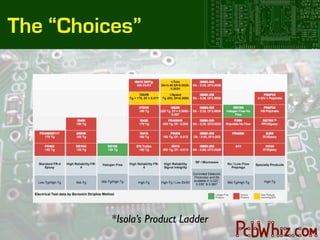
The “Choices”


          *Isola’s Product Ladder
The “Choices”

    •   FR-4 - Flame Retardant Class 4
        •   DICY Epoxy
        •   Modified DICY Epoxy
        •   Fillers
        •   Low Loss
        •   Halogen-Free

    •   Others
        •   PTFE, LCP, Polyamide, CEM
Properties

   •   Tg - Glass Transition Temperature
   •   Td - Decomposition Temperature
   •   CTE - Coefficient of Thermal Expansion
   •   Dk - Dielectric Constant
   •   Df - Dissipation Factor
   •   Moisture Absorption
   •   Flammability
   •   Anti-CAF - Conductive Anodic Filament
Physical Properties
   •   Glass Transition Temperature (Tg)
Physical Properties
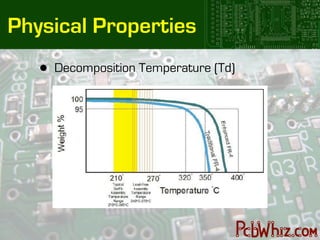
   •   Decomposition Temperature (Td)
Physical Properties
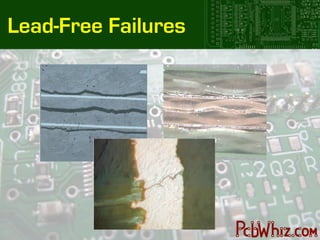
   •   Effects of Multiple Lead-Free Cycles
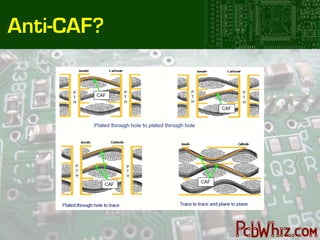
Anti-CAF?
Lead-Free Failures
Electrical Properties
   •   Dielectric Constant (Dk)
Electrical Properties
   •   Dissipation Factor (Df)
Why Do We Care?
  •   Lead-Free Assembly

  •   Higher Layer Counts

  •   Smaller Feature Sizes

  •   Faster Edge Rates
How Do They Stack-Up?
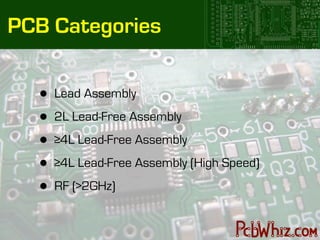
PCB Categories


  •   Lead Assembly

  •   2L Lead-Free Assembly

  •   ≥4L Lead-Free Assembly

  •   ≥4L Lead-Free Assembly (High Speed)

  •   RF (>2GHz)
Lead Assembly

 •   Traditional Epoxy System (/21)

     •   I.e. Nan Ya NP-140

     •   I.e. TLM TLM-140

 •   Meets Customer Tg≥135˚C Requirement

 •   Low Cost Materials (~0.8x)

 •   Easy to Manufacture
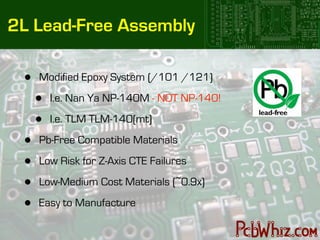
2L Lead-Free Assembly

 •   Modified Epoxy System (/101 /121)

     •   I.e. Nan Ya NP-140M - NOT NP-140!

     •   I.e. TLM TLM-140(mt)

 •   Pb-Free Compatible Materials

 •   Low Risk for Z-Axis CTE Failures

 •   Low-Medium Cost Materials (~0.9x)

 •   Easy to Manufacture
≥4L Lead-Free Assembly

 •   Modified & Filled Epoxy System (/99 /126)
     •   I.e. Nan Ya NP-175F - NOT NP-170!
     •   I.e. TLM TLM-170(t)
 •   Pb-Free Compatible Materials
 •   Anti-CAF
 •   Low CTE Z-Axis Expansion
 •   Medium Cost Materials (~1.0x)
 •   Difficult to Manufacture
     •   Routed NOT Punched!
High Speed & RF
 •   Modified & Filled Epoxy Systems (/29 /129)
     •   I.e. Isola FR408HR
     •   I.e. Nelco N4000-SI
     •   I.e. Panasonic Megtron4
 •   Same as ≥4L Lead-Free Assembly, But Lower Dk/
     Df c/o Specialty Fillers

 •   Higher Cost Materials (~1.8x)
 •   Difficult to Manufacture
 •   Other Important Considerations
Discussion
    •   HATS Testing

    •   Define Qualified Materials in PCB Specification

    •   Specify as IPC-4101 Slash Sheet

    •   More Engineering Consideration

    •   USA vs. Asia Materials

    •   Vendor Portability

    •   Customer Communication

    •   Cost vs. Quality

PCB Laminates 101

  • 1.
  • 2.
    What Is It? Components •Core •Pre-Preg •Foil Vendor Datasheet • Thickness • Glass Weave
  • 3.
    What Is It? • Fiberglass Reinforced Epoxy
  • 4.
    High Speed vs.Glass Weave
  • 5.
    The “Players” • USA • Asia
  • 6.
    The “Choices” *Isola’s Product Ladder
  • 7.
    The “Choices” • FR-4 - Flame Retardant Class 4 • DICY Epoxy • Modified DICY Epoxy • Fillers • Low Loss • Halogen-Free • Others • PTFE, LCP, Polyamide, CEM
  • 8.
    Properties • Tg - Glass Transition Temperature • Td - Decomposition Temperature • CTE - Coefficient of Thermal Expansion • Dk - Dielectric Constant • Df - Dissipation Factor • Moisture Absorption • Flammability • Anti-CAF - Conductive Anodic Filament
  • 9.
    Physical Properties • Glass Transition Temperature (Tg)
  • 10.
    Physical Properties • Decomposition Temperature (Td)
  • 11.
    Physical Properties • Effects of Multiple Lead-Free Cycles
  • 12.
  • 13.
  • 14.
    Electrical Properties • Dielectric Constant (Dk)
  • 15.
    Electrical Properties • Dissipation Factor (Df)
  • 16.
    Why Do WeCare? • Lead-Free Assembly • Higher Layer Counts • Smaller Feature Sizes • Faster Edge Rates
  • 17.
    How Do TheyStack-Up?
  • 18.
    PCB Categories • Lead Assembly • 2L Lead-Free Assembly • ≥4L Lead-Free Assembly • ≥4L Lead-Free Assembly (High Speed) • RF (>2GHz)
  • 19.
    Lead Assembly • Traditional Epoxy System (/21) • I.e. Nan Ya NP-140 • I.e. TLM TLM-140 • Meets Customer Tg≥135˚C Requirement • Low Cost Materials (~0.8x) • Easy to Manufacture
  • 20.
    2L Lead-Free Assembly • Modified Epoxy System (/101 /121) • I.e. Nan Ya NP-140M - NOT NP-140! • I.e. TLM TLM-140(mt) • Pb-Free Compatible Materials • Low Risk for Z-Axis CTE Failures • Low-Medium Cost Materials (~0.9x) • Easy to Manufacture
  • 21.
    ≥4L Lead-Free Assembly • Modified & Filled Epoxy System (/99 /126) • I.e. Nan Ya NP-175F - NOT NP-170! • I.e. TLM TLM-170(t) • Pb-Free Compatible Materials • Anti-CAF • Low CTE Z-Axis Expansion • Medium Cost Materials (~1.0x) • Difficult to Manufacture • Routed NOT Punched!
  • 22.
    High Speed &RF • Modified & Filled Epoxy Systems (/29 /129) • I.e. Isola FR408HR • I.e. Nelco N4000-SI • I.e. Panasonic Megtron4 • Same as ≥4L Lead-Free Assembly, But Lower Dk/ Df c/o Specialty Fillers • Higher Cost Materials (~1.8x) • Difficult to Manufacture • Other Important Considerations
  • 23.
    Discussion • HATS Testing • Define Qualified Materials in PCB Specification • Specify as IPC-4101 Slash Sheet • More Engineering Consideration • USA vs. Asia Materials • Vendor Portability • Customer Communication • Cost vs. Quality