2© Life Cycle Institute
Get Certified!
Achieve your Reliability Engineering Certification (REC) from a top
engineering school
3© Life Cycle Institute
REC has many benefits!
 Build and sustain a strategic reliability engineering program
 Reduce risk and improve asset utilization
 Build an effective predictive maintenance program
 Establish a culture of continuous improvement
 Demonstrate practical learning application
 Privilege of using the REC title designation beside your name
4© Life Cycle Institute
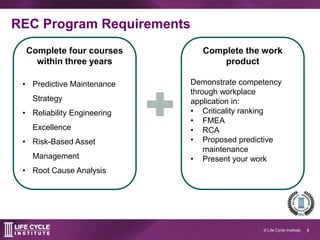
REC program requirements
Complete four courses
within three years
• Predictive Maintenance
Strategy
• Reliability Engineering
Excellence
• Risk-Based Asset
Management
• Root Cause Analysis
Complete the work
product
Demonstrate competency
through workplace
application:
• Criticality ranking
• FMEA
• RCA
• Proposed predictive
maintenance
• Present your work
5© Life Cycle Institute
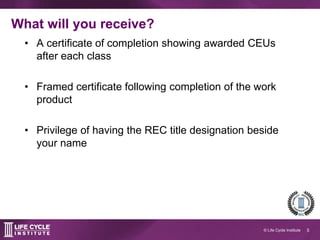
What will you receive?
A certificate of
completion showing
awarded CEUs after
each class
Framed
certificate
following completion
of the work product
Privilege of having
the REC title
designation beside
your name
Images by Creative Stall and Andrew Stauffer
The Noun Project
6© Life Cycle Institute
Who should attend?
People responsible for:
 Improving asset and capacity reliability
 Decreasing repetitive failures
 Building sustainable predictive maintenance
programs
 Creating a culture of continuous improvement
7© Life Cycle Institute
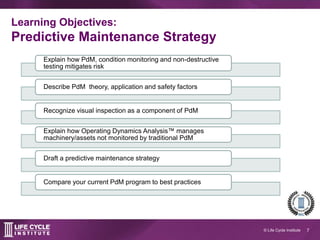
Learning objectives:
Predictive Maintenance Strategy
Explain how PdM, condition monitoring and non-destructive testing mitigate
risk and optimize your asset management plan
Describe the theory, application and safety considerations of 5 PdM
technologies
Recognize visual inspection as a component of PdM
Draft a predictive maintenance strategy
Compare your PdM program to best practices and build a plan to meet your
PdM goals
8© Life Cycle Institute
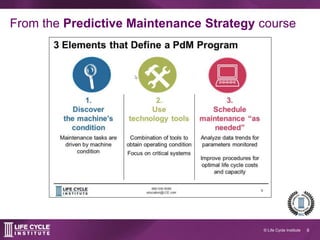
From the Predictive Maintenance Strategy course
9© Life Cycle Institute
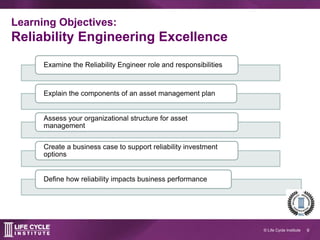
Learning objectives:
Reliability Engineering Excellence
Describe the relationship between reliability and asset management
Define how reliability impacts business performance
Describe the reliability engineer role and responsibilities
Create a business case to support reliability investment options
Describe the main components of an asset information system
Assess internal asset management capabilities and develop a plan to
address gaps
10© Life Cycle Institute
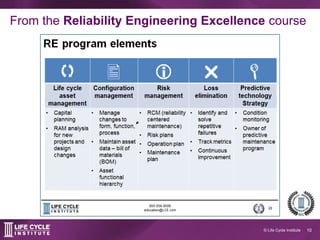
From the Reliability Engineering Excellence course
11© Life Cycle Institute
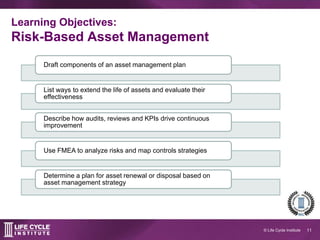
Learning Objectives:
Risk-Based Asset Management
Draft components of an asset management plan
Describe asset information required to manage risk and improve performance
List ways to extend the life of assets and evaluate their effectiveness
Describe how audits, reviews and KPIs drive continuous improvement
Use an FMEA to analyze risks and map controls strategies
Plan for asset renewal or disposal based on asset management strategy
Apply a standard process for preventive maintenance optimization
12© Life Cycle Institute
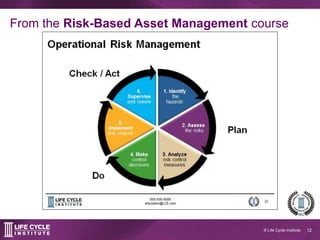
From the Risk-Based Asset Management course
13© Life Cycle Institute
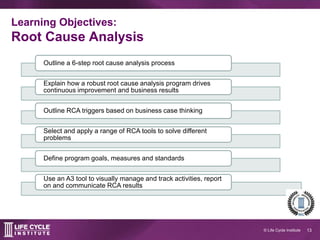
Learning objectives:
Root Cause Analysis
Outline a 6-step root cause analysis (RCA) process
Explain how a robust RCA program drives continuous improvement and
business results
Plan your RCA program
Select and apply a range of RCA tools to solve different problems
Define program goals, measures and standards
Use an A3 tool to visually manage and track activities, report and
communicate results
List RCA group facilitation best practices
14© Life Cycle Institute
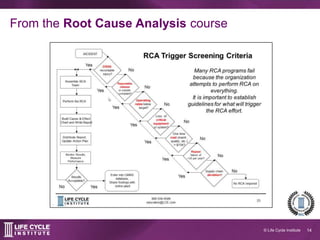
From the Root Cause Analysis course
Reliability Engineering Certification
Work Product
16© Life Cycle Institute
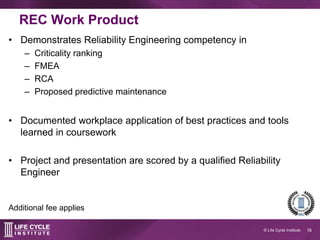
REC work product
• Demonstrates reliability engineering competency:
– Criticality ranking
– FMEA
– RCA
– Proposed predictive maintenance
• Documented workplace application of best
practices and tools learned in coursework
• Project and presentation are scored by a qualified
Reliability Engineer
Additional fee applies
17© Life Cycle Institute
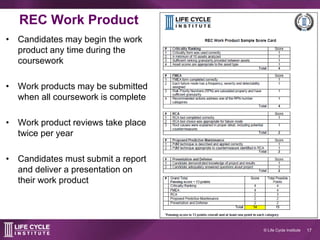
REC work product
• Candidates may begin the work
product any time during the
coursework
• Work products may be submitted
when all coursework is complete
• Work product reviews take place
twice per year
• Candidates must submit a report
and deliver a presentation on
their work product
18© Life Cycle Institute
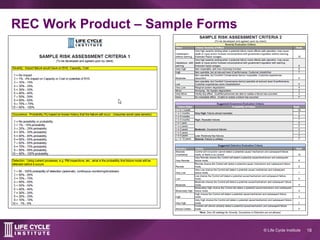
REC work product – sample forms
19© Life Cycle Institute
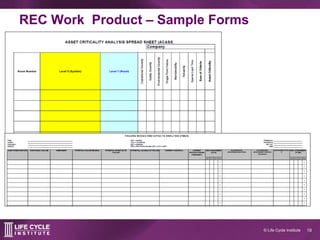
REC work product – sample forms
20© Life Cycle Institute
3 reasons to choose the Life Cycle Institute
Building competency is what we DO!
Our team of learning professionals understands what it takes before,
during and after training to change behavior to produce results!
Instructors are trained learning facilitators
Rigorous facilitator qualification and certification process
Focus on the learning process and transfer to the job
Engage learners, reinforce relevancy and integrate prior experience
Training is an active experience
Learning by doing vs. lecture
Group activities, assessments, case studies
Network with peers
Develop action plans to drive results post-training



21© Life Cycle Institute
Education@LCE.com
www.LCE.com
800-556-9589
Life Cycle Institute is the learning, leadership and change
management practice at Life Cycle Engineering.
Register for the REC program

Reliability Engineering Certification Program

  • 2.
    2© Life CycleInstitute Get Certified! Achieve your Reliability Engineering Certification (REC) from a top engineering school
  • 3.
    3© Life CycleInstitute REC has many benefits!  Build and sustain a strategic reliability engineering program  Reduce risk and improve asset utilization  Build an effective predictive maintenance program  Establish a culture of continuous improvement  Demonstrate practical learning application  Privilege of using the REC title designation beside your name
  • 4.
    4© Life CycleInstitute REC program requirements Complete four courses within three years • Predictive Maintenance Strategy • Reliability Engineering Excellence • Risk-Based Asset Management • Root Cause Analysis Complete the work product Demonstrate competency through workplace application: • Criticality ranking • FMEA • RCA • Proposed predictive maintenance • Present your work
  • 5.
    5© Life CycleInstitute What will you receive? A certificate of completion showing awarded CEUs after each class Framed certificate following completion of the work product Privilege of having the REC title designation beside your name Images by Creative Stall and Andrew Stauffer The Noun Project
  • 6.
    6© Life CycleInstitute Who should attend? People responsible for:  Improving asset and capacity reliability  Decreasing repetitive failures  Building sustainable predictive maintenance programs  Creating a culture of continuous improvement
  • 7.
    7© Life CycleInstitute Learning objectives: Predictive Maintenance Strategy Explain how PdM, condition monitoring and non-destructive testing mitigate risk and optimize your asset management plan Describe the theory, application and safety considerations of 5 PdM technologies Recognize visual inspection as a component of PdM Draft a predictive maintenance strategy Compare your PdM program to best practices and build a plan to meet your PdM goals
  • 8.
    8© Life CycleInstitute From the Predictive Maintenance Strategy course
  • 9.
    9© Life CycleInstitute Learning objectives: Reliability Engineering Excellence Describe the relationship between reliability and asset management Define how reliability impacts business performance Describe the reliability engineer role and responsibilities Create a business case to support reliability investment options Describe the main components of an asset information system Assess internal asset management capabilities and develop a plan to address gaps
  • 10.
    10© Life CycleInstitute From the Reliability Engineering Excellence course
  • 11.
    11© Life CycleInstitute Learning Objectives: Risk-Based Asset Management Draft components of an asset management plan Describe asset information required to manage risk and improve performance List ways to extend the life of assets and evaluate their effectiveness Describe how audits, reviews and KPIs drive continuous improvement Use an FMEA to analyze risks and map controls strategies Plan for asset renewal or disposal based on asset management strategy Apply a standard process for preventive maintenance optimization
  • 12.
    12© Life CycleInstitute From the Risk-Based Asset Management course
  • 13.
    13© Life CycleInstitute Learning objectives: Root Cause Analysis Outline a 6-step root cause analysis (RCA) process Explain how a robust RCA program drives continuous improvement and business results Plan your RCA program Select and apply a range of RCA tools to solve different problems Define program goals, measures and standards Use an A3 tool to visually manage and track activities, report and communicate results List RCA group facilitation best practices
  • 14.
    14© Life CycleInstitute From the Root Cause Analysis course
  • 15.
  • 16.
    16© Life CycleInstitute REC work product • Demonstrates reliability engineering competency: – Criticality ranking – FMEA – RCA – Proposed predictive maintenance • Documented workplace application of best practices and tools learned in coursework • Project and presentation are scored by a qualified Reliability Engineer Additional fee applies
  • 17.
    17© Life CycleInstitute REC work product • Candidates may begin the work product any time during the coursework • Work products may be submitted when all coursework is complete • Work product reviews take place twice per year • Candidates must submit a report and deliver a presentation on their work product
  • 18.
    18© Life CycleInstitute REC work product – sample forms
  • 19.
    19© Life CycleInstitute REC work product – sample forms
  • 20.
    20© Life CycleInstitute 3 reasons to choose the Life Cycle Institute Building competency is what we DO! Our team of learning professionals understands what it takes before, during and after training to change behavior to produce results! Instructors are trained learning facilitators Rigorous facilitator qualification and certification process Focus on the learning process and transfer to the job Engage learners, reinforce relevancy and integrate prior experience Training is an active experience Learning by doing vs. lecture Group activities, assessments, case studies Network with peers Develop action plans to drive results post-training   
  • 21.
    21© Life CycleInstitute Education@LCE.com www.LCE.com 800-556-9589 Life Cycle Institute is the learning, leadership and change management practice at Life Cycle Engineering. Register for the REC program