1© Life Cycle Institute© Life Cycle Institute
ISO 55000: Asset Management System Workshop
2© Life Cycle Institute
ISO 55000 Asset Management Standard
• Published in January 2014, ISO 55000 is an
international standard that is founded on the
premise that the value of an asset is defined by
how much it contributes to the achievement of
organizational goals.
• It is designed to optimize asset value and
decrease organizational risks through a
comprehensive asset management strategy
that is built around business objectives and
goals.
3© Life Cycle Institute
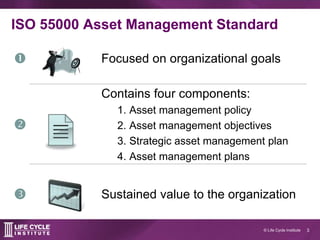
ISO 55000 Asset Management Standard
 Focused on organizational goals

Contains four components:
1. Asset management policy
2. Asset management objectives
3. Strategic asset management plan
4. Asset management plans
 Sustained value to the organization
4© Life Cycle Institute
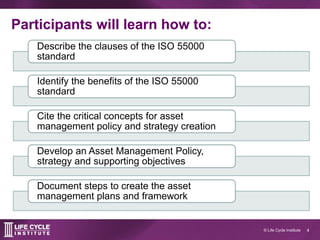
Participants will learn how to:
Describe the clauses of the ISO 55000
standard
Identify the benefits of the ISO 55000
standard
Cite the critical concepts for asset
management policy and strategy creation
Develop an Asset Management Policy,
strategy and supporting objectives
Document steps to create the asset
management plans and framework
5© Life Cycle Institute
ISO 55000: Asset Management System Workshop
2-day workshop
1.4 Continuing Education units (CEUs)
Private
Workshops may be tailored to your specific needs and
delivered at your site.
Institute of Asset Management Endorsed Trainer
6© Life Cycle Institute
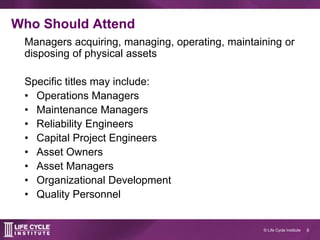
Who Should Attend
Managers acquiring, managing, operating, maintaining or
disposing of physical assets
Specific titles may include:
• Operations Managers
• Maintenance Managers
• Reliability Engineers
• Capital Project Engineers
• Asset Owners
• Asset Managers
• Organizational Development
• Quality Personnel
7© Life Cycle Institute
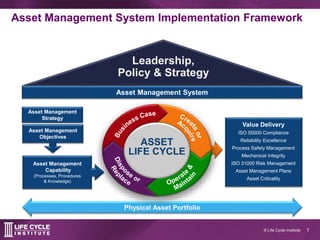
Asset Management System Implementation Framework
Leadership,
Policy & Strategy
Asset Management
Strategy
Physical Asset Portfolio
Business
Case
Procure &
Construct
Commission
Operate &
Maintain
Asset Management System
Asset Management
Capability
(Processes, Procedures
& Knowledge)
Asset Management
Objectives
Value Delivery
ISO 55000 Compliance
Reliability Excellence
Process Safety Management
Mechanical Integrity
ISO 31000 Risk Management
Asset Management Plans
Asset Criticality
ASSET
LIFE CYCLE
8© Life Cycle Institute
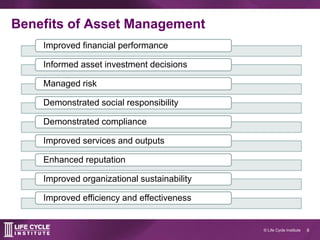
Benefits of Asset Management
Improved financial performance
Informed asset investment decisions
Managed risk
Demonstrated social responsibility
Demonstrated compliance
Improved services and outputs
Enhanced reputation
Improved organizational sustainability
Improved efficiency and effectiveness
9© Life Cycle Institute
Critical concepts for asset management policy
and strategy creation
Line of Sight
Stakeholder
Mapping
Change
Management
Catch Ball
Process
Six anchor
points for
AM
Objectives
Assessing
and
Managing
Risk
10© Life Cycle Institute
3 Reasons to Choose the Life Cycle Institute
Asset Management is what we DO!
Our facilitators are experienced reliability professionals who have implemented
all of the elements of the ISO 55000 standard for organizations in many
industries around the globe.
LCI instructors are trained learning facilitators
Rigorous facilitator qualification and certification process
Focus on the learning process and transfer to the job
Engage learners, reinforce relevancy and integrate prior experience
LCI training is an active experience
Learning by doing vs. lecture
Group activities, assessments, case studies
Network with peers
Develop action plans to drive results post-training



11© Life Cycle Institute
Education@LCE.com
www.LCE.com
800-556-9589
The Life Cycle Institute is the learning, leadership and
change management practice at Life Cycle Engineering.

ISO 55000: Asset Management System Workshop

  • 1.
    1© Life CycleInstitute© Life Cycle Institute ISO 55000: Asset Management System Workshop
  • 2.
    2© Life CycleInstitute ISO 55000 Asset Management Standard • Published in January 2014, ISO 55000 is an international standard that is founded on the premise that the value of an asset is defined by how much it contributes to the achievement of organizational goals. • It is designed to optimize asset value and decrease organizational risks through a comprehensive asset management strategy that is built around business objectives and goals.
  • 3.
    3© Life CycleInstitute ISO 55000 Asset Management Standard  Focused on organizational goals  Contains four components: 1. Asset management policy 2. Asset management objectives 3. Strategic asset management plan 4. Asset management plans  Sustained value to the organization
  • 4.
    4© Life CycleInstitute Participants will learn how to: Describe the clauses of the ISO 55000 standard Identify the benefits of the ISO 55000 standard Cite the critical concepts for asset management policy and strategy creation Develop an Asset Management Policy, strategy and supporting objectives Document steps to create the asset management plans and framework
  • 5.
    5© Life CycleInstitute ISO 55000: Asset Management System Workshop 2-day workshop 1.4 Continuing Education units (CEUs) Private Workshops may be tailored to your specific needs and delivered at your site. Institute of Asset Management Endorsed Trainer
  • 6.
    6© Life CycleInstitute Who Should Attend Managers acquiring, managing, operating, maintaining or disposing of physical assets Specific titles may include: • Operations Managers • Maintenance Managers • Reliability Engineers • Capital Project Engineers • Asset Owners • Asset Managers • Organizational Development • Quality Personnel
  • 7.
    7© Life CycleInstitute Asset Management System Implementation Framework Leadership, Policy & Strategy Asset Management Strategy Physical Asset Portfolio Business Case Procure & Construct Commission Operate & Maintain Asset Management System Asset Management Capability (Processes, Procedures & Knowledge) Asset Management Objectives Value Delivery ISO 55000 Compliance Reliability Excellence Process Safety Management Mechanical Integrity ISO 31000 Risk Management Asset Management Plans Asset Criticality ASSET LIFE CYCLE
  • 8.
    8© Life CycleInstitute Benefits of Asset Management Improved financial performance Informed asset investment decisions Managed risk Demonstrated social responsibility Demonstrated compliance Improved services and outputs Enhanced reputation Improved organizational sustainability Improved efficiency and effectiveness
  • 9.
    9© Life CycleInstitute Critical concepts for asset management policy and strategy creation Line of Sight Stakeholder Mapping Change Management Catch Ball Process Six anchor points for AM Objectives Assessing and Managing Risk
  • 10.
    10© Life CycleInstitute 3 Reasons to Choose the Life Cycle Institute Asset Management is what we DO! Our facilitators are experienced reliability professionals who have implemented all of the elements of the ISO 55000 standard for organizations in many industries around the globe. LCI instructors are trained learning facilitators Rigorous facilitator qualification and certification process Focus on the learning process and transfer to the job Engage learners, reinforce relevancy and integrate prior experience LCI training is an active experience Learning by doing vs. lecture Group activities, assessments, case studies Network with peers Develop action plans to drive results post-training   
  • 11.
    11© Life CycleInstitute Education@LCE.com www.LCE.com 800-556-9589 The Life Cycle Institute is the learning, leadership and change management practice at Life Cycle Engineering.

Editor's Notes

  • #8 Asset Management system implementation framework model Establishes the key concepts and flow that are necessary for many important asset management related deliverables (link to value delivery) Based upon the ISO 55000 management system for asset management Organization’s Leadership and company policy and strategy sits atop and guides and validates the asset management system Organization’s Strategic plan provides the linkages to and supports the commitment for developing, implementing and maintaining an asset management system. Understanding the organizational context is critical to developing an asset management system that aligns to the organization strategic plan A commitment to an developing, implementing and maintaining an asset management system is defined first with an written asset management policy The asset management policy is furthered with addition of an asset management strategy Asset management performance objectives are developed closing with the strategy to form the basis for developing the asset management plans From policy to strategy to objectives flow supporting asset management capabilities. The capabilities are defined through key processes, procedures and knowledge that govern the asset lifecycle The asset lifecycle is the critical concept that must be governed by the asset management system Through a risk based asset management system that governs the asset lifecycle various deliverables are possible. These deliverable serve to extract value from the assets in various forms. This value deliverable can be either an holistic view on asset management through an ISO 55000 certification or through more tactical applications like mechanical integrity or process safety management. In all cases the deliverables are delveloped through a risk based approach with a focus on value.