ISSN 2349-7815
International Journal of Recent Research in Electrical and Electronics Engineering (IJRREEE)
Vol. 2, Issue 3, pp: (66-71), Month: July 2015 - September 2015, Available at: www.paperpublications.org
Page | 66
Paper Publications
IMAGE QUALITY OPTIMIZATION USING
RSATV
1
Neelanjna Parihar, 2
Ashutosh Gupta
1
M.Tech scholar, GIST (RGPV) Bhopal, (m. p), India
2
GIST (RGPV) Bhopal (m. p), India
Abstract: Primarily due to the progresses in super resolution imagery, the methods of segment-based image
analysis for generating and updating geographical information are becoming more and more important. This
work presents a image segmentation based on colour features with K-means clustering. The entire work is divided
into two stages. First enhancement of color separation of satellite image using de correlation stretching is carried
out and then the regions are grouped into a set of five classes using K-means clustering algorithm. At first, the
spatial data is concentrated focused around every pixel, and at that point two separating procedures are added to
smother the impact of pseudoedges. What's more, the spatial data weight is built and grouped with k-means
bunching, and the regularization quality in every district is controlled by the bunching focus esteem. The
exploratory results, on both reenacted and genuine datasets, demonstrate that the proposed methodology can
adequately lessen the pseudoedges of the aggregate variety regularization in the level
Keywords: image, Quality, geographical, colour features, K-means clustering.
I. INTRODUCTION
Image Resolution symbolism assumes a key part in numerous different ranges of use, for example, restorative imaging,
remote sensing, and feature reconnaissance. On the other hand, in light of the fact that there are various constraints with
both the hypothetical and pragmatic viewpoints, for example, the sensor determination and high cost, among different
things, it is clearly harder to acquire a HR picture than a low-determination (LR) picture. FLFC can be easily modified,
simpler, quick and easy to implement. Accordingly, to defeat the deficiency said above, some spatially versatile TV
(SATV) models, which utilize the spatial data to compel the regularization quality in every pixel, have been created. The
fundamental thought of the spatially versatile regularization model is to utilize the spatial data disseminated in the picture
to oblige the regularization quality. Thus, scientists have investigated approaches to produce a HR picture from the picture
preparing angle, and, in late decades, super-determination (SR) engineering, which produces a HR picture from single-
edge or multi frame LR pictures, has been proposed. Thus, many investigations in area of LFC problem have been
reported and various control strategies has been employed in design of load frequency controller in order to achieve better
dynamic performance [2-4]. And finally, Fuzzy-Logic approach is considered to be appropriate choice. Because Fuzzy-
logic controller (FLC) can be simply expressed by set of rules that describes behavior of controller using linguistic terms.
A powerless regularization quality is implemented in the edge pixels to protect subtle element data, and a solid
regularization quality is implemented in the homogeneous range pixels to adequately stifle clamor. The principal spatially
versatile thought for a TV model can be credited to Strong et al., where the creators proposed to utilize an angle picture to
compel the TV regularization quality in distinctive pixels. A feeble regularization quality is authorized in the edge pixels
with a huge slope to protect subtle element data, and a solid regularization quality is implemented in the level range pixels
with a little inclination to viably smother commotion and the "pseudo-edges." Clearly, the execution of this model is to a
great extent reliant on the inclination data extraction process.
ISSN 2349-7815
International Journal of Recent Research in Electrical and Electronics Engineering (IJRREEE)
Vol. 2, Issue 3, pp: (66-71), Month: July 2015 - September 2015, Available at: www.paperpublications.org
Page | 67
Paper Publications
K-Means Clustering:
There are many methods of clustering developed for a wide variety of purposes. Clustering algorithms used for
unsupervised classification of remote sensing data vary according to the efficiency with which clustering takes place
(John R Jenson, 1986).K-means is the clustering algorithm used to determine the natural spectral groupings present in a
data set. This accepts from analyst the number of clusters to be located in the data. The algorithm then arbitrarily seeds or
locates, that number of cluster centers in multidimensional measurement space. Each pixel in the image is then assigned
to the cluster whose arbitrary mean vector is closest. The procedure continues until there is no significant change in the
location of class mean vectors between successive iterations of the algorithms (Lillesand and Keiffer, 2000).
Super-resolution:
Methods for super-resolution can be broadly classified into two families of methods: (i) The classical multi-image super-
resolution (combining images obtained at sub pixel misalignments), and (ii) Example-Based super-resolution (learning
correspondence between low and high resolution image patches from a database). In this paper we propose a unified
framework for combining these two families of methods. The goal of Super-Resolution (SR) methods is to recover a high
resolution image from one or more low resolution input images. Methods for SR can be broadly classified into two
families of methods: (i) The classical multi-image super-resolution, and (ii) Example-Based super-resolution. In the
classical multi-image SR a set of low-resolution images of the same scene are taken (at sub pixel misalignments). Each
low resolution image imposes a set of linear constraints on the unknown high resolution intensity values. If enough low-
resolution images are available (at sub pixel shifts), then the set of equations becomes determined and can be solved to
recover the high-resolution image practically, however, this approach is numerically limited only to small increases in
resolution (by factors smaller than 2). These limitations have lead to the development of
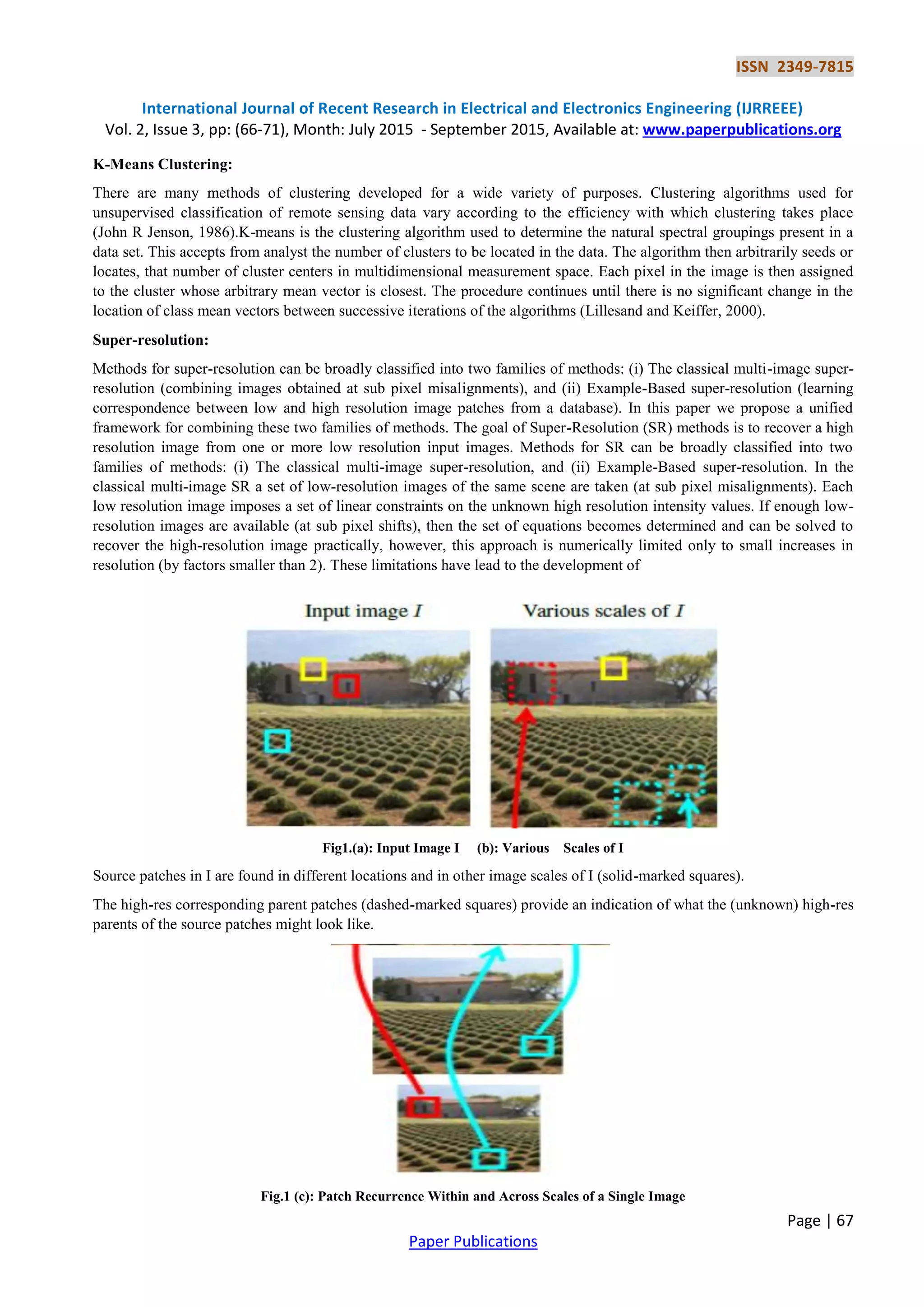
Fig1.(a): Input Image I (b): Various Scales of I
Source patches in I are found in different locations and in other image scales of I (solid-marked squares).
The high-res corresponding parent patches (dashed-marked squares) provide an indication of what the (unknown) high-res
parents of the source patches might look like.
Fig.1 (c): Patch Recurrence Within and Across Scales of a Single Image
ISSN 2349-7815
International Journal of Recent Research in Electrical and Electronics Engineering (IJRREEE)
Vol. 2, Issue 3, pp: (66-71), Month: July 2015 - September 2015, Available at: www.paperpublications.org
Page | 68
Paper Publications
“Example-Based Super-Resolution” also termed “image hallucination” In example-based SR, correspondences between
low and high resolution image patches are learned from a database of low and high resolution image pairs (usually with a
relative scale factor of 2), and then applied to a new low-resolution image to recover its most likely high-resolution
version. Higher SR factors have often been obtained by repeated applications of this process.
Total Variation:
The total variation (TV) of a signal measures how much the signal changes between signal values. Specifically, the total
variation of an N-point signal x(n), 1 ≤ n ≤ N is defined as
The total variation of x can also be written as
TV Denoising:
We assume we observe the signal x corrupted by additive white Gaussian noise,
One approach to estimate x is the signal x minimizing the objective function
This approach is called TV de-noising. The regularization parameter controls how much smoothing is performed. Larger
noise levels call for larger.
In this thesis we take original image then down sampling of the image data. After that we extract spatial information and
optimize data part with the help of noising image and spatial information extraction. After this filtering data for
segmentation and high resolution we are apply mean (k mean) clustering algorithm to optimize the data. After the filtering
we apply mm algorithm in noisy image and then apply RSATV and get high resolution data output in the end.
II. SIMULATION AND RESULT
In this paper, proposed image quality optimization
Table no: 1 compares base and thesis result
Noise variance Value Base Paper Result
8 PSNR 32.14 40.11
SSIM 0.964 0.91
11 PSNR 27.7 29.31
16 PSNR 26.28 27.5
Input (Image)
Pixel Subtraction
Blurred Processing
Add Noise
Extraction Spatial Information
Calculate Mean Value
Apply Clustering
Process with MM and TV
Apply RSATV
Output
Fig.2: Output Procedure Block Diagram
ISSN 2349-7815
International Journal of Recent Research in Electrical and Electronics Engineering (IJRREEE)
Vol. 2, Issue 3, pp: (66-71), Month: July 2015 - September 2015, Available at: www.paperpublications.org
Page | 69
Paper Publications
Fig.3: Input Image
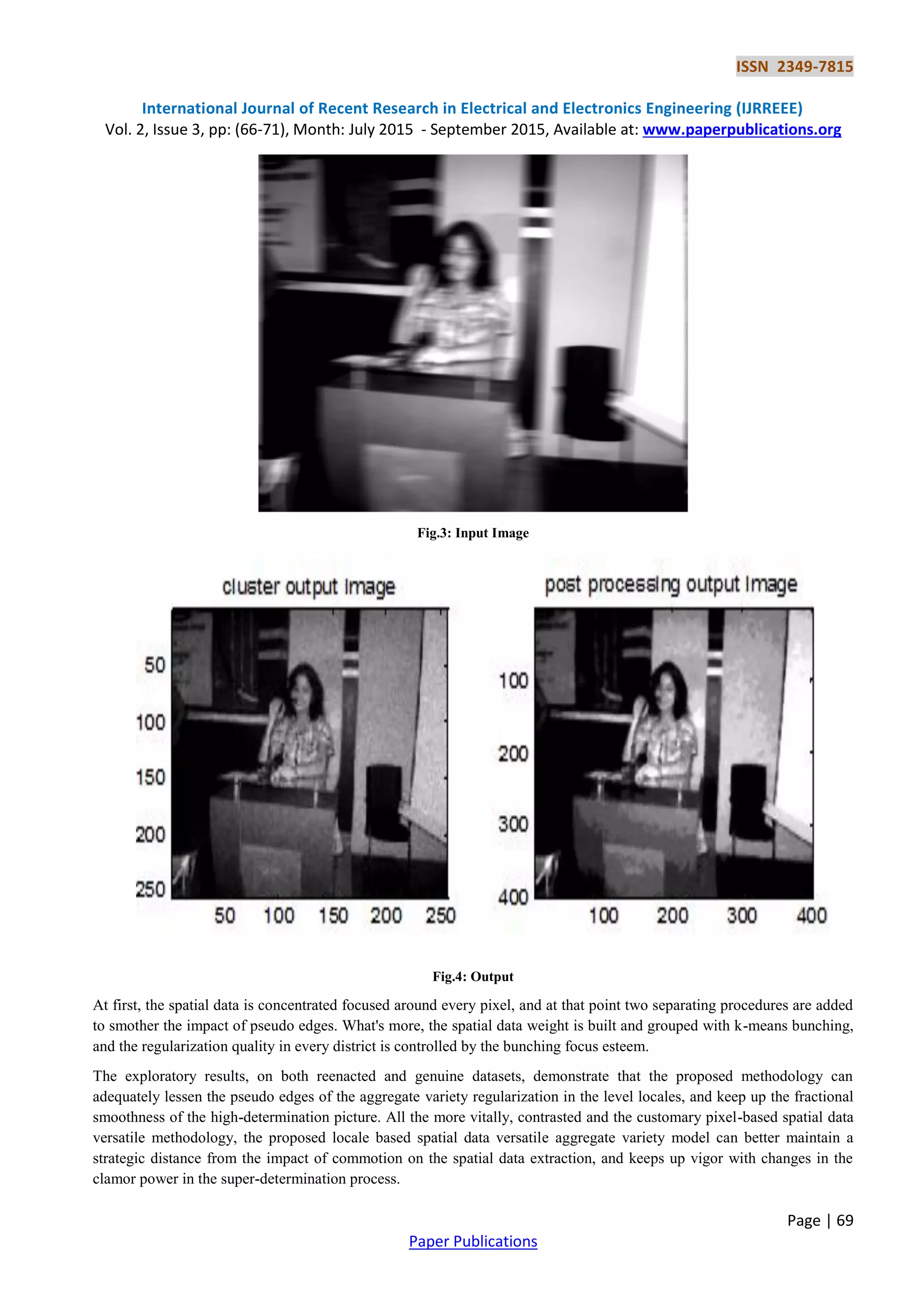
Fig.4: Output
At first, the spatial data is concentrated focused around every pixel, and at that point two separating procedures are added
to smother the impact of pseudo edges. What's more, the spatial data weight is built and grouped with k-means bunching,
and the regularization quality in every district is controlled by the bunching focus esteem.
The exploratory results, on both reenacted and genuine datasets, demonstrate that the proposed methodology can
adequately lessen the pseudo edges of the aggregate variety regularization in the level locales, and keep up the fractional
smoothness of the high-determination picture. All the more vitally, contrasted and the customary pixel-based spatial data
versatile methodology, the proposed locale based spatial data versatile aggregate variety model can better maintain a
strategic distance from the impact of commotion on the spatial data extraction, and keeps up vigor with changes in the
clamor power in the super-determination process.
ISSN 2349-7815
International Journal of Recent Research in Electrical and Electronics Engineering (IJRREEE)
Vol. 2, Issue 3, pp: (66-71), Month: July 2015 - September 2015, Available at: www.paperpublications.org
Page | 70
Paper Publications
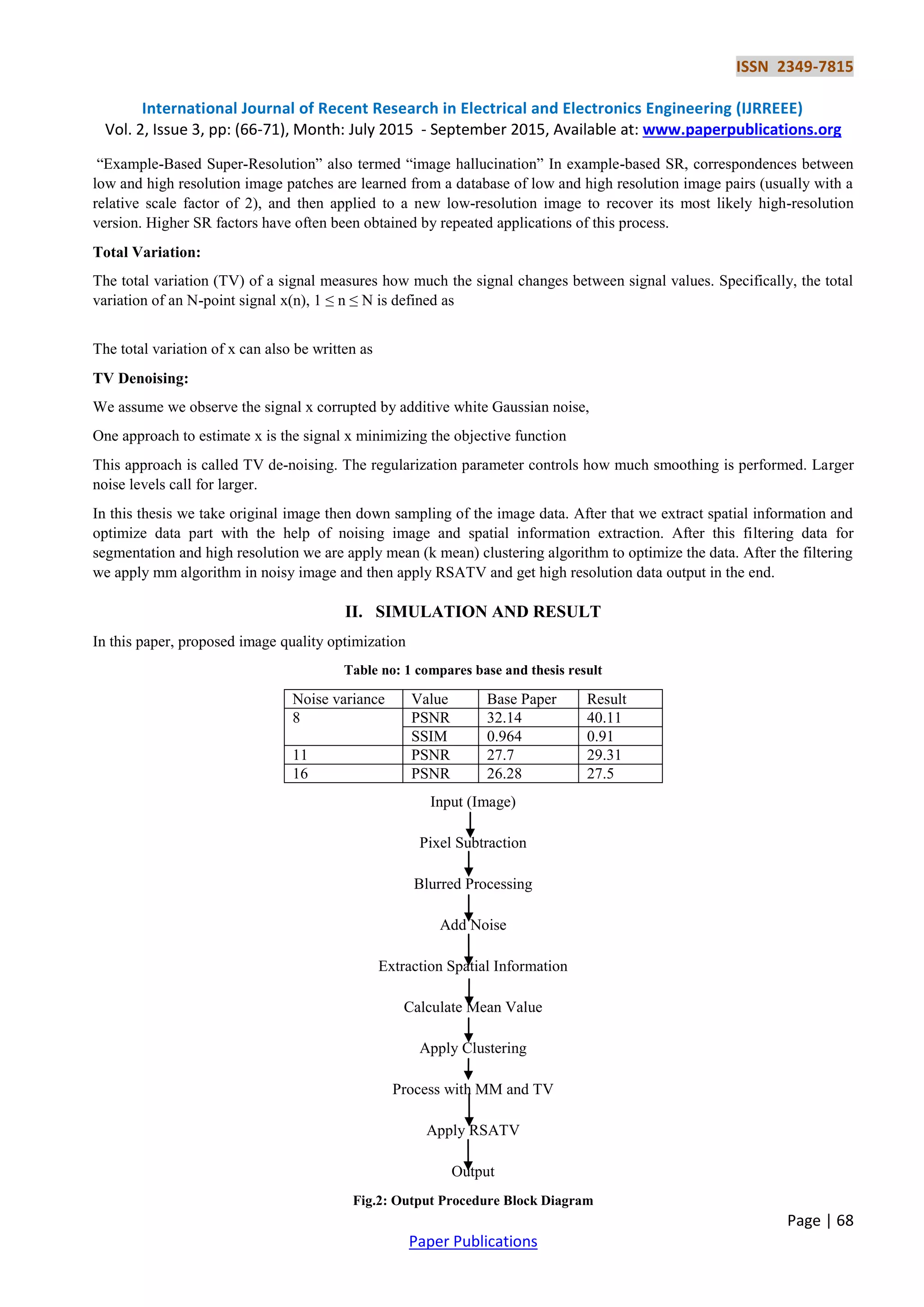
As you see figure its input image (blurring image) In our proposed work we take one image and then substrate pixel value
of original image and apply down sampling algorithm to design the sample of the image as show of image in figure its
blurd and then we are extract spatial information of the sampled data. After it is add noise like Gaussian noise and then
filter of the data with the help of clustering algorithm. Calculate K means. Then group of the similar data of the image
sample. After this apply mm algorithm for the noisy image to de-noise of data sample and then apply RSATV algorithm
get high resolution of image output as show on figure.
III. CONCLUSION
The simulated and real data experiments presented in above Section show that the proposed RSATV model can better
suppress the noise in the flat regions of an image, without losing the edge. In this, work, we propose a local spatially
versatile aggregate variety (RSATV) super-determination calculation with spatial data separating and bunching. The
spatial data is initially extricated for every pixel, and after that the spatial data separating procedure and spatial weight
bunching methodology are included. In this work also used k-mean for data segmentation, and then use mm algorithm for
the best resolution of output image. The conventional spatially versatile aggregate variety model has the inadequacy of
being delicate to clamor, and it performs inadequately in high clamor force conditions. With these two courses of action,
the regularization quality of the aggregate variety model is balanced for every area with distinctive spatial properties,
instead of for every pixel, as in the conventional spatially versatile TV model.
In our future research, we will focus on adaptive parameter selection for the method, and we will also investigate the use
of more efficient optimization algorithms to accelerate the solution speed of the RSATV model.
REFERENCE
[1] H. Greenspan, “Super-resolution in medical imaging,” Comput. J,ol. 52, no. 1, pp. 43–63, Jan. 2009.
[2] X. Huang, L. Zhang, and P. Li, “Classification and extraction of spatial features in urban areas using high-resolution
multispectral imagery,”IEEE Trans. Geosci. Remote Sens. Lett., vol. 4, no. 2, pp. 260–264,Apr. 2007.
[3] X. Huang and L. Zhang, “An adaptive mean-shift analysis approach for object extraction and classification from
urban hyper spectral imagery,”IEEE Trans. Geosci. Remote Sens., vol. 46, no. 12, pp. 4173–4185,Dec. 2008.
[4] L. Zhang, H. Zhang, H. Sheen, and P. Li, “A super-resolution reconstruction algorithm for surveillance images,”
Signal Process., vol. 90, no. 3, pp. 848–859, 2010.
[5] R. Tsai and T. Huang, “Multiple frame image restoration and registration,” Adv. Comput.Vis. Image Process., vol.
1, no. 2, pp. 317–339, 1984.
[6] S. Kim, N. Bose, and H. Valenzuela, “Recursive reconstruction of high resolution image from noisy under sampled
multi frames,” IEEE Trans. Acoust., Speech, Signal Process., vol. 38, no. 6, pp. 1013–1027, Jun. 1990.
[7] S. Kim and W. Su, “Recursive high-resolution reconstruction of blurred multiframe images,” IEEE Trans. Image
Process., vol. 2, no. 4, pp. 534–539, Oct. 1993.
[8] H. Ur and D. Gross, “Improved resolution from sub-pixel shifted pictures,” Comput. Vis. Graph., Graph. Models
Image Process., vol. 54, no. 2, pp. 181–186, 1992.
[9] M. Alam, J. Bognar, R. Hardie, and B. Yasuda, “Infrared image registration and high-resolution reconstruction using
multiple translationally shifted aliased video frames,” IEEE Trans. Instrum. Meas., vol. 49, no. 5, pp. 915–923, Oct.
2000.
[10] B. Tom and A. Katsaggelos, “Reconstruction of a high-resolution image by simultaneous registration, restoration,
and interpolation of low resolution images,” in Proc. IEEE Int. Conf. Image Process., vol. 2. Washington, DC, USA,
1995, pp. 539–542.
[11] R. Schultz and R. Stevenson, “Extraction of high-resolution frames from video sequences,” IEEE Trans. Image
Process., vol. 5, no. 6, pp. 996–1011, Jun. 1996.
ISSN 2349-7815
International Journal of Recent Research in Electrical and Electronics Engineering (IJRREEE)
Vol. 2, Issue 3, pp: (66-71), Month: July 2015 - September 2015, Available at: www.paperpublications.org
Page | 71
Paper Publications
[12] S. Belekos, N. Galatsanos, and A. Katsaggelos, “Maximum a posteriori video super-resolution using a new
multichannel image prior,” IEEE Trans. Image Process., vol. 19, no. 6, pp. 1451–1464, Jun. 2010.
[13] R. Hardie, K. Barnard, and E. Armstrong, “Joint MAP registration and high-resolution image estimation using a
sequence of under sampled images,” IEEE Trans. Image Process., vol. 6, no. 12, pp. 1621–1633, Dec. 1997.
[14] H. Shen, L. Zhang, B. Huang, and P. Li, “A MAP approach for joint motion estimation, segmentation and super-
resolution,” IEEE Trans. Image Process., vol. 16, no. 2, pp. 479–490, Feb. 2007.
[15] M. Elad and A. Feuer, “Restoration of a single super resolution image from several blurred, noisy, and
undersampled measured images,” IEEE Trans. Image Process., vol. 6, no. 12, pp. 1646–1658, Dec. 1997.
[16] M. Protter, M. Elad, H. Takeda, and P. Milanfar “Generalizing the nonlocal-means to super-resolution
reconstruction,” IEEE Trans. Image Process., vol. 18, no. 1, pp. 36–51, Jan. 2009.
[17] H. Takeda, P. Milanfar, M. Protter, and M. Elad, “Super-resolution without explicit subpixel motion estimation,”
IEEE Trans. Image Process., vol. 18, no. 9, pp. 1958–1975, Sep. 2009.
[18] N. Nguyen and P. Milanfar, “A wavelet-based interpolation restoration method for super resolution (wavelet super
resolution),” Circuits, Syst., Signal Process., vol. 19, no. 4, pp. 321–338, Apr. 2000.
[19] H. Ji and C. Fermuller, “Robust wavelet-based super-resolution reconstruction: Theory and algorithm,” IEEE Trans.
Pattern Anal. Mach. Intell., vol. 31, no. 4, pp. 649–660, Apr. 2009.
[20] S. Park, M. Park, and M. Kang, “Super-resolution image reconstruction: A technical overview,” IEEE Signal
Process. Mag., vol. 20, no. 3, pp. 21–36, Mar. 2003.

IMAGE QUALITY OPTIMIZATION USING RSATV

  • 1.
    ISSN 2349-7815 International Journalof Recent Research in Electrical and Electronics Engineering (IJRREEE) Vol. 2, Issue 3, pp: (66-71), Month: July 2015 - September 2015, Available at: www.paperpublications.org Page | 66 Paper Publications IMAGE QUALITY OPTIMIZATION USING RSATV 1 Neelanjna Parihar, 2 Ashutosh Gupta 1 M.Tech scholar, GIST (RGPV) Bhopal, (m. p), India 2 GIST (RGPV) Bhopal (m. p), India Abstract: Primarily due to the progresses in super resolution imagery, the methods of segment-based image analysis for generating and updating geographical information are becoming more and more important. This work presents a image segmentation based on colour features with K-means clustering. The entire work is divided into two stages. First enhancement of color separation of satellite image using de correlation stretching is carried out and then the regions are grouped into a set of five classes using K-means clustering algorithm. At first, the spatial data is concentrated focused around every pixel, and at that point two separating procedures are added to smother the impact of pseudoedges. What's more, the spatial data weight is built and grouped with k-means bunching, and the regularization quality in every district is controlled by the bunching focus esteem. The exploratory results, on both reenacted and genuine datasets, demonstrate that the proposed methodology can adequately lessen the pseudoedges of the aggregate variety regularization in the level Keywords: image, Quality, geographical, colour features, K-means clustering. I. INTRODUCTION Image Resolution symbolism assumes a key part in numerous different ranges of use, for example, restorative imaging, remote sensing, and feature reconnaissance. On the other hand, in light of the fact that there are various constraints with both the hypothetical and pragmatic viewpoints, for example, the sensor determination and high cost, among different things, it is clearly harder to acquire a HR picture than a low-determination (LR) picture. FLFC can be easily modified, simpler, quick and easy to implement. Accordingly, to defeat the deficiency said above, some spatially versatile TV (SATV) models, which utilize the spatial data to compel the regularization quality in every pixel, have been created. The fundamental thought of the spatially versatile regularization model is to utilize the spatial data disseminated in the picture to oblige the regularization quality. Thus, scientists have investigated approaches to produce a HR picture from the picture preparing angle, and, in late decades, super-determination (SR) engineering, which produces a HR picture from single- edge or multi frame LR pictures, has been proposed. Thus, many investigations in area of LFC problem have been reported and various control strategies has been employed in design of load frequency controller in order to achieve better dynamic performance [2-4]. And finally, Fuzzy-Logic approach is considered to be appropriate choice. Because Fuzzy- logic controller (FLC) can be simply expressed by set of rules that describes behavior of controller using linguistic terms. A powerless regularization quality is implemented in the edge pixels to protect subtle element data, and a solid regularization quality is implemented in the homogeneous range pixels to adequately stifle clamor. The principal spatially versatile thought for a TV model can be credited to Strong et al., where the creators proposed to utilize an angle picture to compel the TV regularization quality in distinctive pixels. A feeble regularization quality is authorized in the edge pixels with a huge slope to protect subtle element data, and a solid regularization quality is implemented in the level range pixels with a little inclination to viably smother commotion and the "pseudo-edges." Clearly, the execution of this model is to a great extent reliant on the inclination data extraction process.
  • 2.
    ISSN 2349-7815 International Journalof Recent Research in Electrical and Electronics Engineering (IJRREEE) Vol. 2, Issue 3, pp: (66-71), Month: July 2015 - September 2015, Available at: www.paperpublications.org Page | 67 Paper Publications K-Means Clustering: There are many methods of clustering developed for a wide variety of purposes. Clustering algorithms used for unsupervised classification of remote sensing data vary according to the efficiency with which clustering takes place (John R Jenson, 1986).K-means is the clustering algorithm used to determine the natural spectral groupings present in a data set. This accepts from analyst the number of clusters to be located in the data. The algorithm then arbitrarily seeds or locates, that number of cluster centers in multidimensional measurement space. Each pixel in the image is then assigned to the cluster whose arbitrary mean vector is closest. The procedure continues until there is no significant change in the location of class mean vectors between successive iterations of the algorithms (Lillesand and Keiffer, 2000). Super-resolution: Methods for super-resolution can be broadly classified into two families of methods: (i) The classical multi-image super- resolution (combining images obtained at sub pixel misalignments), and (ii) Example-Based super-resolution (learning correspondence between low and high resolution image patches from a database). In this paper we propose a unified framework for combining these two families of methods. The goal of Super-Resolution (SR) methods is to recover a high resolution image from one or more low resolution input images. Methods for SR can be broadly classified into two families of methods: (i) The classical multi-image super-resolution, and (ii) Example-Based super-resolution. In the classical multi-image SR a set of low-resolution images of the same scene are taken (at sub pixel misalignments). Each low resolution image imposes a set of linear constraints on the unknown high resolution intensity values. If enough low- resolution images are available (at sub pixel shifts), then the set of equations becomes determined and can be solved to recover the high-resolution image practically, however, this approach is numerically limited only to small increases in resolution (by factors smaller than 2). These limitations have lead to the development of Fig1.(a): Input Image I (b): Various Scales of I Source patches in I are found in different locations and in other image scales of I (solid-marked squares). The high-res corresponding parent patches (dashed-marked squares) provide an indication of what the (unknown) high-res parents of the source patches might look like. Fig.1 (c): Patch Recurrence Within and Across Scales of a Single Image
  • 3.
    ISSN 2349-7815 International Journalof Recent Research in Electrical and Electronics Engineering (IJRREEE) Vol. 2, Issue 3, pp: (66-71), Month: July 2015 - September 2015, Available at: www.paperpublications.org Page | 68 Paper Publications “Example-Based Super-Resolution” also termed “image hallucination” In example-based SR, correspondences between low and high resolution image patches are learned from a database of low and high resolution image pairs (usually with a relative scale factor of 2), and then applied to a new low-resolution image to recover its most likely high-resolution version. Higher SR factors have often been obtained by repeated applications of this process. Total Variation: The total variation (TV) of a signal measures how much the signal changes between signal values. Specifically, the total variation of an N-point signal x(n), 1 ≤ n ≤ N is defined as The total variation of x can also be written as TV Denoising: We assume we observe the signal x corrupted by additive white Gaussian noise, One approach to estimate x is the signal x minimizing the objective function This approach is called TV de-noising. The regularization parameter controls how much smoothing is performed. Larger noise levels call for larger. In this thesis we take original image then down sampling of the image data. After that we extract spatial information and optimize data part with the help of noising image and spatial information extraction. After this filtering data for segmentation and high resolution we are apply mean (k mean) clustering algorithm to optimize the data. After the filtering we apply mm algorithm in noisy image and then apply RSATV and get high resolution data output in the end. II. SIMULATION AND RESULT In this paper, proposed image quality optimization Table no: 1 compares base and thesis result Noise variance Value Base Paper Result 8 PSNR 32.14 40.11 SSIM 0.964 0.91 11 PSNR 27.7 29.31 16 PSNR 26.28 27.5 Input (Image) Pixel Subtraction Blurred Processing Add Noise Extraction Spatial Information Calculate Mean Value Apply Clustering Process with MM and TV Apply RSATV Output Fig.2: Output Procedure Block Diagram
  • 4.
    ISSN 2349-7815 International Journalof Recent Research in Electrical and Electronics Engineering (IJRREEE) Vol. 2, Issue 3, pp: (66-71), Month: July 2015 - September 2015, Available at: www.paperpublications.org Page | 69 Paper Publications Fig.3: Input Image Fig.4: Output At first, the spatial data is concentrated focused around every pixel, and at that point two separating procedures are added to smother the impact of pseudo edges. What's more, the spatial data weight is built and grouped with k-means bunching, and the regularization quality in every district is controlled by the bunching focus esteem. The exploratory results, on both reenacted and genuine datasets, demonstrate that the proposed methodology can adequately lessen the pseudo edges of the aggregate variety regularization in the level locales, and keep up the fractional smoothness of the high-determination picture. All the more vitally, contrasted and the customary pixel-based spatial data versatile methodology, the proposed locale based spatial data versatile aggregate variety model can better maintain a strategic distance from the impact of commotion on the spatial data extraction, and keeps up vigor with changes in the clamor power in the super-determination process.
  • 5.
    ISSN 2349-7815 International Journalof Recent Research in Electrical and Electronics Engineering (IJRREEE) Vol. 2, Issue 3, pp: (66-71), Month: July 2015 - September 2015, Available at: www.paperpublications.org Page | 70 Paper Publications As you see figure its input image (blurring image) In our proposed work we take one image and then substrate pixel value of original image and apply down sampling algorithm to design the sample of the image as show of image in figure its blurd and then we are extract spatial information of the sampled data. After it is add noise like Gaussian noise and then filter of the data with the help of clustering algorithm. Calculate K means. Then group of the similar data of the image sample. After this apply mm algorithm for the noisy image to de-noise of data sample and then apply RSATV algorithm get high resolution of image output as show on figure. III. CONCLUSION The simulated and real data experiments presented in above Section show that the proposed RSATV model can better suppress the noise in the flat regions of an image, without losing the edge. In this, work, we propose a local spatially versatile aggregate variety (RSATV) super-determination calculation with spatial data separating and bunching. The spatial data is initially extricated for every pixel, and after that the spatial data separating procedure and spatial weight bunching methodology are included. In this work also used k-mean for data segmentation, and then use mm algorithm for the best resolution of output image. The conventional spatially versatile aggregate variety model has the inadequacy of being delicate to clamor, and it performs inadequately in high clamor force conditions. With these two courses of action, the regularization quality of the aggregate variety model is balanced for every area with distinctive spatial properties, instead of for every pixel, as in the conventional spatially versatile TV model. In our future research, we will focus on adaptive parameter selection for the method, and we will also investigate the use of more efficient optimization algorithms to accelerate the solution speed of the RSATV model. REFERENCE [1] H. Greenspan, “Super-resolution in medical imaging,” Comput. J,ol. 52, no. 1, pp. 43–63, Jan. 2009. [2] X. Huang, L. Zhang, and P. Li, “Classification and extraction of spatial features in urban areas using high-resolution multispectral imagery,”IEEE Trans. Geosci. Remote Sens. Lett., vol. 4, no. 2, pp. 260–264,Apr. 2007. [3] X. Huang and L. Zhang, “An adaptive mean-shift analysis approach for object extraction and classification from urban hyper spectral imagery,”IEEE Trans. Geosci. Remote Sens., vol. 46, no. 12, pp. 4173–4185,Dec. 2008. [4] L. Zhang, H. Zhang, H. Sheen, and P. Li, “A super-resolution reconstruction algorithm for surveillance images,” Signal Process., vol. 90, no. 3, pp. 848–859, 2010. [5] R. Tsai and T. Huang, “Multiple frame image restoration and registration,” Adv. Comput.Vis. Image Process., vol. 1, no. 2, pp. 317–339, 1984. [6] S. Kim, N. Bose, and H. Valenzuela, “Recursive reconstruction of high resolution image from noisy under sampled multi frames,” IEEE Trans. Acoust., Speech, Signal Process., vol. 38, no. 6, pp. 1013–1027, Jun. 1990. [7] S. Kim and W. Su, “Recursive high-resolution reconstruction of blurred multiframe images,” IEEE Trans. Image Process., vol. 2, no. 4, pp. 534–539, Oct. 1993. [8] H. Ur and D. Gross, “Improved resolution from sub-pixel shifted pictures,” Comput. Vis. Graph., Graph. Models Image Process., vol. 54, no. 2, pp. 181–186, 1992. [9] M. Alam, J. Bognar, R. Hardie, and B. Yasuda, “Infrared image registration and high-resolution reconstruction using multiple translationally shifted aliased video frames,” IEEE Trans. Instrum. Meas., vol. 49, no. 5, pp. 915–923, Oct. 2000. [10] B. Tom and A. Katsaggelos, “Reconstruction of a high-resolution image by simultaneous registration, restoration, and interpolation of low resolution images,” in Proc. IEEE Int. Conf. Image Process., vol. 2. Washington, DC, USA, 1995, pp. 539–542. [11] R. Schultz and R. Stevenson, “Extraction of high-resolution frames from video sequences,” IEEE Trans. Image Process., vol. 5, no. 6, pp. 996–1011, Jun. 1996.
  • 6.
    ISSN 2349-7815 International Journalof Recent Research in Electrical and Electronics Engineering (IJRREEE) Vol. 2, Issue 3, pp: (66-71), Month: July 2015 - September 2015, Available at: www.paperpublications.org Page | 71 Paper Publications [12] S. Belekos, N. Galatsanos, and A. Katsaggelos, “Maximum a posteriori video super-resolution using a new multichannel image prior,” IEEE Trans. Image Process., vol. 19, no. 6, pp. 1451–1464, Jun. 2010. [13] R. Hardie, K. Barnard, and E. Armstrong, “Joint MAP registration and high-resolution image estimation using a sequence of under sampled images,” IEEE Trans. Image Process., vol. 6, no. 12, pp. 1621–1633, Dec. 1997. [14] H. Shen, L. Zhang, B. Huang, and P. Li, “A MAP approach for joint motion estimation, segmentation and super- resolution,” IEEE Trans. Image Process., vol. 16, no. 2, pp. 479–490, Feb. 2007. [15] M. Elad and A. Feuer, “Restoration of a single super resolution image from several blurred, noisy, and undersampled measured images,” IEEE Trans. Image Process., vol. 6, no. 12, pp. 1646–1658, Dec. 1997. [16] M. Protter, M. Elad, H. Takeda, and P. Milanfar “Generalizing the nonlocal-means to super-resolution reconstruction,” IEEE Trans. Image Process., vol. 18, no. 1, pp. 36–51, Jan. 2009. [17] H. Takeda, P. Milanfar, M. Protter, and M. Elad, “Super-resolution without explicit subpixel motion estimation,” IEEE Trans. Image Process., vol. 18, no. 9, pp. 1958–1975, Sep. 2009. [18] N. Nguyen and P. Milanfar, “A wavelet-based interpolation restoration method for super resolution (wavelet super resolution),” Circuits, Syst., Signal Process., vol. 19, no. 4, pp. 321–338, Apr. 2000. [19] H. Ji and C. Fermuller, “Robust wavelet-based super-resolution reconstruction: Theory and algorithm,” IEEE Trans. Pattern Anal. Mach. Intell., vol. 31, no. 4, pp. 649–660, Apr. 2009. [20] S. Park, M. Park, and M. Kang, “Super-resolution image reconstruction: A technical overview,” IEEE Signal Process. Mag., vol. 20, no. 3, pp. 21–36, Mar. 2003.