Density and Relative Density 
A. Background Information 
1. Jennifer Anders 
2. Physical Science 
3. Density and Relative Density 
4. 5th Grade 
B. TEKS and NGSS 
1. TEKS: 
112.16.B.2.D – analyze and interpret information to construct reasonable 
explanations from direct (observable) and indirect (inferred) evidence 
112.16.B.2.E - demonstrate that repeated investigations may increase the 
reliability of results 
112.16.B.2.F - communicate valid conclusions in both written and verbal 
forms 
112.16.B.3.A - in all fields of science, analyze, evaluate, and critique 
scientific explanations by using empirical evidence, logical reasoning, and 
experimental and observational testing, including examining all sides of 
scientific evidence of those scientific explanations, so as to encourage 
critical thinking by the student 
112.16.B.5.A - Classify matter based on physical properties, including 
mass, magnetism, physical state, solid, liquid, and gas, relative density 
sinking and floating, solubility in water, and the ability to conduct or 
insulate thermal energy or electric energy. 
2. NGSS: Second Grade: 2-PS1-1. Plan and conduct an investigation to 
describe and classify different kinds of materials by their observable 
properties. 
C. Goals and Objectives 
1. Objective(s): 
 The student is expected to compare which objects sink or float in 
water. 
 Students will make predictions and test 2-4 objects (such as golf balls, 
ping pong balls, whiffle balls, foam balls, metal and wood cubes, etc.) 
to determine their relative density. Students will also conduct a lab 
activity predicting and testing the relative densities of liquids, 
including salt water. 
2. Materials Needed (for 20 students in five groups of four students 
each): 
i. 5 - Aquariums or large, clear containers to hold water, 
ii. Enough water to fill aquariums about half full 
iii. 5 - Coca-Cola (unopened), 
iv. 5 - Diet Coke cans (unopened),
v. 5 - Bars of Ivory soap (travel size), 
vi. 5 - Bars of Dove soap (travel size), 
vii. 10-20 - Variety of objects with different densities such as golf ball, 
ping pong ball, beads, cubes of metal and wood, etc. 
viii. 1 - Large container of Kosher Salt, 
ix. 2 - Bottles of Food Coloring (two different colors), 
x. 10 - Clear Drinking Straws (cut in half), 
xi. 20 - Droppers/Pipets, 
xii. Paper towels (for spills), 
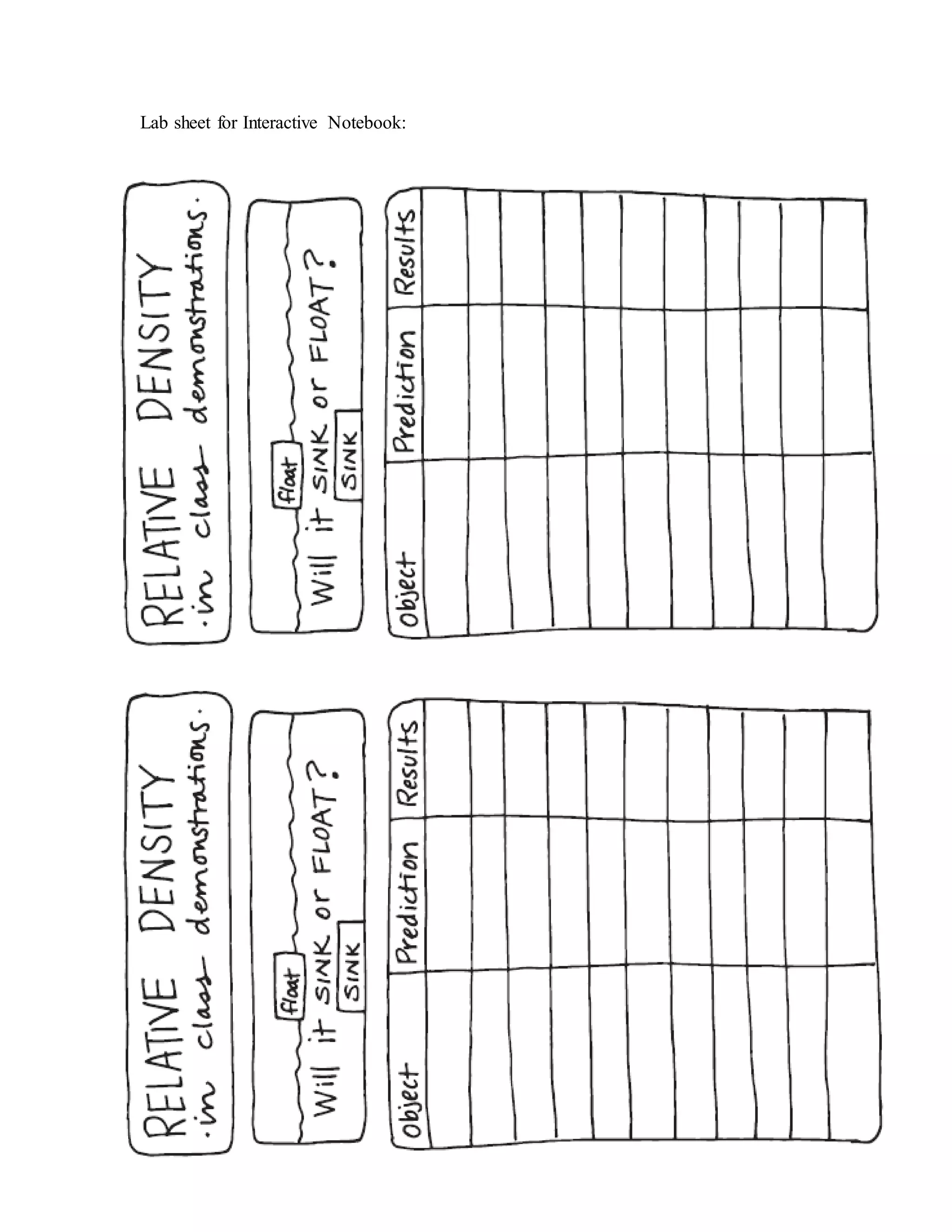
xiii. Relative Density lab chart for Science IN. 
3. Technology that is needed: 
i. Projector 
ii. Document Camera 
4. Safety: 
i. Students should practice safe lab procedures by handling all 
materials properly. 
ii. Students should refrain from consuming food or drink in the science 
lab. 
iii. Students should quickly clean up any spills during lab and wash 
hands thoroughly after lab activity. 
5. Vocabulary (sources: Stem Scopes, dictionary.reference.com/science): 
i. Mass – the amount of matter in an object 
ii. Density – the amount of mass in a known volume of a substance 
iii. Relative Density – the ratio of the density of one substance to that of 
a reference substance, typically water. 
iv. More dense (than water) – object will sink 
v. Less dense (than water) – object will float 
D. Background Information (for the teacher): 
Students are likely unfamiliar with the term “relative density.” Explain to students that 
this term is the relationship between an object’s density and something else (typically 
water). An example would be Italian dressing. When it rests, the oil floats to the top 
because it is less dense than the water. Students may have misconceptions regarding 
density especially when discussing volume without referring to weight. Children often 
persist that an object sinks because of its weight and, without exploration, have difficulty 
grasping the ideas of weight and volume independently. Students need to be given many 
opportunities to investigate both volume and mass – independent of one another – in 
order to fully grasp the understanding of the effects the two variables have on 
floating/sinking.
The density of water is 1.0 g/cm3. Objects with a density greater than water sink. Objects 
with a density less than water will float. 
Object > 1.0g/cm3 = Sink 
Object < 1.0g/cm3 = Float. 
E. Procedures 
1. Setup: Each lab table has the following: 
i. One aquarium half filled with tap water, 
ii. One Coca-Cola can (unopened), one Diet Coke can (unopened), 
iii. One bar of Ivory soap, one bar of Dove soap, 
iv. Assortment of objects in pairs of same shape/size but differe nt 
densities, 
v. Beaker filled with colored tap water, 
vi. Beaker filled with colored salt water, 
vii. Droppers/pipets (2-4 in the regular water and 2-4 in the salt water), 
viii. Clear straws (one per student). 
ix. Paper towels as needed for spills 
2. Engage: What causes an item to float in water? What causes an item to 
sink in water? The object’s size and weight determine whether it will sink 
or float in water. Predict what will happen when the objects are placed in 
the water. The regular soda will sink and the diet Coke will float. Explain 
why. The regular soda has more sugar in it, making it denser than the diet 
Coke. Because it has a higher density, the regular soda sinks. The diet Coke 
has a lower density and floats. 
Students will observe any noticeable differences between the Coke and Diet 
Coke cans, including estimating any weight and size differences. After they 
have recorded their observations and hypothesis regarding the sinking or 
floating of the cans, the students will test them by placing both cans into 
their table aquarium, observing and recording their findings, including why 
they think it happened. 
3. Explore: Why do you think certain objects are floating? They have less 
“stuff” in the given size of the object. Why do you think objects of the same 
size and shape react differently in water? Some have less “stuff” in them 
and others have more. Group objects based on whether they sink or float. 
Students will make predictions on the other solid objects on the lab tray and 
record their predictions on the provided lab chart that will be glued into their 
science interactive notebooks. After each item, the students will record 
whether or not their predictions were supported. 
4. Explain: How would you Density? It is how much “stuff” is in a given 
amount of volume. What about Relative Density? It is the comparison of 
the density of an object to something else, typically water. Discuss how 
relative density relates to the objects sinking or floating. When objects 
have the same volume, the mass will determine whether the object will sink 
or float. Density = Mass/Volume. If the density is greater than 1.0 g/ cm3, 
the object will sink. If the density is less than 1.0 g/ cm3, the object will
float. Students discuss in groups why they think certain materials float and 
others sink even when they are the same size and then discuss as a class 
what the students discovered during the lab activity. 
Misconceptions: students may experience the inability to explain density 
especially when having to discuss volume without referring to weight. When 
children are asked to explain why a larger item displaces more water than a 
smaller item, they often persist that it is due to the item’s weight, not volume . 
It seems that after much exploration, most students have a firm grasp of the 
ideas of weight and volume independently. However, when asked to address 
the question of what makes things float, they often attribute the cause only to 
weight and fail to integrate volume into the equation. Students need to be given 
many opportunities to investigate both, volume independent of mass and mass 
independent of volume to gain a thorough understanding of the effects of each 
variable on floating. 
5. Elaborate: What if we add salt water to the regular water in the aquarium. 
The salt water will be denser than the regular water because it has more 
“stuff” in it. What will happen to the objects when placed in the tank? If 
they floated in regular water, they will still float. If they sank in the regular 
water, they might float above the salt water but below the regular water, or 
they might sink to the bottom. Students will complete the salt water density 
portion of the lab individually to determine the difference in density 
between salt water and regular water. The students will record their 
predictions in their lab science journal, perform the lab, and record their lab 
results. Discuss lab outcome with group. 
6. Evaluate: 
i. Formative Assessment: 
1. Questioning during labs 
2. Science Interactive Notebook recordings, including 
predictions and conclusions. 
3. How could you separate items that are different densities? 
Explain. 
ii. Summative Assessment: 
1. Assessment with multiple choice questions as well as a lab-based 
activity requiring students to determine the density of 
an object and predict its relative density to water. Test and 
write conclusion. Students can create a T-chart with objects 
that are more/less dense than water. Objectives will be 
considered met if the student is able to predict, test, and 
explain/conclude their reasoning in regards to objects’ 
density and relative density in comparison to water. 
F. Modifications – 
1. ELL students 
i. Extended wait time (minimum of 5-6 seconds) 
ii. Picture vocabulary words 
iii. Four Box Vocabulary/Frayer Model for Vocabulary 
1. Definition 
2. Image/Use it in a sentence
3. Non-examples/Antonyms 
4. Examples/Synonyms 
iv. Sentence Stems and/or shortened descriptions of experiment 
v. Note taker/Notes provided 
vi. Adjust the evaluation/grading criteria 
vii. 
2. SpEd students 
i. Extended wait time (minimum of 5-6 seconds) 
ii. Modified questions on assessment (three instead of four choices on 
multiple-choice portion) 
iii. Note taker/Notes provided 
iv. Lab assistant 
v. Additional time for tests, assignments, in lab 
vi. Preferential seating 
vii. Adjust the evaluation/grading criteria 
viii. Assistive technology 
ix. Visual cues to stay on task 
3. GT students 
i. Provide extended questions for students: 
1. Suppose we had four beakers with 100 mL of water in each 
one. The first beaker is just plain tap water. The second 
beaker has 3 grams of salt dissolved into the water. The 
third beaker has 0.5 grams of salt dissolved into the water. 
The fourth beaker has 5 grams of salt dissolved into the 
water. Can you list the beakers from least dense to most 
dense? Explain your reasoning. 
ii. Extension activities: 
1. Design submarines: 
a. Three different types of submarines – a floating 
submarine, a sinking submarine and a hovering 
submarine that is completely underwater but is not 
touching the bottom given the following 
objects/items per student (may work in pairs/small 
groups): three film canisters, variety of small, heavy 
objects (coins, washers, marbles, screws), variety of 
small, light objects (paper clips, corks, beads, 
Styrofoam), rubber bands or string, large containers 
of water. 
b. Have students write down observations about what 
they did to get the submarines to sink, float, and 
hover. 
2. Practice testing density of different liquids and the density 
of objects in those liquids: 
a. Have beakers of the following liquids: vegetable oil, 
light corn syrup, water (colored blue for visibility),
rubbing alcohol (colored red for visibility), and 
baby oil. 
b. Have students predict the densities of the liquids 
and then test them and record the results (should 
layer from most dense/bottom to least dense/top as 
follows: corn syrup, water, vegetable oil, rubbing 
alcohol, baby oil. 
c. Provide a variety of small objects (cork, plastic 
toys, nuts/bolts, Styrofoam, etc.) Have students 
predict where the objects will float when dropped 
into the graduated cylinder containing the liquids. 
G. Integration of Mathematics and Language Arts 
 Math – Students will use math to determine density of objects. Students 
will also use tools, including a triple beam balance to determine the mass, 
a graduated cylinder to determine volume, estimation in measuring water 
using beakers and pipets/droppers. 
o TEKS 5.1A apply mathematics to problems arising in 
everyday life, society, and the workplace; 
o 5.1C select tools, including real objects, manipulatives, paper 
and pencil, and technology as appropriate, and techniques, 
including mental math, estimation, and number sense as 
appropriate, to solve problems 
 Language Arts – Students will complete the assigned lab given the 
instructions and reading material provided. Students will interpret 
information based on graphs/tables created during lab activity. 
o TEKS 5.13A Interpret details from procedural text to complete 
a task, solve a problem, or perform procedures. 
o 5.13B Interpret factual or quantitative information presented 
in maps, charts, illustrations, graphs, timelines, tables, and 
diagrams. 
H. References 
 19 TAC Chapter 112, Subchapter A. (n.d.). Retrieved October 6, 2014, from 
http://ritter.tea.state.tx.us/rules/tac/chapter112/ch112a.html 
 5.5A Classifying Matter. (n.d.). Retrieved October 6, 2014, from 
https://ali3.acceleratelearning.com/scopes/87/elements/5080 
 BIG Science Stations Units: Physical Science. (n.d.). Retrieved October 6, 2014, 
from http://www.thesciencepenguin.com/2014/08/big-science-stations-units-matter. 
html 
 Dabagyan, E. (2007, January 1). What Makes Things Float? Density and 
Buoyancy Misconceptions. Retrieved October 13, 2014, from Dabagyan, E. (n.d.). 
What Makes Things Float? Density and Buoyancy Misconceptions. Retrieved 
October 13, 2014, from 
http://www.csun.edu/~eed39911/coursework/690/Density%20Misconceptions%2 
0Paper.pdf 
 Density and Floating. (n.d.). Retrieved October 6, 2014, from
http://www.newton.dep.anl.gov/askasci/phy00/phy00136.htm 
 Density Bottles Activity Fun! (2014, September 16). Retrieved October 6, 2014, 
from http://www.thesciencepenguin.com/2014/09/density-bottles-activity-fun.html 
 Density Lesson Plan. (n.d.). Retrieved October 6, 2014, from 
http://wordsinplay.com/pdfs/DensityLessonPlan.pdf 
 RESCU | Engage: Classifying Matter (5.5A). (n.d.). Retrieved October 6, 2014, 
from http://rescu.rice.edu/scope/80/engage
Lab sheet for Interactive Notebook:
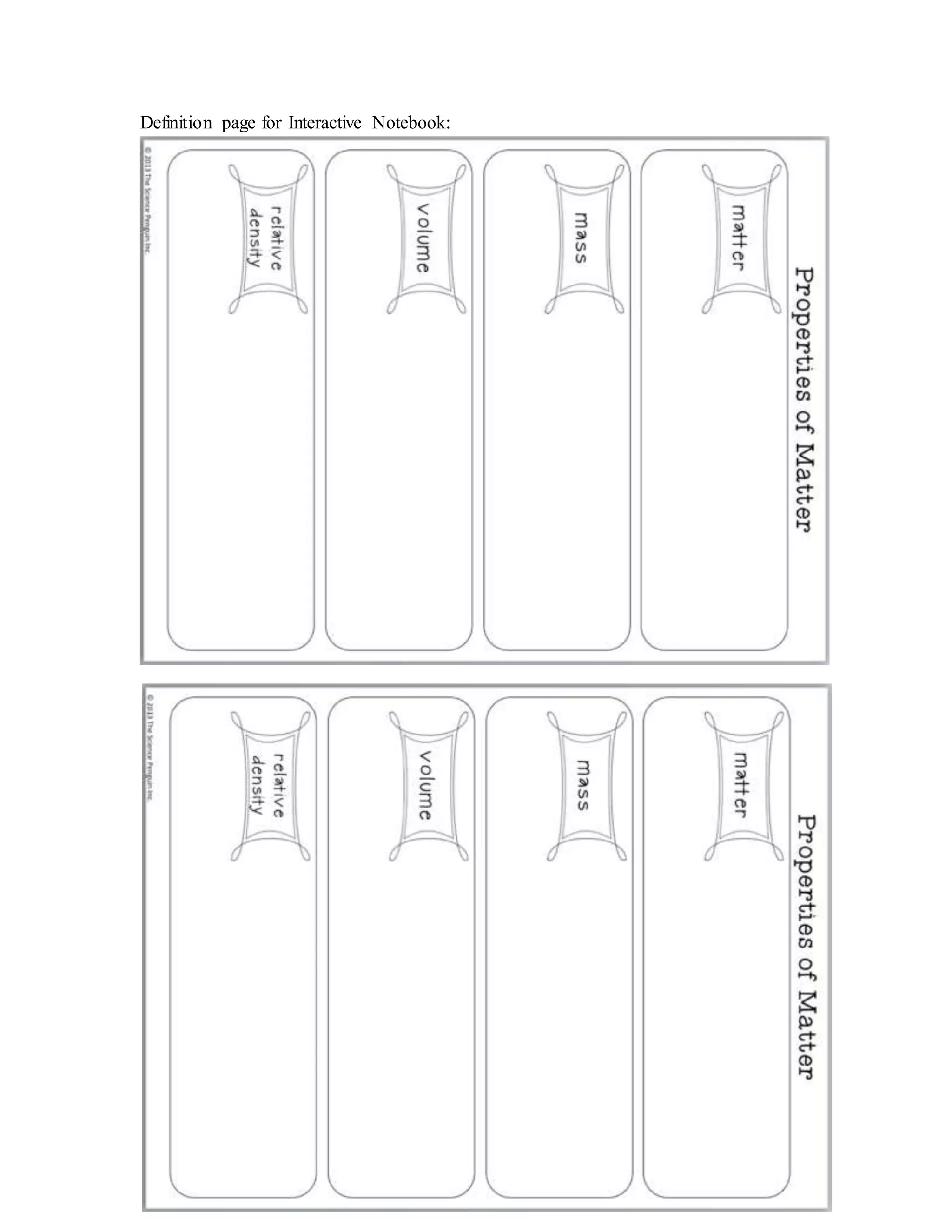
Definition page for Interactive Notebook:

Relative Density Lesson Plan

  • 1.
    Density and RelativeDensity A. Background Information 1. Jennifer Anders 2. Physical Science 3. Density and Relative Density 4. 5th Grade B. TEKS and NGSS 1. TEKS: 112.16.B.2.D – analyze and interpret information to construct reasonable explanations from direct (observable) and indirect (inferred) evidence 112.16.B.2.E - demonstrate that repeated investigations may increase the reliability of results 112.16.B.2.F - communicate valid conclusions in both written and verbal forms 112.16.B.3.A - in all fields of science, analyze, evaluate, and critique scientific explanations by using empirical evidence, logical reasoning, and experimental and observational testing, including examining all sides of scientific evidence of those scientific explanations, so as to encourage critical thinking by the student 112.16.B.5.A - Classify matter based on physical properties, including mass, magnetism, physical state, solid, liquid, and gas, relative density sinking and floating, solubility in water, and the ability to conduct or insulate thermal energy or electric energy. 2. NGSS: Second Grade: 2-PS1-1. Plan and conduct an investigation to describe and classify different kinds of materials by their observable properties. C. Goals and Objectives 1. Objective(s):  The student is expected to compare which objects sink or float in water.  Students will make predictions and test 2-4 objects (such as golf balls, ping pong balls, whiffle balls, foam balls, metal and wood cubes, etc.) to determine their relative density. Students will also conduct a lab activity predicting and testing the relative densities of liquids, including salt water. 2. Materials Needed (for 20 students in five groups of four students each): i. 5 - Aquariums or large, clear containers to hold water, ii. Enough water to fill aquariums about half full iii. 5 - Coca-Cola (unopened), iv. 5 - Diet Coke cans (unopened),
  • 2.
    v. 5 -Bars of Ivory soap (travel size), vi. 5 - Bars of Dove soap (travel size), vii. 10-20 - Variety of objects with different densities such as golf ball, ping pong ball, beads, cubes of metal and wood, etc. viii. 1 - Large container of Kosher Salt, ix. 2 - Bottles of Food Coloring (two different colors), x. 10 - Clear Drinking Straws (cut in half), xi. 20 - Droppers/Pipets, xii. Paper towels (for spills), xiii. Relative Density lab chart for Science IN. 3. Technology that is needed: i. Projector ii. Document Camera 4. Safety: i. Students should practice safe lab procedures by handling all materials properly. ii. Students should refrain from consuming food or drink in the science lab. iii. Students should quickly clean up any spills during lab and wash hands thoroughly after lab activity. 5. Vocabulary (sources: Stem Scopes, dictionary.reference.com/science): i. Mass – the amount of matter in an object ii. Density – the amount of mass in a known volume of a substance iii. Relative Density – the ratio of the density of one substance to that of a reference substance, typically water. iv. More dense (than water) – object will sink v. Less dense (than water) – object will float D. Background Information (for the teacher): Students are likely unfamiliar with the term “relative density.” Explain to students that this term is the relationship between an object’s density and something else (typically water). An example would be Italian dressing. When it rests, the oil floats to the top because it is less dense than the water. Students may have misconceptions regarding density especially when discussing volume without referring to weight. Children often persist that an object sinks because of its weight and, without exploration, have difficulty grasping the ideas of weight and volume independently. Students need to be given many opportunities to investigate both volume and mass – independent of one another – in order to fully grasp the understanding of the effects the two variables have on floating/sinking.
  • 3.
    The density ofwater is 1.0 g/cm3. Objects with a density greater than water sink. Objects with a density less than water will float. Object > 1.0g/cm3 = Sink Object < 1.0g/cm3 = Float. E. Procedures 1. Setup: Each lab table has the following: i. One aquarium half filled with tap water, ii. One Coca-Cola can (unopened), one Diet Coke can (unopened), iii. One bar of Ivory soap, one bar of Dove soap, iv. Assortment of objects in pairs of same shape/size but differe nt densities, v. Beaker filled with colored tap water, vi. Beaker filled with colored salt water, vii. Droppers/pipets (2-4 in the regular water and 2-4 in the salt water), viii. Clear straws (one per student). ix. Paper towels as needed for spills 2. Engage: What causes an item to float in water? What causes an item to sink in water? The object’s size and weight determine whether it will sink or float in water. Predict what will happen when the objects are placed in the water. The regular soda will sink and the diet Coke will float. Explain why. The regular soda has more sugar in it, making it denser than the diet Coke. Because it has a higher density, the regular soda sinks. The diet Coke has a lower density and floats. Students will observe any noticeable differences between the Coke and Diet Coke cans, including estimating any weight and size differences. After they have recorded their observations and hypothesis regarding the sinking or floating of the cans, the students will test them by placing both cans into their table aquarium, observing and recording their findings, including why they think it happened. 3. Explore: Why do you think certain objects are floating? They have less “stuff” in the given size of the object. Why do you think objects of the same size and shape react differently in water? Some have less “stuff” in them and others have more. Group objects based on whether they sink or float. Students will make predictions on the other solid objects on the lab tray and record their predictions on the provided lab chart that will be glued into their science interactive notebooks. After each item, the students will record whether or not their predictions were supported. 4. Explain: How would you Density? It is how much “stuff” is in a given amount of volume. What about Relative Density? It is the comparison of the density of an object to something else, typically water. Discuss how relative density relates to the objects sinking or floating. When objects have the same volume, the mass will determine whether the object will sink or float. Density = Mass/Volume. If the density is greater than 1.0 g/ cm3, the object will sink. If the density is less than 1.0 g/ cm3, the object will
  • 4.
    float. Students discussin groups why they think certain materials float and others sink even when they are the same size and then discuss as a class what the students discovered during the lab activity. Misconceptions: students may experience the inability to explain density especially when having to discuss volume without referring to weight. When children are asked to explain why a larger item displaces more water than a smaller item, they often persist that it is due to the item’s weight, not volume . It seems that after much exploration, most students have a firm grasp of the ideas of weight and volume independently. However, when asked to address the question of what makes things float, they often attribute the cause only to weight and fail to integrate volume into the equation. Students need to be given many opportunities to investigate both, volume independent of mass and mass independent of volume to gain a thorough understanding of the effects of each variable on floating. 5. Elaborate: What if we add salt water to the regular water in the aquarium. The salt water will be denser than the regular water because it has more “stuff” in it. What will happen to the objects when placed in the tank? If they floated in regular water, they will still float. If they sank in the regular water, they might float above the salt water but below the regular water, or they might sink to the bottom. Students will complete the salt water density portion of the lab individually to determine the difference in density between salt water and regular water. The students will record their predictions in their lab science journal, perform the lab, and record their lab results. Discuss lab outcome with group. 6. Evaluate: i. Formative Assessment: 1. Questioning during labs 2. Science Interactive Notebook recordings, including predictions and conclusions. 3. How could you separate items that are different densities? Explain. ii. Summative Assessment: 1. Assessment with multiple choice questions as well as a lab-based activity requiring students to determine the density of an object and predict its relative density to water. Test and write conclusion. Students can create a T-chart with objects that are more/less dense than water. Objectives will be considered met if the student is able to predict, test, and explain/conclude their reasoning in regards to objects’ density and relative density in comparison to water. F. Modifications – 1. ELL students i. Extended wait time (minimum of 5-6 seconds) ii. Picture vocabulary words iii. Four Box Vocabulary/Frayer Model for Vocabulary 1. Definition 2. Image/Use it in a sentence
  • 5.
    3. Non-examples/Antonyms 4.Examples/Synonyms iv. Sentence Stems and/or shortened descriptions of experiment v. Note taker/Notes provided vi. Adjust the evaluation/grading criteria vii. 2. SpEd students i. Extended wait time (minimum of 5-6 seconds) ii. Modified questions on assessment (three instead of four choices on multiple-choice portion) iii. Note taker/Notes provided iv. Lab assistant v. Additional time for tests, assignments, in lab vi. Preferential seating vii. Adjust the evaluation/grading criteria viii. Assistive technology ix. Visual cues to stay on task 3. GT students i. Provide extended questions for students: 1. Suppose we had four beakers with 100 mL of water in each one. The first beaker is just plain tap water. The second beaker has 3 grams of salt dissolved into the water. The third beaker has 0.5 grams of salt dissolved into the water. The fourth beaker has 5 grams of salt dissolved into the water. Can you list the beakers from least dense to most dense? Explain your reasoning. ii. Extension activities: 1. Design submarines: a. Three different types of submarines – a floating submarine, a sinking submarine and a hovering submarine that is completely underwater but is not touching the bottom given the following objects/items per student (may work in pairs/small groups): three film canisters, variety of small, heavy objects (coins, washers, marbles, screws), variety of small, light objects (paper clips, corks, beads, Styrofoam), rubber bands or string, large containers of water. b. Have students write down observations about what they did to get the submarines to sink, float, and hover. 2. Practice testing density of different liquids and the density of objects in those liquids: a. Have beakers of the following liquids: vegetable oil, light corn syrup, water (colored blue for visibility),
  • 6.
    rubbing alcohol (coloredred for visibility), and baby oil. b. Have students predict the densities of the liquids and then test them and record the results (should layer from most dense/bottom to least dense/top as follows: corn syrup, water, vegetable oil, rubbing alcohol, baby oil. c. Provide a variety of small objects (cork, plastic toys, nuts/bolts, Styrofoam, etc.) Have students predict where the objects will float when dropped into the graduated cylinder containing the liquids. G. Integration of Mathematics and Language Arts  Math – Students will use math to determine density of objects. Students will also use tools, including a triple beam balance to determine the mass, a graduated cylinder to determine volume, estimation in measuring water using beakers and pipets/droppers. o TEKS 5.1A apply mathematics to problems arising in everyday life, society, and the workplace; o 5.1C select tools, including real objects, manipulatives, paper and pencil, and technology as appropriate, and techniques, including mental math, estimation, and number sense as appropriate, to solve problems  Language Arts – Students will complete the assigned lab given the instructions and reading material provided. Students will interpret information based on graphs/tables created during lab activity. o TEKS 5.13A Interpret details from procedural text to complete a task, solve a problem, or perform procedures. o 5.13B Interpret factual or quantitative information presented in maps, charts, illustrations, graphs, timelines, tables, and diagrams. H. References  19 TAC Chapter 112, Subchapter A. (n.d.). Retrieved October 6, 2014, from http://ritter.tea.state.tx.us/rules/tac/chapter112/ch112a.html  5.5A Classifying Matter. (n.d.). Retrieved October 6, 2014, from https://ali3.acceleratelearning.com/scopes/87/elements/5080  BIG Science Stations Units: Physical Science. (n.d.). Retrieved October 6, 2014, from http://www.thesciencepenguin.com/2014/08/big-science-stations-units-matter. html  Dabagyan, E. (2007, January 1). What Makes Things Float? Density and Buoyancy Misconceptions. Retrieved October 13, 2014, from Dabagyan, E. (n.d.). What Makes Things Float? Density and Buoyancy Misconceptions. Retrieved October 13, 2014, from http://www.csun.edu/~eed39911/coursework/690/Density%20Misconceptions%2 0Paper.pdf  Density and Floating. (n.d.). Retrieved October 6, 2014, from
  • 7.
    http://www.newton.dep.anl.gov/askasci/phy00/phy00136.htm  DensityBottles Activity Fun! (2014, September 16). Retrieved October 6, 2014, from http://www.thesciencepenguin.com/2014/09/density-bottles-activity-fun.html  Density Lesson Plan. (n.d.). Retrieved October 6, 2014, from http://wordsinplay.com/pdfs/DensityLessonPlan.pdf  RESCU | Engage: Classifying Matter (5.5A). (n.d.). Retrieved October 6, 2014, from http://rescu.rice.edu/scope/80/engage
  • 8.
    Lab sheet forInteractive Notebook:
  • 9.
    Definition page forInteractive Notebook: