DESCRIPTIVE ESSAY WRITING
1)What Is Descriptive Writing? 
                                     
  Descriptive writing creates a 
picture of a person, place, thing, or
event.    Description     tells   what
                             something
looks, sounds, smells, tastes, or feels
                                  like.
2) Elements of Descriptive Writing 

Good descriptive writing is comprised of five 
elements; Sensory Details, Figurative
Language, dominant impression, precise
       language, and Careful Organization.
1) Sensory Details         

    Good descriptive writing includes many vivid 
sensory details that paint a picture and appeals to
all     of     the      reader's      senses       of
sight, hearing, touch, smell, and taste when
appropriate. Descriptive writing may also paint a
pictures of the feelings the person, place or thing
                                  invokes the writer.
2)   Figurative Language         


  Good descriptive writing often makes use of figurative 
language to help paint the picture in the reader's
mind. There are many ways to use figurative
language, and it is a talent that should be practiced until
        perfected.
-A simile uses like or as to compare two unlike things. 
Example: Her smile was like sunshine. 
-A metaphor compares two unlike things without using 
like or as:
      Example: Her smile was a light that lit up the room. 
-Personification suggests comparison between a 
nonliving thing and a person by giving the nonliving
                                        thing human traits.
3) A DOMINANT IMPRESSION
  When you plan a descriptive essay, your focus on          
selecting details that help your readers see what you
see, feel what you feel, and experience what you
experience. Your goal is to create a single dominant
impression, a central theme or idea to which all the
details relate-for example, the liveliness of a street
scene or the quiet of a summer night. This dominant
impression unifies the description and gives readers an
overall sense of what the person, place, object, or scene
looks like(and perhaps what it sounds, smells, tastes, or
feels like). Sometimes_but not always_ your details will
support a thesis making a point about the subject you
                                          are describing.
4) PRECISE LANGUAGE

 Good descriptive writing uses precise language. 
Using specific words and phrases will help the
reader “see” what you are describing. If a word or
phrase is specific, it is exact and precise. The
opposite of specific language is language that is
                           vague, general, or fuzzy.
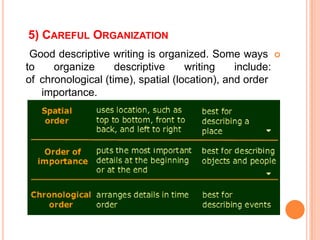
5) CAREFUL ORGANIZATION
 Good descriptive writing is organized. Some ways 
to    organize      descriptive     writing    include:
of chronological (time), spatial (location), and order
   importance.
3)TRANSITION WORDS AND
  PHRASES THAT SIGNAL
                    .
     DESCRIPTION.
Transitions used in descriptive writing 
vary depending on whether you are
describing a person, a place, or a
thing. Here are some examples of
transitions that might be used in
                  descriptive contexts:
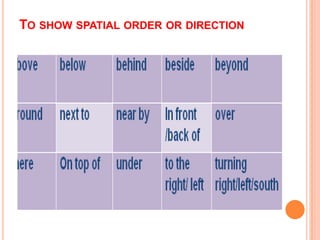
TO SHOW SPATIAL ORDER OR DIRECTION
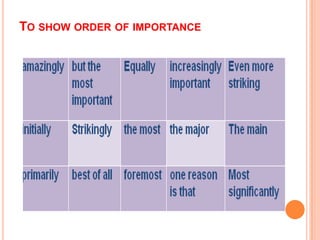
TO SHOW ORDER OF IMPORTANCE
TO SHOW TIME ORDER
4)THE STRUCTURE OF A DESCRIPTIVE
             ESSAY
Descriptive Essay Writing

Descriptive Essay Writing

  • 1.
  • 2.
    1)What Is DescriptiveWriting?   Descriptive writing creates a  picture of a person, place, thing, or event. Description tells what something looks, sounds, smells, tastes, or feels like.
  • 3.
    2) Elements ofDescriptive Writing  Good descriptive writing is comprised of five  elements; Sensory Details, Figurative Language, dominant impression, precise language, and Careful Organization.
  • 4.
    1) Sensory Details  Good descriptive writing includes many vivid  sensory details that paint a picture and appeals to all of the reader's senses of sight, hearing, touch, smell, and taste when appropriate. Descriptive writing may also paint a pictures of the feelings the person, place or thing invokes the writer.
  • 5.
    2) Figurative Language  Good descriptive writing often makes use of figurative  language to help paint the picture in the reader's mind. There are many ways to use figurative language, and it is a talent that should be practiced until perfected. -A simile uses like or as to compare two unlike things.  Example: Her smile was like sunshine.  -A metaphor compares two unlike things without using  like or as: Example: Her smile was a light that lit up the room.  -Personification suggests comparison between a  nonliving thing and a person by giving the nonliving thing human traits.
  • 6.
    3) A DOMINANTIMPRESSION When you plan a descriptive essay, your focus on  selecting details that help your readers see what you see, feel what you feel, and experience what you experience. Your goal is to create a single dominant impression, a central theme or idea to which all the details relate-for example, the liveliness of a street scene or the quiet of a summer night. This dominant impression unifies the description and gives readers an overall sense of what the person, place, object, or scene looks like(and perhaps what it sounds, smells, tastes, or feels like). Sometimes_but not always_ your details will support a thesis making a point about the subject you are describing.
  • 7.
    4) PRECISE LANGUAGE Good descriptive writing uses precise language.  Using specific words and phrases will help the reader “see” what you are describing. If a word or phrase is specific, it is exact and precise. The opposite of specific language is language that is vague, general, or fuzzy.
  • 8.
    5) CAREFUL ORGANIZATION Good descriptive writing is organized. Some ways  to organize descriptive writing include: of chronological (time), spatial (location), and order importance.
  • 9.
    3)TRANSITION WORDS AND PHRASES THAT SIGNAL . DESCRIPTION.
  • 10.
    Transitions used indescriptive writing  vary depending on whether you are describing a person, a place, or a thing. Here are some examples of transitions that might be used in descriptive contexts:
  • 11.
    TO SHOW SPATIALORDER OR DIRECTION
  • 12.
    TO SHOW ORDEROF IMPORTANCE
  • 13.
  • 14.
    4)THE STRUCTURE OFA DESCRIPTIVE ESSAY