ARTS AND CULTURE IN THE 20TH 
AND THE 21ST CENTURIES
Art is a product of a highly creative mind. 
It includes the creation of images or 
objects in fields including painting, 
sculpture, printmaking, photography, and 
other visual arts.
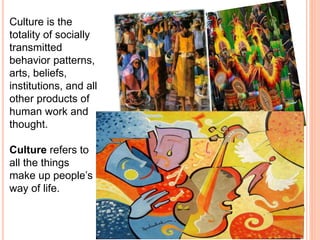
Culture is the 
totality of socially 
transmitted 
behavior patterns, 
arts, beliefs, 
institutions, and all 
other products of 
human work and 
thought. 
Culture refers to 
all the things 
make up people’s 
way of life.
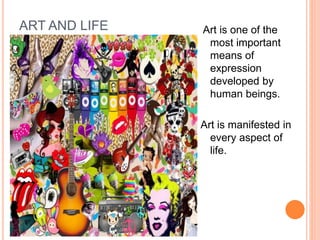
ART AND LIFE Art is one of the 
most important 
means of 
expression 
developed by 
human beings. 
Art is manifested in 
every aspect of 
life.
Artists have 
always shown a 
deep concern 
about life around 
them. 
Many of them 
have recorded in 
paintings their 
observation of 
people going 
about their usual 
ways, performing 
their usual tasks. 
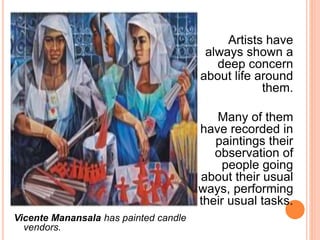
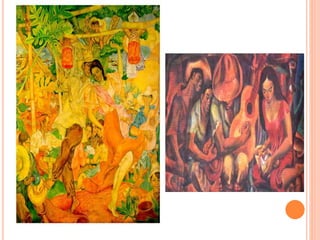
Vicente Manansala has painted candle 
vendors.
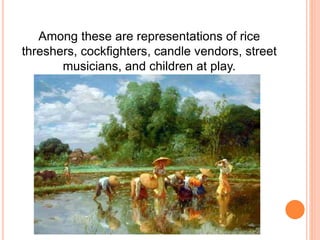
Among these are representations of rice 
threshers, cockfighters, candle vendors, street 
musicians, and children at play.
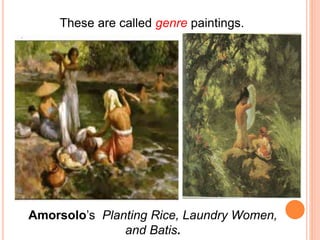
These are called genre paintings. 
Amorsolo’s Planting Rice, Laundry Women, 
and Batis.
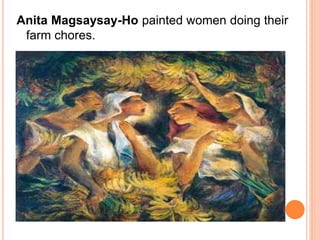
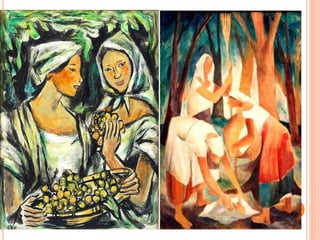
Anita Magsaysay-Ho painted women doing their 
farm chores.
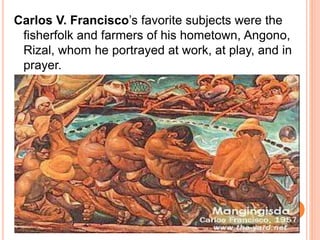
Carlos V. Francisco’s favorite subjects were the 
fisherfolk and farmers of his hometown, Angono, 
Rizal, whom he portrayed at work, at play, and in 
prayer.
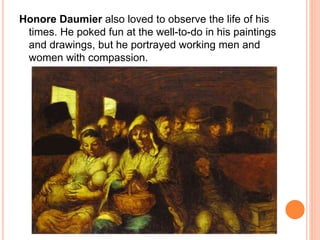
Honore Daumier also loved to observe the life of his 
times. He poked fun at the well-to-do in his paintings 
and drawings, but he portrayed working men and 
women with compassion.
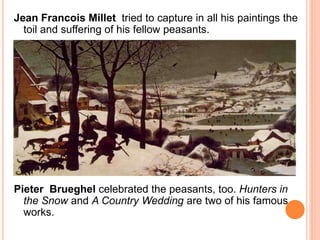
Jean Francois Millet tried to capture in all his paintings the 
toil and suffering of his fellow peasants. 
Pieter Brueghel celebrated the peasants, too. Hunters in 
the Snow and A Country Wedding are two of his famous 
works.
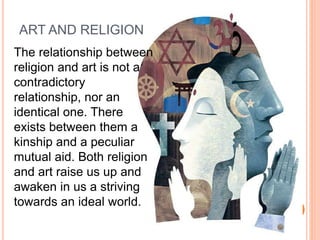
ART AND RELIGION 
The relationship between 
religion and art is not a 
contradictory 
relationship, nor an 
identical one. There 
exists between them a 
kinship and a peculiar 
mutual aid. Both religion 
and art raise us up and 
awaken in us a striving 
towards an ideal world.
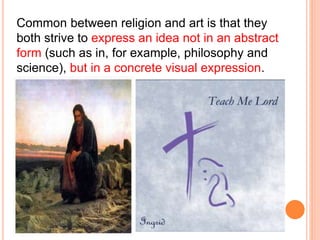
Common between religion and art is that they 
both strive to express an idea not in an abstract 
form (such as in, for example, philosophy and 
science), but in a concrete visual expression.
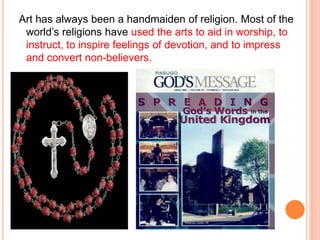
Art has always been a handmaiden of religion. Most of the 
world’s religions have used the arts to aid in worship, to 
instruct, to inspire feelings of devotion, and to impress 
and convert non-believers.
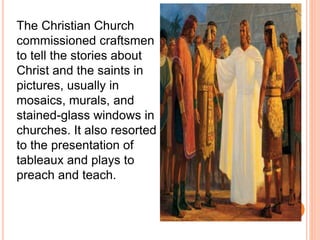
The Christian Church 
commissioned craftsmen 
to tell the stories about 
Christ and the saints in 
pictures, usually in 
mosaics, murals, and 
stained-glass windows in 
churches. It also resorted 
to the presentation of 
tableaux and plays to 
preach and teach.
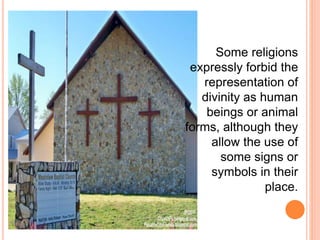
Some religions 
expressly forbid the 
representation of 
divinity as human 
beings or animal 
forms, although they 
allow the use of 
some signs or 
symbols in their 
place.
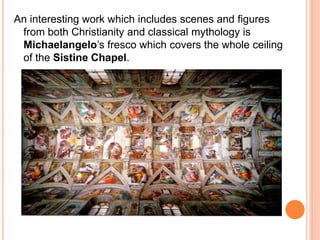
An interesting work which includes scenes and figures 
from both Christianity and classical mythology is 
Michaelangelo’s fresco which covers the whole ceiling 
of the Sistine Chapel.
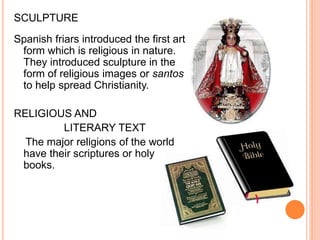
SCULPTURE 
Spanish friars introduced the first art 
form which is religious in nature. 
They introduced sculpture in the 
form of religious images or santos 
to help spread Christianity. 
RELIGIOUS AND 
LITERARY TEXT 
The major religions of the world 
have their scriptures or holy 
books.
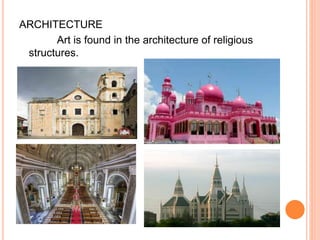
ARCHITECTURE 
Art is found in the architecture of religious 
structures.
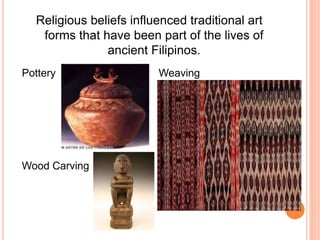
Religious beliefs influenced traditional art 
forms that have been part of the lives of 
ancient Filipinos. 
Pottery Weaving 
Wood Carving
TRADITIONAL FOLK ART 
OBJECTS 
Folk arts are traditional arts 
made by common people 
who have had no formal art 
training, and instead, have 
practiced art styles and 
craftsmanship that have 
been handed through 
generations. 
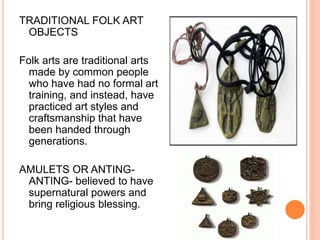
AMULETS OR ANTING-ANTING- 
believed to have 
supernatural powers and 
bring religious blessing.
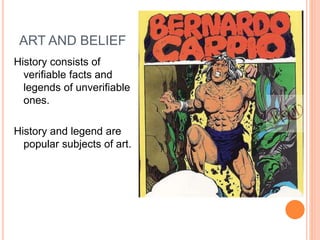
ART AND BELIEF 
History consists of 
verifiable facts and 
legends of unverifiable 
ones. 
History and legend are 
popular subjects of art.
Felix Resurrection Hidalgo, painted the controversial 
Assassination of Governor-General Fernando 
Bustamante. 
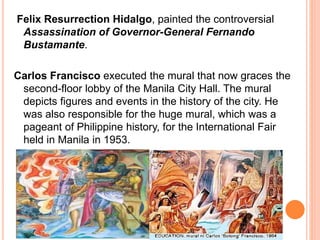
Carlos Francisco executed the mural that now graces the 
second-floor lobby of the Manila City Hall. The mural 
depicts figures and events in the history of the city. He 
was also responsible for the huge mural, which was a 
pageant of Philippine history, for the International Fair 
held in Manila in 1953.
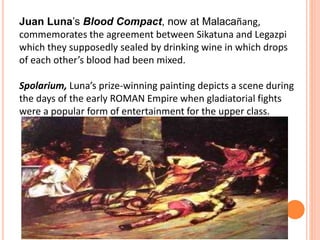
Juan Luna’s Blood Compact, now at Malacañang, 
commemorates the agreement between Sikatuna and Legazpi 
which they supposedly sealed by drinking wine in which drops 
of each other’s blood had been mixed. 
Spolarium, Luna’s prize-winning painting depicts a scene during 
the days of the early ROMAN Empire when gladiatorial fights 
were a popular form of entertainment for the upper class.
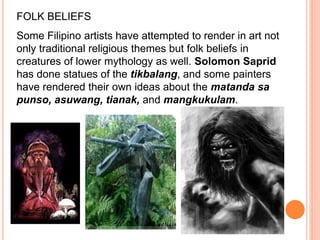
FOLK BELIEFS 
Some Filipino artists have attempted to render in art not 
only traditional religious themes but folk beliefs in 
creatures of lower mythology as well. Solomon Saprid 
has done statues of the tikbalang, and some painters 
have rendered their own ideas about the matanda sa 
punso, asuwang, tianak, and mangkukulam.
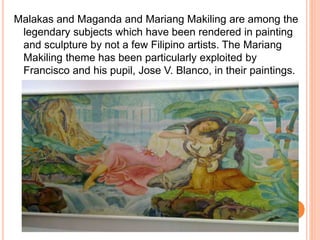
Malakas and Maganda and Mariang Makiling are among the 
legendary subjects which have been rendered in painting 
and sculpture by not a few Filipino artists. The Mariang 
Makiling theme has been particularly exploited by 
Francisco and his pupil, Jose V. Blanco, in their paintings.
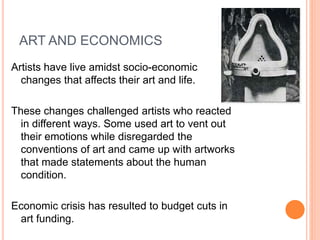
ART AND ECONOMICS 
Artists have live amidst socio-economic 
changes that affects their art and life. 
These changes challenged artists who reacted 
in different ways. Some used art to vent out 
their emotions while disregarded the 
conventions of art and came up with artworks 
that made statements about the human 
condition. 
Economic crisis has resulted to budget cuts in 
art funding.
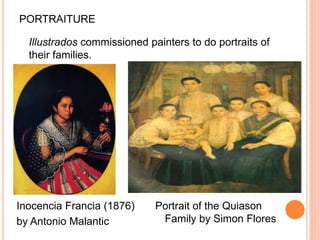
PORTRAITURE 
Illustrados commissioned painters to do portraits of 
their families. 
Inocencia Francia (1876) 
by Antonio Malantic 
Portrait of the Quiason 
Family by Simon Flores
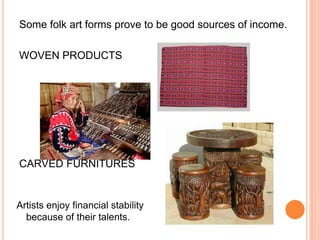
Some folk art forms prove to be good sources of income. 
WOVEN PRODUCTS 
CARVED FURNITURES 
Artists enjoy financial stability 
because of their talents.
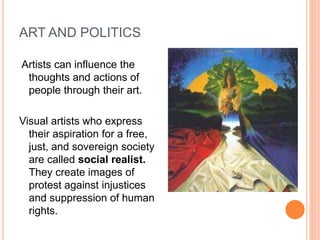
ART AND POLITICS 
Artists can influence the 
thoughts and actions of 
people through their art. 
Visual artists who express 
their aspiration for a free, 
just, and sovereign society 
are called social realist. 
They create images of 
protest against injustices 
and suppression of human 
rights.
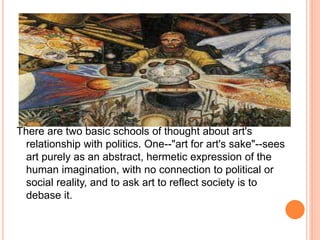
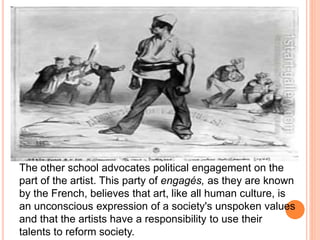
There are two basic schools of thought about art's 
relationship with politics. One--"art for art's sake"--sees 
art purely as an abstract, hermetic expression of the 
human imagination, with no connection to political or 
social reality, and to ask art to reflect society is to 
debase it.
The other school advocates political engagement on the 
part of the artist. This party of engagés, as they are known 
by the French, believes that art, like all human culture, is 
an unconscious expression of a society's unspoken values 
and that the artists have a responsibility to use their 
talents to reform society.
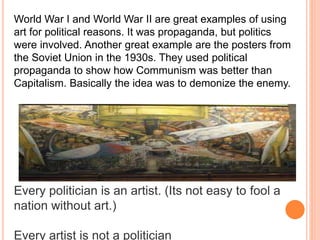
World War I and World War II are great examples of using 
art for political reasons. It was propaganda, but politics 
were involved. Another great example are the posters from 
the Soviet Union in the 1930s. They used political 
propaganda to show how Communism was better than 
Capitalism. Basically the idea was to demonize the enemy. 
Every politician is an artist. (Its not easy to fool a 
nation without art.) 
Every artist is not a politician
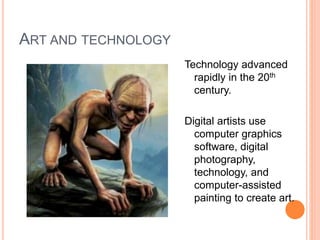
ART AND TECHNOLOGY 
Technology advanced 
rapidly in the 20th 
century. 
Digital artists use 
computer graphics 
software, digital 
photography, 
technology, and 
computer-assisted 
painting to create art.
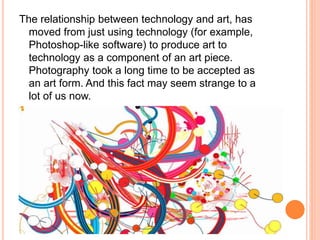
The relationship between technology and art, has 
moved from just using technology (for example, 
Photoshop-like software) to produce art to 
technology as a component of an art piece. 
Photography took a long time to be accepted as 
an art form. And this fact may seem strange to a 
lot of us now.
Artists have been producing art using technology since 
the 1960s. 
Jean Tinguely is one sculptor, who focused on making 
metallic, mechanical sculptures, that could move, 
designed to destroy itself (Homage to New York, 1960). 
Robert Rauschenberg was another artist, filled an 
aluminium tank with mud, put an apparatus underneath it, 
to make bubbles on the mud, synchronised with sounds, 
played on the site (Mud Muse, 1971).
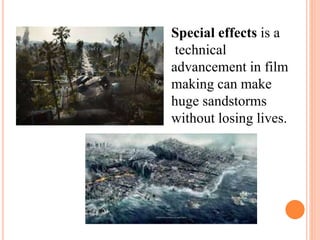
Special effects is a 
technical 
advancement in film 
making can make 
huge sandstorms 
without losing lives.
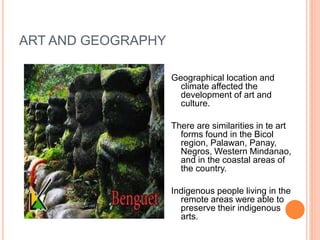
ART AND GEOGRAPHY 
Geographical location and 
climate affected the 
development of art and 
culture. 
There are similarities in te art 
forms found in the Bicol 
region, Palawan, Panay, 
Negros, Western Mindanao, 
and in the coastal areas of 
the country. 
Indigenous people living in the 
remote areas were able to 
preserve their indigenous 
arts.
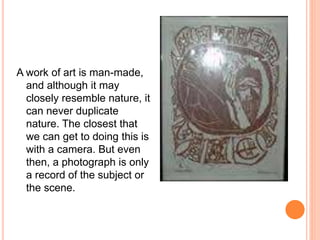
A work of art is man-made, 
and although it may 
closely resemble nature, it 
can never duplicate 
nature. The closest that 
we can get to doing this is 
with a camera. But even 
then, a photograph is only 
a record of the subject or 
the scene.
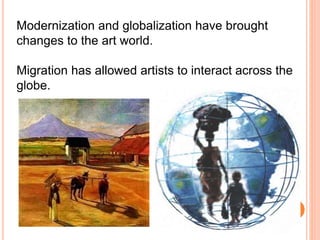
Modernization and globalization have brought 
changes to the art world. 
Migration has allowed artists to interact across the 
globe.
Determine what aspect in life is 
being shown in the following masterpieces. 
1. a painting of children at play 
2. stories of Christ and the saints in 
pictures 
3. sculpture of Malakas and Maganda 
4. mural of rallies’ 
5. wedding pictures
Determine the following: 
a. functions of art 
b. modern and contemporary art styles

Relationships between arts and culture

  • 3.
    ARTS AND CULTUREIN THE 20TH AND THE 21ST CENTURIES
  • 4.
    Art is aproduct of a highly creative mind. It includes the creation of images or objects in fields including painting, sculpture, printmaking, photography, and other visual arts.
  • 5.
    Culture is the totality of socially transmitted behavior patterns, arts, beliefs, institutions, and all other products of human work and thought. Culture refers to all the things make up people’s way of life.
  • 6.
    ART AND LIFEArt is one of the most important means of expression developed by human beings. Art is manifested in every aspect of life.
  • 7.
    Artists have alwaysshown a deep concern about life around them. Many of them have recorded in paintings their observation of people going about their usual ways, performing their usual tasks. Vicente Manansala has painted candle vendors.
  • 8.
    Among these arerepresentations of rice threshers, cockfighters, candle vendors, street musicians, and children at play.
  • 9.
    These are calledgenre paintings. Amorsolo’s Planting Rice, Laundry Women, and Batis.
  • 10.
    Anita Magsaysay-Ho paintedwomen doing their farm chores.
  • 12.
    Carlos V. Francisco’sfavorite subjects were the fisherfolk and farmers of his hometown, Angono, Rizal, whom he portrayed at work, at play, and in prayer.
  • 14.
    Honore Daumier alsoloved to observe the life of his times. He poked fun at the well-to-do in his paintings and drawings, but he portrayed working men and women with compassion.
  • 15.
    Jean Francois Millettried to capture in all his paintings the toil and suffering of his fellow peasants. Pieter Brueghel celebrated the peasants, too. Hunters in the Snow and A Country Wedding are two of his famous works.
  • 16.
    ART AND RELIGION The relationship between religion and art is not a contradictory relationship, nor an identical one. There exists between them a kinship and a peculiar mutual aid. Both religion and art raise us up and awaken in us a striving towards an ideal world.
  • 17.
    Common between religionand art is that they both strive to express an idea not in an abstract form (such as in, for example, philosophy and science), but in a concrete visual expression.
  • 18.
    Art has alwaysbeen a handmaiden of religion. Most of the world’s religions have used the arts to aid in worship, to instruct, to inspire feelings of devotion, and to impress and convert non-believers.
  • 19.
    The Christian Church commissioned craftsmen to tell the stories about Christ and the saints in pictures, usually in mosaics, murals, and stained-glass windows in churches. It also resorted to the presentation of tableaux and plays to preach and teach.
  • 20.
    Some religions expresslyforbid the representation of divinity as human beings or animal forms, although they allow the use of some signs or symbols in their place.
  • 21.
    An interesting workwhich includes scenes and figures from both Christianity and classical mythology is Michaelangelo’s fresco which covers the whole ceiling of the Sistine Chapel.
  • 22.
    SCULPTURE Spanish friarsintroduced the first art form which is religious in nature. They introduced sculpture in the form of religious images or santos to help spread Christianity. RELIGIOUS AND LITERARY TEXT The major religions of the world have their scriptures or holy books.
  • 23.
    ARCHITECTURE Art isfound in the architecture of religious structures.
  • 24.
    Religious beliefs influencedtraditional art forms that have been part of the lives of ancient Filipinos. Pottery Weaving Wood Carving
  • 25.
    TRADITIONAL FOLK ART OBJECTS Folk arts are traditional arts made by common people who have had no formal art training, and instead, have practiced art styles and craftsmanship that have been handed through generations. AMULETS OR ANTING-ANTING- believed to have supernatural powers and bring religious blessing.
  • 26.
    ART AND BELIEF History consists of verifiable facts and legends of unverifiable ones. History and legend are popular subjects of art.
  • 27.
    Felix Resurrection Hidalgo,painted the controversial Assassination of Governor-General Fernando Bustamante. Carlos Francisco executed the mural that now graces the second-floor lobby of the Manila City Hall. The mural depicts figures and events in the history of the city. He was also responsible for the huge mural, which was a pageant of Philippine history, for the International Fair held in Manila in 1953.
  • 28.
    Juan Luna’s BloodCompact, now at Malacañang, commemorates the agreement between Sikatuna and Legazpi which they supposedly sealed by drinking wine in which drops of each other’s blood had been mixed. Spolarium, Luna’s prize-winning painting depicts a scene during the days of the early ROMAN Empire when gladiatorial fights were a popular form of entertainment for the upper class.
  • 29.
    FOLK BELIEFS SomeFilipino artists have attempted to render in art not only traditional religious themes but folk beliefs in creatures of lower mythology as well. Solomon Saprid has done statues of the tikbalang, and some painters have rendered their own ideas about the matanda sa punso, asuwang, tianak, and mangkukulam.
  • 30.
    Malakas and Magandaand Mariang Makiling are among the legendary subjects which have been rendered in painting and sculpture by not a few Filipino artists. The Mariang Makiling theme has been particularly exploited by Francisco and his pupil, Jose V. Blanco, in their paintings.
  • 31.
    ART AND ECONOMICS Artists have live amidst socio-economic changes that affects their art and life. These changes challenged artists who reacted in different ways. Some used art to vent out their emotions while disregarded the conventions of art and came up with artworks that made statements about the human condition. Economic crisis has resulted to budget cuts in art funding.
  • 32.
    PORTRAITURE Illustrados commissionedpainters to do portraits of their families. Inocencia Francia (1876) by Antonio Malantic Portrait of the Quiason Family by Simon Flores
  • 33.
    Some folk artforms prove to be good sources of income. WOVEN PRODUCTS CARVED FURNITURES Artists enjoy financial stability because of their talents.
  • 34.
    ART AND POLITICS Artists can influence the thoughts and actions of people through their art. Visual artists who express their aspiration for a free, just, and sovereign society are called social realist. They create images of protest against injustices and suppression of human rights.
  • 35.
    There are twobasic schools of thought about art's relationship with politics. One--"art for art's sake"--sees art purely as an abstract, hermetic expression of the human imagination, with no connection to political or social reality, and to ask art to reflect society is to debase it.
  • 36.
    The other schooladvocates political engagement on the part of the artist. This party of engagés, as they are known by the French, believes that art, like all human culture, is an unconscious expression of a society's unspoken values and that the artists have a responsibility to use their talents to reform society.
  • 37.
    World War Iand World War II are great examples of using art for political reasons. It was propaganda, but politics were involved. Another great example are the posters from the Soviet Union in the 1930s. They used political propaganda to show how Communism was better than Capitalism. Basically the idea was to demonize the enemy. Every politician is an artist. (Its not easy to fool a nation without art.) Every artist is not a politician
  • 38.
    ART AND TECHNOLOGY Technology advanced rapidly in the 20th century. Digital artists use computer graphics software, digital photography, technology, and computer-assisted painting to create art.
  • 39.
    The relationship betweentechnology and art, has moved from just using technology (for example, Photoshop-like software) to produce art to technology as a component of an art piece. Photography took a long time to be accepted as an art form. And this fact may seem strange to a lot of us now.
  • 40.
    Artists have beenproducing art using technology since the 1960s. Jean Tinguely is one sculptor, who focused on making metallic, mechanical sculptures, that could move, designed to destroy itself (Homage to New York, 1960). Robert Rauschenberg was another artist, filled an aluminium tank with mud, put an apparatus underneath it, to make bubbles on the mud, synchronised with sounds, played on the site (Mud Muse, 1971).
  • 41.
    Special effects isa technical advancement in film making can make huge sandstorms without losing lives.
  • 42.
    ART AND GEOGRAPHY Geographical location and climate affected the development of art and culture. There are similarities in te art forms found in the Bicol region, Palawan, Panay, Negros, Western Mindanao, and in the coastal areas of the country. Indigenous people living in the remote areas were able to preserve their indigenous arts.
  • 43.
    A work ofart is man-made, and although it may closely resemble nature, it can never duplicate nature. The closest that we can get to doing this is with a camera. But even then, a photograph is only a record of the subject or the scene.
  • 44.
    Modernization and globalizationhave brought changes to the art world. Migration has allowed artists to interact across the globe.
  • 45.
    Determine what aspectin life is being shown in the following masterpieces. 1. a painting of children at play 2. stories of Christ and the saints in pictures 3. sculpture of Malakas and Maganda 4. mural of rallies’ 5. wedding pictures
  • 46.
    Determine the following: a. functions of art b. modern and contemporary art styles