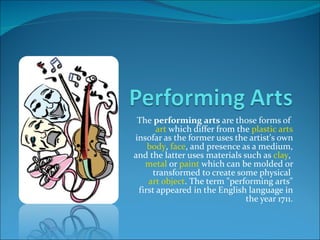
The  performing arts  are those forms of  art  which differ from the  plastic arts  insofar as the former uses the artist's own  body ,  face , and presence as a medium, and the latter uses materials such as  clay ,  metal  or  paint  which can be molded or transformed to create some physical  art object . The term "performing arts" first appeared in the English language in the year 1711.
 
DANCE
MUSIC
DRAMA
CIRCUS ARTS
MUSICALS
Artists who participate in performing arts in front of an audience are called performers, including  actors ,  comedians ,  dancers ,  magicians ,  musicians , and  singers . Performing arts are also supported by workers in related fields, such as  songwriting  and  stagecraft .
 
Music as an academic discipline mainly focuses on three career paths , music performance, music education (training music teachers), and musicology (theory, history, etc.).   Students learn to play a musical instrument, but also study music theory, musicology, history of music and musical composition.
It is an  art  form whose  medium  is  sound  and silence.  E lements of music are  pitch  (which governs  melody  and  harmony ),  rhythm  (and its associated concepts  tempo ,  meter , and  articulation ),  dynamics , and the sonic qualities of  timbre  and  texture . The word derives from  Greek   μουσική  ( mousike ; "art of the  Muses "
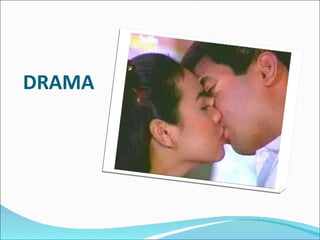
"Drama" (Greek "to do", "seeing place") is the branch of the performing arts concerned with  acting  out stories in front of an audience using combinations of speech, gesture, music, dance, sound and spectacle.
theatre takes such forms as  musicals ,  opera ,  ballet ,  illusion ,  mime ,  classical Indian dance ,  kabuki ,  mummers' plays ,  improvisational theatre ,  stand-up comedy ,  pantomime , and non-conventional or  arthouse  theatre.
Character Plot Theme Dialogue Genre Audience Stagecraft
Character Most simply a character is one of the persons who appears in the play, one of the dramatis personae (literally, the persons of the play). Most plays contain major characters and minor characters. Protagonist and the Antagonist.
 
Plot the order of events in a narrative or any other type of story.  
Theme   The plot has been called the body of a play and the theme has been called its soul. It is a broad idea, message, or moral of a story. The message may be about life, society, or human nature.   
Dialogue It is a  literary  and  theatrical  form consisting of a written or spoken  conversational  exchange between two or more people.
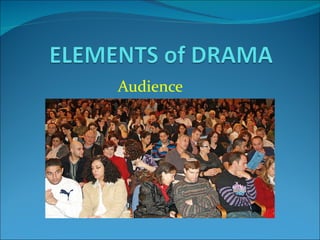
Audience is a group of  people  who participate in a  show  or encounter a  work of art ,  literature  in any  medium . Audience members participate in different ways in different kinds of art; some events invite overt audience  participation  and others allowing only modest  clapping  and  criticism  and  reception .
Audience
Stagecraft A generic term referring to the technical aspects of theatrical, film, and video production. It includes, but is not limited to, constructing and rigging scenery, hanging and focusing of lighting, design and procurement of costumes, makeup, procurement of  props , stage management, and recording and mixing of sound.
Stagecraft
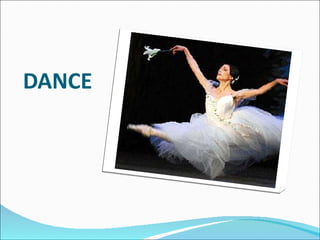
 Dance  (from  Old French   dancier)  generally refers to  human   movement  either used as a form of  expression  or presented in a  social ,  spiritual  or  performance  setting.
  Choreography  is the art of making dances, and the person who does this is called a choreographer.
Centering Gravity Balance Posture Gesture Rhythm Moving in Space Breathing
Centering This is maintaining a sense of your own body center that holds you together as you move. It allows you to move gracefully and freely.
Gravity This is the force that holds you to the earth. It is a force you have to work with because it constantly inhibits movement.
Balance Balance is concerned with more than balancing on one leg. Your aim is to achieve and constantly maintain an inner balance of the whole body. It is tension of mutual support among all parts that brings the whole together in a new way.
Posture It is the key to balance and movement. Your posture not only reveals your feelings but can also reveal feelings in you.
Gesture Gesture involves using the body as an expressive instrument to communicate feelings and ideas in patterns of movement. With subtle gestures and postural attitudes we show cooperation, give confidence to friends or display aggression to enemies
Rhythm It is the timing of events on a human scale of the steps of a  dance . Rhythm may also refer to visual presentation, as "timed movement through space."
Moving in Space You need to be aware of the space around you. Space is not just empty air but a tangible element that you move through.
Breathing Breathing is crucial to dance. Not only does it bring oxygen to the body but it also gives your movements fluency and harmony. This gives a more emotional, organic look to a dance.

Performing Art

  • 1.
    The performingarts are those forms of art which differ from the plastic arts insofar as the former uses the artist's own body , face , and presence as a medium, and the latter uses materials such as clay , metal or paint which can be molded or transformed to create some physical art object . The term "performing arts" first appeared in the English language in the year 1711.
  • 2.
  • 3.
  • 4.
  • 5.
  • 6.
  • 7.
  • 8.
    Artists who participatein performing arts in front of an audience are called performers, including actors , comedians , dancers , magicians , musicians , and singers . Performing arts are also supported by workers in related fields, such as songwriting and stagecraft .
  • 9.
  • 10.
    Music as anacademic discipline mainly focuses on three career paths , music performance, music education (training music teachers), and musicology (theory, history, etc.). Students learn to play a musical instrument, but also study music theory, musicology, history of music and musical composition.
  • 11.
    It is an art form whose medium is sound and silence. E lements of music are pitch (which governs melody and harmony ), rhythm (and its associated concepts tempo , meter , and articulation ), dynamics , and the sonic qualities of timbre and texture . The word derives from Greek μουσική ( mousike ; "art of the Muses "
  • 12.
    "Drama" (Greek "todo", "seeing place") is the branch of the performing arts concerned with acting out stories in front of an audience using combinations of speech, gesture, music, dance, sound and spectacle.
  • 13.
    theatre takes suchforms as musicals , opera , ballet , illusion , mime , classical Indian dance , kabuki , mummers' plays , improvisational theatre , stand-up comedy , pantomime , and non-conventional or arthouse theatre.
  • 14.
    Character Plot ThemeDialogue Genre Audience Stagecraft
  • 15.
    Character Most simplya character is one of the persons who appears in the play, one of the dramatis personae (literally, the persons of the play). Most plays contain major characters and minor characters. Protagonist and the Antagonist.
  • 16.
  • 17.
    Plot the orderof events in a narrative or any other type of story.  
  • 18.
    Theme   Theplot has been called the body of a play and the theme has been called its soul. It is a broad idea, message, or moral of a story. The message may be about life, society, or human nature.  
  • 19.
    Dialogue It isa literary and theatrical form consisting of a written or spoken conversational exchange between two or more people.
  • 20.
    Audience is agroup of people who participate in a show or encounter a work of art , literature in any medium . Audience members participate in different ways in different kinds of art; some events invite overt audience participation and others allowing only modest clapping and criticism and reception .
  • 21.
  • 22.
    Stagecraft A genericterm referring to the technical aspects of theatrical, film, and video production. It includes, but is not limited to, constructing and rigging scenery, hanging and focusing of lighting, design and procurement of costumes, makeup, procurement of props , stage management, and recording and mixing of sound.
  • 23.
  • 24.
    Dance (from Old French dancier) generally refers to human movement either used as a form of expression or presented in a social , spiritual or performance setting.
  • 25.
    Choreography is the art of making dances, and the person who does this is called a choreographer.
  • 26.
    Centering Gravity BalancePosture Gesture Rhythm Moving in Space Breathing
  • 27.
    Centering This ismaintaining a sense of your own body center that holds you together as you move. It allows you to move gracefully and freely.
  • 28.
    Gravity This isthe force that holds you to the earth. It is a force you have to work with because it constantly inhibits movement.
  • 29.
    Balance Balance isconcerned with more than balancing on one leg. Your aim is to achieve and constantly maintain an inner balance of the whole body. It is tension of mutual support among all parts that brings the whole together in a new way.
  • 30.
    Posture It isthe key to balance and movement. Your posture not only reveals your feelings but can also reveal feelings in you.
  • 31.
    Gesture Gesture involvesusing the body as an expressive instrument to communicate feelings and ideas in patterns of movement. With subtle gestures and postural attitudes we show cooperation, give confidence to friends or display aggression to enemies
  • 32.
    Rhythm It isthe timing of events on a human scale of the steps of a dance . Rhythm may also refer to visual presentation, as "timed movement through space."
  • 33.
    Moving in SpaceYou need to be aware of the space around you. Space is not just empty air but a tangible element that you move through.
  • 34.
    Breathing Breathing iscrucial to dance. Not only does it bring oxygen to the body but it also gives your movements fluency and harmony. This gives a more emotional, organic look to a dance.