Chapter 1

WHAT IS ART?
In both the sciences and the arts
     we strive to weave our
experiences into coherent bodies
      of knowledge and to
      communicate them.
Art…
□ enhances daily experiences.
□ is linked to quality of life.
□ touches everyone.
□ is all around us.
The Meaning of the Word Art…

1. Ability - The human capacity to make
   things of beauty and things that stir us.
2. Process - The different forms of art such as
   drawing, painting, sculpting, architecture,
   and photography.
3. Product - The completed work

Whatever the definition, it is important to know
  the vocabulary of art in order to
  understand it.
Some “Truths” About Art

1. There is no agreed-upon
   definition of art.
2. Art does not necessarily have to
   be beautiful.
3. Art can be created for any
   number of reasons.
The Philosophies About Art:
Many philosophers have argued that art
  serves no function, that it exists for its own
  sake.
Some have asserted that the essence of art
  transcends the human occupation with
  usefulness.
Others have held that in trying to analyze art
  too closely, one loses sight of its beauty and
  wonderment.
Understanding and
       appreciating art…

The questions to ask…
□ “Why was this created?”
□ “What is its purpose?”
What Are the Purposes of Art?
ART AND BEAUTY

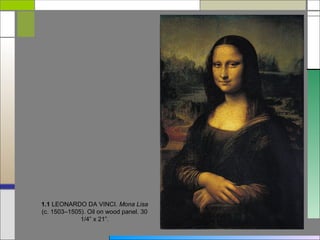
□ Art adds beauty to our lives by looking
  to nature
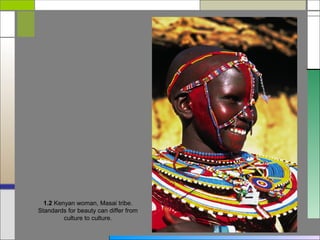
□ Art depicts both Western & Non-
  Western concepts of beauty
1.1 LEONARDO DA VINCI. Mona Lisa
(c. 1503–1505). Oil on wood panel. 30
             1/4” x 21”.
1.2 Kenyan woman, Masai tribe.
Standards for beauty can differ from
         culture to culture.
“A Closer Look”

A Portrait in the Flesh

Sometimes artists try to improve
 on nature – thereby creating an
      alternative standard
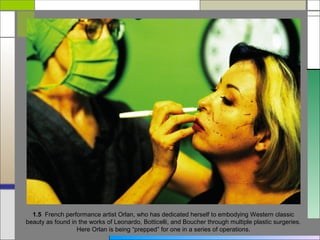
1.5 French performance artist Orlan, who has dedicated herself to embodying Western classic
beauty as found in the works of Leonardo, Botticelli, and Boucher through multiple plastic surgeries.
                  Here Orlan is being “prepped” for one in a series of operations.
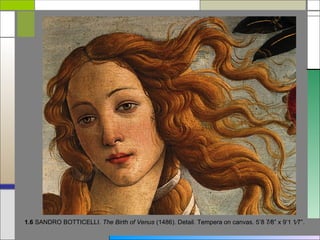
1.6 SANDRO BOTTICELLI. The Birth of Venus (1486). Detail. Tempera on canvas. 5’8 7⁄8” x 9’1 1⁄7”.
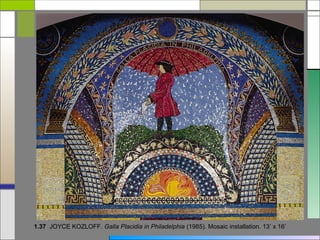
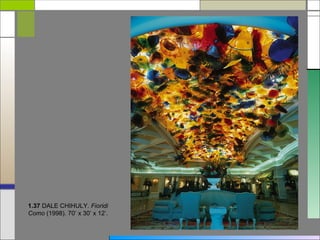
ART AND OUR ENVIRONMENT


       Used to create pleasing
            environments.
        Used as Decoration.
 Used to transport to another place.
1.37 JOYCE KOZLOFF. Galla Placidia in Philadelphia (1985). Mosaic installation. 13’ x 16’
1.37 DALE CHIHULY. Fioridi
Como (1998). 70’ x 30’ x 12’.
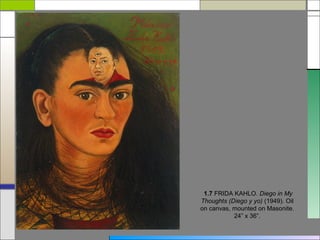
ART AND TRUTH


  Truth in art is subjective.
        True to nature?
True to human experience?
      True to materials?
1.7 FRIDA KAHLO. Diego in My
Thoughts (Diego y yo) (1949). Oil
on canvas, mounted on Masonite.
           24” x 36”.
Art can be used to

□ Replicate nature
□ Show reality
□ Express an artist’s own experiences.
ART AND IMMORTALITY


Used to defy mortality, by staying in the
audiences consciousness for decades.
 Art can bring people “together” from
       different periods of time.
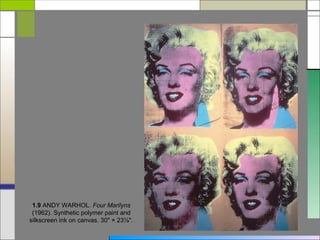
1.9 ANDY WARHOL. Four Marilyns
 (1962). Synthetic polymer paint and
silkscreen ink on canvas. 30" × 23⅞".
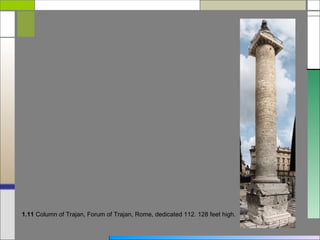
ART AND GLORY
□ Art immortalizes people and events
  throughout the ages.

□ Art history’s wealthiest patrons
  commissioned artists to create works
  that glorified their reigns and
  accomplishments.
1.11 Column of Trajan, Forum of Trajan, Rome, dedicated 112. 128 feet high.
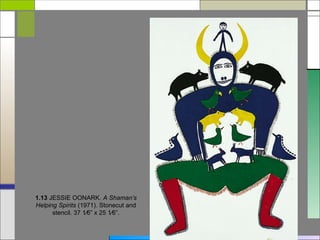
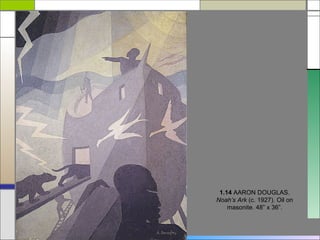
ART AND RELIGION

  Humans developed art forms to
     visually render the unseen.
Throughout different societies these
 depictions include human forms,
  animals, and composite figures.
  Art is used to express hope, faith
and symbolize religious events and
                values.
1.13 JESSIE OONARK. A Shaman’s
Helping Spirits (1971). Stonecut and
      stencil. 37 1⁄6” x 25 1⁄6”.
1.14 AARON DOUGLAS.
Noah’s Ark (c. 1927). Oil on
    masonite. 48” x 36”.
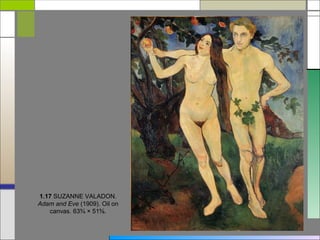
ART AND IDEOLOGY
  Ideologies are an organized
collection of ideas. They tend to
 originate from commonly held
     beliefs within a society.
 Art uses images to create and
       reinforce ideology.
1.17 SUZANNE VALADON.
Adam and Eve (1909). Oil on
   canvas. 63¾ × 51⅝.
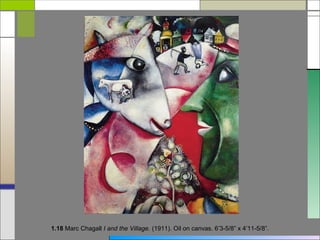
ART AND FANTASY

   Some artists use their art as an
 outlet to vent their imaginary inner
lives. These images can be evoked
from dreams or could simply be the
objects and landscapes conceived
       in the unconscious mind.
1.18 Marc Chagall I and the Village. (1911). Oil on canvas. 6’3-5/8” x 4’11-5/8”.
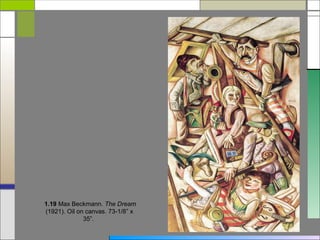
Art and Psychoanalytic

Many 20th Century artists looked to the
psychoanalytic writings of Sigmund Freud
and Carl Jung, who suggested that
primeval forces are at wok in the
unconscious reaches of the mind.
Artist’s sought to use their art as an outlet
for these unconscious forces.
1.19 Max Beckmann. The Dream
(1921). Oil on canvas. 73-1/8” x
              35”.
ART, INTELLECT, AND EMOTION

   Art can make you think, feel, and
  can trigger associations. The viewer
    may ponder the purpose of the
  artist, the emotions or activity of the
  subject, all while forming one’s own
           response to the piece.
Conceptual Art

Conceptual art does not only represent
 external objects. It also challenges the
 traditional view of the artist as creative
 visionary, skilled craftsperson, and
 master of one’s media. The “art” lies in
 the artist’s conception.
ART, ORDER, AND
   HARMONY
                 Art is harmony.

                           –Georges Seurat


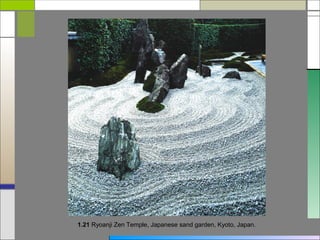
Artists and scientists try to find the underlying
order of nature.

A perfect examples is Zen, a Buddhist sect that
seeks inner harmony through introspection and
meditation.
1.21 Ryoanji Zen Temple, Japanese sand garden, Kyoto, Japan.
COMPARE +
    CONTRAST
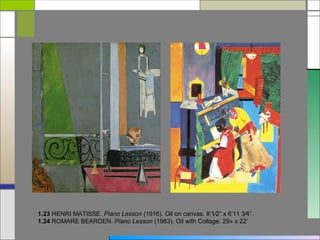
The Piano Lesson(s) by
 Matisse and Bearden
1.23 HENRI MATISSE. Piano Lesson (1916). Oil on canvas. 8’1⁄2” x 6’11 3⁄4”.
1.24 ROMARE BEARDEN. Piano Lesson (1983). Oil with Collage. 29» x 22’
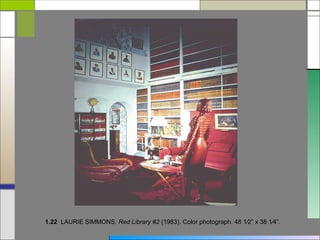
1.22 LAURIE SIMMONS. Red Library #2 (1983). Color photograph. 48 1⁄2” x 38 1⁄4”.
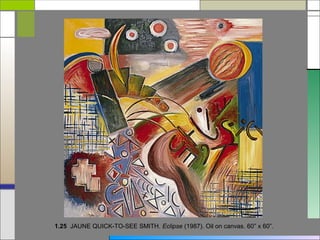
ART AND CHAOS


   On the flipside of order and harmony,
artists have also sought to depict chaos. It
  is often visualized through apocalyptic
 events, war, and famine, but also merely
suggested even without specific content.
1.25 JAUNE QUICK-TO-SEE SMITH. Eclipse (1987). Oil on canvas. 60” x 60”.
ART, EXPERIENCE, AND
             MEMORY
□ Art has served to record and
  communicate experiences and
  events.
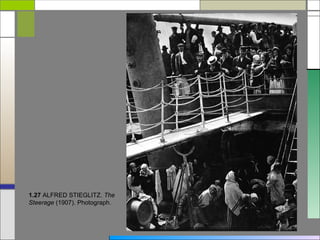
  □ Memorials
  □ Photographs of momentous occasions
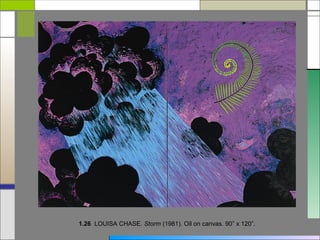
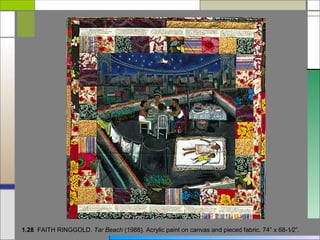
□ Art also conveys the personal
  experience of an artist.
1.26 LOUISA CHASE. Storm (1981). Oil on canvas. 90” x 120”.
1.27 ALFRED STIEGLITZ. The
Steerage (1907). Photograph.
1.28 FAITH RINGGOLD. Tar Beach (1988). Acrylic paint on canvas and pieced fabric. 74” x 68-1⁄2”.
ART IN THE SOCIAL AND CULTURAL
              CONTEXT

    While recording experiences, artists
             frequently note:

□ The activities and the objects of their
  times and places
□ Contemporary fashion and beliefs
□ The crafts and sciences
□ Architecture
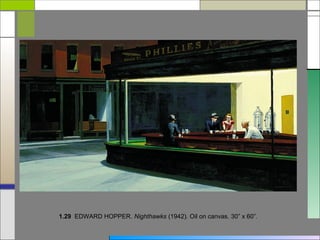
1.29 EDWARD HOPPER. Nighthawks (1942). Oil on canvas. 30” x 60”.
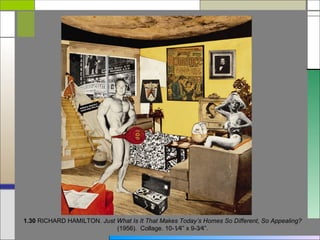
1.30 RICHARD HAMILTON. Just What Is It That Makes Today’s Homes So Different, So Appealing?
                            (1956). Collage. 10-1⁄4” x 9-3⁄4”.
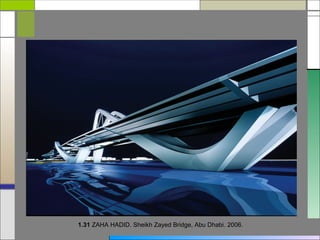
1.31 ZAHA HADID. Sheikh Zayed Bridge, Abu Dhabi. 2006.
ART AND SOCIAL
    CONSCIOUSNESS

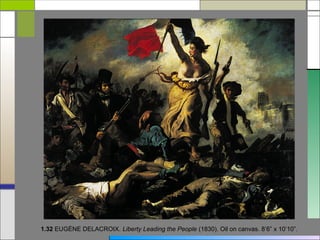
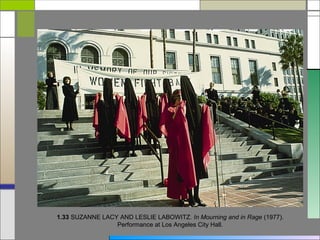
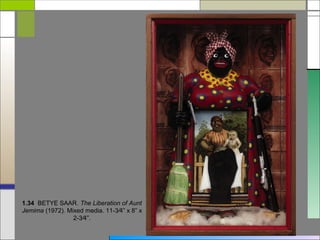
Artists have taken on bitter struggles
against the injustices of their times
and have tried to persuade others to
join them in their causes, and it has
been natural for them to use their
creative skills to do so.
1.32 EUGÈNE DELACROIX. Liberty Leading the People (1830). Oil on canvas. 8’6” x 10’10”.
1.33 SUZANNE LACY AND LESLIE LABOWITZ. In Mourning and in Rage (1977).
                 Performance at Los Angeles City Hall.
1.34 BETYE SAAR. The Liberation of Aunt
Jemima (1972). Mixed media. 11-3⁄4” x 8” x
                 2-3⁄4”.
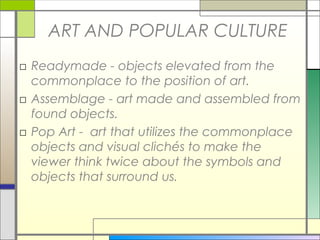
ART AND POPULAR CULTURE
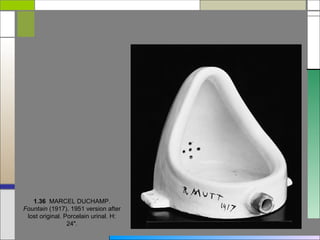
□ Readymade - objects elevated from the
  commonplace to the position of art.
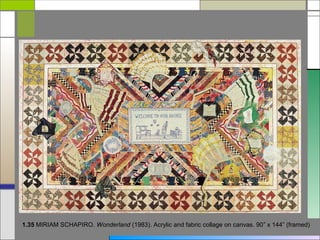
□ Assemblage - art made and assembled from
  found objects.
□ Pop Art - art that utilizes the commonplace
  objects and visual clichés to make the
  viewer think twice about the symbols and
  objects that surround us.
1.35 MIRIAM SCHAPIRO. Wonderland (1983). Acrylic and fabric collage on canvas. 90” x 144” (framed)
1.36 MARCEL DUCHAMP.
Fountain (1917). 1951 version after
 lost original. Porcelain urinal. H:
                 24".
Some artist create solely for:


□ “Self-actualization”
□ Novelty
□ Exploration
□ Understanding
□ Aesthetics
□ Beauty
□ Order
□ Emotional or psychological needs
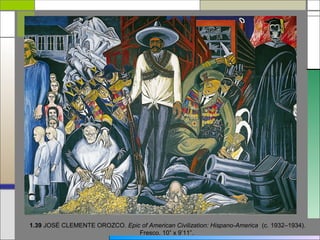
1.39 JOSÉ CLEMENTE OROZCO. Epic of American Civilization: Hispano-America (c. 1932–1934).
                               Fresco. 10” x 9’11”.

Chapter 1 online

  • 1.
  • 2.
    In both thesciences and the arts we strive to weave our experiences into coherent bodies of knowledge and to communicate them.
  • 3.
    Art… □ enhances dailyexperiences. □ is linked to quality of life. □ touches everyone. □ is all around us.
  • 4.
    The Meaning ofthe Word Art… 1. Ability - The human capacity to make things of beauty and things that stir us. 2. Process - The different forms of art such as drawing, painting, sculpting, architecture, and photography. 3. Product - The completed work Whatever the definition, it is important to know the vocabulary of art in order to understand it.
  • 5.
    Some “Truths” AboutArt 1. There is no agreed-upon definition of art. 2. Art does not necessarily have to be beautiful. 3. Art can be created for any number of reasons.
  • 6.
    The Philosophies AboutArt: Many philosophers have argued that art serves no function, that it exists for its own sake. Some have asserted that the essence of art transcends the human occupation with usefulness. Others have held that in trying to analyze art too closely, one loses sight of its beauty and wonderment.
  • 7.
    Understanding and appreciating art… The questions to ask… □ “Why was this created?” □ “What is its purpose?”
  • 8.
    What Are thePurposes of Art?
  • 9.
    ART AND BEAUTY □Art adds beauty to our lives by looking to nature □ Art depicts both Western & Non- Western concepts of beauty
  • 10.
    1.1 LEONARDO DAVINCI. Mona Lisa (c. 1503–1505). Oil on wood panel. 30 1/4” x 21”.
  • 11.
    1.2 Kenyan woman,Masai tribe. Standards for beauty can differ from culture to culture.
  • 12.
    “A Closer Look” APortrait in the Flesh Sometimes artists try to improve on nature – thereby creating an alternative standard
  • 13.
    1.5 French performanceartist Orlan, who has dedicated herself to embodying Western classic beauty as found in the works of Leonardo, Botticelli, and Boucher through multiple plastic surgeries. Here Orlan is being “prepped” for one in a series of operations.
  • 14.
    1.6 SANDRO BOTTICELLI.The Birth of Venus (1486). Detail. Tempera on canvas. 5’8 7⁄8” x 9’1 1⁄7”.
  • 15.
    ART AND OURENVIRONMENT Used to create pleasing environments. Used as Decoration. Used to transport to another place.
  • 16.
    1.37 JOYCE KOZLOFF.Galla Placidia in Philadelphia (1985). Mosaic installation. 13’ x 16’
  • 17.
    1.37 DALE CHIHULY.Fioridi Como (1998). 70’ x 30’ x 12’.
  • 18.
    ART AND TRUTH Truth in art is subjective. True to nature? True to human experience? True to materials?
  • 19.
    1.7 FRIDA KAHLO.Diego in My Thoughts (Diego y yo) (1949). Oil on canvas, mounted on Masonite. 24” x 36”.
  • 20.
    Art can beused to □ Replicate nature □ Show reality □ Express an artist’s own experiences.
  • 21.
    ART AND IMMORTALITY Usedto defy mortality, by staying in the audiences consciousness for decades. Art can bring people “together” from different periods of time.
  • 22.
    1.9 ANDY WARHOL.Four Marilyns (1962). Synthetic polymer paint and silkscreen ink on canvas. 30" × 23⅞".
  • 23.
    ART AND GLORY □Art immortalizes people and events throughout the ages. □ Art history’s wealthiest patrons commissioned artists to create works that glorified their reigns and accomplishments.
  • 24.
    1.11 Column ofTrajan, Forum of Trajan, Rome, dedicated 112. 128 feet high.
  • 25.
    ART AND RELIGION Humans developed art forms to visually render the unseen. Throughout different societies these depictions include human forms, animals, and composite figures. Art is used to express hope, faith and symbolize religious events and values.
  • 26.
    1.13 JESSIE OONARK.A Shaman’s Helping Spirits (1971). Stonecut and stencil. 37 1⁄6” x 25 1⁄6”.
  • 27.
    1.14 AARON DOUGLAS. Noah’sArk (c. 1927). Oil on masonite. 48” x 36”.
  • 28.
    ART AND IDEOLOGY Ideologies are an organized collection of ideas. They tend to originate from commonly held beliefs within a society. Art uses images to create and reinforce ideology.
  • 29.
    1.17 SUZANNE VALADON. Adamand Eve (1909). Oil on canvas. 63¾ × 51⅝.
  • 30.
    ART AND FANTASY Some artists use their art as an outlet to vent their imaginary inner lives. These images can be evoked from dreams or could simply be the objects and landscapes conceived in the unconscious mind.
  • 31.
    1.18 Marc ChagallI and the Village. (1911). Oil on canvas. 6’3-5/8” x 4’11-5/8”.
  • 32.
    Art and Psychoanalytic Many20th Century artists looked to the psychoanalytic writings of Sigmund Freud and Carl Jung, who suggested that primeval forces are at wok in the unconscious reaches of the mind. Artist’s sought to use their art as an outlet for these unconscious forces.
  • 33.
    1.19 Max Beckmann.The Dream (1921). Oil on canvas. 73-1/8” x 35”.
  • 34.
    ART, INTELLECT, ANDEMOTION Art can make you think, feel, and can trigger associations. The viewer may ponder the purpose of the artist, the emotions or activity of the subject, all while forming one’s own response to the piece.
  • 35.
    Conceptual Art Conceptual artdoes not only represent external objects. It also challenges the traditional view of the artist as creative visionary, skilled craftsperson, and master of one’s media. The “art” lies in the artist’s conception.
  • 36.
    ART, ORDER, AND HARMONY Art is harmony. –Georges Seurat Artists and scientists try to find the underlying order of nature. A perfect examples is Zen, a Buddhist sect that seeks inner harmony through introspection and meditation.
  • 37.
    1.21 Ryoanji ZenTemple, Japanese sand garden, Kyoto, Japan.
  • 38.
    COMPARE + CONTRAST The Piano Lesson(s) by Matisse and Bearden
  • 39.
    1.23 HENRI MATISSE.Piano Lesson (1916). Oil on canvas. 8’1⁄2” x 6’11 3⁄4”. 1.24 ROMARE BEARDEN. Piano Lesson (1983). Oil with Collage. 29» x 22’
  • 40.
    1.22 LAURIE SIMMONS.Red Library #2 (1983). Color photograph. 48 1⁄2” x 38 1⁄4”.
  • 41.
    ART AND CHAOS On the flipside of order and harmony, artists have also sought to depict chaos. It is often visualized through apocalyptic events, war, and famine, but also merely suggested even without specific content.
  • 42.
    1.25 JAUNE QUICK-TO-SEESMITH. Eclipse (1987). Oil on canvas. 60” x 60”.
  • 43.
    ART, EXPERIENCE, AND MEMORY □ Art has served to record and communicate experiences and events. □ Memorials □ Photographs of momentous occasions □ Art also conveys the personal experience of an artist.
  • 44.
    1.26 LOUISA CHASE.Storm (1981). Oil on canvas. 90” x 120”.
  • 45.
    1.27 ALFRED STIEGLITZ.The Steerage (1907). Photograph.
  • 46.
    1.28 FAITH RINGGOLD.Tar Beach (1988). Acrylic paint on canvas and pieced fabric. 74” x 68-1⁄2”.
  • 47.
    ART IN THESOCIAL AND CULTURAL CONTEXT While recording experiences, artists frequently note: □ The activities and the objects of their times and places □ Contemporary fashion and beliefs □ The crafts and sciences □ Architecture
  • 48.
    1.29 EDWARD HOPPER.Nighthawks (1942). Oil on canvas. 30” x 60”.
  • 49.
    1.30 RICHARD HAMILTON.Just What Is It That Makes Today’s Homes So Different, So Appealing? (1956). Collage. 10-1⁄4” x 9-3⁄4”.
  • 50.
    1.31 ZAHA HADID.Sheikh Zayed Bridge, Abu Dhabi. 2006.
  • 51.
    ART AND SOCIAL CONSCIOUSNESS Artists have taken on bitter struggles against the injustices of their times and have tried to persuade others to join them in their causes, and it has been natural for them to use their creative skills to do so.
  • 52.
    1.32 EUGÈNE DELACROIX.Liberty Leading the People (1830). Oil on canvas. 8’6” x 10’10”.
  • 53.
    1.33 SUZANNE LACYAND LESLIE LABOWITZ. In Mourning and in Rage (1977). Performance at Los Angeles City Hall.
  • 54.
    1.34 BETYE SAAR.The Liberation of Aunt Jemima (1972). Mixed media. 11-3⁄4” x 8” x 2-3⁄4”.
  • 55.
    ART AND POPULARCULTURE □ Readymade - objects elevated from the commonplace to the position of art. □ Assemblage - art made and assembled from found objects. □ Pop Art - art that utilizes the commonplace objects and visual clichés to make the viewer think twice about the symbols and objects that surround us.
  • 56.
    1.35 MIRIAM SCHAPIRO.Wonderland (1983). Acrylic and fabric collage on canvas. 90” x 144” (framed)
  • 57.
    1.36 MARCEL DUCHAMP. Fountain(1917). 1951 version after lost original. Porcelain urinal. H: 24".
  • 58.
    Some artist createsolely for: □ “Self-actualization” □ Novelty □ Exploration □ Understanding □ Aesthetics □ Beauty □ Order □ Emotional or psychological needs
  • 59.
    1.39 JOSÉ CLEMENTEOROZCO. Epic of American Civilization: Hispano-America (c. 1932–1934). Fresco. 10” x 9’11”.