CHAPTER 2
CUSTOMER RELATIONSHIP:
CUSTOMER SERVICE
Lesson 1:
Relationship Marketing
I a
mJ
o
h
e
m
i
e
RELATIONSHIP MARKETING
According to Serrano, Relationship Marketing includes activities
aimed at developing and managing trusting and long-term
relationships with larger customers. (Customer profile, buying
patterns and history of contacts are kept in a sales database)
Relationship marketing is a strategy designed for customer loyalty,
interaction, and long-term engagement to be fostered. Customer
Relationship focuses more on long-term customer retention than
acquiring large numbers of new and potentially single-transaction
customers.
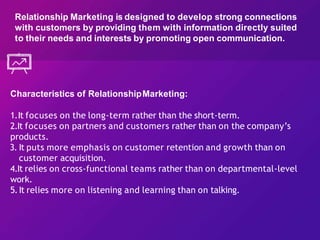
Characteristics of RelationshipMarketing:
1.It focuses on the long-term rather than the short-term.
2.It focuses on partners and customers rather than on the company’s
products.
3. It puts more emphasis on customer retention and growth than on
customer acquisition.
4.It relies on cross-functional teams rather than on departmental-level
work.
5.It relies more on listening and learning than on talking.
Relationship Marketing is designed to develop strong connections
with customers by providing them with information directly suited
to their needs and interests by promoting open communication.
Relationship marketing callsfor
new practices within the 4p’s.
THIS IS A SLIDE t i t l e
▹Here you have a list of items
▹And some text
▹But remember not to overload your slides with
content
Your audience will listen to you or read the content,
but won’t do both.
▹More products are customized to the customers’
preferences.
▹New products are developed and designed
cooperatively with suppliers and distributors.
▹The company will set a price based on the relationship
with the customer and the bundle of features and
services ordered by the customer.
▹In business-to-business marketing, there is more
negotiation because products are often designed for
each customer.
PRICE
▹RM favors more direct marketing to the customer, thus
reducingthe role of middlemen.
▹RM favors offering alternatives to customers to choose
the way they want to order, pay for, receive, install, and
even repair theproduct.
PLACE
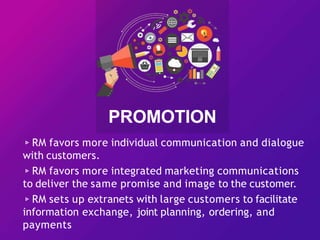
▹RM favors more individual communication and dialogue
with customers.
▹RM favors more integrated marketing communications
to deliver the same promise and image to the customer.
▹RM sets up extranets with large customers to facilitate
information exchange, joint planning, ordering, and
payments
PROMOTION
In the business world,
retaining customers has a
lesser cost at least eight
times compared to acquiring
new ones. Thus, this
marketing capitalizes on the
same fact and is beneficial to
thecompany in several ways.
.
BENEFITS OF RELATIONSHIPMARKETING
1. Understanding customer
characteristics
the company can segregate its
customers into groups based on
their characteristics like
purchasing power, frequencyand
volume of sale transactions. It
also helps the company get
valuable feedback from its
customers and understand their
needs and expectations.
2. Delivery and meeting
expectations
if the company knows what its
customers’ needs are, it willhelp
reduce wastage due to trial and
error methods. It is easier to
create a product if the features
and specifications of the product
are known.
BENEFITS OF RELATIONSHIPMARKETING
3. Repeat Business
Sellers should
maintain good
attitude to the
buyers. By doing
this, buyers will
feel that they do
not need toswitch
sellers.
4. Prevents negative
transition
trust and loyalty go
hand in hand and it is
super beneficial forall
business. It will help
prevent customers
from turning to
competitors.
5. Word-of-mouth
marketing
a happy customer
will always promote
business by telling
ten other people
about the amazing
services or
performance
received from a
company.
BENEFITS OF RELATIONSHIPMARKETING
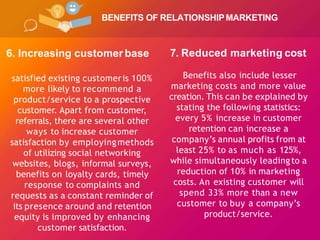
6. Increasing customer base
satisfied existing customeris 100%
more likely to recommend a
product/service to a prospective
customer. Apart from customer,
referrals, there are several other
ways to increase customer
satisfaction by employingmethods
of utilizing social networking
websites, blogs, informal surveys,
benefits on loyalty cards, timely
response to complaints and
requests as a constant reminder of
its presence around and retention
equity is improved by enhancing
customer satisfaction.
7. Reduced marketing cost
Benefits also include lesser
marketing costs and more value
creation. This can be explained by
stating the following statistics:
every 5% increase in customer
retention can increase a
company’s annual profits from at
least 25% to as much as 125%,
while simultaneously leadingto a
reduction of 10% in marketing
costs. An existing customer will
spend 33% more than a new
customer to buy a company’s
product/service.
BENEFITS OF RELATIONSHIP MARKETING
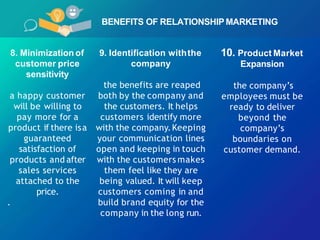
8. Minimization of
customer price
sensitivity
a happy customer
will be willing to
pay more for a
product if there isa
guaranteed
satisfaction of
products and after
sales services
attached to the
price.
.
9. Identification withthe
company
the benefits are reaped
both by the company and
the customers. It helps
customers identify more
with the company.Keeping
your communication lines
open and keeping in touch
with the customers makes
them feel like they are
being valued. It will keep
customers coming in and
build brand equity for the
company in the long run.
10. Product Market
Expansion
the company’s
employees must be
ready to deliver
beyond the
company’s
boundaries on
customer demand.
▹Examples of companies using
relationship marketing
▹Ikea
▹Direct recruitment
▹American airlines
▹Dell
▹Vyvanse
CHAPTER 2
CUSTOMER RELATIONSHIP:
CUSTOMER SERVICE
Lesson 2:
Customer Value
CUSTOMER VALUE
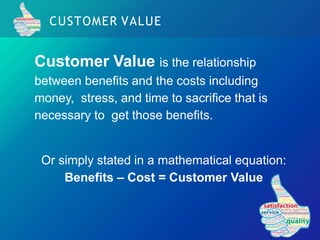
Customer Value is the relationship
between benefits and the costs including
money, stress, and time to sacrifice that is
necessary to get those benefits.
Or simply stated in a mathematical equation:
Benefits – Cost = Customer Value
CUSTOMER VALUE
In essence, customer value entails extraordinary delivery of four
value-points or components known also as SQIP:
SERVICE the intangible value offered to customers.
In essence, customer value entails extraordinary delivery of four
value-points or components known also as SQIP:
QUALITY customer’s perception of how well a company’s
products and services meet expectations
In essence, customer value entails extraordinary delivery of four
value-points or components known also as SQIP:
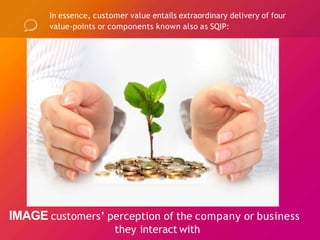
IMAGE customers’ perception of the company or business
they interact with
In essence, customer value entails extraordinary delivery of four
value-points or components known also as SQIP:
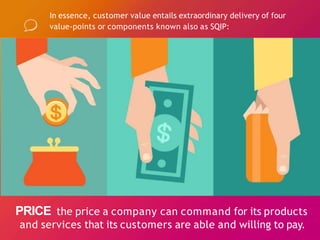
PRICE the price a company can command for its products
and services that its customers are able and willing to pay.
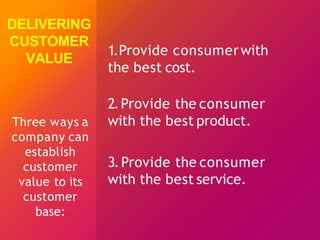
1.Provide consumerwith
the best cost.
2.Provide the consumer
with the best product.
3.Provide the consumer
with the best service.
Three ways a
company can
establish
customer
value to its
customer
base:
DELIVERING
CUSTOMER
VALUE
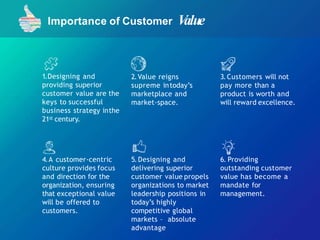
Importance of Customer V
alue
1.Designing and
providing superior
customer value are the
keys to successful
business strategy inthe
21st century.
2.Value reigns
supreme intoday’s
marketplace and
market-space.
3.Customers will not
pay more than a
product is worth and
will reward excellence.
4.A customer-centric
culture provides focus
and direction for the
organization, ensuring
that exceptional value
will be offered to
customers.
5.Designing and
delivering superior
customer value propels
organizations to market
leadership positions in
today’s highly
competitive global
markets – absolute
advantage
6. Providing
outstanding customer
value has become a
mandate for
management.
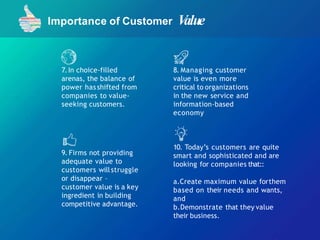
Importance of Customer V
alue
7.In choice-filled
arenas, the balance of
power has shifted from
companies to value-
seeking customers.
8. Managing customer
value is even more
critical to organizations
in the new service and
information-based
economy
9. Firms not providing
adequate value to
customers willstruggle
or disappear –
customer value is a key
ingredient in building
competitive advantage.
10. Today’s customers are quite
smart and sophisticated and are
looking for companies that::
a.Create maximum value forthem
based on their needs and wants,
and
b.Demonstrate that they value
their business.
thanks!
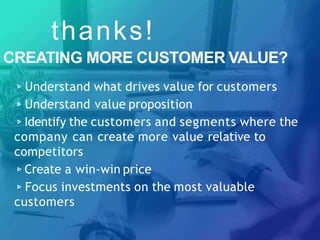
CREATING MORE CUSTOMER VALUE?
▹Understand what drives value for customers
▹Understand value proposition
▹Identify the customers and segments where the
company can create more value relative to
competitors
▹Create a win-win price
▹Focus investments on the most valuable
customers
CHAPTER 2
CUSTOMER RELATIONSHIP:
CUSTOMER SERVICE
Lesson 3:
Customer Relationship
Development Strategies
Benefits of Developing Customer Relationship
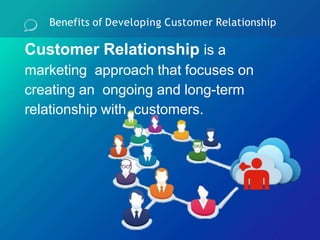
Customer Relationship is a
marketing approach that focuses on
creating an ongoing and long-term
relationship with customers.
Benefits in developing and implementing
customer relationship
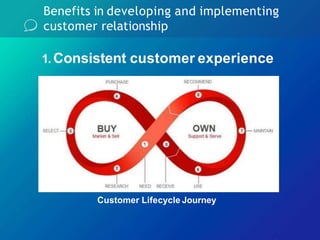
1. Consistent customer experience
Customer Lifecycle Journey
Benefits in developing and implementing
customer relationship
2.Customer
feedback
Benefits in developing and implementing
customer relationship
3.Customer Profitability
Benefits in developing and implementing
customer relationship
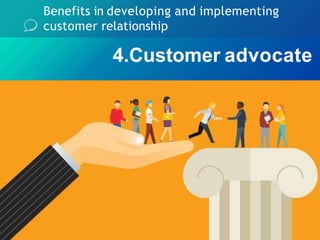
4.Customer advocate
Benefits in developing and implementing
customer relationship
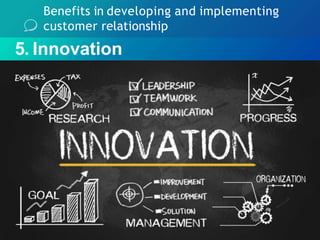
5. Innovation
Benefits in developing and implementing
customer relationship
2. Customer Feedback
3. Customer Profitability
4. Customer advocate
5. Innovation
1. Consistent customer experience
1. Make every customer interaction count
Strategies in Developing Customer Relationship
2. Follow-through on commitments andclaims
about products orservices.
Strategies in Developing Customer Relationship
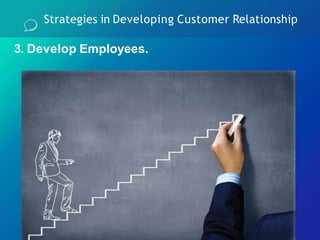
3. Develop Employees.
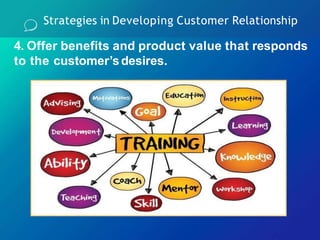
4. Offer benefits and product value that responds
to the customer’sdesires.
Strategies in Developing Customer Relationship
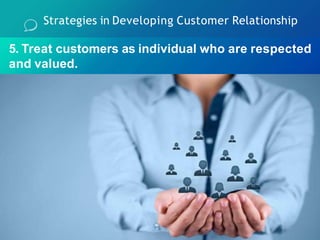
5. Treat customers as individual who are respected
and valued.
Strategies in Developing Customer Relationship
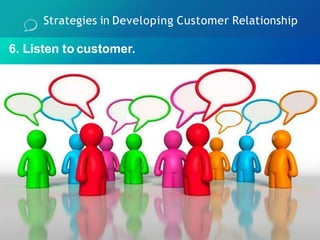
6. Listen to customer.
Strategies in Developing Customer Relationship
7. Build a strong brandidentity.
Strategies in Developing Customer Relationship
8. Surround customers with valuable information by using emails,
websites, content, social media, and other methods of outreach but do
not be invasive.
Strategies in Developing Customer Relationship
9. The business must have a website.
Strategies in Developing Customer Relationship
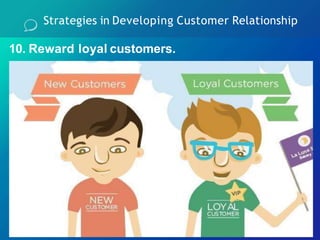
10. Reward loyal customers.
Strategies in Developing Customer Relationship
11. Nothing strengthens a bond morethat
appreciation.
Strategies in Developing Customer Relationship
12. Create a blog about the business where discuss
is more casual and inviting.
Strategies in Developing Customer Relationship
Benefits in developing and implementing
customer relationship
1.Make every customer interaction count
2.Follow-through on commitmentsand
claims about products or services.
3. Develop Employees.
4.Offer benefits and product value that
responds to thecustomer’s desires.
5. Treat customers as individual who are
respected and valued.
6. Listen to customer.
Benefits in developing and implementing
customer relationship
7. Build a strong brandidentity.
8.Surround customers with valuable
information by using emails, websites,content,
social media, and other methods of outreach
but do not beinvasive.
9. The business must have awebsite.
10. Reward loyal customers.
11.Nothing strengthens a bond more that
appreciation.
12.Create a blog about the business where
discuss is more casual and inviting.
CHAPTER 2
CUSTOMER RELATIONSHIP:
CUSTOMER SERVICE
Lesson 4: Customer Service
Strategy in the Philippine
Business Enterprise
Customer Service Strategy
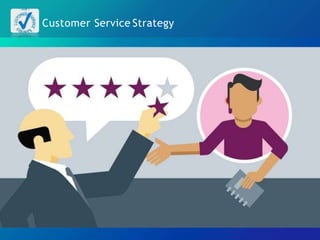
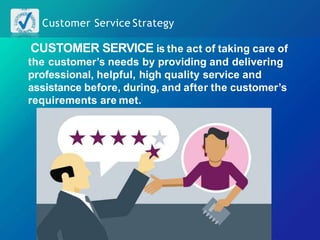
CUSTOMER SERVICE is the act of taking care of
the customer’s needs by providing and delivering
professional, helpful, high quality service and
assistance before, during, and after the customer’s
requirements are met.
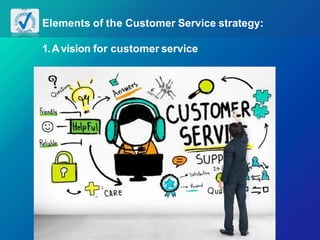
Elements of the Customer Service strategy:
1.Avision for customer service
Elements of the Customer Service strategy:
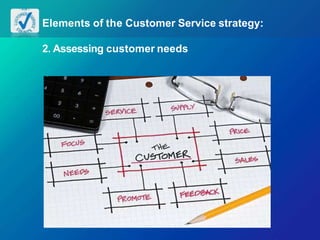
2. Assessing customer needs
Elements of the Customer Service strategy:
3. Hiring for Service
Elements of the Customer Service strategy:
4. Organizational goals for customerservice
Elements of the Customer Service strategy:
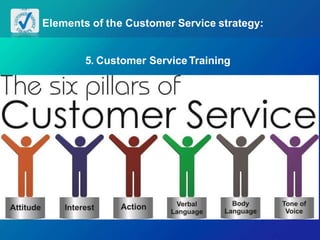
5. Customer Service Training
Elements of the Customer Service strategy:
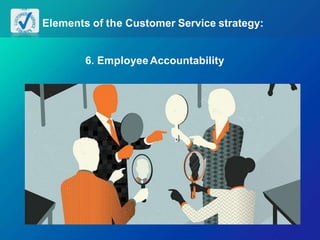
6. Employee Accountability
Elements of the Customer Service strategy:
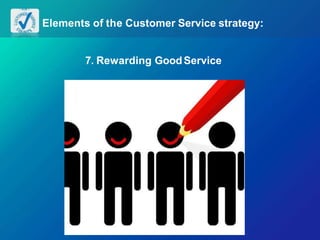
7. Rewarding GoodService
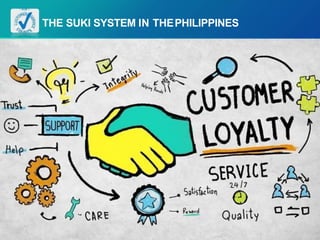
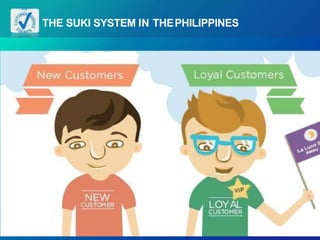
THE SUKI SYSTEM IN THEPHILIPPINES
Benefits in developing and implementing
customer relationship
SUKI SYSTEM system of
patronage in which acustomer
regularly buys their
merchandise from a certain
client.
THE SUKI SYSTEM IN THEPHILIPPINES
Benefits in developing and implementing
customer relationship
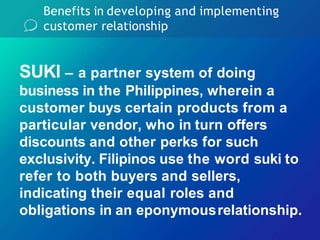
SUKI – a partner system of doing
business in the Philippines, wherein a
customer buys certain products from a
particular vendor, who in turn offers
discounts and other perks for such
exclusivity. Filipinos use the word suki to
refer to both buyers and sellers,
indicating their equal roles and
obligations in an eponymousrelationship.
Thanks!

principlesofmarketing-chapter2-170810162334.pptx

  • 1.
    CHAPTER 2 CUSTOMER RELATIONSHIP: CUSTOMERSERVICE Lesson 1: Relationship Marketing I a mJ o h e m i e
  • 2.
    RELATIONSHIP MARKETING According toSerrano, Relationship Marketing includes activities aimed at developing and managing trusting and long-term relationships with larger customers. (Customer profile, buying patterns and history of contacts are kept in a sales database) Relationship marketing is a strategy designed for customer loyalty, interaction, and long-term engagement to be fostered. Customer Relationship focuses more on long-term customer retention than acquiring large numbers of new and potentially single-transaction customers.
  • 3.
    Characteristics of RelationshipMarketing: 1.Itfocuses on the long-term rather than the short-term. 2.It focuses on partners and customers rather than on the company’s products. 3. It puts more emphasis on customer retention and growth than on customer acquisition. 4.It relies on cross-functional teams rather than on departmental-level work. 5.It relies more on listening and learning than on talking. Relationship Marketing is designed to develop strong connections with customers by providing them with information directly suited to their needs and interests by promoting open communication.
  • 4.
    Relationship marketing callsfor newpractices within the 4p’s.
  • 5.
    THIS IS ASLIDE t i t l e ▹Here you have a list of items ▹And some text ▹But remember not to overload your slides with content Your audience will listen to you or read the content, but won’t do both.
  • 6.
    ▹More products arecustomized to the customers’ preferences. ▹New products are developed and designed cooperatively with suppliers and distributors.
  • 7.
    ▹The company willset a price based on the relationship with the customer and the bundle of features and services ordered by the customer. ▹In business-to-business marketing, there is more negotiation because products are often designed for each customer. PRICE
  • 8.
    ▹RM favors moredirect marketing to the customer, thus reducingthe role of middlemen. ▹RM favors offering alternatives to customers to choose the way they want to order, pay for, receive, install, and even repair theproduct. PLACE
  • 9.
    ▹RM favors moreindividual communication and dialogue with customers. ▹RM favors more integrated marketing communications to deliver the same promise and image to the customer. ▹RM sets up extranets with large customers to facilitate information exchange, joint planning, ordering, and payments PROMOTION
  • 10.
    In the businessworld, retaining customers has a lesser cost at least eight times compared to acquiring new ones. Thus, this marketing capitalizes on the same fact and is beneficial to thecompany in several ways. . BENEFITS OF RELATIONSHIPMARKETING
  • 11.
    BENEFITS OF RELATIONSHIPMARKETING 1.Understanding customer characteristics the company can segregate its customers into groups based on their characteristics like purchasing power, frequencyand volume of sale transactions. It also helps the company get valuable feedback from its customers and understand their needs and expectations. 2. Delivery and meeting expectations if the company knows what its customers’ needs are, it willhelp reduce wastage due to trial and error methods. It is easier to create a product if the features and specifications of the product are known.
  • 12.
    BENEFITS OF RELATIONSHIPMARKETING 3.Repeat Business Sellers should maintain good attitude to the buyers. By doing this, buyers will feel that they do not need toswitch sellers. 4. Prevents negative transition trust and loyalty go hand in hand and it is super beneficial forall business. It will help prevent customers from turning to competitors. 5. Word-of-mouth marketing a happy customer will always promote business by telling ten other people about the amazing services or performance received from a company.
  • 13.
    BENEFITS OF RELATIONSHIPMARKETING 6.Increasing customer base satisfied existing customeris 100% more likely to recommend a product/service to a prospective customer. Apart from customer, referrals, there are several other ways to increase customer satisfaction by employingmethods of utilizing social networking websites, blogs, informal surveys, benefits on loyalty cards, timely response to complaints and requests as a constant reminder of its presence around and retention equity is improved by enhancing customer satisfaction. 7. Reduced marketing cost Benefits also include lesser marketing costs and more value creation. This can be explained by stating the following statistics: every 5% increase in customer retention can increase a company’s annual profits from at least 25% to as much as 125%, while simultaneously leadingto a reduction of 10% in marketing costs. An existing customer will spend 33% more than a new customer to buy a company’s product/service.
  • 14.
    BENEFITS OF RELATIONSHIPMARKETING 8. Minimization of customer price sensitivity a happy customer will be willing to pay more for a product if there isa guaranteed satisfaction of products and after sales services attached to the price. . 9. Identification withthe company the benefits are reaped both by the company and the customers. It helps customers identify more with the company.Keeping your communication lines open and keeping in touch with the customers makes them feel like they are being valued. It will keep customers coming in and build brand equity for the company in the long run. 10. Product Market Expansion the company’s employees must be ready to deliver beyond the company’s boundaries on customer demand.
  • 15.
    ▹Examples of companiesusing relationship marketing ▹Ikea ▹Direct recruitment ▹American airlines ▹Dell ▹Vyvanse
  • 20.
    CHAPTER 2 CUSTOMER RELATIONSHIP: CUSTOMERSERVICE Lesson 2: Customer Value
  • 21.
    CUSTOMER VALUE Customer Valueis the relationship between benefits and the costs including money, stress, and time to sacrifice that is necessary to get those benefits. Or simply stated in a mathematical equation: Benefits – Cost = Customer Value
  • 22.
  • 23.
    In essence, customervalue entails extraordinary delivery of four value-points or components known also as SQIP: SERVICE the intangible value offered to customers.
  • 24.
    In essence, customervalue entails extraordinary delivery of four value-points or components known also as SQIP: QUALITY customer’s perception of how well a company’s products and services meet expectations
  • 25.
    In essence, customervalue entails extraordinary delivery of four value-points or components known also as SQIP: IMAGE customers’ perception of the company or business they interact with
  • 26.
    In essence, customervalue entails extraordinary delivery of four value-points or components known also as SQIP: PRICE the price a company can command for its products and services that its customers are able and willing to pay.
  • 27.
    1.Provide consumerwith the bestcost. 2.Provide the consumer with the best product. 3.Provide the consumer with the best service. Three ways a company can establish customer value to its customer base: DELIVERING CUSTOMER VALUE
  • 28.
    Importance of CustomerV alue 1.Designing and providing superior customer value are the keys to successful business strategy inthe 21st century. 2.Value reigns supreme intoday’s marketplace and market-space. 3.Customers will not pay more than a product is worth and will reward excellence. 4.A customer-centric culture provides focus and direction for the organization, ensuring that exceptional value will be offered to customers. 5.Designing and delivering superior customer value propels organizations to market leadership positions in today’s highly competitive global markets – absolute advantage 6. Providing outstanding customer value has become a mandate for management.
  • 29.
    Importance of CustomerV alue 7.In choice-filled arenas, the balance of power has shifted from companies to value- seeking customers. 8. Managing customer value is even more critical to organizations in the new service and information-based economy 9. Firms not providing adequate value to customers willstruggle or disappear – customer value is a key ingredient in building competitive advantage. 10. Today’s customers are quite smart and sophisticated and are looking for companies that:: a.Create maximum value forthem based on their needs and wants, and b.Demonstrate that they value their business.
  • 30.
    thanks! CREATING MORE CUSTOMERVALUE? ▹Understand what drives value for customers ▹Understand value proposition ▹Identify the customers and segments where the company can create more value relative to competitors ▹Create a win-win price ▹Focus investments on the most valuable customers
  • 31.
    CHAPTER 2 CUSTOMER RELATIONSHIP: CUSTOMERSERVICE Lesson 3: Customer Relationship Development Strategies
  • 32.
    Benefits of DevelopingCustomer Relationship Customer Relationship is a marketing approach that focuses on creating an ongoing and long-term relationship with customers.
  • 33.
    Benefits in developingand implementing customer relationship 1. Consistent customer experience Customer Lifecycle Journey
  • 34.
    Benefits in developingand implementing customer relationship 2.Customer feedback
  • 35.
    Benefits in developingand implementing customer relationship 3.Customer Profitability
  • 36.
    Benefits in developingand implementing customer relationship 4.Customer advocate
  • 37.
    Benefits in developingand implementing customer relationship 5. Innovation
  • 38.
    Benefits in developingand implementing customer relationship 2. Customer Feedback 3. Customer Profitability 4. Customer advocate 5. Innovation 1. Consistent customer experience
  • 39.
    1. Make everycustomer interaction count Strategies in Developing Customer Relationship
  • 40.
    Strategies in DevelopingCustomer Relationship 2. Follow-through on commitments andclaims about products orservices.
  • 41.
    Strategies in DevelopingCustomer Relationship 3. Develop Employees.
  • 42.
    4. Offer benefitsand product value that responds to the customer’sdesires. Strategies in Developing Customer Relationship
  • 43.
    5. Treat customersas individual who are respected and valued. Strategies in Developing Customer Relationship
  • 44.
    6. Listen tocustomer. Strategies in Developing Customer Relationship
  • 45.
    7. Build astrong brandidentity. Strategies in Developing Customer Relationship
  • 46.
    8. Surround customerswith valuable information by using emails, websites, content, social media, and other methods of outreach but do not be invasive. Strategies in Developing Customer Relationship
  • 47.
    9. The businessmust have a website. Strategies in Developing Customer Relationship
  • 48.
    10. Reward loyalcustomers. Strategies in Developing Customer Relationship
  • 49.
    11. Nothing strengthensa bond morethat appreciation. Strategies in Developing Customer Relationship
  • 50.
    12. Create ablog about the business where discuss is more casual and inviting. Strategies in Developing Customer Relationship
  • 51.
    Benefits in developingand implementing customer relationship 1.Make every customer interaction count 2.Follow-through on commitmentsand claims about products or services. 3. Develop Employees. 4.Offer benefits and product value that responds to thecustomer’s desires. 5. Treat customers as individual who are respected and valued. 6. Listen to customer.
  • 52.
    Benefits in developingand implementing customer relationship 7. Build a strong brandidentity. 8.Surround customers with valuable information by using emails, websites,content, social media, and other methods of outreach but do not beinvasive. 9. The business must have awebsite. 10. Reward loyal customers. 11.Nothing strengthens a bond more that appreciation. 12.Create a blog about the business where discuss is more casual and inviting.
  • 53.
    CHAPTER 2 CUSTOMER RELATIONSHIP: CUSTOMERSERVICE Lesson 4: Customer Service Strategy in the Philippine Business Enterprise
  • 54.
  • 55.
    Customer Service Strategy CUSTOMERSERVICE is the act of taking care of the customer’s needs by providing and delivering professional, helpful, high quality service and assistance before, during, and after the customer’s requirements are met.
  • 56.
    Elements of theCustomer Service strategy: 1.Avision for customer service
  • 57.
    Elements of theCustomer Service strategy: 2. Assessing customer needs
  • 58.
    Elements of theCustomer Service strategy: 3. Hiring for Service
  • 59.
    Elements of theCustomer Service strategy: 4. Organizational goals for customerservice
  • 60.
    Elements of theCustomer Service strategy: 5. Customer Service Training
  • 61.
    Elements of theCustomer Service strategy: 6. Employee Accountability
  • 62.
    Elements of theCustomer Service strategy: 7. Rewarding GoodService
  • 63.
    THE SUKI SYSTEMIN THEPHILIPPINES
  • 64.
    Benefits in developingand implementing customer relationship SUKI SYSTEM system of patronage in which acustomer regularly buys their merchandise from a certain client.
  • 65.
    THE SUKI SYSTEMIN THEPHILIPPINES
  • 66.
    Benefits in developingand implementing customer relationship SUKI – a partner system of doing business in the Philippines, wherein a customer buys certain products from a particular vendor, who in turn offers discounts and other perks for such exclusivity. Filipinos use the word suki to refer to both buyers and sellers, indicating their equal roles and obligations in an eponymousrelationship.
  • 67.