Relations as Executable Specifications
Taming Partiality and Non-determinism Using Invariants
Nuno Macedo

Hugo Pacheco

Alcino Cunha

HASLab — High Assurance Software Laboratory
INESC TEC & Universidade do Minho, Braga, Portugal

RAMiCS 13
September 20, 2012, Cambridge
Introduction

Relational Calculus

Optimizations

Recursion

Bidirectional Transformations

Conclusions

Introduction

• Relational calculus provides a more natural way to specify

programs;

• Many programs are partial and non-deterministic;

• A point-free (PF) version has been used in a variety of

computer science areas;

• Such specifications are not amenable for execution.

Nuno Macedo, Hugo Pacheco, Alcino Cunha

2 / 21
Introduction

Relational Calculus

Optimizations

Recursion

Bidirectional Transformations

Conclusions

Motivating Example
(id

id)◦ ◦ (head◦

length◦ ) : Nat → [Nat]

• Calculates a list with length n and the same n at its head;
• Not total nor functional;

• Very inefficient given a naive semantics;

• head◦ could be generating all lists by increasing length and

never reach n.

(id4id)

(id4id)
Nuno Macedo, Hugo Pacheco, Alcino Cunha

head 4length

(head 4length )
3 / 21
Introduction

Relational Calculus

Optimizations

Recursion

Bidirectional Transformations

Conclusions

Motivating Example

• We can predict the behavior of partial expressions by

calculating the exact domain and range;

• They can also be used to narrow non-deterministic executions.
●{(l, l0 ) 2 [Nat] ⇥ [Nat]|head l = length l0 ^ l = l0 }

(id4id)

●{l 2 [Nat]|head l = length l}

Nuno Macedo, Hugo Pacheco, Alcino Cunha

(id4id)

head 4length

(head 4length )

●{n 2 Nat|n 6= 0}

4 / 21
Introduction

Relational Calculus

Optimizations

Recursion

Bidirectional Transformations

Conclusions

Taming Partiality and Non-determinism

• We propose a PF relational framework where data-types are

enhanced with invariants;

• The simplicity of the PF calculus allows us to develop

practical type-inference and type-checking algorithms;

• Those invariants can then used to run the specifications more

efficiently;

• Bidirectional transformations are our application scenario.

Nuno Macedo, Hugo Pacheco, Alcino Cunha

5 / 21
Introduction

Relational Calculus

Optimizations

Recursion

Bidirectional Transformations

Conclusions

PF Relational Calculus
Identity
Top
Bottom
Converse
Composition
Intersection
Union
Split
Projections
Either
Injections
Constants
Conditional

id : A → A
:A→B
⊥:A→B
·◦ : (A → B) → (B → A)
· ◦ · : (B → C ) → (A → B) → (A → C )
· ∩ · : (A → B) → (A → B) → (A → B)
· ∪ · : (A → B) → (A → B) → (A → B)
· · : (A → B) → (A → C ) → (A → B × C )
π1 : A × B → A and π2 : A × B → B
· · : (B → A) → (C → A) → (B + C → A)
i1 : A → (A + B) and i2 : B → (A + B)
! : A → 1 and · : B → (A → B)
· ? :(A → A) → (A → A + A)

• The simple equational rules are harnessed in a strategic

rewrite system that simplifies expressions.

Nuno Macedo, Hugo Pacheco, Alcino Cunha

6 / 21
Introduction

Relational Calculus

Optimizations

Recursion

Bidirectional Transformations

Conclusions

Membership Semantics
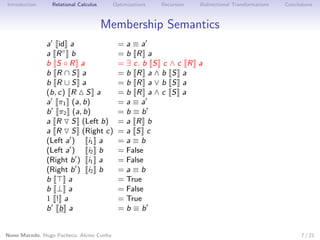
a id a
a R◦ b
b S ◦R a
b R ∩S a
b R ∪S a
(b, c) R S a
a π1 (a, b)
b π2 (a, b)
a R S (Left b)
a R S (Right c)
(Left a )
i1 a
(Left a )
i2 b
(Right b ) i1 a
(Right b ) i2 b
b
a
b ⊥ a
1 ! a
b b a

Nuno Macedo, Hugo Pacheco, Alcino Cunha

=a≡a
=b R a
= ∃ c. b S c
=b R a∧b
=b R a∨b
=b R a∧c
=a≡a
=b≡b
=a R b
=a S c
=a≡b
= False
= False
=a≡b
= True
= False
= True
=b≡b

∧c R a
S a
S a
S a

7 / 21
Introduction

Relational Calculus

Optimizations

Recursion

Bidirectional Transformations

Conclusions

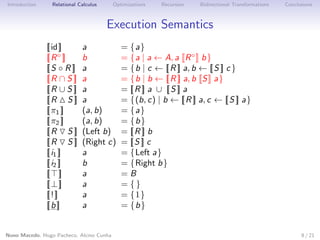
Execution Semantics
| id |
| R◦ |
|S ◦R|
|R ∩S|
|R ∪S|
|R S|
| π1 |
| π2 |
|R S|
|R S|
| i1 |
| i2 |
| |
|⊥|
|!|
|b|

a
b
a
a
a
a
(a, b)
(a, b)
(Left b)
(Right c)
a
b
a
a
a
a

Nuno Macedo, Hugo Pacheco, Alcino Cunha

= {a}
= {a | a ← A, a R ◦ b }
= {b | c ← | R | a, b ← | S | c }
= {b | b ← | R | a, b S a}
= |R| a ∪ |S| a
= {(b, c) | b ← | R | a, c ← | S | a}
= {a}
= {b }
= |R| b
= |S| c
= {Left a}
= {Right b }
=B
= {}
= {1}
= {b }
8 / 21
Introduction

Relational Calculus

Optimizations

Recursion

Bidirectional Transformations

Conclusions

Predicates as Coreflexives

• Domain δR and range ρR are predicates that can be defined

as coreflexives;

• Coreflexives Φ : A → A are relations smaller than the identity;
• If a satisfies the predicate Φ then a Φ a;

• For pairs A × B related by R : A → B, the invariant is lifted as

[R] : A × B → A × B;

• Invariants on coproducts are simply the coproduct Φ + Ψ;
• R : Φ → Ψ denotes δR = Φ and ρR = Ψ.

Nuno Macedo, Hugo Pacheco, Alcino Cunha

9 / 21
Introduction

Relational Calculus

Optimizations

Recursion

Bidirectional Transformations

Conclusions

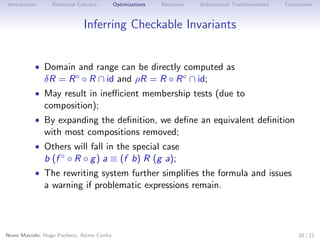
Inferring Checkable Invariants

• Domain and range can be directly computed as

δR = R ◦ ◦ R ∩ id and ρR = R ◦ R ◦ ∩ id;

• May result in inefficient membership tests (due to

composition);

• By expanding the definition, we define an equivalent definition

with most compositions removed;

• Others will fall in the special case

b (f ◦ ◦ R ◦ g ) a ≡ (f b) R (g a);

• The rewriting system further simplifies the formula and issues

a warning if problematic expressions remain.

Nuno Macedo, Hugo Pacheco, Alcino Cunha

10 / 21
Introduction

Relational Calculus

Optimizations

Recursion

Bidirectional Transformations

Conclusions

Example
(id

id)◦ ◦ (head◦

length◦ ) : Nat → [Nat]

ρ((id id)◦ ◦ (head◦ length◦ ))
={Range definition}
ρ((id id)◦ ◦ ρ(head◦ length◦ ))
={Range definition}
ρ((id id)◦ ◦ [length◦ ◦ head])
={Range definition}
δ([length◦ ◦ head] ◦ (id id))
={Domain definition, Simplifications : PF Laws}
(head◦ ◦ length) ∩ id

(id id)◦ ◦(length◦ head◦ ):inN ◦(⊥+id)◦outN → (head◦ ◦length)∩id

Nuno Macedo, Hugo Pacheco, Alcino Cunha

11 / 21
Introduction

Relational Calculus

Optimizations

Recursion

Bidirectional Transformations

Conclusions

Optimizing Non-deterministic Executions

• After determining the domain and range, they can be

propagated down to primitives,

• This reduces the generation of irrelevant intermediate values;
| id : Φ → Ψ | a = | Ψ | a

| π1 : [U ] → Ψ | (a, b) = | Ψ | a

| R ◦ S : Φ → Ψ | a = {b | c ← | S : Φ → δR | a,
b ← | R : ρS → Ψ | c }

| R ∩ S : Φ → Ψ | a = {b | b ← | R : Φ ∩ δS → ρ(Ψ ◦ S ◦ a) | a}

Nuno Macedo, Hugo Pacheco, Alcino Cunha

12 / 21
Introduction

Relational Calculus

Optimizations

Recursion

Bidirectional Transformations

Conclusions

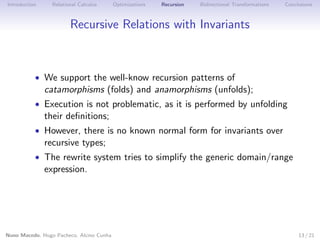
Recursive Relations with Invariants

• We support the well-know recursion patterns of

catamorphisms (folds) and anamorphisms (unfolds);

• Execution is not problematic, as it is performed by unfolding

their definitions;

• However, there is no known normal form for invariants over

recursive types;

• The rewrite system tries to simplify the generic domain/range

expression.

Nuno Macedo, Hugo Pacheco, Alcino Cunha

13 / 21
Introduction

Relational Calculus

Optimizations

Recursion

Bidirectional Transformations

Conclusions

Recursive Relations: Example
unzip : [A × B ] → [A] × [B ]
ρunzip
={Range definition}
(unzip ◦ unzip◦ ) ∩ id
={Simplifications : unzip is functional, Liftify : range of unzip is a product}
◦
[π2 ◦ unzip ◦ unzip◦ ◦ π1 ]
={Catamorphism fusion : π1 ◦ g = nil (cons ◦ (π1 × id)) ◦ F π1 }
[(
|nil (cons ◦ (π1 × id))| ◦ (
) |nil (cons ◦ (π2 × id))| ◦ ]
)
={Definitions : map}
[(map π1 ) ◦ (map π2 )◦ ]
={Simplifications : map converse, map fusion (see below )}
◦
[map (π1 ◦ π2 )]
={Simplifications : PF Laws}
[map ]

unzip : id → [map
Nuno Macedo, Hugo Pacheco, Alcino Cunha

]

14 / 21
Introduction

Relational Calculus

Optimizations

Recursion

Bidirectional Transformations

Conclusions

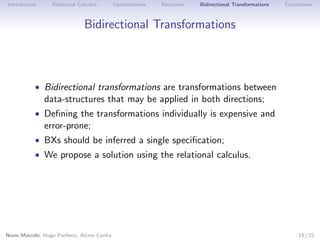
Bidirectional Transformations

• Bidirectional transformations are transformations between

data-structures that may be applied in both directions;

• Defining the transformations individually is expensive and

error-prone;

• BXs should be inferred a single specification;

• We propose a solution using the relational calculus.

Nuno Macedo, Hugo Pacheco, Alcino Cunha

15 / 21
Introduction

Relational Calculus

Optimizations

Recursion

Bidirectional Transformations

Conclusions

Bidirectional Transformations

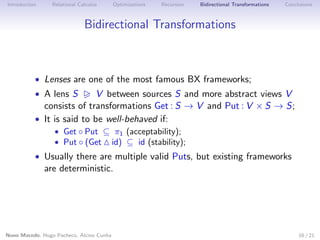
• Lenses are one of the most famous BX frameworks;
• A lens S

V between sources S and more abstract views V
consists of transformations Get : S → V and Put : V × S → S;
• It is said to be well-behaved if:
• Get ◦ Put ⊆ π1 (acceptability);
• Put ◦ (Get id) ⊆ id (stability);

• Usually there are multiple valid Puts, but existing frameworks

are deterministic.

Nuno Macedo, Hugo Pacheco, Alcino Cunha

16 / 21
Introduction

Relational Calculus

Optimizations

Recursion

Bidirectional Transformations

Conclusions

Bidirectional Transformations
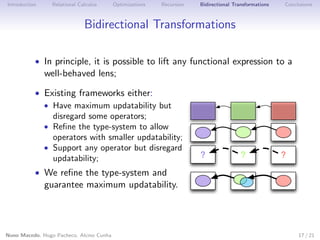
• In principle, it is possible to lift any functional expression to a

well-behaved lens;

• Existing frameworks either:
• Have maximum updatability but
disregard some operators;
• Refine the type-system to allow
operators with smaller updatability;
• Support any operator but disregard
updatability;

?

?

?

• We refine the type-system and

guarantee maximum updatability.

Nuno Macedo, Hugo Pacheco, Alcino Cunha

17 / 21
Introduction

Relational Calculus

Optimizations

Recursion

Bidirectional Transformations

Conclusions

Generic Non-deterministic Lenses
• Using relational calculus we can define a generic Put that is

the largest relation that satisfies the properties;

• A transformation get : A → B can be lifted to a well-behaved

non-deterministic lens get : δget
Put = (π2

ρget, with

(get◦ ◦ π1 )) ◦ [get◦ ] ?

• Emerges naturally from the lens laws:
• [get◦ ] ? (v , s) tests if v was changed, returning either the
original s (acceptability), or any source s such that s = get v
(stability);
• Maximum updatability: δPut = ρget × δget.

Nuno Macedo, Hugo Pacheco, Alcino Cunha

18 / 21
Introduction

Relational Calculus

Optimizations

Recursion

Bidirectional Transformations

Conclusions

Generic Non-deterministic Lenses
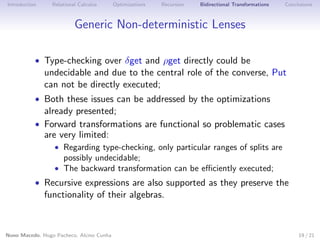
• Type-checking over δget and ρget directly could be

undecidable and due to the central role of the converse, Put
can not be directly executed;

• Both these issues can be addressed by the optimizations

already presented;

• Forward transformations are functional so problematic cases

are very limited:

• Regarding type-checking, only particular ranges of splits are

possibly undecidable;
• The backward transformation can be efficiently executed;

• Recursive expressions are also supported as they preserve the

functionality of their algebras.

Nuno Macedo, Hugo Pacheco, Alcino Cunha

19 / 21
Introduction

Relational Calculus

Optimizations

Recursion

Bidirectional Transformations

Conclusions

Generic Non-deterministic Lenses: Example

π1

id : id

◦
[π1 ]

◦
• The range is [π1 ] : A × (A × B) → A × (A × B), so Put only

takes views (a, (b, c)) where a ≡ b;

◦
id)◦ will run, and π1 could
generate all pairs until reaching (a, c);

• When the view is updated, (π1

• With our optimization, the output of π1 is restricted to have c

in the second element.

Nuno Macedo, Hugo Pacheco, Alcino Cunha

20 / 21
Introduction

Relational Calculus

Optimizations

Recursion

Bidirectional Transformations

Conclusions

Conclusions
• We have presented mechanisms for the efficient execution PF
relational expressions over data-types with invariants;
• Regarding BX, we identify an open problem in the
composition of lenses;
• By modeling lenses in this framework we were able to
implement an expressive PF BX language with maximum
updatability;
• Researching possible normal forms for invariants over recursive
types;
• Exploring mechanisms for a better control of the
non-determinism through user-defined quality measures.

Nuno Macedo, Hugo Pacheco, Alcino Cunha

21 / 21

Relations as Executable Specifications

  • 1.
    Relations as ExecutableSpecifications Taming Partiality and Non-determinism Using Invariants Nuno Macedo Hugo Pacheco Alcino Cunha HASLab — High Assurance Software Laboratory INESC TEC & Universidade do Minho, Braga, Portugal RAMiCS 13 September 20, 2012, Cambridge
  • 2.
    Introduction Relational Calculus Optimizations Recursion Bidirectional Transformations Conclusions Introduction •Relational calculus provides a more natural way to specify programs; • Many programs are partial and non-deterministic; • A point-free (PF) version has been used in a variety of computer science areas; • Such specifications are not amenable for execution. Nuno Macedo, Hugo Pacheco, Alcino Cunha 2 / 21
  • 3.
    Introduction Relational Calculus Optimizations Recursion Bidirectional Transformations Conclusions MotivatingExample (id id)◦ ◦ (head◦ length◦ ) : Nat → [Nat] • Calculates a list with length n and the same n at its head; • Not total nor functional; • Very inefficient given a naive semantics; • head◦ could be generating all lists by increasing length and never reach n. (id4id) (id4id) Nuno Macedo, Hugo Pacheco, Alcino Cunha head 4length (head 4length ) 3 / 21
  • 4.
    Introduction Relational Calculus Optimizations Recursion Bidirectional Transformations Conclusions MotivatingExample • We can predict the behavior of partial expressions by calculating the exact domain and range; • They can also be used to narrow non-deterministic executions. ●{(l, l0 ) 2 [Nat] ⇥ [Nat]|head l = length l0 ^ l = l0 } (id4id) ●{l 2 [Nat]|head l = length l} Nuno Macedo, Hugo Pacheco, Alcino Cunha (id4id) head 4length (head 4length ) ●{n 2 Nat|n 6= 0} 4 / 21
  • 5.
    Introduction Relational Calculus Optimizations Recursion Bidirectional Transformations Conclusions TamingPartiality and Non-determinism • We propose a PF relational framework where data-types are enhanced with invariants; • The simplicity of the PF calculus allows us to develop practical type-inference and type-checking algorithms; • Those invariants can then used to run the specifications more efficiently; • Bidirectional transformations are our application scenario. Nuno Macedo, Hugo Pacheco, Alcino Cunha 5 / 21
  • 6.
    Introduction Relational Calculus Optimizations Recursion Bidirectional Transformations Conclusions PFRelational Calculus Identity Top Bottom Converse Composition Intersection Union Split Projections Either Injections Constants Conditional id : A → A :A→B ⊥:A→B ·◦ : (A → B) → (B → A) · ◦ · : (B → C ) → (A → B) → (A → C ) · ∩ · : (A → B) → (A → B) → (A → B) · ∪ · : (A → B) → (A → B) → (A → B) · · : (A → B) → (A → C ) → (A → B × C ) π1 : A × B → A and π2 : A × B → B · · : (B → A) → (C → A) → (B + C → A) i1 : A → (A + B) and i2 : B → (A + B) ! : A → 1 and · : B → (A → B) · ? :(A → A) → (A → A + A) • The simple equational rules are harnessed in a strategic rewrite system that simplifies expressions. Nuno Macedo, Hugo Pacheco, Alcino Cunha 6 / 21
  • 7.
    Introduction Relational Calculus Optimizations Recursion Bidirectional Transformations Conclusions MembershipSemantics a id a a R◦ b b S ◦R a b R ∩S a b R ∪S a (b, c) R S a a π1 (a, b) b π2 (a, b) a R S (Left b) a R S (Right c) (Left a ) i1 a (Left a ) i2 b (Right b ) i1 a (Right b ) i2 b b a b ⊥ a 1 ! a b b a Nuno Macedo, Hugo Pacheco, Alcino Cunha =a≡a =b R a = ∃ c. b S c =b R a∧b =b R a∨b =b R a∧c =a≡a =b≡b =a R b =a S c =a≡b = False = False =a≡b = True = False = True =b≡b ∧c R a S a S a S a 7 / 21
  • 8.
    Introduction Relational Calculus Optimizations Recursion Bidirectional Transformations Conclusions ExecutionSemantics | id | | R◦ | |S ◦R| |R ∩S| |R ∪S| |R S| | π1 | | π2 | |R S| |R S| | i1 | | i2 | | | |⊥| |!| |b| a b a a a a (a, b) (a, b) (Left b) (Right c) a b a a a a Nuno Macedo, Hugo Pacheco, Alcino Cunha = {a} = {a | a ← A, a R ◦ b } = {b | c ← | R | a, b ← | S | c } = {b | b ← | R | a, b S a} = |R| a ∪ |S| a = {(b, c) | b ← | R | a, c ← | S | a} = {a} = {b } = |R| b = |S| c = {Left a} = {Right b } =B = {} = {1} = {b } 8 / 21
  • 9.
    Introduction Relational Calculus Optimizations Recursion Bidirectional Transformations Conclusions Predicatesas Coreflexives • Domain δR and range ρR are predicates that can be defined as coreflexives; • Coreflexives Φ : A → A are relations smaller than the identity; • If a satisfies the predicate Φ then a Φ a; • For pairs A × B related by R : A → B, the invariant is lifted as [R] : A × B → A × B; • Invariants on coproducts are simply the coproduct Φ + Ψ; • R : Φ → Ψ denotes δR = Φ and ρR = Ψ. Nuno Macedo, Hugo Pacheco, Alcino Cunha 9 / 21
  • 10.
    Introduction Relational Calculus Optimizations Recursion Bidirectional Transformations Conclusions InferringCheckable Invariants • Domain and range can be directly computed as δR = R ◦ ◦ R ∩ id and ρR = R ◦ R ◦ ∩ id; • May result in inefficient membership tests (due to composition); • By expanding the definition, we define an equivalent definition with most compositions removed; • Others will fall in the special case b (f ◦ ◦ R ◦ g ) a ≡ (f b) R (g a); • The rewriting system further simplifies the formula and issues a warning if problematic expressions remain. Nuno Macedo, Hugo Pacheco, Alcino Cunha 10 / 21
  • 11.
    Introduction Relational Calculus Optimizations Recursion Bidirectional Transformations Conclusions Example (id id)◦◦ (head◦ length◦ ) : Nat → [Nat] ρ((id id)◦ ◦ (head◦ length◦ )) ={Range definition} ρ((id id)◦ ◦ ρ(head◦ length◦ )) ={Range definition} ρ((id id)◦ ◦ [length◦ ◦ head]) ={Range definition} δ([length◦ ◦ head] ◦ (id id)) ={Domain definition, Simplifications : PF Laws} (head◦ ◦ length) ∩ id (id id)◦ ◦(length◦ head◦ ):inN ◦(⊥+id)◦outN → (head◦ ◦length)∩id Nuno Macedo, Hugo Pacheco, Alcino Cunha 11 / 21
  • 12.
    Introduction Relational Calculus Optimizations Recursion Bidirectional Transformations Conclusions OptimizingNon-deterministic Executions • After determining the domain and range, they can be propagated down to primitives, • This reduces the generation of irrelevant intermediate values; | id : Φ → Ψ | a = | Ψ | a | π1 : [U ] → Ψ | (a, b) = | Ψ | a | R ◦ S : Φ → Ψ | a = {b | c ← | S : Φ → δR | a, b ← | R : ρS → Ψ | c } | R ∩ S : Φ → Ψ | a = {b | b ← | R : Φ ∩ δS → ρ(Ψ ◦ S ◦ a) | a} Nuno Macedo, Hugo Pacheco, Alcino Cunha 12 / 21
  • 13.
    Introduction Relational Calculus Optimizations Recursion Bidirectional Transformations Conclusions RecursiveRelations with Invariants • We support the well-know recursion patterns of catamorphisms (folds) and anamorphisms (unfolds); • Execution is not problematic, as it is performed by unfolding their definitions; • However, there is no known normal form for invariants over recursive types; • The rewrite system tries to simplify the generic domain/range expression. Nuno Macedo, Hugo Pacheco, Alcino Cunha 13 / 21
  • 14.
    Introduction Relational Calculus Optimizations Recursion Bidirectional Transformations Conclusions RecursiveRelations: Example unzip : [A × B ] → [A] × [B ] ρunzip ={Range definition} (unzip ◦ unzip◦ ) ∩ id ={Simplifications : unzip is functional, Liftify : range of unzip is a product} ◦ [π2 ◦ unzip ◦ unzip◦ ◦ π1 ] ={Catamorphism fusion : π1 ◦ g = nil (cons ◦ (π1 × id)) ◦ F π1 } [( |nil (cons ◦ (π1 × id))| ◦ ( ) |nil (cons ◦ (π2 × id))| ◦ ] ) ={Definitions : map} [(map π1 ) ◦ (map π2 )◦ ] ={Simplifications : map converse, map fusion (see below )} ◦ [map (π1 ◦ π2 )] ={Simplifications : PF Laws} [map ] unzip : id → [map Nuno Macedo, Hugo Pacheco, Alcino Cunha ] 14 / 21
  • 15.
    Introduction Relational Calculus Optimizations Recursion Bidirectional Transformations Conclusions BidirectionalTransformations • Bidirectional transformations are transformations between data-structures that may be applied in both directions; • Defining the transformations individually is expensive and error-prone; • BXs should be inferred a single specification; • We propose a solution using the relational calculus. Nuno Macedo, Hugo Pacheco, Alcino Cunha 15 / 21
  • 16.
    Introduction Relational Calculus Optimizations Recursion Bidirectional Transformations Conclusions BidirectionalTransformations • Lenses are one of the most famous BX frameworks; • A lens S V between sources S and more abstract views V consists of transformations Get : S → V and Put : V × S → S; • It is said to be well-behaved if: • Get ◦ Put ⊆ π1 (acceptability); • Put ◦ (Get id) ⊆ id (stability); • Usually there are multiple valid Puts, but existing frameworks are deterministic. Nuno Macedo, Hugo Pacheco, Alcino Cunha 16 / 21
  • 17.
    Introduction Relational Calculus Optimizations Recursion Bidirectional Transformations Conclusions BidirectionalTransformations • In principle, it is possible to lift any functional expression to a well-behaved lens; • Existing frameworks either: • Have maximum updatability but disregard some operators; • Refine the type-system to allow operators with smaller updatability; • Support any operator but disregard updatability; ? ? ? • We refine the type-system and guarantee maximum updatability. Nuno Macedo, Hugo Pacheco, Alcino Cunha 17 / 21
  • 18.
    Introduction Relational Calculus Optimizations Recursion Bidirectional Transformations Conclusions GenericNon-deterministic Lenses • Using relational calculus we can define a generic Put that is the largest relation that satisfies the properties; • A transformation get : A → B can be lifted to a well-behaved non-deterministic lens get : δget Put = (π2 ρget, with (get◦ ◦ π1 )) ◦ [get◦ ] ? • Emerges naturally from the lens laws: • [get◦ ] ? (v , s) tests if v was changed, returning either the original s (acceptability), or any source s such that s = get v (stability); • Maximum updatability: δPut = ρget × δget. Nuno Macedo, Hugo Pacheco, Alcino Cunha 18 / 21
  • 19.
    Introduction Relational Calculus Optimizations Recursion Bidirectional Transformations Conclusions GenericNon-deterministic Lenses • Type-checking over δget and ρget directly could be undecidable and due to the central role of the converse, Put can not be directly executed; • Both these issues can be addressed by the optimizations already presented; • Forward transformations are functional so problematic cases are very limited: • Regarding type-checking, only particular ranges of splits are possibly undecidable; • The backward transformation can be efficiently executed; • Recursive expressions are also supported as they preserve the functionality of their algebras. Nuno Macedo, Hugo Pacheco, Alcino Cunha 19 / 21
  • 20.
    Introduction Relational Calculus Optimizations Recursion Bidirectional Transformations Conclusions GenericNon-deterministic Lenses: Example π1 id : id ◦ [π1 ] ◦ • The range is [π1 ] : A × (A × B) → A × (A × B), so Put only takes views (a, (b, c)) where a ≡ b; ◦ id)◦ will run, and π1 could generate all pairs until reaching (a, c); • When the view is updated, (π1 • With our optimization, the output of π1 is restricted to have c in the second element. Nuno Macedo, Hugo Pacheco, Alcino Cunha 20 / 21
  • 21.
    Introduction Relational Calculus Optimizations Recursion Bidirectional Transformations Conclusions Conclusions •We have presented mechanisms for the efficient execution PF relational expressions over data-types with invariants; • Regarding BX, we identify an open problem in the composition of lenses; • By modeling lenses in this framework we were able to implement an expressive PF BX language with maximum updatability; • Researching possible normal forms for invariants over recursive types; • Exploring mechanisms for a better control of the non-determinism through user-defined quality measures. Nuno Macedo, Hugo Pacheco, Alcino Cunha 21 / 21