4/7/14	
  
1	
  
Understanding NonfictionText
Complexity:	

The Intersection of 	

Text Complexity and Skills	


[handouts available on my website under “Odds&Ends”]	

Jennifer Serravallo	

www.jenniferserravallo.com	

@jserravallo	

Name some of your favorite
nonfiction children’s book
authors….	

50/50  by  Grade  4!	
	
	
Teachers  Need  to  Learn:	
CCSS  ELA  Reading  Informational  Standards  1-­‐‑9=  	


COMPREHENSION
Standard  2:	
“Determine  the  main  idea  
of  a  text  and  explain  how  
it  is  supported  by  key  
details…”	
CCSS  ELA  Reading  Informational  
Standards  1-­‐‑9=  	


COMPREHENSION
The  Status  Quo:	
	
T:  “What’s  that?”	
  
S:  “A  caption!”	
  
T:  “Great!”	
CCSS  ELA  Reading  Informational  Standards  1-­‐‑9=  	


COMPREHENSION
The  Status  Quo:	
	
T:  “You  can  dip  
in  and  out  of  
nonfiction  texts.  
Just  look  for  the  
info  you  want.”	
Nonfiction reading can’t just be Time for Kids…	

“The  average  
student  spends  
just  3.6  min  per  
day  reading  
informational  
texts.  Less  if  the  
student  is  in  a  
low-­‐‑income  
area.”  (Duke,  2000)  	
These  are  
REAL  
BOOKS  and  
are  WHOLE  
TEXTS!	
From  CCSS  Appendix  B:
4/7/14	
  
2	
  
4/7/14	
  
3	
  
How was the experience
comprehending the two
texts different?	


How do responses change
based on the level of the
text?	

Text  Complexity	
CCSS  Premise:  “…the  clearest  differentiator  
was  students’  ability  to  answer  questions  
associated  with  complex  texts.”  	
	
“Text  complexity  is  the  new  black.”  	
–  Fisher,  Frey  and  Lapp,  2012	
Standard  10:  Text  Complexity	
Text  Complexity:  
Nonfiction	
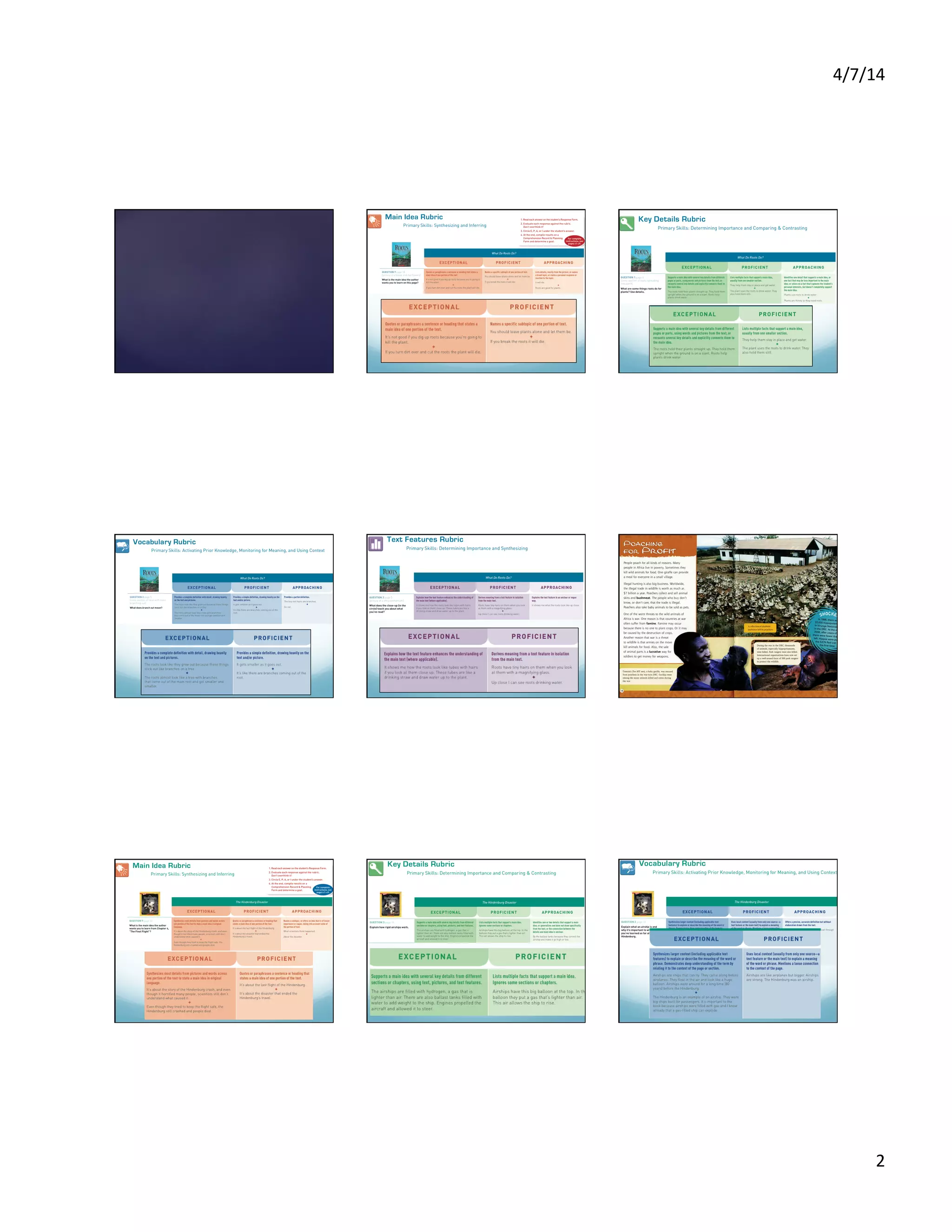
Main  Idea 	
	
Ñ Determining  main  idea  of  a  
part  of  a  text  (chapter,  
section)	
Ñ Determining  main  idea  of  a  
whole  text  	
RI  3.2,  4.2,  5.2  	
Main  Idea	
•  Look  back  across  this  chapter/
section/page.  What  is  this  
mostly  about?	
•  What  is  the  most  important  idea  
the  author  wants  you  to  learn  
from  this  section?	
•  What  is  the  most  important  
main  idea  you  learned  from  
reading  this  whole  book?
4/7/14	
  
4	
  
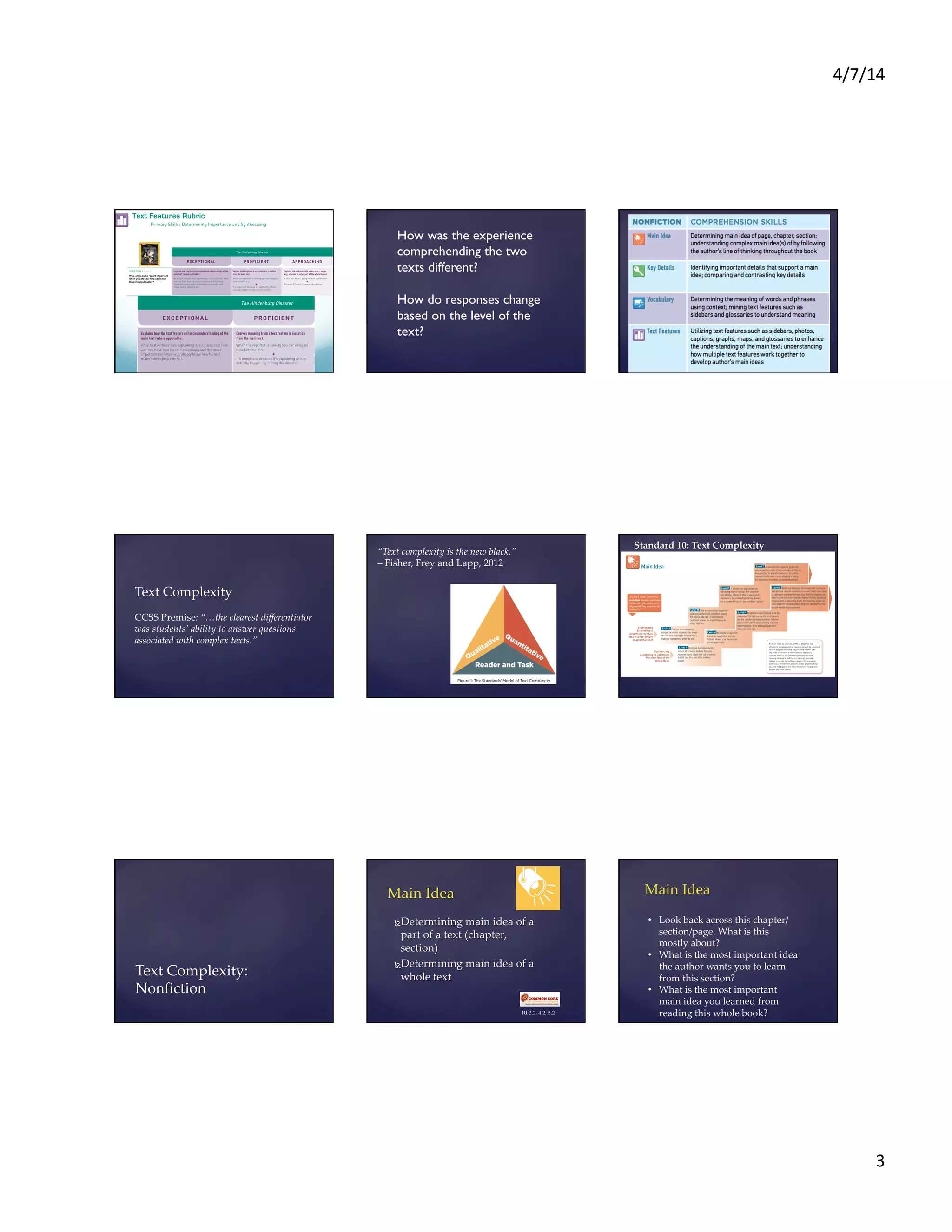
Key  Details	
Ñ Determining  key  details  
that  support  a  main  idea	
Ñ Comparing  and  contrasting  
key  details	
RI  3.2,4.2,  5.2;  3.3,  4.3,  
5.3;  3.8,  4.8,  5.8	
Key  Details	
•  Which  details  support  the  idea  that  
________?	
•  The  author  claims  _______.  Which  
details  from  this  section  support  
that  idea?	
•    	
•  What  is  similar  about  ____  and  
____?  What  is  different?	
•  Compare  and  contrast  _____  and  
______.	
	
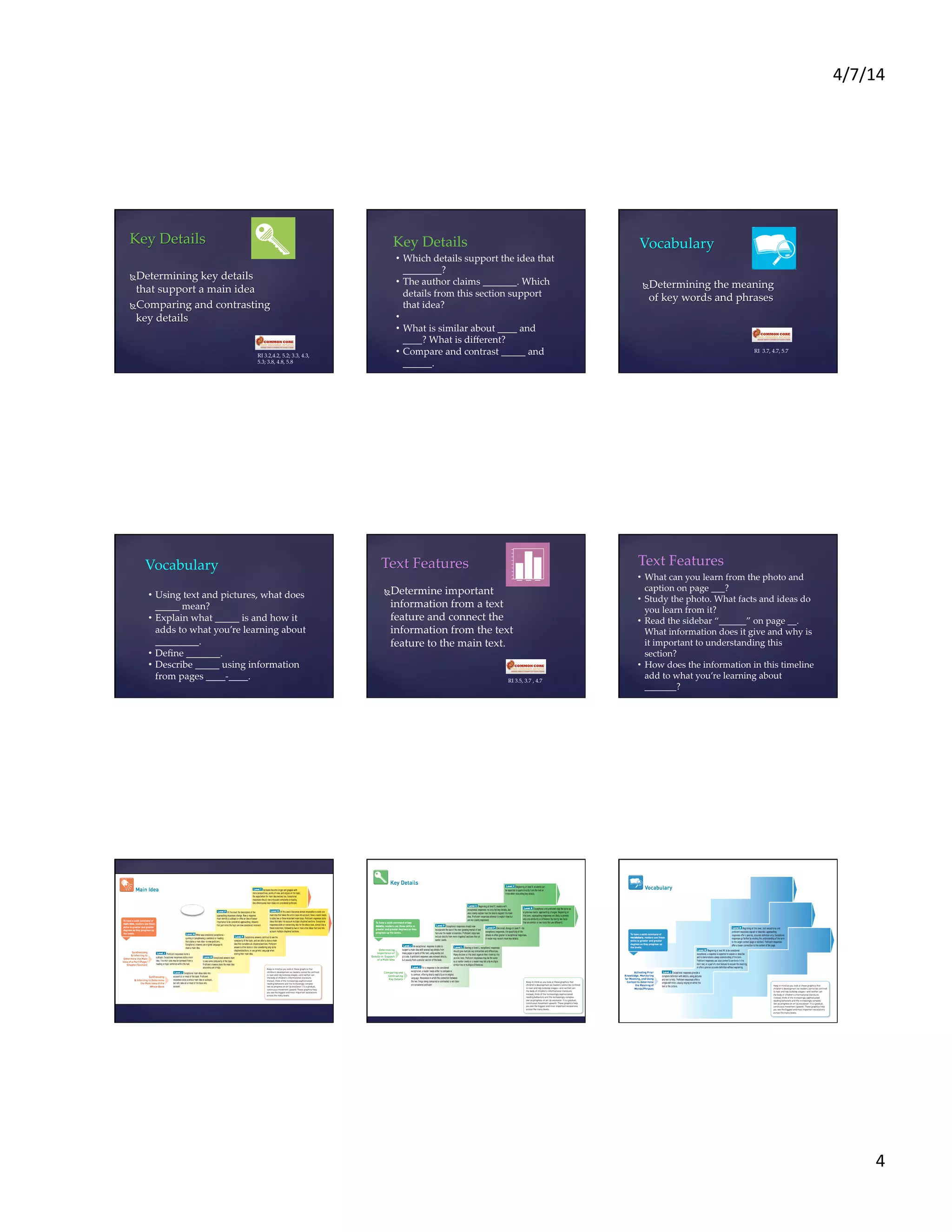
Vocabulary	
Ñ Determining  the  meaning  
of  key  words  and  phrases	
RI    3.7,  4.7,  5.7	
Vocabulary	
•  Using  text  and  pictures,  what  does  
_____  mean?	
•  Explain  what  _____  is  and  how  it  
adds  to  what  you’re  learning  about  
_________.	
•  Define  _______.	
•  Describe  _____  using  information  
from  pages  ____-­‐‑____.	
	
    
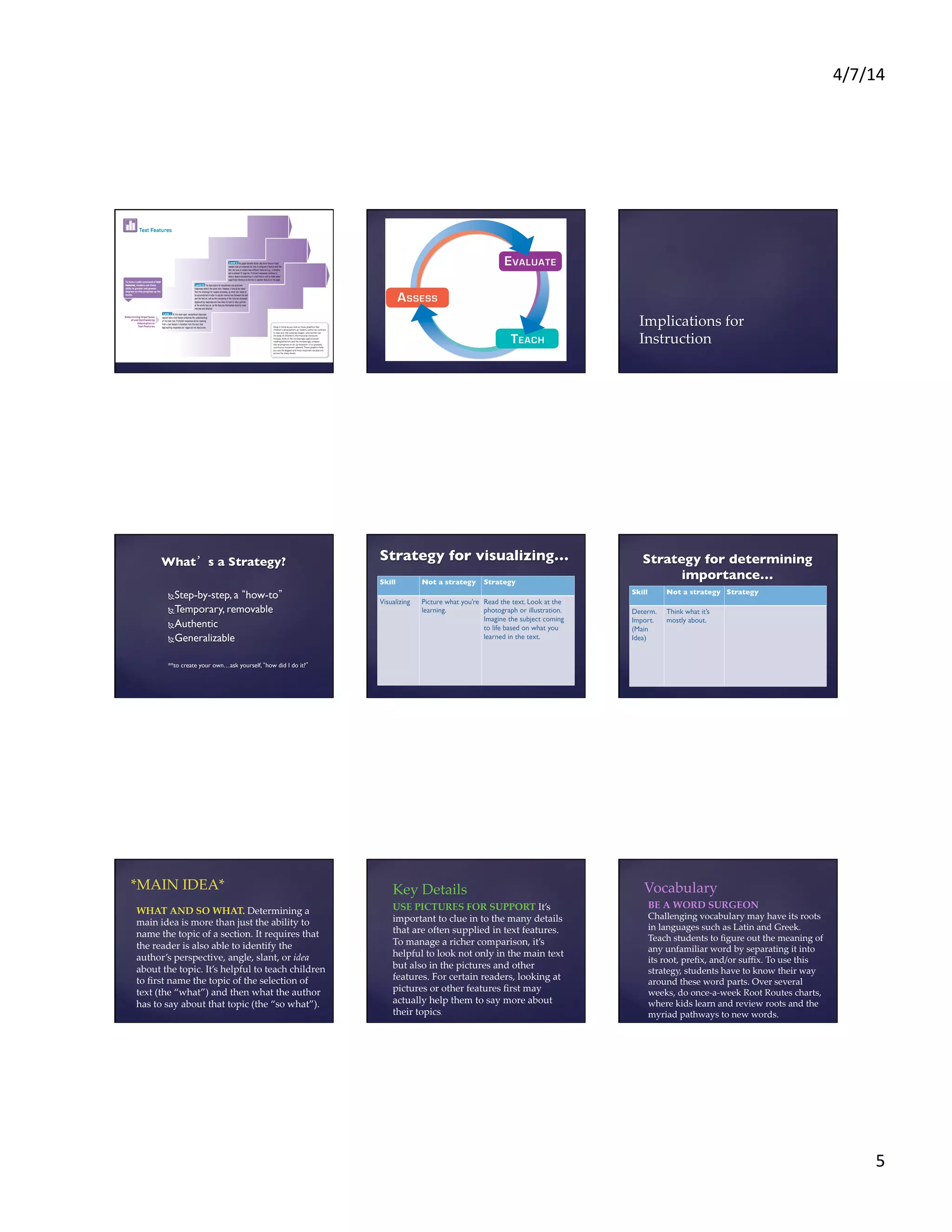
Text  Features	
Ñ Determine  important  
information  from  a  text  
feature  and  connect  the  
information  from  the  text  
feature  to  the  main  text.	
RI  3.5,  3.7  ,  4.7	
Text  Features	
•  What  can  you  learn  from  the  photo  and  
caption  on  page  ___?	
•  Study  the  photo.  What  facts  and  ideas  do  
you  learn  from  it?	
•  Read  the  sidebar  “______”  on  page  __.  
What  information  does  it  give  and  why  is  
it  important  to  understanding  this  
section?	
•  How  does  the  information  in  this  timeline  
add  to  what  you’re  learning  about  
_______?  
4/7/14	
  
5	
  
Implications  for  
Instruction	
Ñ Step-by-step, a how-to 	

Ñ Temporary, removable	

Ñ Authentic	

Ñ Generalizable	


**to create your own…ask yourself, how did I do it? 	

What’s a Strategy?	

Skill	

 Not a strategy	


Strategy	


Visualizing	


Picture what you’re
learning.	


Read the text. Look at the
photograph or illustration.
Imagine the subject coming
to life based on what you
learned in the text.	

Strategy for visualizing…	

Skill	

 Not a strategy	


Strategy	


Determ.
Import.
(Main
Idea)	


Think what it’s
mostly about.	


Strategy for determining
importance…	

*MAIN  IDEA*	
WHAT  AND  SO  WHAT.  Determining  a  
main  idea  is  more  than  just  the  ability  to  
name  the  topic  of  a  section.  It  requires  that  
the  reader  is  also  able  to  identify  the  
author’s  perspective,  angle,  slant,  or  idea  
about  the  topic.  It’s  helpful  to  teach  children  
to  first  name  the  topic  of  the  selection  of  
text  (the  “what”)  and  then  what  the  author  
has  to  say  about  that  topic  (the  “so  what”).  	
Key  Details	
	
USE  PICTURES  FOR  SUPPORT  It’s  
important  to  clue  in  to  the  many  details  
that  are  often  supplied  in  text  features.  
To  manage  a  richer  comparison,  it’s  
helpful  to  look  not  only  in  the  main  text  
but  also  in  the  pictures  and  other  
features.  For  certain  readers,  looking  at  
pictures  or  other  features  first  may  
actually  help  them  to  say  more  about  
their  topics.  	
	
Vocabulary	
BE  A  WORD  SURGEON	
Challenging  vocabulary  may  have  its  roots  
in  languages  such  as  Latin  and  Greek.  
Teach  students  to  figure  out  the  meaning  of  
any  unfamiliar  word  by  separating  it  into  
its  root,  prefix,  and/or  suffix.  To  use  this  
strategy,  students  have  to  know  their  way  
around  these  word  parts.  Over  several  
weeks,  do  once-­‐‑a-­‐‑week  Root  Routes  charts,  
where  kids  learn  and  review  roots  and  the  
myriad  pathways  to  new  words.  
4/7/14	
  
6	
  
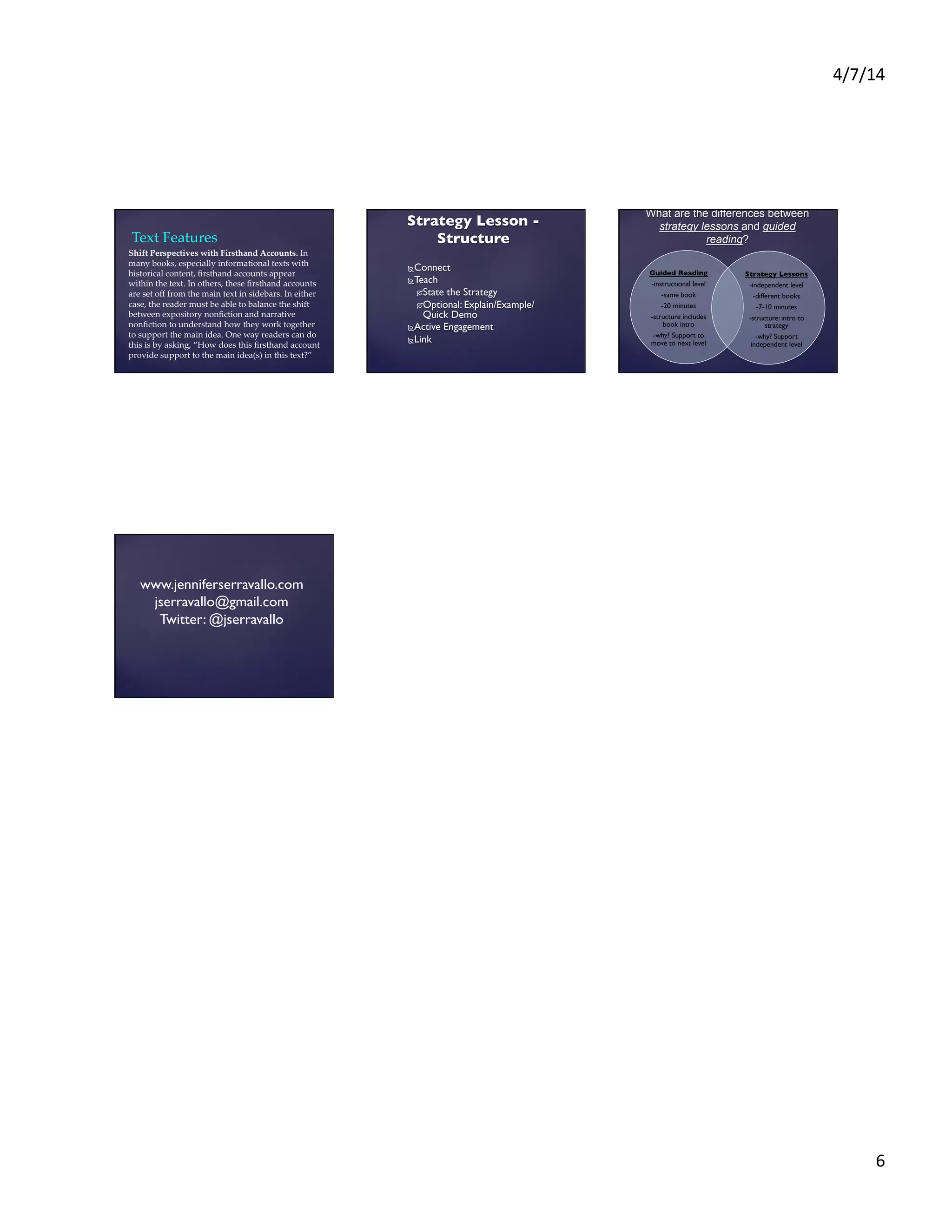
Shift  Perspectives  with  Firsthand  Accounts.  In  
many  books,  especially  informational  texts  with  
historical  content,  firsthand  accounts  appear  
within  the  text.  In  others,  these  firsthand  accounts  
are  set  off  from  the  main  text  in  sidebars.  In  either  
case,  the  reader  must  be  able  to  balance  the  shift  
between  expository  nonfiction  and  narrative  
nonfiction  to  understand  how  they  work  together  
to  support  the  main  idea.  One  way  readers  can  do  
this  is  by  asking,  “How  does  this  firsthand  account  
provide  support  to  the  main  idea(s)  in  this  text?”  	
	
Text  Features	
Ñ Connect	

Ñ Teach 	

Ó State the Strategy	

Ó Optional: Explain/Example/
Quick Demo	

Ñ Active Engagement	

Ñ Link	

Strategy Lesson -
Structure	


Guided Reading	

-instructional level	

-same book	

-20 minutes	

-structure includes
book intro	

-why? Support to
move to next level	


Strategy Lessons	

-independent level	

-different books	

-7-10 minutes	

-structure: intro to
strategy	

-why? Support
independent level	

	
What are the differences between
strategy lessons and guided
reading?
www.jenniferserravallo.com	

jserravallo@gmail.com	

Twitter: @jserravallo

SoMIRAC nf text complexity

  • 1.
    4/7/14   1   UnderstandingNonfictionText Complexity: The Intersection of Text Complexity and Skills [handouts available on my website under “Odds&Ends”] Jennifer Serravallo www.jenniferserravallo.com @jserravallo Name some of your favorite nonfiction children’s book authors…. 50/50  by  Grade  4! Teachers  Need  to  Learn: CCSS  ELA  Reading  Informational  Standards  1-­‐‑9=   COMPREHENSION Standard  2: “Determine  the  main  idea   of  a  text  and  explain  how   it  is  supported  by  key   details…” CCSS  ELA  Reading  Informational   Standards  1-­‐‑9=   COMPREHENSION The  Status  Quo: T:  “What’s  that?”   S:  “A  caption!”   T:  “Great!” CCSS  ELA  Reading  Informational  Standards  1-­‐‑9=   COMPREHENSION The  Status  Quo: T:  “You  can  dip   in  and  out  of   nonfiction  texts.   Just  look  for  the   info  you  want.” Nonfiction reading can’t just be Time for Kids… “The  average   student  spends   just  3.6  min  per   day  reading   informational   texts.  Less  if  the   student  is  in  a   low-­‐‑income   area.”  (Duke,  2000)   These  are   REAL   BOOKS  and   are  WHOLE   TEXTS! From  CCSS  Appendix  B:
  • 2.
  • 3.
    4/7/14   3   Howwas the experience comprehending the two texts different? How do responses change based on the level of the text? Text  Complexity CCSS  Premise:  “…the  clearest  differentiator   was  students’  ability  to  answer  questions   associated  with  complex  texts.”   “Text  complexity  is  the  new  black.”   –  Fisher,  Frey  and  Lapp,  2012 Standard  10:  Text  Complexity Text  Complexity:   Nonfiction Main  Idea Ñ Determining  main  idea  of  a   part  of  a  text  (chapter,   section) Ñ Determining  main  idea  of  a   whole  text   RI  3.2,  4.2,  5.2   Main  Idea •  Look  back  across  this  chapter/ section/page.  What  is  this   mostly  about? •  What  is  the  most  important  idea   the  author  wants  you  to  learn   from  this  section? •  What  is  the  most  important   main  idea  you  learned  from   reading  this  whole  book?
  • 4.
    4/7/14   4   Key Details Ñ Determining  key  details   that  support  a  main  idea Ñ Comparing  and  contrasting   key  details RI  3.2,4.2,  5.2;  3.3,  4.3,   5.3;  3.8,  4.8,  5.8 Key  Details •  Which  details  support  the  idea  that   ________? •  The  author  claims  _______.  Which   details  from  this  section  support   that  idea? •    •  What  is  similar  about  ____  and   ____?  What  is  different? •  Compare  and  contrast  _____  and   ______. Vocabulary Ñ Determining  the  meaning   of  key  words  and  phrases RI    3.7,  4.7,  5.7 Vocabulary •  Using  text  and  pictures,  what  does   _____  mean? •  Explain  what  _____  is  and  how  it   adds  to  what  you’re  learning  about   _________. •  Define  _______. •  Describe  _____  using  information   from  pages  ____-­‐‑____.     Text  Features Ñ Determine  important   information  from  a  text   feature  and  connect  the   information  from  the  text   feature  to  the  main  text. RI  3.5,  3.7  ,  4.7 Text  Features •  What  can  you  learn  from  the  photo  and   caption  on  page  ___? •  Study  the  photo.  What  facts  and  ideas  do   you  learn  from  it? •  Read  the  sidebar  “______”  on  page  __.   What  information  does  it  give  and  why  is   it  important  to  understanding  this   section? •  How  does  the  information  in  this  timeline   add  to  what  you’re  learning  about   _______?  
  • 5.
    4/7/14   5   Implications for   Instruction Ñ Step-by-step, a how-to Ñ Temporary, removable Ñ Authentic Ñ Generalizable **to create your own…ask yourself, how did I do it? What’s a Strategy? Skill Not a strategy Strategy Visualizing Picture what you’re learning. Read the text. Look at the photograph or illustration. Imagine the subject coming to life based on what you learned in the text. Strategy for visualizing… Skill Not a strategy Strategy Determ. Import. (Main Idea) Think what it’s mostly about. Strategy for determining importance… *MAIN  IDEA* WHAT  AND  SO  WHAT.  Determining  a   main  idea  is  more  than  just  the  ability  to   name  the  topic  of  a  section.  It  requires  that   the  reader  is  also  able  to  identify  the   author’s  perspective,  angle,  slant,  or  idea   about  the  topic.  It’s  helpful  to  teach  children   to  first  name  the  topic  of  the  selection  of   text  (the  “what”)  and  then  what  the  author   has  to  say  about  that  topic  (the  “so  what”).   Key  Details USE  PICTURES  FOR  SUPPORT  It’s   important  to  clue  in  to  the  many  details   that  are  often  supplied  in  text  features.   To  manage  a  richer  comparison,  it’s   helpful  to  look  not  only  in  the  main  text   but  also  in  the  pictures  and  other   features.  For  certain  readers,  looking  at   pictures  or  other  features  first  may   actually  help  them  to  say  more  about   their  topics.   Vocabulary BE  A  WORD  SURGEON Challenging  vocabulary  may  have  its  roots   in  languages  such  as  Latin  and  Greek.   Teach  students  to  figure  out  the  meaning  of   any  unfamiliar  word  by  separating  it  into   its  root,  prefix,  and/or  suffix.  To  use  this   strategy,  students  have  to  know  their  way   around  these  word  parts.  Over  several   weeks,  do  once-­‐‑a-­‐‑week  Root  Routes  charts,   where  kids  learn  and  review  roots  and  the   myriad  pathways  to  new  words.  
  • 6.
    4/7/14   6   Shift Perspectives  with  Firsthand  Accounts.  In   many  books,  especially  informational  texts  with   historical  content,  firsthand  accounts  appear   within  the  text.  In  others,  these  firsthand  accounts   are  set  off  from  the  main  text  in  sidebars.  In  either   case,  the  reader  must  be  able  to  balance  the  shift   between  expository  nonfiction  and  narrative   nonfiction  to  understand  how  they  work  together   to  support  the  main  idea.  One  way  readers  can  do   this  is  by  asking,  “How  does  this  firsthand  account   provide  support  to  the  main  idea(s)  in  this  text?”   Text  Features Ñ Connect Ñ Teach Ó State the Strategy Ó Optional: Explain/Example/ Quick Demo Ñ Active Engagement Ñ Link Strategy Lesson - Structure Guided Reading -instructional level -same book -20 minutes -structure includes book intro -why? Support to move to next level Strategy Lessons -independent level -different books -7-10 minutes -structure: intro to strategy -why? Support independent level What are the differences between strategy lessons and guided reading? www.jenniferserravallo.com jserravallo@gmail.com Twitter: @jserravallo