Distributed Systems
(3rd Edition)
Chapter 07: Consistency and Replication
Version: March 20, 2022
2 / 37
Consistency and replication: Introduction Reasons for replication
Performance and scalability
Main issue
Tokeep replicas consistent, we generally need to ensure that all
conflicting operations are done in the the same order everywhere
Conflicting operations: From the world of transactions
► Read–write conflict: a read operation and a write operation act
concurrently
► Write–write conflict: two concurrent write operations
Issue
Guaranteeing global ordering on conflicting operations may be a costly
operation, downgrading scalability Solution: weaken consistency
requirements so that hopefully global synchronization can be avoided
Consistency and replication: Data-centric consistency models
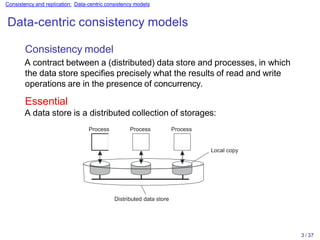
Data-centric consistency models
Distributed data store
Consistency model
A contract between a (distributed) data store and processes, in which
the data store specifies precisely what the results of read and write
operations are in the presence of concurrency.
Essential
A data store is a distributed collection of storages:
Process Process Process
Local copy
3 / 37
4 / 37
Consistency and replication: Data-centric consistency models Continuous consistency
Continuous Consistency
We can actually talk about a degree of consistency
► replicas may differ in their numerical value
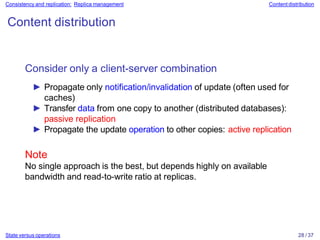
► replicas may differ in their relative staleness
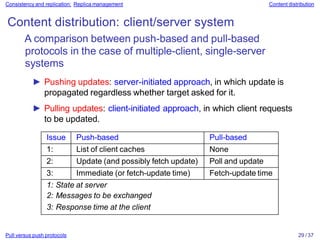
► there may be differences with respect to (number and order) of
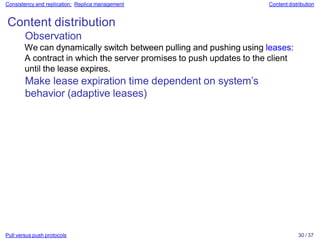
performed update operations
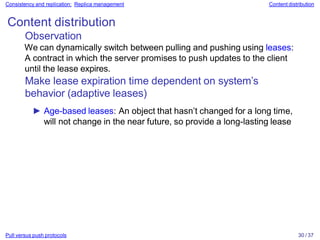
Conit
Consistency unit ⇒ specifies the data unit over which consistency is to
be measured.
Consistency and replication: Data-centric consistency models Continuous consistency
Example: Conit
Replica A
[ g = 95 ]
[ p = 78 ]
[ d = 558 ]
< 5, B> g  g + 45
< 8, A> g  g + 50
< 9, A> p  p + 78
<10, A> d  d + 558
Operation Result
[ g = 45 ]
d = 558 // distance
g = 95 // gas
p = 78 // price
Conit
[ p = 70 ]
[ d = 412 ]
< 5, B> g  g + 45
< 6, B> p  p + 70
< 7, B> d  d + 412
Operation Result
[ g = 45 ]
d = 412 // distance
g = 45 // gas
p = 70 // price
The notion of a conit 5 / 37
Conit
Vector clock A
Order deviation
= (11, 5)
= 3
Replica B
Vector clock B
Order deviation
= (0, 8)
= 1
Numerical deviation = (2, 482) Numerical deviation = (3, 686)
Conit (contains the variables g, p, and d)
► Each replica has a vector clock: ([known] time @ A, [known] time
@ B)
► B sends A operation [(5,B) : g ← d + 45]; A has made this
operation permanent (cannot be rolled back)
Consistency and replication: Data-centric consistency models Continuous consistency
Example: Conit
Replica A
[ g = 95 ]
[ p = 78 ]
[ d = 558 ]
< 5, B> g  g + 45
< 8, A> g  g + 50
< 9, A> p  p + 78
<10, A> d  d + 558
Operation Result
[ g = 45 ]
d = 558 // distance
g = 95 // gas
p = 78 // price
Conit
[ p = 70 ]
[ d = 412 ]
< 5, B> g  g + 45
< 6, B> p  p + 70
< 7, B> d  d + 412
Operation Result
[ g = 45 ]
d = 412 // distance
g = 45 // gas
p = 70 // price
The notion of a conit 6 / 37
Conit
Vector clock A
Order deviation
= (11, 5)
= 3
Replica B
Vector clock B
Order deviation
= (0, 8)
= 1
Numerical deviation = (2, 482) Numerical deviation = (3, 686)
Conit (contains the variables g, p, and d)
► A has three pending operations ⇒ order deviation = 3
► A missed two operations from B; max diff is 70 + 412 units ⇒
(2,482)
Consistency and replication: Data-centric consistency models Consistent ordering of operations
Some notations
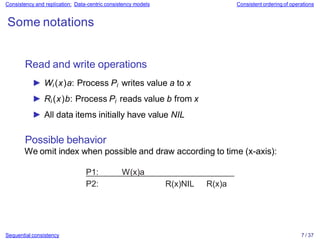
Read and write operations
► Wi (x)a: Process Pi writes value a to x
► Ri (x)b: Process Pi reads value b from x
► All data items initially have value NIL
Possible behavior
We omit index when possible and draw according to time (x-axis):
P1: W(x)a
P2: R(x)NIL R(x)a
Sequential consistency 7 / 37
Consistency and replication: Data-centric consistency models Consistent ordering of operations
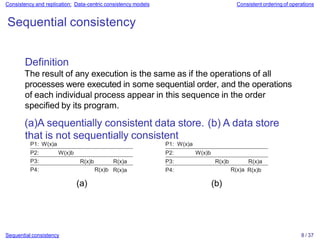
Sequential consistency
Definition
The result of any execution is the same as if the operations of all
processes were executed in some sequential order, and the operations
of each individual process appear in this sequence in the order
specified by its program.
(a)A sequentially consistent data store. (b) A data store
that is not sequentially consistent
P1: W(x)a P1: W(x)a
P2: W(x)b P2: W(x)b
P3: R(x)b R(x)a P3: R(x)b R(x)a
P4: R(x)b R(x)a P4: R(x)a R(x)b
(a) (b)
Sequential consistency 8 / 37
Consistency and replication: Data-centric consistency models Consistent ordering of operations
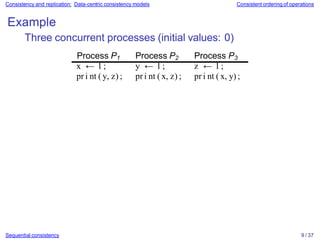
Example
Three concurrent processes (initial values: 0)
Process P1 Process P2 Process P3
x ← 1 ; y ← 1 ; z ← 1 ;
pr i nt ( y, z) ; pr i nt ( x, z) ; pr i nt ( x, y) ;
Sequential consistency 9 / 37
Consistency and replication: Data-centric consistency models Consistent ordering of operations
Example
Three concurrent processes (initial values: 0)
Process P1 Process P2 Process P3
x ← 1 ; y ← 1 ; z ← 1 ;
pr i nt ( y, z) ; pr i nt ( x, z) ; pr i nt ( x, y) ;
Example execution sequences (signature = [ouput P1
output P2 output P3]
Sequential consistency 9 / 37
Execution 1 Execution 2 Execution 3 Execution 4
P1: x ← 1 ; P1: x ← 1 ; P2: y ← 1 ; P2: y ← 1 ;
P1: print(y,z); P2: y ← 1 ; P3: z ← 1 ; P1: x ← 1 ;
P2: y ← 1 ; P2: print(x,z); P3: print(x,y); P3: z ← 1 ;
P2: print(x,z); P1: print(y,z); P2: print(x,z); P2: print(x,z);
P3: z ← 1 ; P3: z ← 1 ; P1: x ← 1 ; P1: print(y,z);
P3: print(x,y); P3: print(x,y); P1: print(y,z); P3: print(x,y);
Prints: 001011 Prints: 101011 Prints: 010111 Prints: 111111
Signature: 0 0 10 11 Signature: 10 10 11 Signature: 11 0 1 0 1 Signature: 11 11 11
Consistency and replication: Data-centric consistency models Consistent ordering of operations
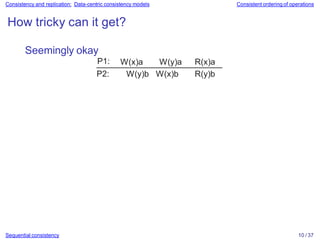
How tricky can it get?
Seemingly okay
P1: R(x)a
R(y)b
W(x)a
W(y)b
W(y)a
W(x)b
P2:
Sequential consistency 10 / 37
Consistency and replication: Data-centric consistency models Consistent ordering of operations
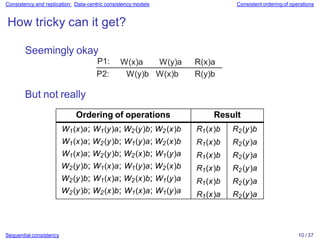
How tricky can it get?
Seemingly okay
P1: R(x)a
R(y)b
W(x)a
W(y)b
W(y)a
W(x)b
P2:
But not really
Sequential consistency 10 / 37
Ordering of operations Result
W1(x)a; W1(y)a; W2(y)b; W2(x)b
W1(x)a; W2(y)b; W1(y)a; W2(x)b
W1(x)a; W2(y)b; W2(x)b; W1(y)a
W2(y)b; W1(x)a; W1(y)a; W2(x)b
W2(y)b; W1(x)a; W2(x)b; W1(y)a
W2(y)b; W2(x)b; W1(x)a; W1(y)a
R1(x)b
R1(x)b
R1(x)b
R1(x)b
R1(x)b
R1(x)a
R2(y)b
R2(y)a
R2(y)a
R2(y)a
R2(y)a
R2(y)a
Consistency and replication: Data-centric consistency models Consistent ordering of operations
How tricky can it get?
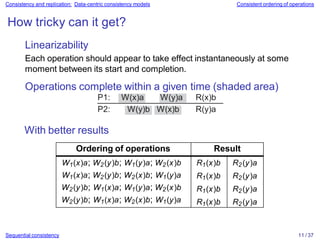
Linearizability
Each operation should appear to take effect instantaneously at some
moment between its start and completion.
Operations complete within a given time (shaded area)
P1: W(x)a W(y)a R(x)b
P2: W(y)b W(x)b R(y)a
With better results
Sequential consistency 11 / 37
Ordering of operations Result
W1(x)a; W2(y)b; W1(y)a; W2(x)b
W1(x)a; W2(y)b; W2(x)b; W1(y)a
W2(y)b; W1(x)a; W1(y)a; W2(x)b
W2(y)b; W1(x)a; W2(x)b; W1(y)a
R1(x)b
R1(x)b
R1(x)b
R1(x)b
R2(y)a
R2(y)a
R2(y)a
R2(y)a
Consistency and replication: Data-centric consistency models Consistent ordering of operations
Causal consistency
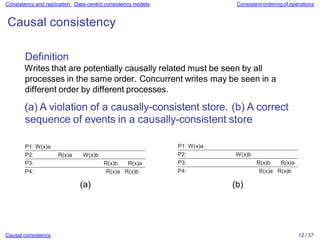
Definition
Writes that are potentially causally related must be seen by all
processes in the same order. Concurrent writes may be seen in a
different order by different processes.
(a) A violation of a causally-consistent store. (b) A correct
sequence of events in a causally-consistent store
P1: W(x)a
R(x)a
P2:
P3:
P4:
W(x)b
R(x)a R(x)b
R(x)b R(x)a
P1: W(x)a
P2:
P3:
P4:
W(x)b
Causal consistency 12 / 37
R(x)a R(x)b
R(x)b R(x)a
(a) (b)
Grouping operations 13 / 37
Consistency and replication: Data-centric consistency models Consistent ordering of operations
Grouping operations
Entry consistency: Definition
► Accesses to locks are sequentially consistent.
► No access to a lock is allowed to be performed until all previous
writes have completed everywhere.
► No data access is allowed to be performed until all previous
accesses to locks have been performed.
Grouping operations 13 / 37
Consistency and replication: Data-centric consistency models Consistent ordering of operations
Grouping operations
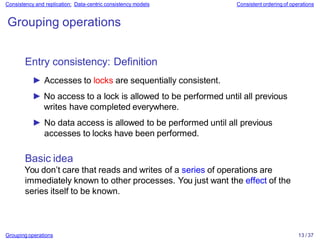
Entry consistency: Definition
► Accesses to locks are sequentially consistent.
► No access to a lock is allowed to be performed until all previous
writes have completed everywhere.
► No data access is allowed to be performed until all previous
accesses to locks have been performed.
Basic idea
You don’t care that reads and writes of a series of operations are
immediately known to other processes. You just want the effect of the
series itself to be known.
Consistency and replication: Data-centric consistency models Consistent ordering of operations
Grouping operations
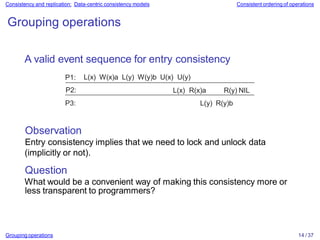
A valid event sequence for entry consistency
P1: L(x) W(x)a L(y) W(y)b U(x) U(y)
P2: L(x) R(x)a R(y) NIL
P3: L(y) R(y)b
Observation
Entry consistency implies that we need to lock and unlock data
(implicitly or not).
Question
What would be a convenient way of making this consistency more or
less transparent to programmers?
Grouping operations 14 / 37
15 / 37
Consistency and replication: Client-centric consistency models
Consistency for mobile users
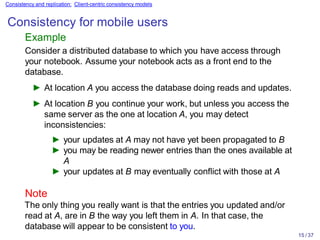
Example
Consider a distributed database to which you have access through
your notebook. Assume your notebook acts as a front end to the
database.
► At location A you access the database doing reads and updates.
► At location B you continue your work, but unless you access the
same server as the one at location A, you may detect
inconsistencies:
► your updates at A may not have yet been propagated to B
► you may be reading newer entries than the ones available at
A
► your updates at B may eventually conflict with those at A
Note
The only thing you really want is that the entries you updated and/or
read at A, are in B the way you left them in A. In that case, the
database will appear to be consistent to you.
Consistency and replication: Client-centric consistency models
Basic architecture
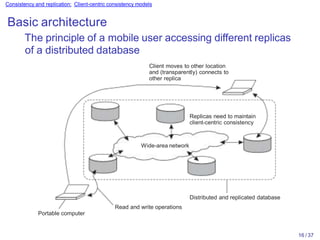
The principle of a mobile user accessing different replicas
of a distributed database
Client moves to other location
and (transparently) connects to
other replica
16 / 37
Replicas need to maintain
client-centric consistency
Wide-area network
Distributed and replicated database
Read and write operations
Portable computer
17 / 37
Consistency and replication: Client-centric consistency models Monotonicreads
Monotonic reads
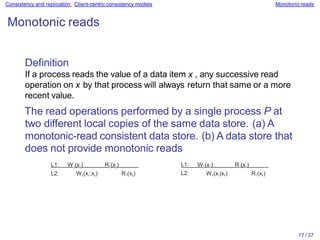
Definition
If a process reads the value of a data item x , any successive read
operation on x by that process will always return that same or a more
recent value.
The read operations performed by a single process P at
two different local copies of the same data store. (a) A
monotonic-read consistent data store. (b) A data store that
does not provide monotonic reads
L1: W1(x1) R1(x1) L1: W1(x1) R1(x1)
L2: W2(x1;x2) R1(x2) L2: W2(x1|x2) R1(x2)
18 / 37
Consistency and replication: Client-centric consistency models Monotonicreads
Client-centric consistency: notation
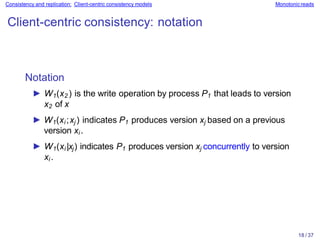
Notation
► W1(x2 ) is the write operation by process P1 that leads to version
x2 of x
► W1(xi ;xj ) indicates P1 produces version xj based on a previous
version xi .
► W1(xi |xj) indicates P1 produces version xj concurrently to version
xi .
19 / 37
Consistency and replication: Client-centric consistency models Monotonicreads
Monotonic reads
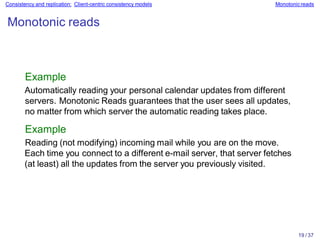
Example
Automatically reading your personal calendar updates from different
servers. Monotonic Reads guarantees that the user sees all updates,
no matter from which server the automatic reading takes place.
Example
Reading (not modifying) incoming mail while you are on the move.
Each time you connect to a different e-mail server, that server fetches
(at least) all the updates from the server you previously visited.
20 / 37
Consistency and replication: Client-centric consistency models Monotonic writes
Monotonic writes
Definition
A write operation by a process on a data item x is completed before
any successive write operation on x by the same process.
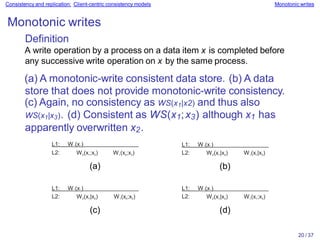
(a) A monotonic-write consistent data store. (b) A data
store that does not provide monotonic-write consistency.
(c) Again, no consistency as WS(x1|x2) and thus also
WS(x1|x3). (d) Consistent as WS(x1;x3) although x1 has
apparently overwritten x2.
L1: W1(x1)
L2: W2(x1;x2) W1(x2;x3)
(a)
L1: W1(x1)
L2: W2(x1|x2) W1(x1|x3)
(b)
L1: W1(x1)
L2: W2(x1|x2) W1(x2;x3)
(c)
L1: W1(x1)
L2: W2(x1|x2) W1(x1;x3)
(d)
21 / 37
Consistency and replication: Client-centric consistency models Monotonic writes
Monotonic writes
Example
Updating a program at server S2 , and ensuring that all components on
which compilation and linking depends, are also placed at S2 .
Example
Maintaining versions of replicated files in the correct order everywhere
(propagate the previous version to the server where the newest version
is installed).
22 / 37
Consistency and replication: Client-centric consistency models Read your writes
Read your writes
Definition
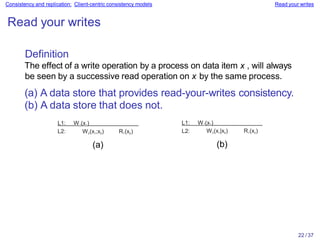
The effect of a write operation by a process on data item x , will always
be seen by a successive read operation on x by the same process.
(a) A data store that provides read-your-writes consistency.
(b) A data store that does not.
L2:
L1: W1(x1) L1: W1(x1)
W2(x1;x2) R1(x2) L2:
(a)
W2(x1|x2) R1(x2)
(b)
22 / 37
Consistency and replication: Client-centric consistency models Read your writes
Read your writes
Definition
The effect of a write operation by a process on data item x , will always
be seen by a successive read operation on x by the same process.
(a) A data store that provides read-your-writes consistency.
(b) A data store that does not.
L2:
L1: W1(x1) L1: W1(x1)
W2(x1;x2) R1(x2) L2:
(a)
W2(x1|x2) R1(x2)
(b)
Example
Updating your Web page and guaranteeing that your Web browser
shows the newest version instead of its cached copy.
23 / 37
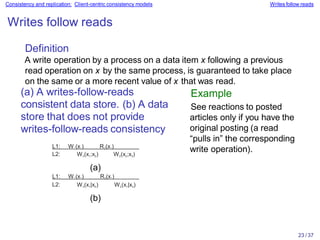
Consistency and replication: Client-centric consistency models Writes follow reads
Writes follow reads
Definition
A write operation by a process on a data item x following a previous
read operation on x by the same process, is guaranteed to take place
on the same or a more recent value of x that was read.
(a) A writes-follow-reads
consistent data store. (b) A data
store that does not provide
writes-follow-reads consistency
L1: W1(x1) R2(x1)
L2: W3(x1;x2) W2(x2;x3)
(a)
L1: W1(x1) R2(x1)
L2: W3(x1|x2) W2(x1|x3)
(b)
Example
See reactions to posted
articles only if you have the
original posting (a read
“pulls in” the corresponding
write operation).
24 / 37
Consistency and replication: Replica management Finding the best server location
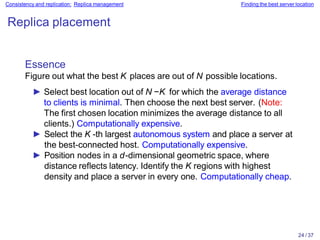
Replica placement
Essence
Figure out what the best K places are out of N possible locations.
24 / 37
Consistency and replication: Replica management Finding the best server location
Replica placement
Essence
Figure out what the best K places are out of N possible locations.
► Select best location out of N −K for which the average distance
to clients is minimal. Then choose the next best server. (Note:
The first chosen location minimizes the average distance to all
clients.) Computationally expensive.
24 / 37
Consistency and replication: Replica management Finding the best server location
Replica placement
Essence
Figure out what the best K places are out of N possible locations.
► Select best location out of N −K for which the average distance
to clients is minimal. Then choose the next best server. (Note:
The first chosen location minimizes the average distance to all
clients.) Computationally expensive.
► Select the K -th largest autonomous system and place a server at
the best-connected host. Computationally expensive.
24 / 37
Consistency and replication: Replica management Finding the best server location
Replica placement
Essence
Figure out what the best K places are out of N possible locations.
► Select best location out of N −K for which the average distance
to clients is minimal. Then choose the next best server. (Note:
The first chosen location minimizes the average distance to all
clients.) Computationally expensive.
► Select the K -th largest autonomous system and place a server at
the best-connected host. Computationally expensive.
► Position nodes in a d-dimensional geometric space, where
distance reflects latency. Identify the K regions with highest
density and place a server in every one. Computationally cheap.
Permanent replicas 25 / 37
Consistency and replication: Replica management Content replication and placement
Content replication
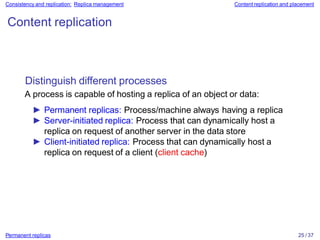
Distinguish different processes
A process is capable of hosting a replica of an object or data:
► Permanent replicas: Process/machine always having a replica
► Server-initiated replica: Process that can dynamically host a
replica on request of another server in the data store
► Client-initiated replica: Process that can dynamically host a
replica on request of a client (client cache)
Consistency and replication: Replica management Content replication and placement
Content replication
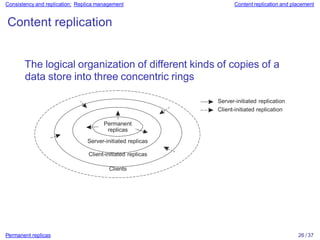
The logical organization of different kinds of copies of a
data store into three concentric rings
Permanent
replicas
Server-initiated replicas
Client-initiated replicas
Clients
Permanent replicas 26 / 37
Server-initiated replication
Client-initiated replication
Consistency and replication: Replica management Content replication and placement
Server-initiated replicas
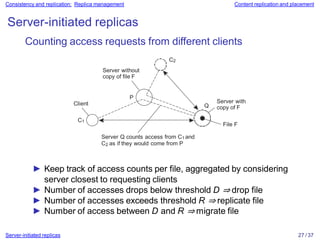
Client Server with
copy of F
P
Q
C1
Counting access requests from different clients
C2
Server without
copy of file F
Server Q counts access from C1 and
C2 as if they would come from P
File F
► Keep track of access counts per file, aggregated by considering
server closest to requesting clients
► Number of accesses drops below threshold D ⇒ drop file
► Number of accesses exceeds threshold R ⇒ replicate file
► Number of access between D and R ⇒ migrate file
Server-initiated replicas 27 / 37
Consistency and replication: Replica management Content distribution
Content distribution
Consider only a client-server combination
► Propagate only notification/invalidation of update (often used for
caches)
► Transfer data from one copy to another (distributed databases):
passive replication
► Propagate the update operation to other copies: active replication
Note
No single approach is the best, but depends highly on available
bandwidth and read-to-write ratio at replicas.
State versus operations 28 / 37
Pull versus push protocols 29 / 37
Consistency and replication: Replica management Content distribution
Content distribution: client/server system
A comparison between push-based and pull-based
protocols in the case of multiple-client, single-server
systems
► Pushing updates: server-initiated approach, in which update is
propagated regardless whether target asked for it.
► Pulling updates: client-initiated approach, in which client requests
to be updated.
Issue Push-based Pull-based
1: List of client caches None
2: Update (and possibly fetch update) Poll and update
3: Immediate (or fetch-update time) Fetch-update time
1: State at server
2: Messages to be exchanged
3: Response time at the client
Pull versus push protocols 30 / 37
Consistency and replication: Replica management Content distribution
Content distribution
Observation
We can dynamically switch between pulling and pushing using leases:
A contract in which the server promises to push updates to the client
until the lease expires.
Make lease expiration time dependent on system’s
behavior (adaptive leases)
Pull versus push protocols 30 / 37
Consistency and replication: Replica management Content distribution
Content distribution
Observation
We can dynamically switch between pulling and pushing using leases:
A contract in which the server promises to push updates to the client
until the lease expires.
Make lease expiration time dependent on system’s
behavior (adaptive leases)
► Age-based leases: An object that hasn’t changed for a long time,
will not change in the near future, so provide a long-lasting lease
Pull versus push protocols 30 / 37
Consistency and replication: Replica management Content distribution
Content distribution
Observation
We can dynamically switch between pulling and pushing using leases:
A contract in which the server promises to push updates to the client
until the lease expires.
Make lease expiration time dependent on system’s
behavior (adaptive leases)
► Renewal-frequency based leases: The more often a client
requests a specific object, the longer the expiration time for that
client (for that object) will be
Pull versus push protocols 30 / 37
Consistency and replication: Replica management Content distribution
Content distribution
Observation
We can dynamically switch between pulling and pushing using leases:
A contract in which the server promises to push updates to the client
until the lease expires.
Make lease expiration time dependent on system’s
behavior (adaptive leases)
► State-based leases: The more loaded a server is, the shorter the
expiration times become
Pull versus push protocols 30 / 37
Consistency and replication: Replica management Content distribution
Content distribution
Observation
We can dynamically switch between pulling and pushing using leases:
A contract in which the server promises to push updates to the client
until the lease expires.
Make lease expiration time dependent on system’s
behavior (adaptive leases)
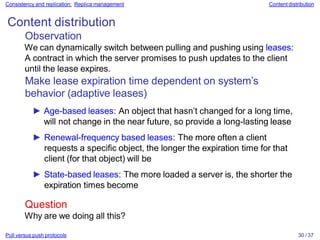
► Age-based leases: An object that hasn’t changed for a long time,
will not change in the near future, so provide a long-lasting lease
► Renewal-frequency based leases: The more often a client
requests a specific object, the longer the expiration time for that
client (for that object) will be
► State-based leases: The more loaded a server is, the shorter the
expiration times become
Question
Why are we doing all this?
Bounding numerical deviation 31 / 37
Consistency and replication: Consistency protocols Continuous consistency
Continuous consistency: Numerical errors
Principal operation
► Every server Si has a log, denoted as Li .
► Consider a data item x and let val (W ) denote the numerical
change in its value after a write operation W. Assume that
∀
W : val(W) > 0
► W is initially forwarded to one of the N replicas, denoted as
origin(W ). TW [i, j ] are the writes executed by server Si that
originated from Sj :
TW[i,j] = ∑{val(W)|origin(W) = Sj & W ∈Li }
Bounding numerical deviation 32 / 37
Consistency and replication: Consistency protocols Continuous consistency
Continuous consistency: Numerical errors
Note
Actual value v(t) of x:
N
N
v(t) = vinit + ∑ TW[k,k]
k= 1
value vi of x at server Si :
vi = vinit + ∑ TW[i,k]
k= 1
Bounding numerical deviation 33 / 37
Consistency and replication: Consistency protocols Continuous consistency
Continuous consistency: Numerical errors
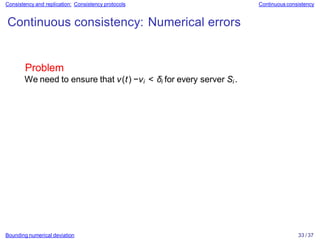
Problem
We need to ensure that v(t) −vi < δi for every server Si .
Bounding numerical deviation 33 / 37
Consistency and replication: Consistency protocols Continuous consistency
Continuous consistency: Numerical errors
Problem
We need to ensure that v(t) −vi < δi for every server Si .
Approach
Let every server Sk maintain a view TWk [i, j ] of what it believes is the
value of TW [i, j ]. This information can be gossiped when an update is
propagated.
Bounding numerical deviation 33 / 37
Consistency and replication: Consistency protocols Continuous consistency
Continuous consistency: Numerical errors
Problem
We need to ensure that v(t) −vi < δi for every server Si .
Approach
Let every server Sk maintain a view TWk [i, j ] of what it believes is the
value of TW [i, j ]. This information can be gossiped when an update is
propagated.
Note
0 ≤TWk [i,j] ≤TW[i,j] ≤TW[j,j]
Bounding numerical deviation 34 / 37
Consistency and replication: Consistency protocols Continuous consistency
Continuous consistency: Numerical errors
Solution
Sk sends operations from its log to Si when it sees that TWk [i, k] is
getting too far from TW[k,k], in particular, when
TW[k,k]−TWk [i,k] > δi / (N −1)
Bounding numerical deviation 34 / 37
Consistency and replication: Consistency protocols Continuous consistency
Continuous consistency: Numerical errors
Solution
Sk sends operations from its log to Si when it sees that TWk [i, k] is
getting too far from TW[k,k], in particular, when
TW[k,k]−TWk [i,k] > δi / (N −1)
Question
To what extent are we being pessimistic here: where does δi/(N −1)
come from?
Bounding numerical deviation 34 / 37
Consistency and replication: Consistency protocols Continuous consistency
Continuous consistency: Numerical errors
Solution
Sk sends operations from its log to Si when it sees that TWk [i, k] is
getting too far from TW[k,k], in particular, when
TW[k,k]−TWk [i,k] > δi / (N −1)
Question
To what extent are we being pessimistic here: where does δi/(N −1)
come from?
Note
Staleness can be done analogously, by essentially keeping track of
what has been seen last from Si (see book).
Consistency and replication: Consistency protocols Sequential consistency: Primary-based protocols
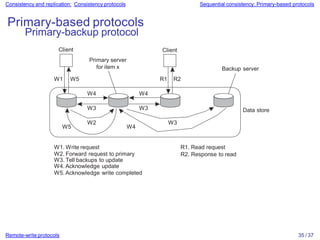
Primary-based protocols
Data store
for item x
Primary-backup protocol
Client
Primary server
Client
Backup server
W1. Write request
W2. Forward request to primary
W3. Tell backups to update
W4. Acknowledge update
W5. Acknowledge write completed
W2
W3 W3
W3
W4 W4
W4
W1 W5
R1. Read request
R2. Response to read
R1 R2
W5
Remote-write protocols 35 / 37
Consistency and replication: Consistency protocols Sequential consistency: Primary-based protocols
Primary-based protocols
Data store
for item x
Primary-backup protocol
Client
Primary server
Client
Backup server
W1. Write request
W2. Forward request to primary
W3. Tell backups to update
W4. Acknowledge update
W5. Acknowledge write completed
W2
W3 W3
W3
W4 W4
W4
W1 W5
R1. Read request
R2. Response to read
R1 R2
W5
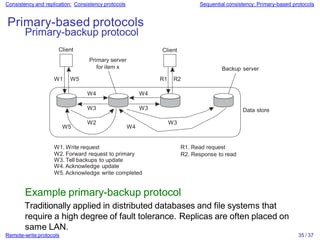
Example primary-backup protocol
Traditionally applied in distributed databases and file systems that
require a high degree of fault tolerance. Replicas are often placed on
same LAN.
Remote-write protocols 35 / 37
Consistency and replication: Consistency protocols Sequential consistency: Primary-based protocols
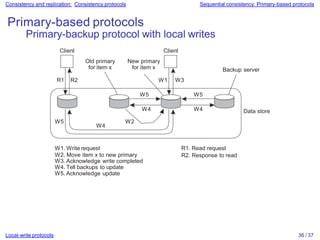
Primary-based protocols
Data store
Old primary
for item x
Primary-backup protocol with local writes
Client Client
Backup server
W1. Write request
W2. Move item x to new primary
W3. Acknowledge write completed
W4. Tell backups to update
W5. Acknowledge update
W2
W4
W4
W4
R1 R2
R1. Read request
R2. Response to read
W1 W3
New primary
for item x
W5 W5
W5
Local-write protocols 36 / 37
Consistency and replication: Consistency protocols Sequential consistency: Primary-based protocols
Primary-based protocols
Data store
Old primary
for item x
Primary-backup protocol with local writes
Client Client
Backup server
W1. Write request
W2. Move item x to new primary
W3. Acknowledge write completed
W4. Tell backups to update
W5. Acknowledge update
W2
W4
W4
W4
R1 R2
R1. Read request
R2. Response to read
W1 W3
New primary
for item x
W5 W5
W5
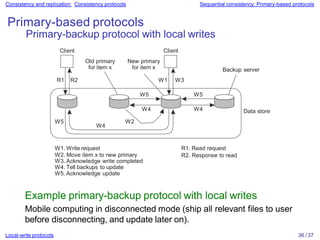
Example primary-backup protocol with local writes
Mobile computing in disconnected mode (ship all relevant files to user
before disconnecting, and update later on).
Local-write protocols 36 / 37
Consistency and replication: Consistency protocols Sequential consistency: Replicated-write protocols
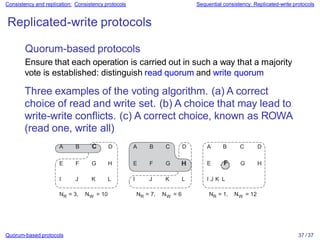
Replicated-write protocols
Quorum-based protocols
Ensure that each operation is carried out in such a way that a majority
vote is established: distinguish read quorum and write quorum
Three examples of the voting algorithm. (a) A correct
choice of read and write set. (b) A choice that may lead to
write-write conflicts. (c) A correct choice, known as ROWA
(read one, write all)
A B C D A B C D A B C D
E F G H E F G H E F G H
I J K L I J K L I J K L
NR = 3, NW = 10 NR = 7, NW = 6 NR = 1, NW = 12
Quorum-based protocols 37 / 37

slides.07.pptx

  • 1.
    Distributed Systems (3rd Edition) Chapter07: Consistency and Replication Version: March 20, 2022
  • 2.
    2 / 37 Consistencyand replication: Introduction Reasons for replication Performance and scalability Main issue Tokeep replicas consistent, we generally need to ensure that all conflicting operations are done in the the same order everywhere Conflicting operations: From the world of transactions ► Read–write conflict: a read operation and a write operation act concurrently ► Write–write conflict: two concurrent write operations Issue Guaranteeing global ordering on conflicting operations may be a costly operation, downgrading scalability Solution: weaken consistency requirements so that hopefully global synchronization can be avoided
  • 3.
    Consistency and replication:Data-centric consistency models Data-centric consistency models Distributed data store Consistency model A contract between a (distributed) data store and processes, in which the data store specifies precisely what the results of read and write operations are in the presence of concurrency. Essential A data store is a distributed collection of storages: Process Process Process Local copy 3 / 37
  • 4.
    4 / 37 Consistencyand replication: Data-centric consistency models Continuous consistency Continuous Consistency We can actually talk about a degree of consistency ► replicas may differ in their numerical value ► replicas may differ in their relative staleness ► there may be differences with respect to (number and order) of performed update operations Conit Consistency unit ⇒ specifies the data unit over which consistency is to be measured.
  • 5.
    Consistency and replication:Data-centric consistency models Continuous consistency Example: Conit Replica A [ g = 95 ] [ p = 78 ] [ d = 558 ] < 5, B> g  g + 45 < 8, A> g  g + 50 < 9, A> p  p + 78 <10, A> d  d + 558 Operation Result [ g = 45 ] d = 558 // distance g = 95 // gas p = 78 // price Conit [ p = 70 ] [ d = 412 ] < 5, B> g  g + 45 < 6, B> p  p + 70 < 7, B> d  d + 412 Operation Result [ g = 45 ] d = 412 // distance g = 45 // gas p = 70 // price The notion of a conit 5 / 37 Conit Vector clock A Order deviation = (11, 5) = 3 Replica B Vector clock B Order deviation = (0, 8) = 1 Numerical deviation = (2, 482) Numerical deviation = (3, 686) Conit (contains the variables g, p, and d) ► Each replica has a vector clock: ([known] time @ A, [known] time @ B) ► B sends A operation [(5,B) : g ← d + 45]; A has made this operation permanent (cannot be rolled back)
  • 6.
    Consistency and replication:Data-centric consistency models Continuous consistency Example: Conit Replica A [ g = 95 ] [ p = 78 ] [ d = 558 ] < 5, B> g  g + 45 < 8, A> g  g + 50 < 9, A> p  p + 78 <10, A> d  d + 558 Operation Result [ g = 45 ] d = 558 // distance g = 95 // gas p = 78 // price Conit [ p = 70 ] [ d = 412 ] < 5, B> g  g + 45 < 6, B> p  p + 70 < 7, B> d  d + 412 Operation Result [ g = 45 ] d = 412 // distance g = 45 // gas p = 70 // price The notion of a conit 6 / 37 Conit Vector clock A Order deviation = (11, 5) = 3 Replica B Vector clock B Order deviation = (0, 8) = 1 Numerical deviation = (2, 482) Numerical deviation = (3, 686) Conit (contains the variables g, p, and d) ► A has three pending operations ⇒ order deviation = 3 ► A missed two operations from B; max diff is 70 + 412 units ⇒ (2,482)
  • 7.
    Consistency and replication:Data-centric consistency models Consistent ordering of operations Some notations Read and write operations ► Wi (x)a: Process Pi writes value a to x ► Ri (x)b: Process Pi reads value b from x ► All data items initially have value NIL Possible behavior We omit index when possible and draw according to time (x-axis): P1: W(x)a P2: R(x)NIL R(x)a Sequential consistency 7 / 37
  • 8.
    Consistency and replication:Data-centric consistency models Consistent ordering of operations Sequential consistency Definition The result of any execution is the same as if the operations of all processes were executed in some sequential order, and the operations of each individual process appear in this sequence in the order specified by its program. (a)A sequentially consistent data store. (b) A data store that is not sequentially consistent P1: W(x)a P1: W(x)a P2: W(x)b P2: W(x)b P3: R(x)b R(x)a P3: R(x)b R(x)a P4: R(x)b R(x)a P4: R(x)a R(x)b (a) (b) Sequential consistency 8 / 37
  • 9.
    Consistency and replication:Data-centric consistency models Consistent ordering of operations Example Three concurrent processes (initial values: 0) Process P1 Process P2 Process P3 x ← 1 ; y ← 1 ; z ← 1 ; pr i nt ( y, z) ; pr i nt ( x, z) ; pr i nt ( x, y) ; Sequential consistency 9 / 37
  • 10.
    Consistency and replication:Data-centric consistency models Consistent ordering of operations Example Three concurrent processes (initial values: 0) Process P1 Process P2 Process P3 x ← 1 ; y ← 1 ; z ← 1 ; pr i nt ( y, z) ; pr i nt ( x, z) ; pr i nt ( x, y) ; Example execution sequences (signature = [ouput P1 output P2 output P3] Sequential consistency 9 / 37 Execution 1 Execution 2 Execution 3 Execution 4 P1: x ← 1 ; P1: x ← 1 ; P2: y ← 1 ; P2: y ← 1 ; P1: print(y,z); P2: y ← 1 ; P3: z ← 1 ; P1: x ← 1 ; P2: y ← 1 ; P2: print(x,z); P3: print(x,y); P3: z ← 1 ; P2: print(x,z); P1: print(y,z); P2: print(x,z); P2: print(x,z); P3: z ← 1 ; P3: z ← 1 ; P1: x ← 1 ; P1: print(y,z); P3: print(x,y); P3: print(x,y); P1: print(y,z); P3: print(x,y); Prints: 001011 Prints: 101011 Prints: 010111 Prints: 111111 Signature: 0 0 10 11 Signature: 10 10 11 Signature: 11 0 1 0 1 Signature: 11 11 11
  • 11.
    Consistency and replication:Data-centric consistency models Consistent ordering of operations How tricky can it get? Seemingly okay P1: R(x)a R(y)b W(x)a W(y)b W(y)a W(x)b P2: Sequential consistency 10 / 37
  • 12.
    Consistency and replication:Data-centric consistency models Consistent ordering of operations How tricky can it get? Seemingly okay P1: R(x)a R(y)b W(x)a W(y)b W(y)a W(x)b P2: But not really Sequential consistency 10 / 37 Ordering of operations Result W1(x)a; W1(y)a; W2(y)b; W2(x)b W1(x)a; W2(y)b; W1(y)a; W2(x)b W1(x)a; W2(y)b; W2(x)b; W1(y)a W2(y)b; W1(x)a; W1(y)a; W2(x)b W2(y)b; W1(x)a; W2(x)b; W1(y)a W2(y)b; W2(x)b; W1(x)a; W1(y)a R1(x)b R1(x)b R1(x)b R1(x)b R1(x)b R1(x)a R2(y)b R2(y)a R2(y)a R2(y)a R2(y)a R2(y)a
  • 13.
    Consistency and replication:Data-centric consistency models Consistent ordering of operations How tricky can it get? Linearizability Each operation should appear to take effect instantaneously at some moment between its start and completion. Operations complete within a given time (shaded area) P1: W(x)a W(y)a R(x)b P2: W(y)b W(x)b R(y)a With better results Sequential consistency 11 / 37 Ordering of operations Result W1(x)a; W2(y)b; W1(y)a; W2(x)b W1(x)a; W2(y)b; W2(x)b; W1(y)a W2(y)b; W1(x)a; W1(y)a; W2(x)b W2(y)b; W1(x)a; W2(x)b; W1(y)a R1(x)b R1(x)b R1(x)b R1(x)b R2(y)a R2(y)a R2(y)a R2(y)a
  • 14.
    Consistency and replication:Data-centric consistency models Consistent ordering of operations Causal consistency Definition Writes that are potentially causally related must be seen by all processes in the same order. Concurrent writes may be seen in a different order by different processes. (a) A violation of a causally-consistent store. (b) A correct sequence of events in a causally-consistent store P1: W(x)a R(x)a P2: P3: P4: W(x)b R(x)a R(x)b R(x)b R(x)a P1: W(x)a P2: P3: P4: W(x)b Causal consistency 12 / 37 R(x)a R(x)b R(x)b R(x)a (a) (b)
  • 15.
    Grouping operations 13/ 37 Consistency and replication: Data-centric consistency models Consistent ordering of operations Grouping operations Entry consistency: Definition ► Accesses to locks are sequentially consistent. ► No access to a lock is allowed to be performed until all previous writes have completed everywhere. ► No data access is allowed to be performed until all previous accesses to locks have been performed.
  • 16.
    Grouping operations 13/ 37 Consistency and replication: Data-centric consistency models Consistent ordering of operations Grouping operations Entry consistency: Definition ► Accesses to locks are sequentially consistent. ► No access to a lock is allowed to be performed until all previous writes have completed everywhere. ► No data access is allowed to be performed until all previous accesses to locks have been performed. Basic idea You don’t care that reads and writes of a series of operations are immediately known to other processes. You just want the effect of the series itself to be known.
  • 17.
    Consistency and replication:Data-centric consistency models Consistent ordering of operations Grouping operations A valid event sequence for entry consistency P1: L(x) W(x)a L(y) W(y)b U(x) U(y) P2: L(x) R(x)a R(y) NIL P3: L(y) R(y)b Observation Entry consistency implies that we need to lock and unlock data (implicitly or not). Question What would be a convenient way of making this consistency more or less transparent to programmers? Grouping operations 14 / 37
  • 18.
    15 / 37 Consistencyand replication: Client-centric consistency models Consistency for mobile users Example Consider a distributed database to which you have access through your notebook. Assume your notebook acts as a front end to the database. ► At location A you access the database doing reads and updates. ► At location B you continue your work, but unless you access the same server as the one at location A, you may detect inconsistencies: ► your updates at A may not have yet been propagated to B ► you may be reading newer entries than the ones available at A ► your updates at B may eventually conflict with those at A Note The only thing you really want is that the entries you updated and/or read at A, are in B the way you left them in A. In that case, the database will appear to be consistent to you.
  • 19.
    Consistency and replication:Client-centric consistency models Basic architecture The principle of a mobile user accessing different replicas of a distributed database Client moves to other location and (transparently) connects to other replica 16 / 37 Replicas need to maintain client-centric consistency Wide-area network Distributed and replicated database Read and write operations Portable computer
  • 20.
    17 / 37 Consistencyand replication: Client-centric consistency models Monotonicreads Monotonic reads Definition If a process reads the value of a data item x , any successive read operation on x by that process will always return that same or a more recent value. The read operations performed by a single process P at two different local copies of the same data store. (a) A monotonic-read consistent data store. (b) A data store that does not provide monotonic reads L1: W1(x1) R1(x1) L1: W1(x1) R1(x1) L2: W2(x1;x2) R1(x2) L2: W2(x1|x2) R1(x2)
  • 21.
    18 / 37 Consistencyand replication: Client-centric consistency models Monotonicreads Client-centric consistency: notation Notation ► W1(x2 ) is the write operation by process P1 that leads to version x2 of x ► W1(xi ;xj ) indicates P1 produces version xj based on a previous version xi . ► W1(xi |xj) indicates P1 produces version xj concurrently to version xi .
  • 22.
    19 / 37 Consistencyand replication: Client-centric consistency models Monotonicreads Monotonic reads Example Automatically reading your personal calendar updates from different servers. Monotonic Reads guarantees that the user sees all updates, no matter from which server the automatic reading takes place. Example Reading (not modifying) incoming mail while you are on the move. Each time you connect to a different e-mail server, that server fetches (at least) all the updates from the server you previously visited.
  • 23.
    20 / 37 Consistencyand replication: Client-centric consistency models Monotonic writes Monotonic writes Definition A write operation by a process on a data item x is completed before any successive write operation on x by the same process. (a) A monotonic-write consistent data store. (b) A data store that does not provide monotonic-write consistency. (c) Again, no consistency as WS(x1|x2) and thus also WS(x1|x3). (d) Consistent as WS(x1;x3) although x1 has apparently overwritten x2. L1: W1(x1) L2: W2(x1;x2) W1(x2;x3) (a) L1: W1(x1) L2: W2(x1|x2) W1(x1|x3) (b) L1: W1(x1) L2: W2(x1|x2) W1(x2;x3) (c) L1: W1(x1) L2: W2(x1|x2) W1(x1;x3) (d)
  • 24.
    21 / 37 Consistencyand replication: Client-centric consistency models Monotonic writes Monotonic writes Example Updating a program at server S2 , and ensuring that all components on which compilation and linking depends, are also placed at S2 . Example Maintaining versions of replicated files in the correct order everywhere (propagate the previous version to the server where the newest version is installed).
  • 25.
    22 / 37 Consistencyand replication: Client-centric consistency models Read your writes Read your writes Definition The effect of a write operation by a process on data item x , will always be seen by a successive read operation on x by the same process. (a) A data store that provides read-your-writes consistency. (b) A data store that does not. L2: L1: W1(x1) L1: W1(x1) W2(x1;x2) R1(x2) L2: (a) W2(x1|x2) R1(x2) (b)
  • 26.
    22 / 37 Consistencyand replication: Client-centric consistency models Read your writes Read your writes Definition The effect of a write operation by a process on data item x , will always be seen by a successive read operation on x by the same process. (a) A data store that provides read-your-writes consistency. (b) A data store that does not. L2: L1: W1(x1) L1: W1(x1) W2(x1;x2) R1(x2) L2: (a) W2(x1|x2) R1(x2) (b) Example Updating your Web page and guaranteeing that your Web browser shows the newest version instead of its cached copy.
  • 27.
    23 / 37 Consistencyand replication: Client-centric consistency models Writes follow reads Writes follow reads Definition A write operation by a process on a data item x following a previous read operation on x by the same process, is guaranteed to take place on the same or a more recent value of x that was read. (a) A writes-follow-reads consistent data store. (b) A data store that does not provide writes-follow-reads consistency L1: W1(x1) R2(x1) L2: W3(x1;x2) W2(x2;x3) (a) L1: W1(x1) R2(x1) L2: W3(x1|x2) W2(x1|x3) (b) Example See reactions to posted articles only if you have the original posting (a read “pulls in” the corresponding write operation).
  • 28.
    24 / 37 Consistencyand replication: Replica management Finding the best server location Replica placement Essence Figure out what the best K places are out of N possible locations.
  • 29.
    24 / 37 Consistencyand replication: Replica management Finding the best server location Replica placement Essence Figure out what the best K places are out of N possible locations. ► Select best location out of N −K for which the average distance to clients is minimal. Then choose the next best server. (Note: The first chosen location minimizes the average distance to all clients.) Computationally expensive.
  • 30.
    24 / 37 Consistencyand replication: Replica management Finding the best server location Replica placement Essence Figure out what the best K places are out of N possible locations. ► Select best location out of N −K for which the average distance to clients is minimal. Then choose the next best server. (Note: The first chosen location minimizes the average distance to all clients.) Computationally expensive. ► Select the K -th largest autonomous system and place a server at the best-connected host. Computationally expensive.
  • 31.
    24 / 37 Consistencyand replication: Replica management Finding the best server location Replica placement Essence Figure out what the best K places are out of N possible locations. ► Select best location out of N −K for which the average distance to clients is minimal. Then choose the next best server. (Note: The first chosen location minimizes the average distance to all clients.) Computationally expensive. ► Select the K -th largest autonomous system and place a server at the best-connected host. Computationally expensive. ► Position nodes in a d-dimensional geometric space, where distance reflects latency. Identify the K regions with highest density and place a server in every one. Computationally cheap.
  • 32.
    Permanent replicas 25/ 37 Consistency and replication: Replica management Content replication and placement Content replication Distinguish different processes A process is capable of hosting a replica of an object or data: ► Permanent replicas: Process/machine always having a replica ► Server-initiated replica: Process that can dynamically host a replica on request of another server in the data store ► Client-initiated replica: Process that can dynamically host a replica on request of a client (client cache)
  • 33.
    Consistency and replication:Replica management Content replication and placement Content replication The logical organization of different kinds of copies of a data store into three concentric rings Permanent replicas Server-initiated replicas Client-initiated replicas Clients Permanent replicas 26 / 37 Server-initiated replication Client-initiated replication
  • 34.
    Consistency and replication:Replica management Content replication and placement Server-initiated replicas Client Server with copy of F P Q C1 Counting access requests from different clients C2 Server without copy of file F Server Q counts access from C1 and C2 as if they would come from P File F ► Keep track of access counts per file, aggregated by considering server closest to requesting clients ► Number of accesses drops below threshold D ⇒ drop file ► Number of accesses exceeds threshold R ⇒ replicate file ► Number of access between D and R ⇒ migrate file Server-initiated replicas 27 / 37
  • 35.
    Consistency and replication:Replica management Content distribution Content distribution Consider only a client-server combination ► Propagate only notification/invalidation of update (often used for caches) ► Transfer data from one copy to another (distributed databases): passive replication ► Propagate the update operation to other copies: active replication Note No single approach is the best, but depends highly on available bandwidth and read-to-write ratio at replicas. State versus operations 28 / 37
  • 36.
    Pull versus pushprotocols 29 / 37 Consistency and replication: Replica management Content distribution Content distribution: client/server system A comparison between push-based and pull-based protocols in the case of multiple-client, single-server systems ► Pushing updates: server-initiated approach, in which update is propagated regardless whether target asked for it. ► Pulling updates: client-initiated approach, in which client requests to be updated. Issue Push-based Pull-based 1: List of client caches None 2: Update (and possibly fetch update) Poll and update 3: Immediate (or fetch-update time) Fetch-update time 1: State at server 2: Messages to be exchanged 3: Response time at the client
  • 37.
    Pull versus pushprotocols 30 / 37 Consistency and replication: Replica management Content distribution Content distribution Observation We can dynamically switch between pulling and pushing using leases: A contract in which the server promises to push updates to the client until the lease expires. Make lease expiration time dependent on system’s behavior (adaptive leases)
  • 38.
    Pull versus pushprotocols 30 / 37 Consistency and replication: Replica management Content distribution Content distribution Observation We can dynamically switch between pulling and pushing using leases: A contract in which the server promises to push updates to the client until the lease expires. Make lease expiration time dependent on system’s behavior (adaptive leases) ► Age-based leases: An object that hasn’t changed for a long time, will not change in the near future, so provide a long-lasting lease
  • 39.
    Pull versus pushprotocols 30 / 37 Consistency and replication: Replica management Content distribution Content distribution Observation We can dynamically switch between pulling and pushing using leases: A contract in which the server promises to push updates to the client until the lease expires. Make lease expiration time dependent on system’s behavior (adaptive leases) ► Renewal-frequency based leases: The more often a client requests a specific object, the longer the expiration time for that client (for that object) will be
  • 40.
    Pull versus pushprotocols 30 / 37 Consistency and replication: Replica management Content distribution Content distribution Observation We can dynamically switch between pulling and pushing using leases: A contract in which the server promises to push updates to the client until the lease expires. Make lease expiration time dependent on system’s behavior (adaptive leases) ► State-based leases: The more loaded a server is, the shorter the expiration times become
  • 41.
    Pull versus pushprotocols 30 / 37 Consistency and replication: Replica management Content distribution Content distribution Observation We can dynamically switch between pulling and pushing using leases: A contract in which the server promises to push updates to the client until the lease expires. Make lease expiration time dependent on system’s behavior (adaptive leases) ► Age-based leases: An object that hasn’t changed for a long time, will not change in the near future, so provide a long-lasting lease ► Renewal-frequency based leases: The more often a client requests a specific object, the longer the expiration time for that client (for that object) will be ► State-based leases: The more loaded a server is, the shorter the expiration times become Question Why are we doing all this?
  • 42.
    Bounding numerical deviation31 / 37 Consistency and replication: Consistency protocols Continuous consistency Continuous consistency: Numerical errors Principal operation ► Every server Si has a log, denoted as Li . ► Consider a data item x and let val (W ) denote the numerical change in its value after a write operation W. Assume that ∀ W : val(W) > 0 ► W is initially forwarded to one of the N replicas, denoted as origin(W ). TW [i, j ] are the writes executed by server Si that originated from Sj : TW[i,j] = ∑{val(W)|origin(W) = Sj & W ∈Li }
  • 43.
    Bounding numerical deviation32 / 37 Consistency and replication: Consistency protocols Continuous consistency Continuous consistency: Numerical errors Note Actual value v(t) of x: N N v(t) = vinit + ∑ TW[k,k] k= 1 value vi of x at server Si : vi = vinit + ∑ TW[i,k] k= 1
  • 44.
    Bounding numerical deviation33 / 37 Consistency and replication: Consistency protocols Continuous consistency Continuous consistency: Numerical errors Problem We need to ensure that v(t) −vi < δi for every server Si .
  • 45.
    Bounding numerical deviation33 / 37 Consistency and replication: Consistency protocols Continuous consistency Continuous consistency: Numerical errors Problem We need to ensure that v(t) −vi < δi for every server Si . Approach Let every server Sk maintain a view TWk [i, j ] of what it believes is the value of TW [i, j ]. This information can be gossiped when an update is propagated.
  • 46.
    Bounding numerical deviation33 / 37 Consistency and replication: Consistency protocols Continuous consistency Continuous consistency: Numerical errors Problem We need to ensure that v(t) −vi < δi for every server Si . Approach Let every server Sk maintain a view TWk [i, j ] of what it believes is the value of TW [i, j ]. This information can be gossiped when an update is propagated. Note 0 ≤TWk [i,j] ≤TW[i,j] ≤TW[j,j]
  • 47.
    Bounding numerical deviation34 / 37 Consistency and replication: Consistency protocols Continuous consistency Continuous consistency: Numerical errors Solution Sk sends operations from its log to Si when it sees that TWk [i, k] is getting too far from TW[k,k], in particular, when TW[k,k]−TWk [i,k] > δi / (N −1)
  • 48.
    Bounding numerical deviation34 / 37 Consistency and replication: Consistency protocols Continuous consistency Continuous consistency: Numerical errors Solution Sk sends operations from its log to Si when it sees that TWk [i, k] is getting too far from TW[k,k], in particular, when TW[k,k]−TWk [i,k] > δi / (N −1) Question To what extent are we being pessimistic here: where does δi/(N −1) come from?
  • 49.
    Bounding numerical deviation34 / 37 Consistency and replication: Consistency protocols Continuous consistency Continuous consistency: Numerical errors Solution Sk sends operations from its log to Si when it sees that TWk [i, k] is getting too far from TW[k,k], in particular, when TW[k,k]−TWk [i,k] > δi / (N −1) Question To what extent are we being pessimistic here: where does δi/(N −1) come from? Note Staleness can be done analogously, by essentially keeping track of what has been seen last from Si (see book).
  • 50.
    Consistency and replication:Consistency protocols Sequential consistency: Primary-based protocols Primary-based protocols Data store for item x Primary-backup protocol Client Primary server Client Backup server W1. Write request W2. Forward request to primary W3. Tell backups to update W4. Acknowledge update W5. Acknowledge write completed W2 W3 W3 W3 W4 W4 W4 W1 W5 R1. Read request R2. Response to read R1 R2 W5 Remote-write protocols 35 / 37
  • 51.
    Consistency and replication:Consistency protocols Sequential consistency: Primary-based protocols Primary-based protocols Data store for item x Primary-backup protocol Client Primary server Client Backup server W1. Write request W2. Forward request to primary W3. Tell backups to update W4. Acknowledge update W5. Acknowledge write completed W2 W3 W3 W3 W4 W4 W4 W1 W5 R1. Read request R2. Response to read R1 R2 W5 Example primary-backup protocol Traditionally applied in distributed databases and file systems that require a high degree of fault tolerance. Replicas are often placed on same LAN. Remote-write protocols 35 / 37
  • 52.
    Consistency and replication:Consistency protocols Sequential consistency: Primary-based protocols Primary-based protocols Data store Old primary for item x Primary-backup protocol with local writes Client Client Backup server W1. Write request W2. Move item x to new primary W3. Acknowledge write completed W4. Tell backups to update W5. Acknowledge update W2 W4 W4 W4 R1 R2 R1. Read request R2. Response to read W1 W3 New primary for item x W5 W5 W5 Local-write protocols 36 / 37
  • 53.
    Consistency and replication:Consistency protocols Sequential consistency: Primary-based protocols Primary-based protocols Data store Old primary for item x Primary-backup protocol with local writes Client Client Backup server W1. Write request W2. Move item x to new primary W3. Acknowledge write completed W4. Tell backups to update W5. Acknowledge update W2 W4 W4 W4 R1 R2 R1. Read request R2. Response to read W1 W3 New primary for item x W5 W5 W5 Example primary-backup protocol with local writes Mobile computing in disconnected mode (ship all relevant files to user before disconnecting, and update later on). Local-write protocols 36 / 37
  • 54.
    Consistency and replication:Consistency protocols Sequential consistency: Replicated-write protocols Replicated-write protocols Quorum-based protocols Ensure that each operation is carried out in such a way that a majority vote is established: distinguish read quorum and write quorum Three examples of the voting algorithm. (a) A correct choice of read and write set. (b) A choice that may lead to write-write conflicts. (c) A correct choice, known as ROWA (read one, write all) A B C D A B C D A B C D E F G H E F G H E F G H I J K L I J K L I J K L NR = 3, NW = 10 NR = 7, NW = 6 NR = 1, NW = 12 Quorum-based protocols 37 / 37